Allergy Treatment Options: Home Care to Immunotherapy
How to treat and relieve allergies the sensible way — starting with the simplest steps and adding stronger options only when you need them.

Quick answer: how allergy treatment works
Short answer: treat allergies in layers. Reduce exposure to the trigger first, then add home care and over-the-counter medicine matched to your worst symptom — a non-drowsy antihistamine for sneezing and itching, a steroid nasal spray for congestion. If that is not enough, a doctor can add prescription treatment or immunotherapy, the only option aimed at the cause.
Allergy treatment works best in layers. First reduce your exposure to the trigger, then ease symptoms with home care and over-the-counter medicine — a non-drowsy antihistamine such as cetirizine (Zyrtec), fexofenadine (Allegra) or loratadine (Claritin) for sneezing and itching, or a steroid nasal spray like fluticasone (Flonase) for a stuffy, inflamed nose. If symptoms persist, a doctor can add prescription medicine or recommend allergen immunotherapy (allergy shots or under-the-tongue tablets), which can lower how strongly you react over time. Always seek emergency care for a severe reaction such as trouble breathing or swelling of the face, lips or throat.
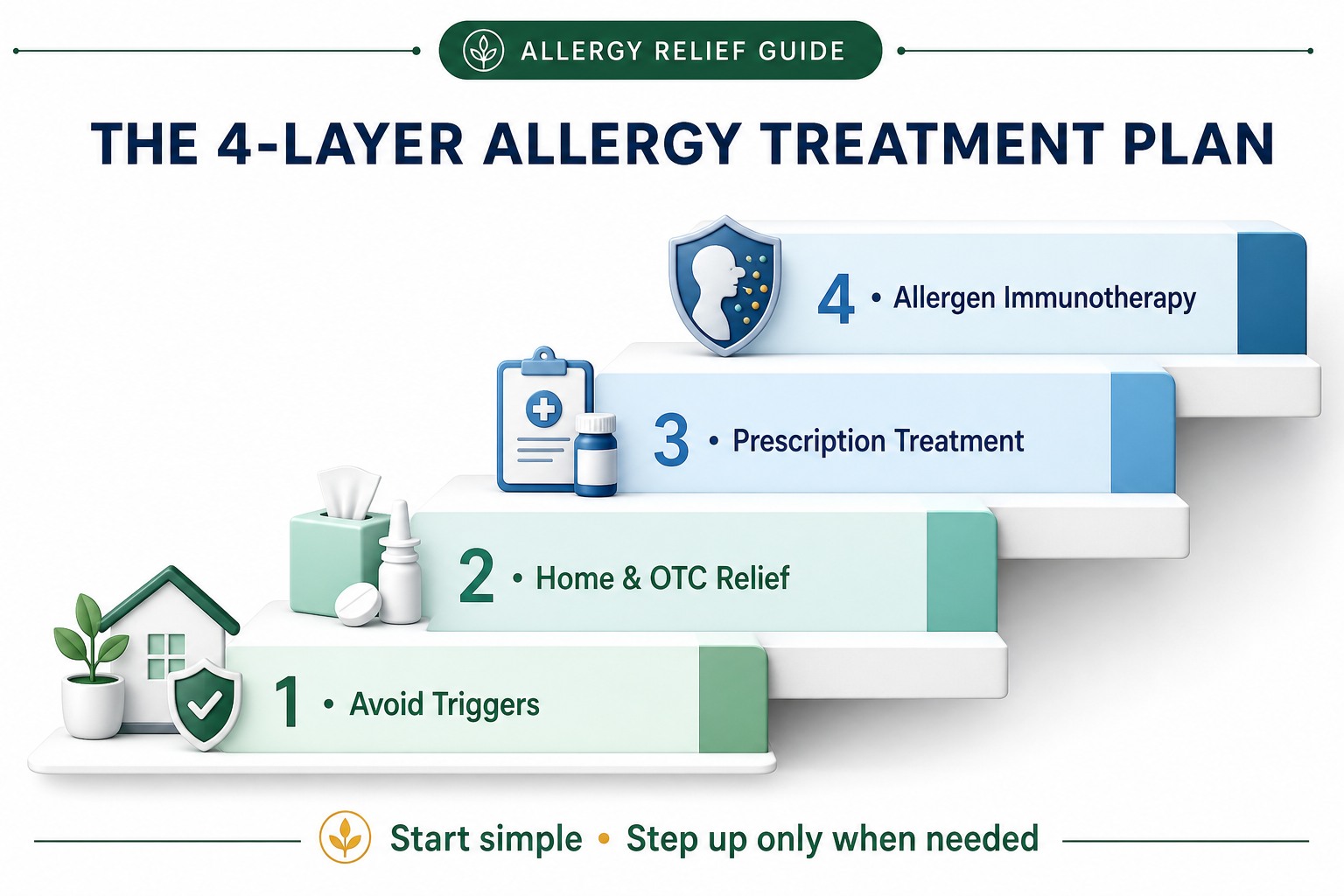
How allergy treatment works: the 4-layer approach
There is rarely a single "cure" for allergies. Instead, effective treatment is a ladder: you start with the safest, simplest steps and only step up to stronger options if your symptoms aren't controlled. Most people find good relief in the first two layers; the upper layers are there when allergies are more stubborn or affecting daily life.
Avoid your triggers
Reducing contact with pollen, dust mites, mold or pet dander is the most effective step of all — no medicine needed.
Home care & OTC medicine
Saline rinses and simple habits, plus over-the-counter antihistamines and nasal sprays for day-to-day symptoms.
Prescription treatment
If OTC options aren't enough, a doctor may prescribe stronger or combination medicines tailored to you.
Immunotherapy
Allergy shots or under-the-tongue tablets can retrain the immune system and reduce allergies over the long term.
The sections below walk through each layer, then show how to match treatment to your main symptom. This whole page is the treatment chapter of our wider allergy relief guide; it's educational and doesn't replace personal medical advice — a pharmacist or doctor can help you choose what's right for you.
First, what are you treating?
Allergy symptoms happen when your immune system overreacts to a normally harmless substance — an allergen — and releases chemicals such as histamine that cause inflammation. That single mechanism explains why one trigger can cause several symptoms at once: sneezing and a runny nose, itchy watery eyes, congestion, coughing, or skin reactions like hives.
Because the symptoms all trace back to the same overreaction, treatment aims at two things: lowering your exposure to the allergen, and calming the immune response once it starts. Knowing which allergen sets you off — pollen, dust mites, mold, pet dander, a food, or an insect sting — shapes every choice that follows. If you're still identifying your trigger, start with our guides to allergy symptoms, types of allergies and allergy testing.
Layer 1 — Avoid your triggers
Avoiding the substance you react to is the single most effective allergy treatment, because it prevents symptoms before they start. The catch is that you first need to know what your trigger actually is.
If your symptoms follow a clear pattern — every spring, around a particular pet, or when dusting — that's a strong clue. When it isn't obvious, allergy testing (a skin-prick or blood test arranged by a doctor) can pinpoint what you're sensitive to. Once you know the trigger, avoidance becomes practical:
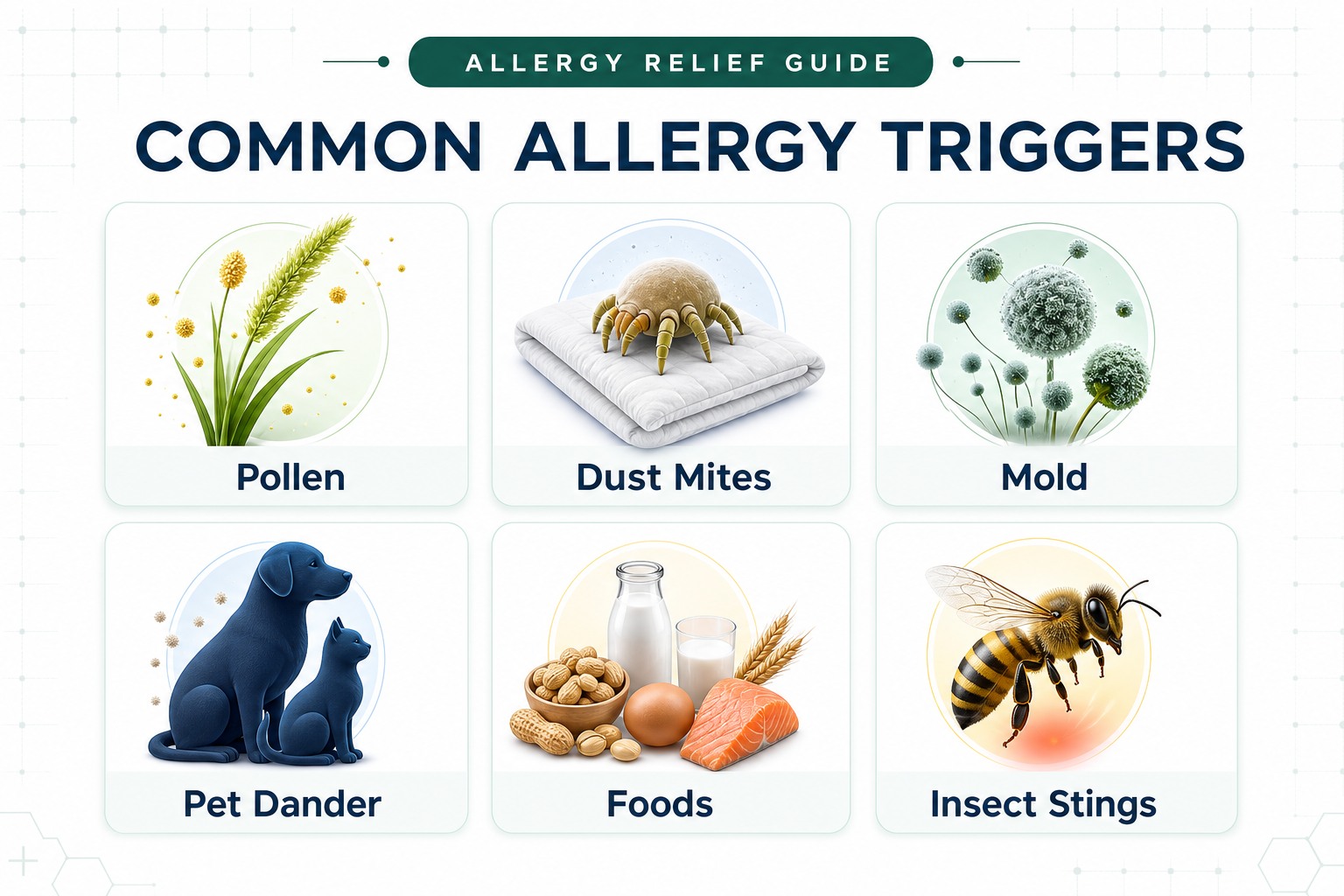
- Pollen: keep windows closed on dry, windy, high-pollen days and use air conditioning instead. Check a daily pollen forecast, plan outdoor time for after rain (which clears the air) rather than early morning, and shower and change clothes when you come inside so you're not carrying pollen to bed. See seasonal allergies for a season-by-season plan.
- Dust mites: use allergen-proof mattress and pillow covers, wash bedding weekly in hot water at least 130°F (54°C), keep indoor humidity below about 50%, and vacuum with a HEPA-filter cleaner. Full detail in dust mite allergy and indoor & environmental allergies.
- Mold: fix leaks promptly, run a dehumidifier in damp rooms, ventilate bathrooms and kitchens, and clean visible mold from hard surfaces so spores don't build up.
- Pet dander: keep pets out of the bedroom, wash your hands after contact, bathe and groom pets regularly, and clean floors and soft furnishings often — dander lingers on fabric long after the animal has left the room.
You can't always avoid a trigger completely — pollen in spring is a good example, and giving up a family pet may not be realistic — which is exactly where the next layers come in.
Layer 2 — Home care & natural relief
Simple, drug-free measures can bring quick relief and are safe for most people, so they're a sensible first step alongside avoidance. They also work well next to medicine when you need extra help.
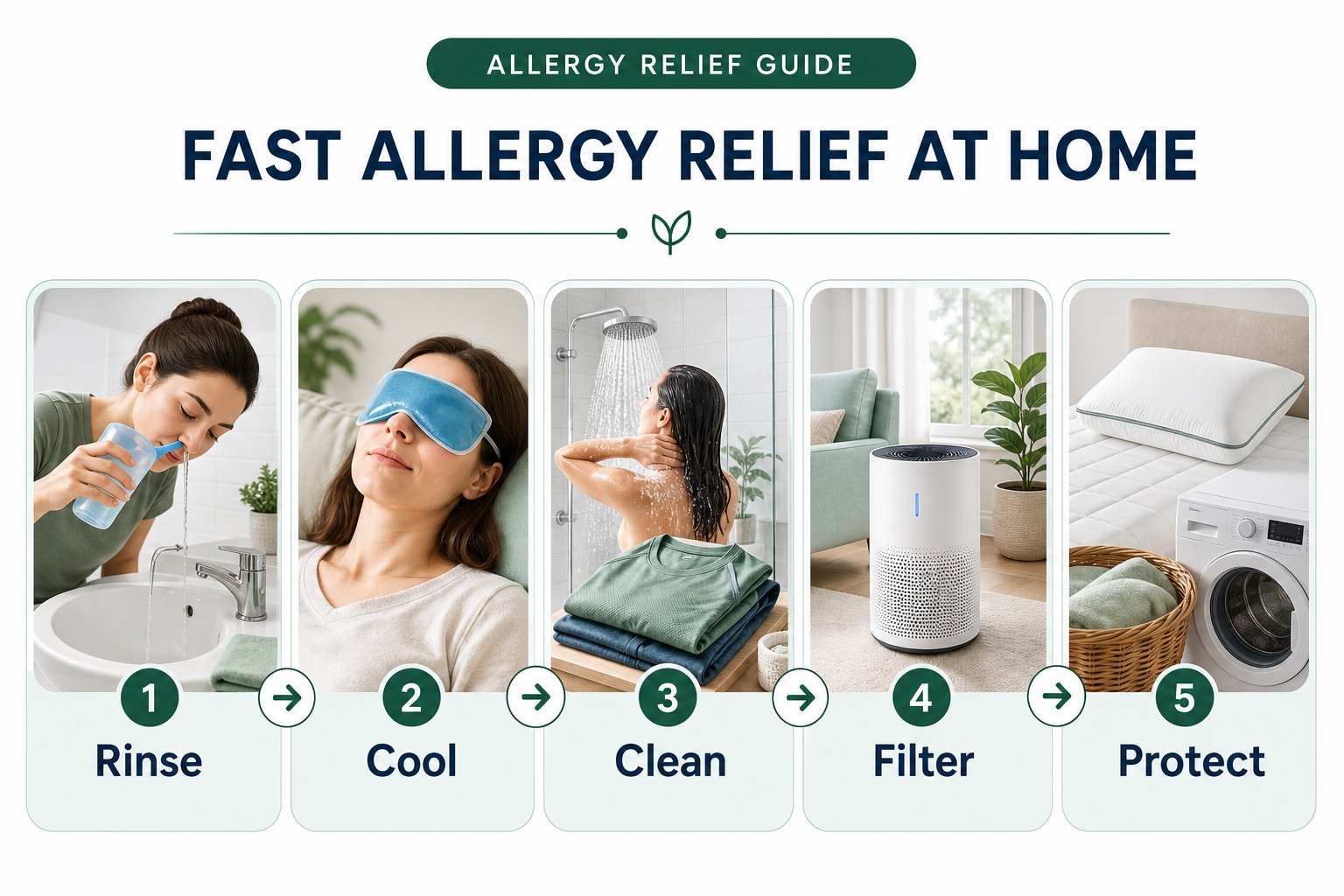
- Rinse your nose with saline. A saline rinse or spray flushes out pollen, dust and mucus and eases congestion. See the safety note below on which water to use.
- Calm itchy eyes. A clean, cool compress over closed eyes, or lubricating (or allergy-specific) eye drops, reduces itching and redness. More in relief for itchy, watery eyes.
- Clean your indoor air. Run a HEPA air purifier in the rooms you use most and use air conditioning instead of open windows during allergy season.
- Get allergens off you. Shower and change clothes after time outdoors, and avoid drying laundry outside on high-pollen days.
⚠️ Critical safety note: water for nasal rinses
Never use untreated tap water in a neti pot or saline nasal rinse. Use only distilled or sterile water, or tap water that has been boiled for at least 1 minute (3 minutes at high elevations) and then cooled. Tap water is safe to drink but not to send through your nasal passages, because it can contain microorganisms — including the rare but often-fatal amoeba Naegleria fowleri — that can cause serious infection. Rinse the device with safe water after each use and let it air-dry. This follows U.S. FDA and CDC guidance.
Many people also ask about natural allergy remedies such as local honey, butterbur or quercetin. Evidence for these is mixed, and supplements can interact with other medicines, so treat them as extras rather than replacements for proven relief — and talk to your doctor first, especially for children or during pregnancy.
Over-the-counter allergy medicine
For everyday symptoms, a non-drowsy oral antihistamine is the usual first choice for sneezing, itching and a runny nose, while a steroid nasal spray is the most effective option for a blocked, inflamed nose. Each type below targets different symptoms. This is an overview, not a dosing guide — always follow the label and ask a pharmacist or doctor, especially for children, during pregnancy, or if you take other medicines.
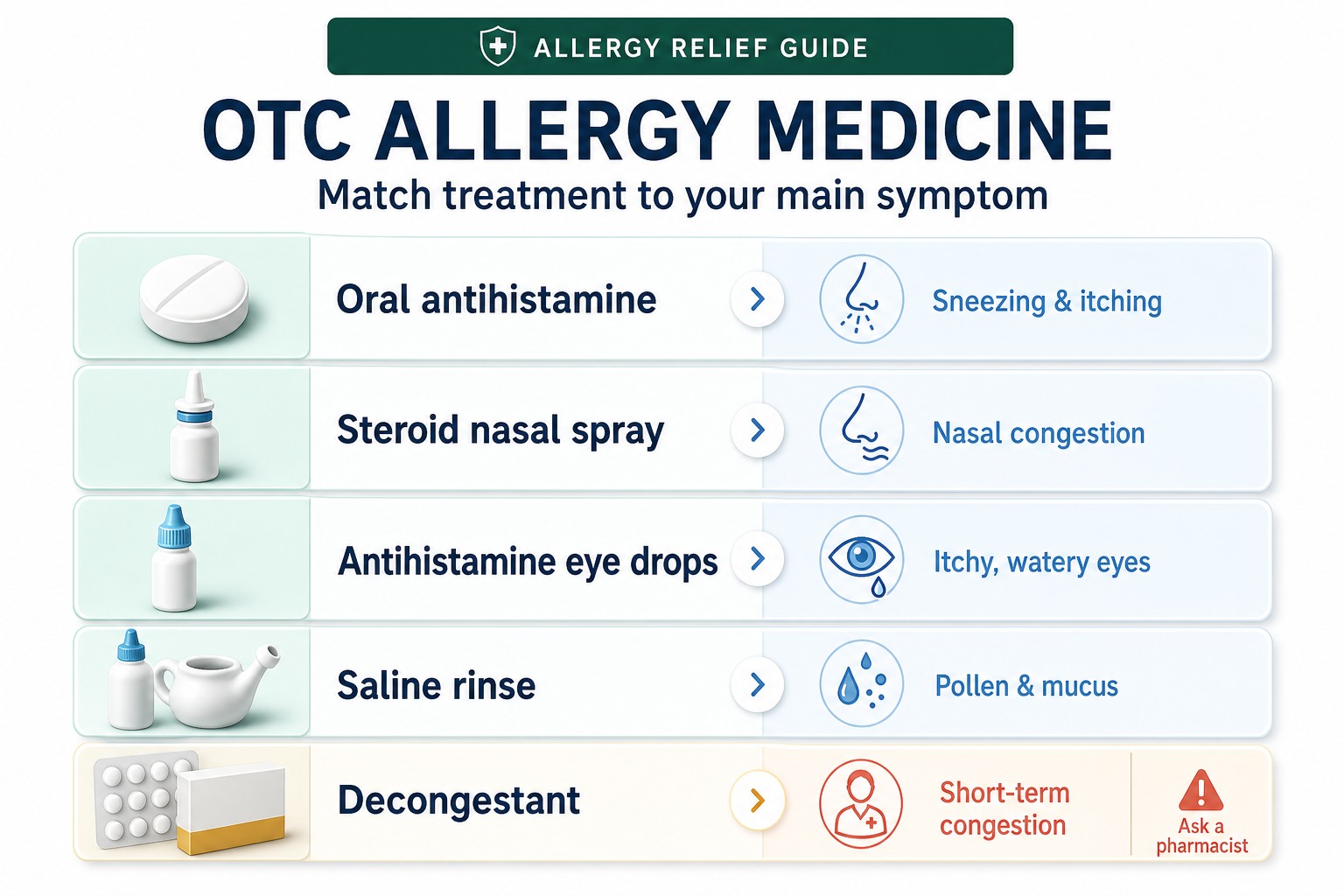
| Medicine type | Common options (generic → brand) | Best for | Good to know |
|---|---|---|---|
| Oral antihistamines | Cetirizine (Zyrtec), fexofenadine (Allegra), loratadine (Claritin), levocetirizine (Xyzal) | Sneezing, itching, runny nose, itchy eyes | Pick a newer, non-drowsy option. Compare in best antihistamine and Claritin vs. Zyrtec. |
| Steroid nasal sprays | Fluticasone (Flonase), budesonide (Rhinocort), triamcinolone (Nasacort) | Nasal congestion and inflammation | Most effective for a blocked nose; works best used daily, with full effect after several days. See nasal sprays for allergies. |
| Antihistamine eye drops | Ketotifen (Zaditor), olopatadine (Pataday) | Itchy, red, watery eyes | Target eye symptoms directly when an oral medicine isn't enough. |
| Decongestants | Pseudoephedrine (Sudafed), oxymetazoline nasal (Afrin) | Short-term stuffiness | Use only briefly. Nasal sprays can cause rebound congestion after a few days; oral forms may not suit high blood pressure — ask a pharmacist. |
| Mast cell stabilizer | Cromolyn sodium nasal spray (NasalCrom) | Preventing nasal symptoms | Very safe, but needs several daily uses and works best started before allergen exposure. |
For a fuller walk-through of how these work and how to choose, see our allergy medicine overview and antihistamines guide. If you're deciding between specific brands, we compare them head-to-head in Claritin vs. Zyrtec, Zyrtec vs. Allegra and Claritin vs. Allegra.
Layer 3 — Prescription allergy treatments
If avoidance, home care and over-the-counter medicine aren't controlling your symptoms, a doctor can prescribe stronger or combination treatments tailored to you. These are chosen, dosed and monitored by a clinician, so this section is for general understanding rather than self-treatment.
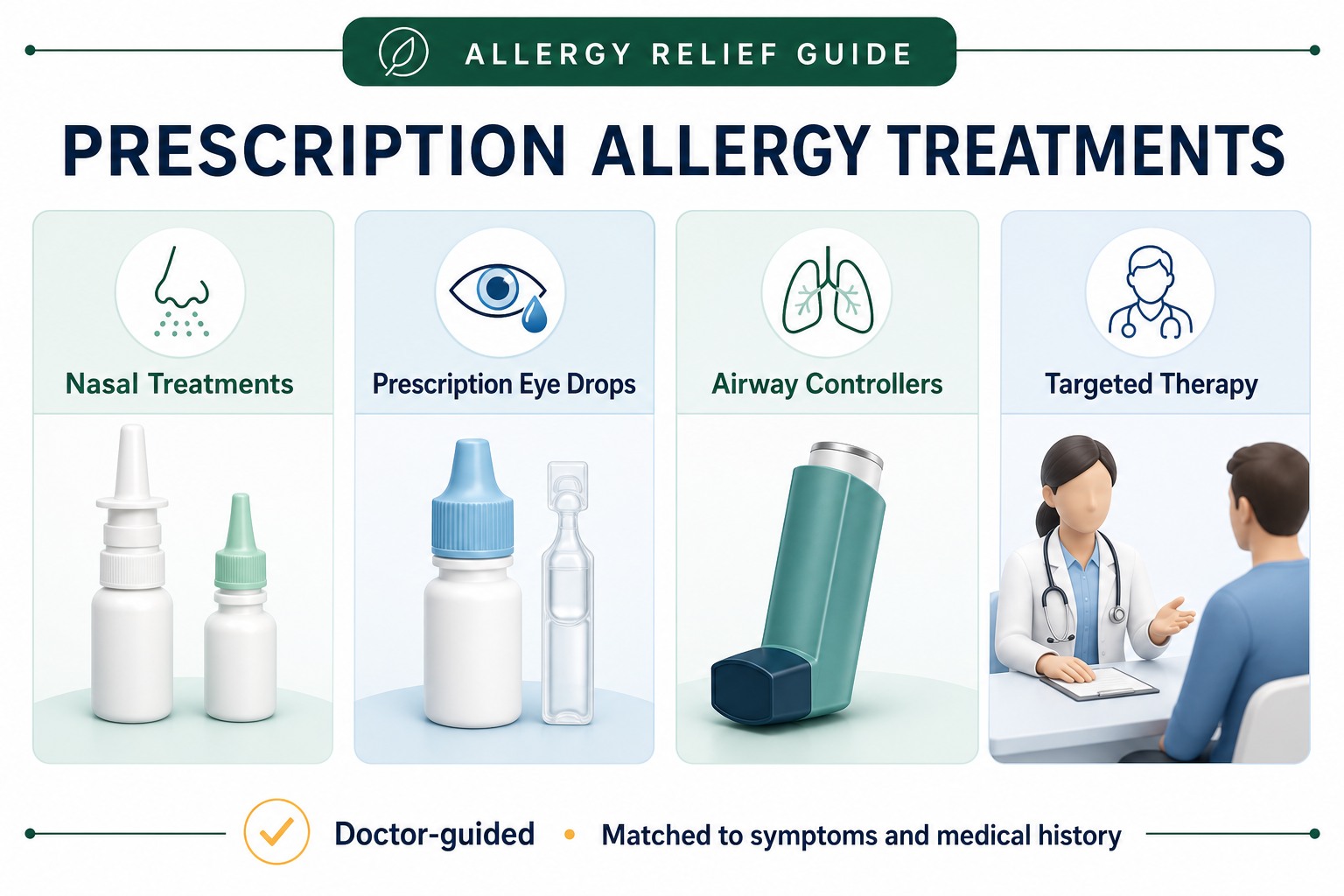
Depending on your symptoms, prescription options a doctor might consider include prescription-strength or combination nasal sprays, a leukotriene modifier such as montelukast (usually when asthma is also involved), or — for certain hard-to-control cases like chronic hives or allergic asthma — a biologic medicine such as omalizumab (Xolair), given as an injection under specialist care. Your doctor will weigh the benefits and possible side effects and explain how to use anything they prescribe.
One prescription option carries a boxed warning
Montelukast is useful for some people, particularly when asthma is involved, but it is not an ordinary allergy tablet. MedlinePlus states it may cause serious or life-threatening mental health changes during treatment or after stopping, listing agitation, aggression, anxiety, depression, sleep problems, hallucinations and suicidal thoughts among the possible effects. The FDA added a boxed warning in March 2020. Its labelling limits use in allergic rhinitis to people who cannot be treated with other medicines — so it is a second-line option, not a starting point. If you or your child take it and notice any change in mood, behaviour or sleep, contact the prescriber. Never stop a prescribed medicine without medical advice. More in allergy medicine.
The takeaway: persistent symptoms are a reason to see a doctor, not to keep doubling up on OTC products. A tailored prescription plan is often more effective and safer.
Layer 4 — Allergen immunotherapy (long-term relief)
Allergen immunotherapy is the closest thing to a long-term fix: it gradually exposes your immune system to tiny, controlled amounts of your trigger so it reacts less strongly over time. It's prescribed and supervised by a doctor, usually an allergist.
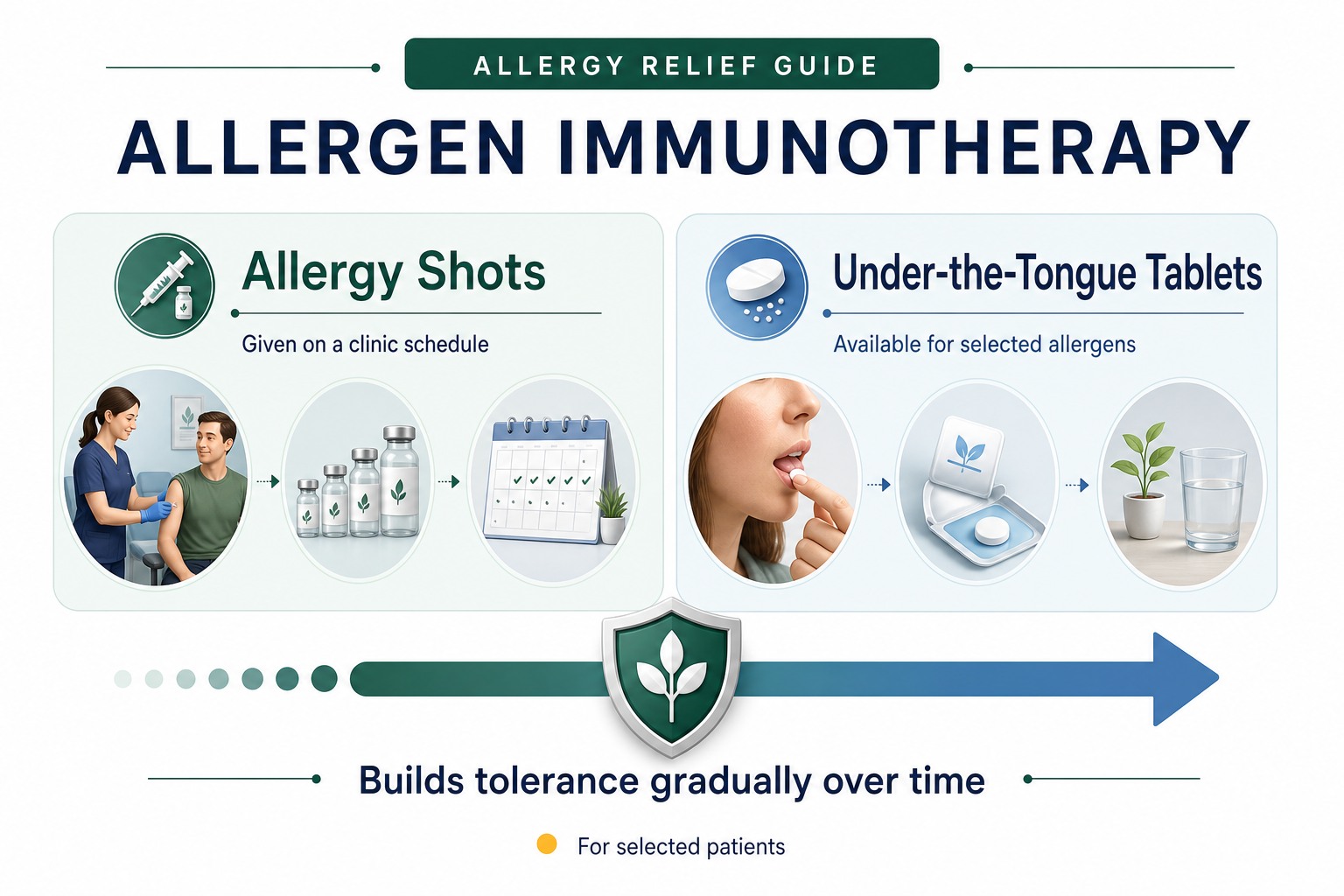
There are a few forms:
- Allergy shots (subcutaneous immunotherapy, SCIT): regular injections given in a medical setting, typically over a few years.
- Under-the-tongue tablets or drops (sublingual immunotherapy, SLIT): a daily dose taken at home after the first dose is supervised, available for certain triggers such as some pollens and dust mites.
- Oral immunotherapy (OIT): a specialist-supervised approach used for some food allergies to raise the amount that triggers a reaction.
What to expect: immunotherapy is a commitment rather than a quick fix. A typical course of allergy shots runs for several years, often starting with more frequent visits during a build-up phase and then settling into occasional maintenance doses. Many people notice their symptoms and their need for day-to-day medicine gradually ease over the first year, with benefits that can last after treatment ends. Because there's a small risk of a reaction, doses are given or started under medical supervision.
Immunotherapy isn't right for everyone, so an allergist will weigh your triggers, symptoms and overall health before recommending it. Getting an accurate diagnosis comes first — see our allergy testing guide.
What immunotherapy actually involves
People often rule immunotherapy in or out without knowing what it asks of them. Here is the practical shape of both routes, so you can judge whether the commitment fits your life before you raise it with an allergist.
| Allergy shots (SCIT) | Under-the-tongue tablets (SLIT) | |
|---|---|---|
| Where | In an allergist's office, every time | First dose in the office, then daily at home |
| Schedule | Usually weekly for around seven months, then every two weeks, then every four weeks | One tablet daily, held under the tongue for one to two minutes then swallowed |
| Typical duration | Three to five years, sometimes longer | Three years or longer for lasting effect |
| What it covers | Nose, eye, ear and lung allergy, and severe insect sting allergy | FDA-approved tablets exist for ragweed, northern pasture grasses such as timothy, and dust mites |
| When you start | Any time, building up gradually | Grass and ragweed tablets before and during the season; dust mite tablets year-round |
| Safety arrangement | Given in the office because of a small risk of anaphylaxis shortly after an injection, so you wait there afterwards | An epinephrine auto-injector is prescribed to treat a severe reaction at home |
The payoff that makes the commitment worth considering: ACAAI notes that allergy shots have a lasting beneficial effect well after therapy has been completed. That is the key difference from everything in Layers 1 to 3, which control symptoms only while you keep using them. Immunotherapy is the one option aimed at changing how strongly you react in the first place.
Neither route is right for everyone, and the decision depends on which allergens you actually react to — which is why testing comes first. Read the detail in allergy shots and sublingual immunotherapy, and see how to find a good allergist and what to expect at the appointment.
A note on food allergy
Oral immunotherapy for food allergy is a different undertaking from the pollen and dust-mite treatments above, with its own risks, monitoring and specialist requirements. It aims to raise the amount that triggers a reaction rather than to make a food safe to eat freely. Discuss it only with an allergist — see food allergies.
How long does allergy treatment take to work?
It depends on the treatment: some ease symptoms within an hour, others need days of regular use, and immunotherapy works over months. Knowing the timeline helps you use each option correctly instead of switching too soon.
- Saline rinse: relief within minutes as it clears the nose.
- Oral antihistamines: often about an hour to start easing sneezing and itching. Compare options in best antihistamine.
- Steroid nasal sprays: some effect within a day, but full benefit usually after several days to two weeks of daily use — so keep going even if day one feels slow. More in nasal sprays for allergies.
- Decongestants: fast, but for short-term use only.
- Immunotherapy: gradual, over months to years, with the aim of lasting change.
If a treatment hasn't helped after a fair trial used correctly, that's a good moment to talk to a pharmacist or doctor rather than simply adding more products.
Allergy treatment by symptom
The quickest way to choose relief is to start from your most bothersome symptom. Use this quick map, then follow the links for detail.
| Main symptom | First-line relief to consider |
|---|---|
| Sneezing & runny nose | Non-drowsy oral antihistamine; saline rinse. See allergy symptoms. |
| Nasal congestion | Steroid nasal spray (daily); short-term decongestant only if needed. See nasal sprays. |
| Itchy, watery eyes | Antihistamine eye drops; cool compress. See itchy eyes relief. |
| Postnasal drip | Saline rinse; steroid nasal spray. See postnasal drip. |
| Cough or mild wheeze | Treat the underlying nasal allergy; see a doctor if breathing is affected. See allergy cough. |
| Hives or itchy skin | Oral antihistamine; avoid the trigger. See hives. |
| Facial pressure or sinus fullness | Steroid nasal spray + saline rinse to reduce inflammation and drainage. |
| Tiredness from poor sleep | Get symptoms (especially congestion) under control at night; see allergy fatigue. |
Not sure whether it's an allergy at all? Our guides on allergic rhinitis (hay fever) and allergies vs. a cold can help you tell the difference before you treat it.
Allergy treatment for children and during pregnancy
Children and people who are pregnant can treat allergies, but the safest options and doses differ — so check with a doctor or pharmacist before starting any medicine.
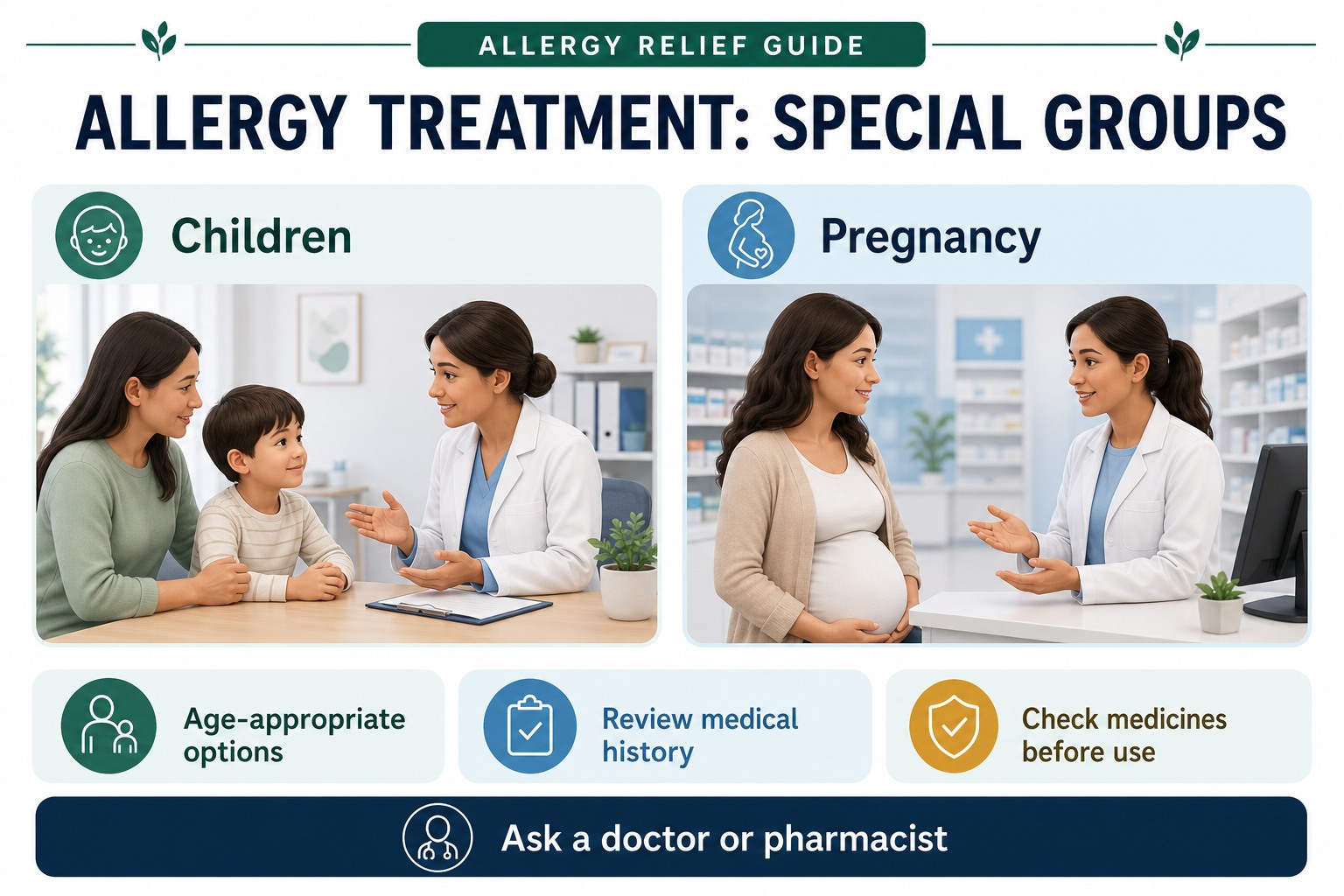
For children, non-drug steps like trigger avoidance and saline rinses are a good foundation, and several allergy medicines have child-specific forms; a pediatrician can advise what's appropriate for your child's age. During pregnancy, many people still get symptoms and some treatments are considered lower-risk than others, but this is a decision to make with your healthcare provider rather than from a label alone. For more, see allergies in children.
Each of these situations has its own guide, because the answers genuinely differ. For pregnancy and feeding, read allergy medicine during pregnancy, allergies during pregnancy and allergy medicine while breastfeeding. For children, the minimum age is printed on every product and differs by brand — see children's allergy medicine. Older adults have their own considerations, including avoiding sedating antihistamines where possible; see allergies in older adults. If allergies reach the chest, allergic asthma is managed alongside rather than instead of the nasal symptoms.
When to see a doctor about allergies
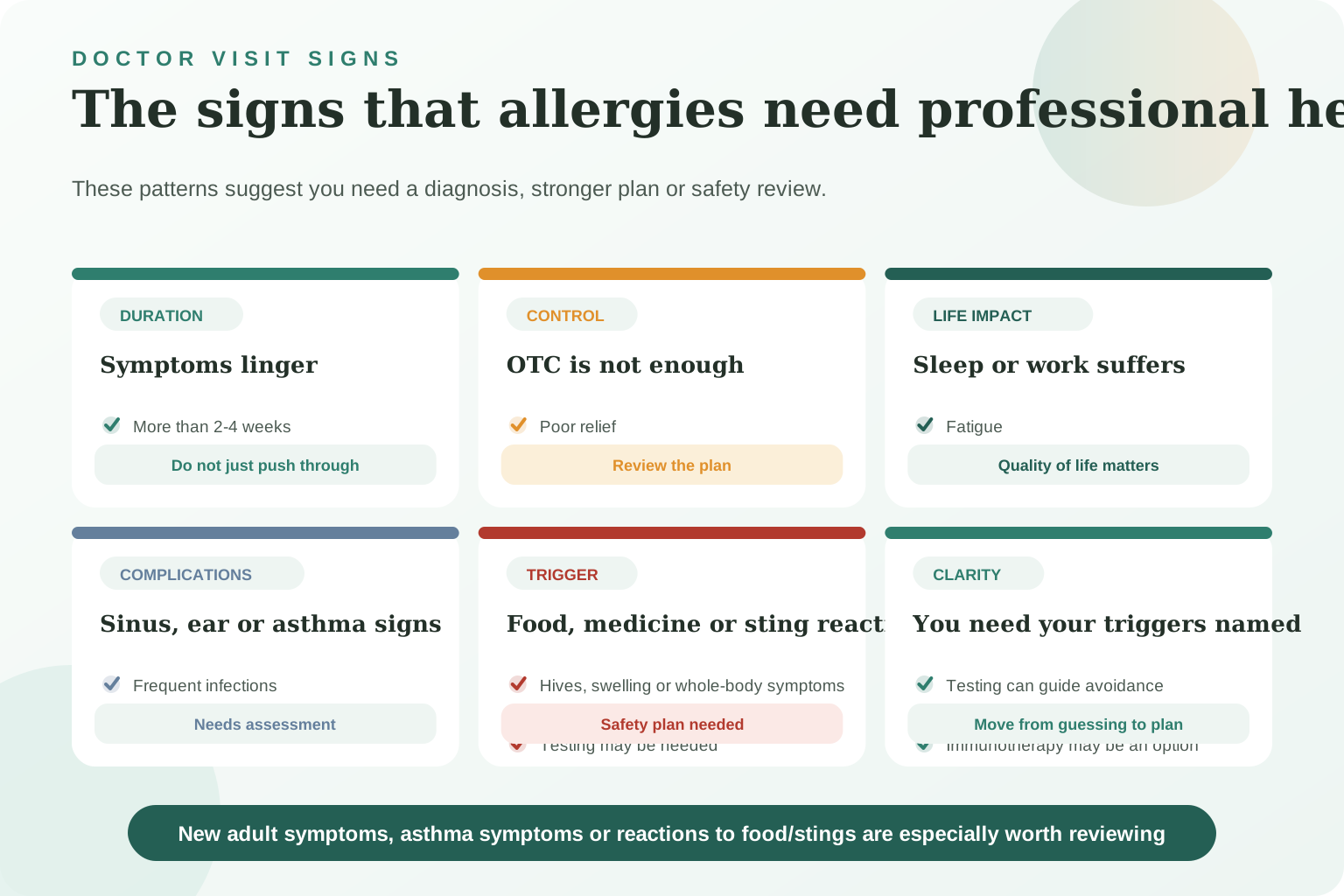
See a doctor if over-the-counter medicine isn't controlling your symptoms, if they disrupt your sleep or daily life, if they last for many weeks, or if you're unsure what's triggering them. An allergist can confirm your triggers and tailor a stronger plan, including prescription treatment or immunotherapy. Read more in when to see a doctor for allergies.
Allergic emergency — act fast
A severe, whole-body allergic reaction (anaphylaxis) is a medical emergency. Call 911 (or your local emergency number) right away if you notice trouble breathing; swelling of the face, lips, tongue or throat; widespread hives; chest tightness; dizziness or fainting; or a sudden sense of dread.
If epinephrine (an auto-injector such as EpiPen or Auvi-Q) has been prescribed, use it immediately — it's the first-line treatment. Do not rely on antihistamines in place of epinephrine, and still call emergency services. See our allergy safety guide.
Go deeper on any layer
Every part of this ladder has a guide of its own. Use whichever matches the decision you are actually making.
| Layer | What you might be deciding | Guide |
|---|---|---|
| 1. Avoid | Making the bedroom less reactive | Allergy-proof bedroom |
| Whether a purifier or filter helps | Air purifiers and HEPA filters | |
| Which season is yours | Seasonal allergies and indoor allergies | |
| 2. Home care | Rinsing safely | Neti pot and saline rinsing |
| Whether natural options are worth it | Natural allergy remedies | |
| 2b. OTC medicine | Which category to buy at all | Allergy medicine |
| Choosing a spray | Nasal spray for allergies | |
| Eye symptoms and decongestants | Eye drops and decongestants | |
| Side effects and combining safely | Antihistamine side effects and taking two antihistamines | |
| 3. Prescription | When OTC is not enough | When to see a doctor |
| 4. Immunotherapy | Shots or tablets | Allergy shots and SLIT tablets |
| Finding the right clinician | Find an allergist | |
| Emergency | Severe reactions | Allergy emergency and epinephrine auto-injectors |
How to prevent allergy flare-ups
Consistent habits prevent many flare-ups before they start — often more reliably than treating symptoms after they appear.
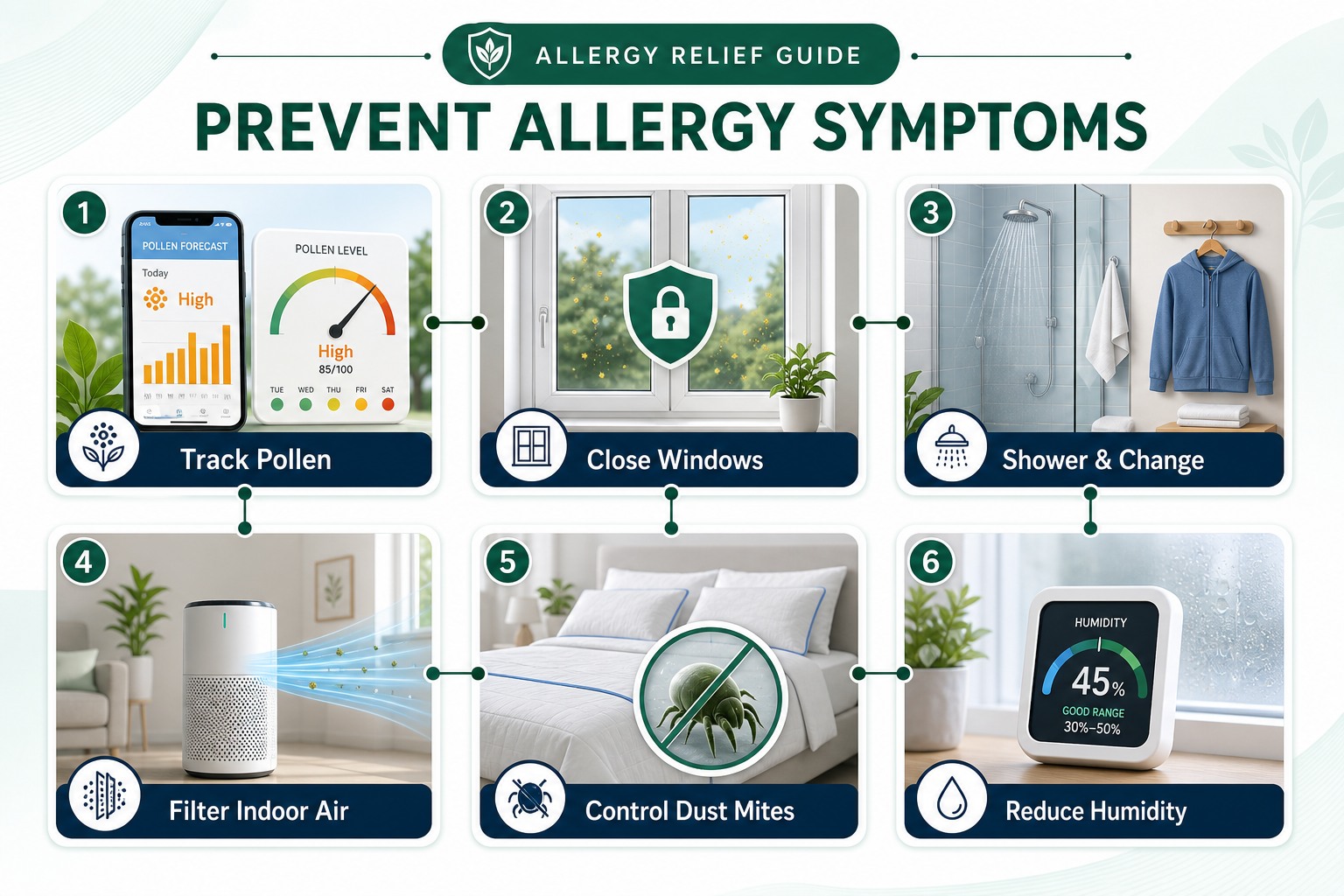
- Keep windows closed and use air conditioning on high-pollen days.
- Run a HEPA air purifier and change HVAC filters on schedule.
- Wash bedding weekly in hot water (at least 130°F / 54°C) and use allergen-proof covers.
- Control indoor humidity and fix leaks to discourage mold and dust mites.
- If you know a season is coming, ask a pharmacist about starting daily medicine before symptoms begin — some options work best that way.
Allergy treatment: frequently asked questions
What is the best treatment for allergies?
How do I treat allergies without medication?
What's the difference between antihistamines and steroid nasal sprays?
Can allergies be cured permanently?
When should I see a doctor or allergist for allergy treatment?
How long do allergy shots take, and how often are they given?
Which allergies can be treated with under-the-tongue tablets?
Does the benefit of immunotherapy last after you stop?
Is montelukast a good allergy treatment?
Should I take an antihistamine and a nasal spray together?
How we create and review this guide
This guide is written for a general audience using patient-education material from the authoritative sources below, not blogs or forums:
- American Academy of Allergy, Asthma & Immunology (AAAAI)
- American College of Allergy, Asthma & Immunology (ACAAI)
- Mayo Clinic
- U.S. National Institute of Allergy and Infectious Diseases (NIH / NIAID)
- U.S. Centers for Disease Control and Prevention (CDC)
- U.S. Food and Drug Administration (FDA)
Sources for the specific figures on this page
- American College of Allergy, Asthma & Immunology. Allergy shots (immunotherapy) (opens in a new tab). Therapy lasting three to five years and sometimes longer; injections about once weekly for around seven months before spacing to every two and then every four weeks; shots given in an allergist's office because of a small danger of anaphylaxis shortly after an injection; use for nose, eye, ear and lung allergy and severe insect sting allergy; and a lasting beneficial effect well after therapy is completed.
- American College of Allergy, Asthma & Immunology. Immunotherapy with allergy tablets (opens in a new tab). FDA-approved sublingual tablets limited to ragweed, northern pasture grasses such as timothy, and dust mites; tablets held under the tongue for one to two minutes then swallowed; an epinephrine auto-injector prescribed for a severe reaction at home; treatment continued for three years or longer; and seasonal versus year-round dosing.
- MedlinePlus, U.S. National Library of Medicine. Montelukast (opens in a new tab). The warning that montelukast may cause serious or life-threatening mental health changes during or after treatment, the list of neuropsychiatric symptoms, and the statement that it should be used for allergic rhinitis only in people who cannot be treated with other medications.
- Wallace DV, Dykewicz MS, Oppenheimer J, Portnoy JM, Lang DM. Pharmacologic Treatment of Seasonal Allergic Rhinitis: Synopsis of Guidance From the 2017 Joint Task Force on Practice Parameters (opens in a new tab). Annals of Internal Medicine 2017;167(12):876–881. Intranasal corticosteroid monotherapy recommended over combination with an oral antihistamine for people aged 12 and over, and intranasal corticosteroid plus intranasal antihistamine as an option in moderate-to-severe disease.
- American College of Allergy, Asthma & Immunology. Hay fever (allergic rhinitis) (opens in a new tab). Intranasal corticosteroids described as the single most effective drug class for allergic rhinitis, and rebound swelling from prolonged decongestant nasal spray use.
- U.S. Food and Drug Administration. Is Rinsing Your Sinuses With Neti Pots Safe? (opens in a new tab). The requirement to use distilled, sterile or previously boiled and cooled water for nasal rinsing, and to clean and dry the device after each use.
Medical disclaimer: This guide is for general education and isn't a substitute for personalized medical advice. Always talk to a qualified healthcare professional about your symptoms and before starting, stopping or changing any treatment.
 MD
MDMedically reviewed
Dr. Hannah H. Walford, MD
Allergist and Immunologist
- Website role
- Owner, Medical Director and Medical Reviewer of Allergy Relief Guide
- Professional affiliation
- Stanford Health Care / Menlo Medical Clinic, Menlo Park, California
- Areas of expertise
- Food allergy, eczema, allergic rhinitis, sinusitis and asthma
Dr. Hannah H. Walford is a board-certified allergist and immunologist experienced in caring for adults and children with allergic conditions. Her areas of expertise include food allergy, eczema, allergic rhinitis, sinusitis and asthma. She provides medical leadership and review oversight for the educational health content published by Allergy Relief Guide.
Medical content is provided for education and is not a substitute for diagnosis or individualized medical care.
Related guides
Keep exploring the parts of the allergy relief guide that fit your situation:
Antihistamines guide
How they work, plus best antihistamine and brand comparisons.
Natural remedies
What the evidence says about home and herbal options.
Allergy symptoms
Identify what you're feeling before you treat it.
Testing & diagnosis
Pinpoint your triggers with skin or blood tests.
Seasonal allergies
Pollen, hay fever and season-by-season relief.
Allergies in children
Age-aware, safety-first guidance for kids.
Allergy shots
The schedule, the commitment and the payoff.
Allergy medicine
Which type to take for which symptom.
Nasal sprays
The most effective option for congestion.
Allergy emergency
What to do when a reaction turns severe.
Not sure which option is right for you?
Start by matching relief to your main symptom, and see an allergist if OTC medicine isn't keeping symptoms under control.
Compare allergy medicines & antihistamines