Allergy Medicine: Which Type to Take for Which Symptom
Antihistamines, nasal sprays, eye drops and more — what each type actually treats, and how to match the right one to your symptoms.
Quick answer: which allergy medicine do you need?
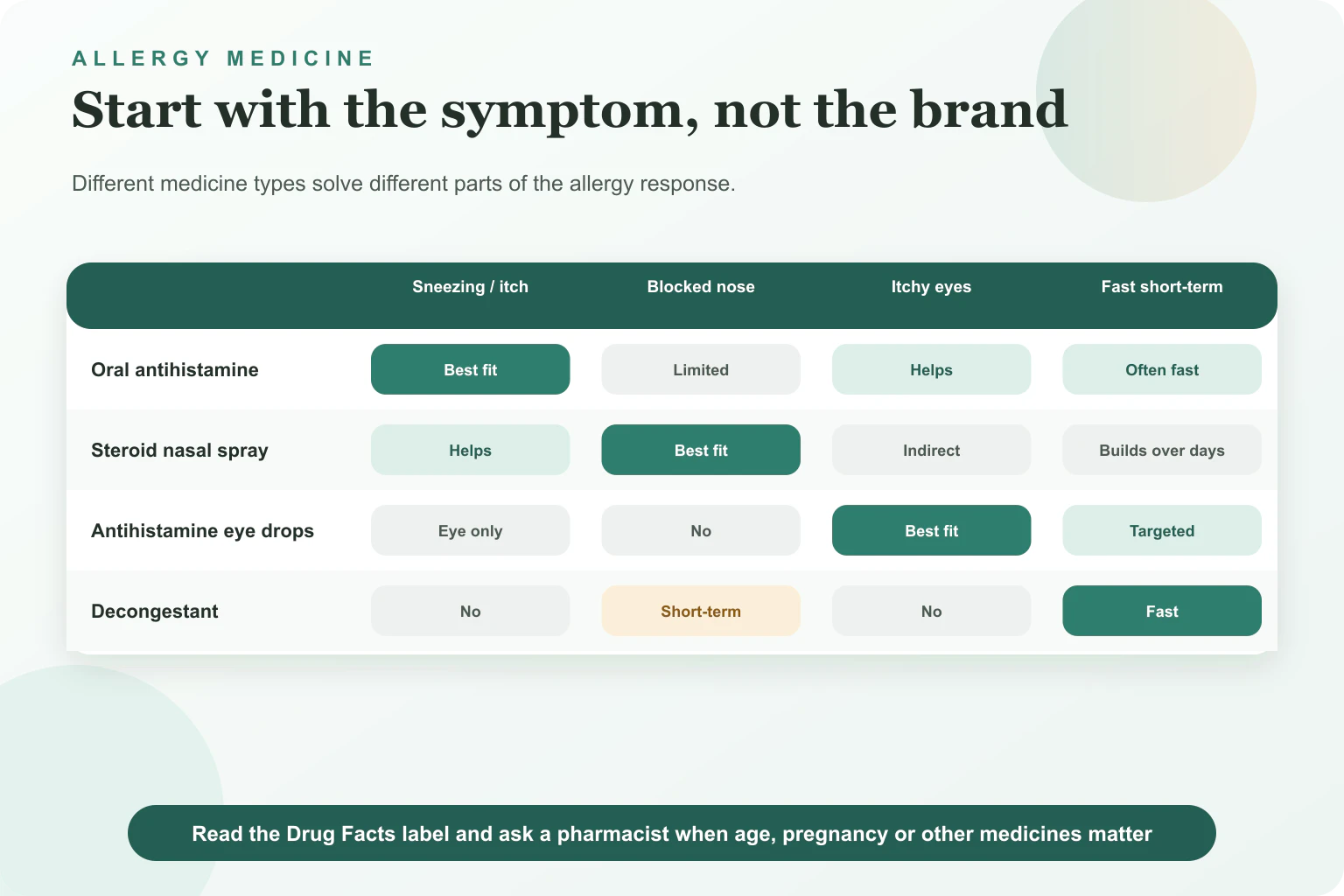
Short answer: pick by your worst symptom. A non-drowsy antihistamine tablet handles sneezing, itching and a runny nose. A steroid nasal spray is the strongest option for a blocked nose and is first-line for ongoing symptoms. Antihistamine eye drops handle itchy eyes. Decongestants are short-term only. Many people do best combining a spray with a tablet.
The best allergy medicine depends on your main symptom. For sneezing, itching and a runny nose, a non-drowsy oral antihistamine works well. For nasal congestion, a steroid nasal spray is usually the most effective and is considered first-line for ongoing symptoms. For itchy, watery eyes, antihistamine eye drops help most. Decongestants relieve congestion short-term only, and combining a nasal spray with an antihistamine often gives the best control. The table below maps each type to what it treats. This is general information, not dosing advice.
The main types of allergy medicine at a glance
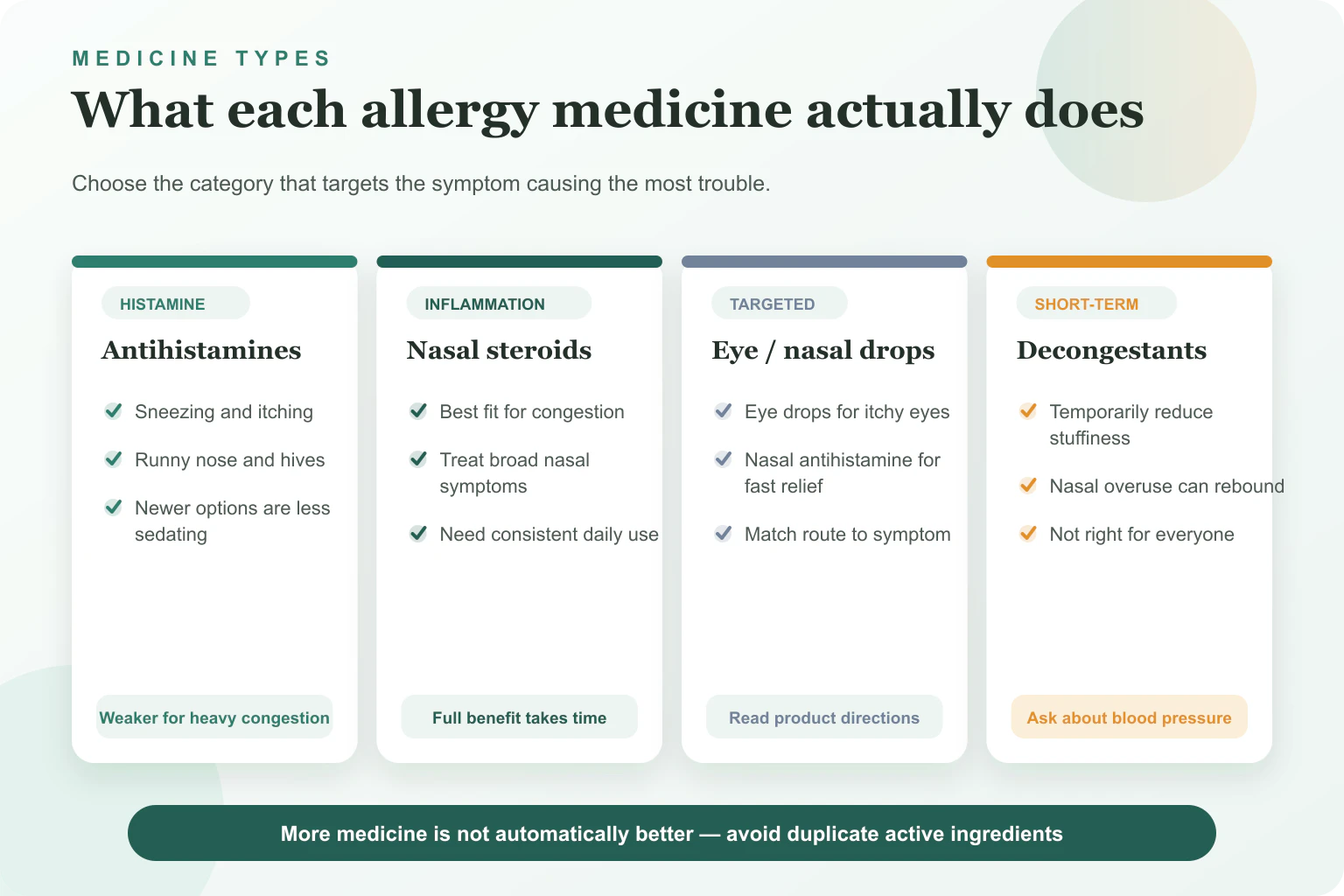
Most allergy medicines fall into a handful of groups. Here's what each is best for.
| Type | Best for | Good to know |
|---|---|---|
| Oral antihistamines | Sneezing, itching, runny nose, itchy eyes | Choose non-drowsy (second-generation); weaker for congestion |
| Steroid nasal sprays | Congestion & overall nasal symptoms | Most effective for congestion; use daily to build up |
| Antihistamine nasal sprays | Fast nasal relief | Work faster than steroid sprays; can cause a bitter taste |
| Decongestants | Short-term congestion | Sprays: max ~3 days (rebound). Oral type raises blood pressure |
| Antihistamine eye drops | Itchy, watery, red eyes | Targeted eye relief; can pair with other medicines |
| Mast-cell stabilisers | Prevention (nose/eyes) | Work best started before exposure; very well tolerated |
| Leukotriene inhibitors | Allergy with asthma | Prescription only; discuss mood side effects with a doctor |
| Immunotherapy | Long-term, cause-targeting | Shots or tablets; the only option that changes the allergy itself |
Each type, explained
Oral antihistamines
Antihistamines block histamine, the chemical behind sneezing, itching and a runny nose. Modern second-generation options — cetirizine (Zyrtec), loratadine (Claritin) and fexofenadine (Allegra) — are non-drowsy for most people and are the everyday workhorse of allergy relief. Older first-generation types (like diphenhydramine) cause significant drowsiness and are best avoided for daytime use. They're convenient and effective for most symptoms except heavy congestion. Compare them in our antihistamines guide and see the best antihistamine by need.
Steroid nasal sprays
Steroid (corticosteroid) nasal sprays — fluticasone (Flonase), mometasone (Nasonex) and triamcinolone (Nasacort) — reduce inflammation directly in the nose and are widely considered the single most effective treatment for nasal allergy symptoms, especially congestion. The catch: they work best used daily and take a few days to a couple of weeks to reach full effect, so consistency matters more than with a pill. Full detail in our nasal spray guide.
Antihistamine nasal sprays
Azelastine (Astepro) and olopatadine are antihistamines delivered as a spray. They act faster than steroid sprays — often within minutes to hours — which makes them useful for quick relief or occasional symptoms. Some people notice a temporary bitter taste. They can be used alongside a steroid spray under guidance.
Decongestants
Decongestants shrink swollen nasal tissue to relieve a blocked nose. Decongestant nasal sprays like oxymetazoline (Afrin) work fast but should only be used for a short spell — more than about three days in a row can cause rebound congestion, where your nose gets more blocked once you stop. Oral decongestants like pseudoephedrine (Sudafed) can raise blood pressure and disturb sleep, and are kept behind the pharmacy counter. Decongestants ease congestion but don't treat the underlying allergy.
Antihistamine eye drops
For itchy, watery, red eyes that pills don't fully settle, antihistamine eye drops (such as ketotifen or olopatadine drops) give targeted relief and can be combined with other allergy medicines. See allergy itchy eyes.
Mast-cell stabilisers
Cromolyn sodium — available as a nasal spray and eye drops — helps prevent the allergic reaction rather than treat it after the fact. It's very well tolerated, but works best when started before you're exposed and used regularly.
Leukotriene inhibitors
Montelukast is a prescription tablet that blocks leukotrienes, another group of inflammatory chemicals. It's mainly used when allergies come with asthma. Because it carries a warning about mood and behaviour changes, it should only be used under a doctor's guidance.
Montelukast carries an FDA boxed warning
This is stronger than an ordinary side-effect caution. MedlinePlus states that montelukast may cause serious or life-threatening mental health changes while you are taking it or after treatment has stopped, and lists agitation, aggressive behaviour, anxiety, irritability, trouble concentrating, memory problems, confusion, unusual dreams, hallucinations, depression, sleep problems, sleepwalking, tremor and suicidal thoughts or actions. The FDA added a boxed warning in March 2020 after continuing reports of neuropsychiatric events.
Because of this, montelukast is labelled for seasonal or perennial allergic rhinitis only in adults and children who cannot be treated with other medicines — it is a second-line option for allergy, not a starting point. If you or your child take it and notice any change in mood, behaviour or sleep, contact your prescriber. Do not stop a prescribed medicine without medical advice.
Combination products
Some products combine ingredients — for example a "-D" oral antihistamine (like Zyrtec-D or Allegra-D) pairs an antihistamine with the decongestant pseudoephedrine, and some nasal sprays combine a steroid with an antihistamine. These can simplify treatment, but the decongestant part carries the same cautions above, so check with a pharmacist before choosing one.
Immunotherapy
Allergy shots and under-the-tongue tablets (sublingual immunotherapy) gradually train the immune system to react less to your triggers. It's the only approach that targets the cause rather than masking symptoms, but it's doctor-prescribed and takes months to years. Learn more in the treatment & relief guide.
Which allergy medicine for which symptom?
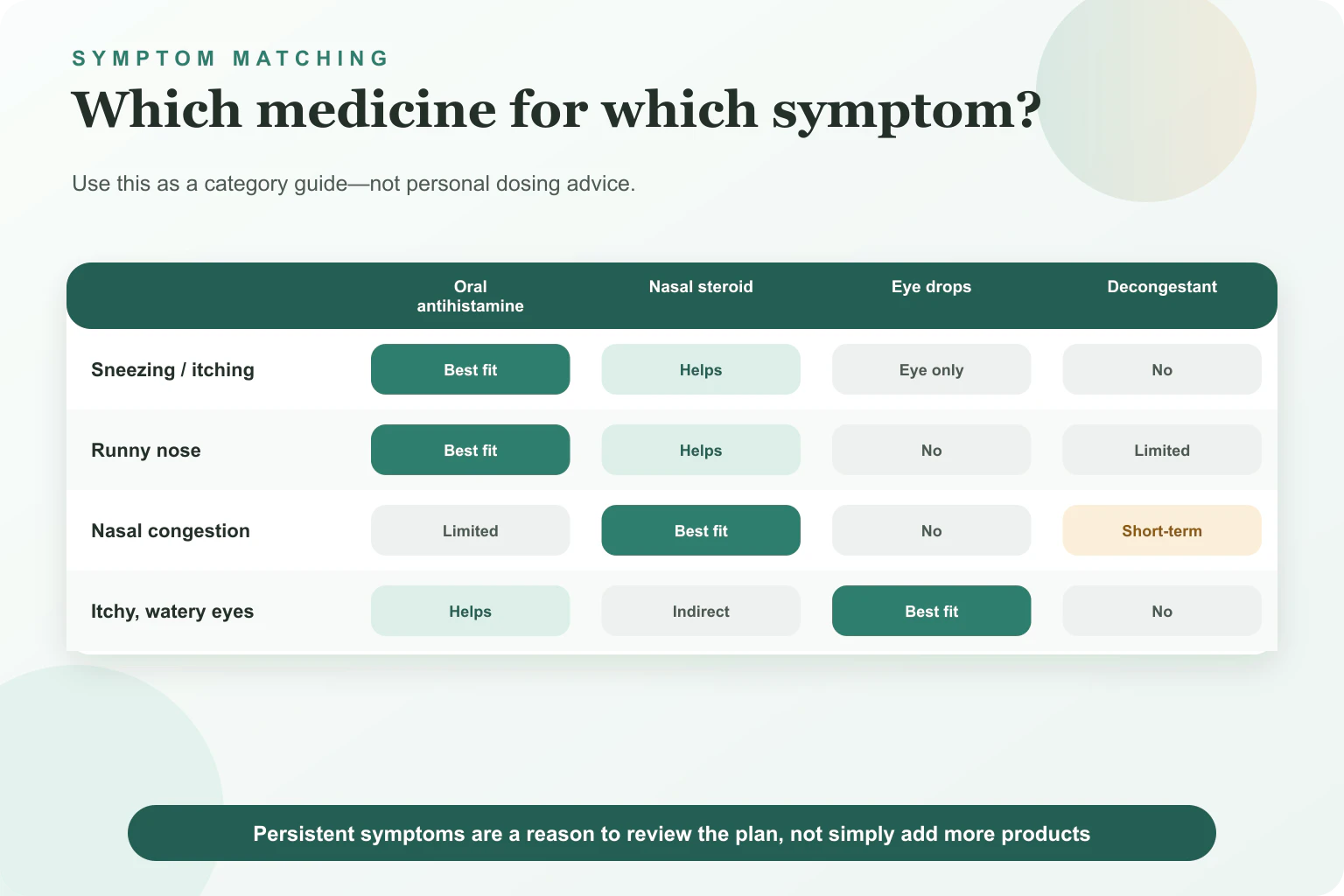
Matching the medicine to your main symptom is the quickest route to relief.
| Main symptom | First thing to try |
|---|---|
| Sneezing & runny nose | Non-drowsy oral antihistamine |
| Nasal congestion / blocked nose | Steroid nasal spray (daily) |
| Itchy, watery eyes | Antihistamine eye drops |
| Everything at once | Steroid nasal spray + oral antihistamine |
| Fast relief before an event | Antihistamine nasal spray |
| Allergies plus asthma | See a doctor (may include a leukotriene inhibitor) |
Still deciding between brands? Our comparisons help: Claritin vs. Zyrtec, Zyrtec vs. Allegra and Claritin vs. Allegra.
Choosing by situation, not just by symptom
Symptom is the first filter; who you are is the second. The same blocked nose is treated differently at age 3, at 34 weeks pregnant, and at 78 on blood-pressure tablets. Use this to find the right starting point, then read the detail on the linked page.
| Your situation | What usually shapes the choice | Where to read more |
|---|---|---|
| Children | Minimum age printed on each product; child-strength versions; avoid sedating older antihistamines | Children's allergy medicine, allergies in children |
| Pregnancy | Decided with your provider; nasal and local treatments are often preferred because so little is absorbed | Allergy medicine in pregnancy |
| Breastfeeding | Sedating options are the usual concern; check each label and ask a pharmacist | Allergy medicine while breastfeeding |
| Older adults | Sedating first-generation antihistamines are generally avoided; kidney function can affect dosing | Allergies in older adults |
| High blood pressure or heart disease | The decongestant component is the issue, not the antihistamine | See the next section |
| Allergies with asthma | Asthma control comes first and is prescribed separately | Managing allergic asthma |
| Hives and itchy skin | Oral antihistamines are the mainstay; sprays and drops do nothing here | Antihistamines for hives |
| Mainly eye symptoms | Drops reach the eye surface that tablets only partly settle | Allergy eye drops |
| Mainly a blocked nose | A daily steroid nasal spray, not a stronger tablet | Nasal spray for allergies |
| Symptoms most of the year | Worth testing and treating the cause rather than the symptoms | Allergy testing, allergy shots |
How fast does allergy medicine work?
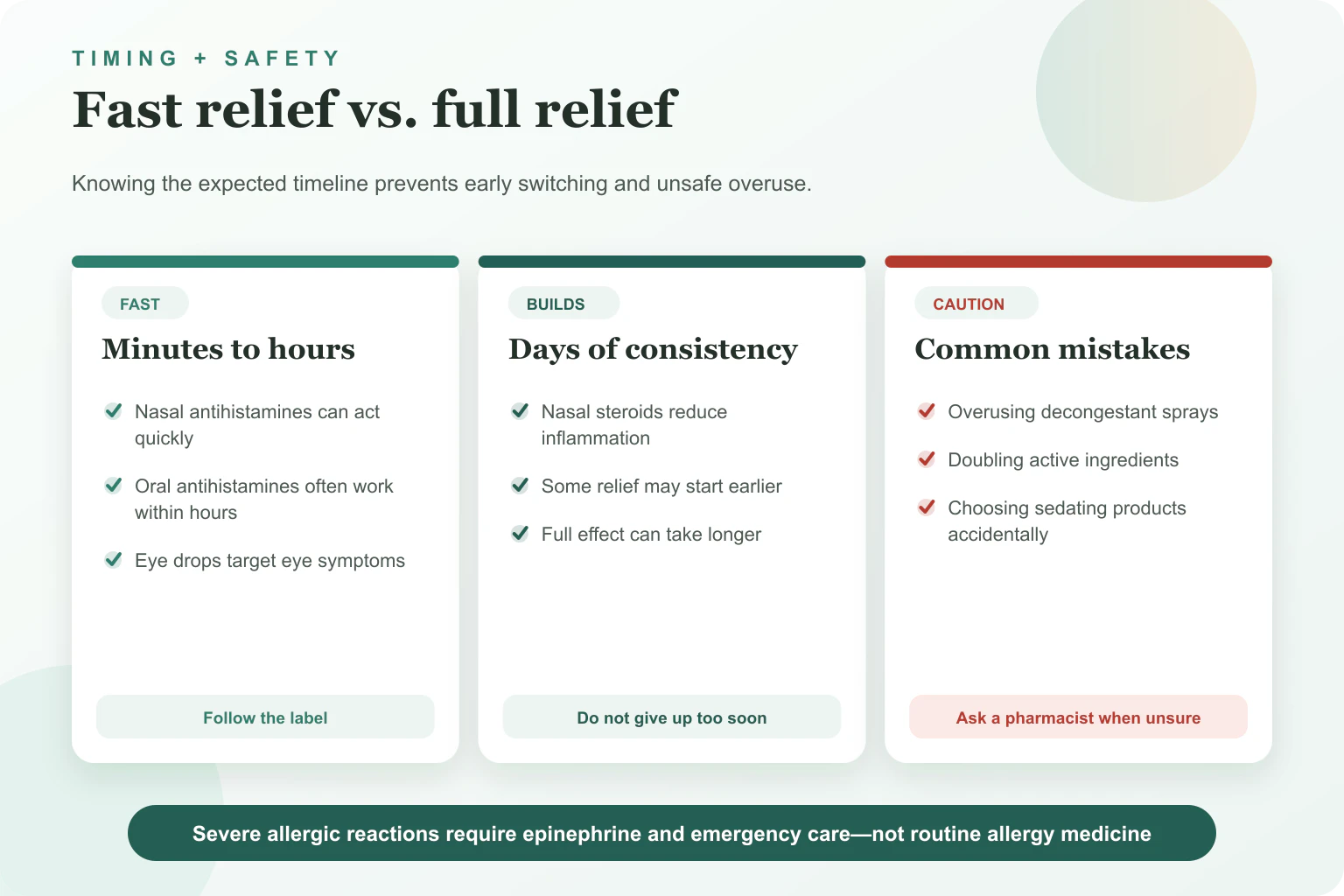
Speed varies a lot by type — knowing this saves you from giving up on something too early.
- Antihistamine nasal sprays and decongestant sprays — fastest, often within minutes to an hour.
- Oral antihistamines — usually within one to three hours, and they last all day.
- Steroid nasal sprays — the slowest to peak: some relief in a day or two, but full benefit takes up to two weeks of daily use. This is why people wrongly conclude they "don't work."
- Immunotherapy — a long game, with benefit building over months and lasting for years.
Allergy medicine with high blood pressure, heart or thyroid conditions
The antihistamine is rarely the problem. The decongestant added to it usually is. This is the single most common avoidable mistake in the allergy aisle, because the risky products sit right beside the plain ones and look almost identical.
Plain cetirizine, loratadine and fexofenadine are antihistamines only. Add a "-D" to the box — Zyrtec-D, Claritin-D, Allegra-D — and you have also bought pseudoephedrine, a decongestant that narrows blood vessels throughout the body, not only in your nose.
The over-the-counter Drug Facts label for Zyrtec-D Allergy Plus Congestion tells you to ask a doctor before use if you have heart disease, high blood pressure, thyroid disease, diabetes, glaucoma, trouble urinating due to an enlarged prostate, or liver or kidney disease. It also says do not use if you are taking a prescription MAOI, or within two weeks of stopping one, and it is for adults and children 12 and over only. MedlinePlus gives the same list for pseudoephedrine on its own.
How to read the box in five seconds
Turn it over and read the active ingredients panel. One ingredient means an antihistamine only. Two ingredients, with the second being pseudoephedrine or phenylephrine, means a decongestant is included. If you have any of the conditions above, the plain version plus a steroid nasal spray for the congestion is usually the better combination — and a pharmacist can confirm it against your other medicines in under a minute.
Decongestant nasal sprays such as oxymetazoline carry their own cautions and the three-day limit. More in decongestants for allergies and nasal spray for allergies.
Common mistakes to avoid
With so many options, it's easy to pick the wrong one or use the right one incorrectly. The most frequent slip-ups:
- Using a decongestant spray too long. More than about three days of oxymetazoline (Afrin) can trigger rebound congestion that's worse than where you started.
- Grabbing a drowsy antihistamine by accident. "Night-time" or first-generation products cause sedation — check for a non-drowsy second-generation option for daytime.
- Giving up on a steroid nasal spray too soon. It needs consistent daily use to build up; occasional use rarely works.
- Treating congestion with an antihistamine alone. Pills are weaker for a blocked nose — a nasal spray usually helps more.
- Doubling up on the same ingredient. Combination products can hide a second dose of something you're already taking, so read labels or ask a pharmacist.
Why the decongestant in your allergy tablet may not be working
There are two oral decongestants on the shelf, and US regulators have concluded that one of them does not work. If you have ever wondered why a "sinus and congestion" tablet did nothing, this is often the reason.
- Pseudoephedrine works, but it is kept behind the pharmacy counter in the United States, so you have to ask for it. It is the ingredient in the "-D" products above, with the cautions described there.
- Phenylephrine is the ingredient in most "PE" tablets sitting on the open shelf. In September 2023 an FDA advisory committee voted unanimously that oral phenylephrine at the marketed dose is not effective as a nasal decongestant, and in November 2024 the FDA issued a proposed order to remove it from the over-the-counter monograph.
Two points matter for how you read that. The FDA was explicit that the proposal is about effectiveness, not safety — nobody is saying phenylephrine is dangerous. And it applies to the oral form only; phenylephrine nasal sprays are not covered by the proposal, because the medicine reaches the nose directly rather than surviving a trip through the liver. As of this update the order is proposed rather than final, so products containing it may still be on sale.
Practically: if congestion is your main symptom, a daily steroid nasal spray is the better-evidenced route than any oral decongestant, and it avoids the blood-pressure question entirely.
Over-the-counter vs. prescription
Most people manage allergies well with over-the-counter medicine. Non-drowsy antihistamines, steroid and antihistamine nasal sprays, decongestants and eye drops are all available without a prescription.
It's worth seeing a doctor when OTC options aren't controlling your symptoms, when you need them most of the year, or for treatments that are prescription-only — such as leukotriene inhibitors and immunotherapy. A doctor can also confirm exactly what you react to with allergy testing and tailor a stronger plan. Prefer a drug-free approach first? See natural allergy remedies.
Brand, generic and store brand: is there a difference?
For allergy medicines the answer is almost always no, and the price gap is often large. A store-brand box of cetirizine carries the same active ingredient at the same strength as the branded version, and the same Drug Facts panel — the same uses, the same warnings, the same directions. What differs is the fillers, dyes, flavouring, tablet shape and price.
Two practical caveats. Compare the active ingredients panel rather than the front of the box, because a cheaper product is sometimes a different drug entirely rather than a cheaper version of the same one. And if you have a dye or excipient sensitivity, the inactive ingredients list is the part worth reading.
How long can you keep taking allergy medicine?
Modern non-drowsy antihistamines are intended for daily use through an allergy season, and many people take one for months at a time. They do not stop working in the way people often assume; what usually changes is the pollen count, not the tablet.
- Second-generation antihistamines (cetirizine, loratadine, fexofenadine, levocetirizine) are the ones designed for regular daily use.
- First-generation antihistamines such as diphenhydramine are a different matter and are not intended as a daily long-term allergy treatment. See first- vs. second-generation antihistamines and antihistamine side effects.
- Steroid nasal sprays are meant to be used daily, and children's labels carry their own duration limits.
- Decongestant nasal sprays are the exception that must stay short-term.
The better question is usually not "how long can I take this" but "why do I still need it." Needing medicine most of the year is a reason to have your triggers confirmed with allergy testing and to ask about immunotherapy, which targets the cause rather than the symptoms. If your usual medicine seems to have stopped helping, why are my allergies so bad this year? covers the common reasons.
Who should take extra care
Allergy medicine is generally safe, but some groups should check with a pharmacist or doctor first:
- Children — many medicines have child-specific products with different minimum ages; don't use adult products by guesswork. See allergies in children.
- Pregnancy & breastfeeding — choices should be made with your provider.
- Older adults — avoid sedating first-generation antihistamines where possible; non-drowsy options are preferred.
- High blood pressure, heart conditions or glaucoma — take particular care with oral decongestants and check before use.
Before you combine two allergy medicines
Some combinations are standard practice; a few are worth a pharmacist's check first. The pattern to remember is that combining medicines from different categories is usually sensible, while doubling up within the same category rarely is.
- Usually fine: a steroid nasal spray plus an oral antihistamine; either of those plus antihistamine eye drops; saline alongside anything.
- Usually not: two oral antihistamines at once. See can you take two antihistamines together?
- Check the ingredients panel: combination products hide a second dose of something you may already be taking — a "-D" tablet, a night-time cold remedy or a multi-symptom product can all contain an antihistamine or a decongestant you did not intend to take twice.
- Alcohol and sedatives: labels for sedating products, including the "-D" combinations, warn that drowsiness may occur, to avoid alcoholic drinks, that sedatives and tranquillisers may increase drowsiness, and to be careful when driving. See antihistamines and alcohol and do antihistamines make you sleepy?
- MAOI medicines: the Zyrtec-D label says not to use it if you are taking a prescription MAOI or within two weeks of stopping one.
- Everything else you take: bring your full list, including supplements, to the pharmacy counter. This is a thirty-second conversation that prevents most real problems.
Allergy medicine won't treat a severe reaction
None of these everyday medicines treats anaphylaxis, a severe whole-body allergic reaction. The first-line treatment is epinephrine (an auto-injector such as EpiPen). Call 911 for trouble breathing; swelling of the face, lips, tongue or throat; widespread hives; or feeling faint, and use a prescribed epinephrine auto-injector right away if available. See our allergy safety guide.
Allergy medicine: frequently asked questions
What is the best allergy medicine?
What's the difference between allergy pills and nasal sprays?
Can I take two allergy medicines at the same time?
Why shouldn't I use decongestant nasal spray for more than a few days?
Do allergy medicines stop working over time?
Which allergy medicine is safe with high blood pressure?
Why does the decongestant in my allergy tablet not work?
Is generic or store-brand allergy medicine as good as the brand?
Can I take allergy medicine every day, long term?
Is montelukast a good allergy medicine?
What is the strongest allergy medicine you can buy without a prescription?
How we create and review this guide
This guide is written for a general audience using patient-education material from the authoritative sources below, not blogs or forums:
- American Academy of Allergy, Asthma & Immunology (AAAAI)
- American College of Allergy, Asthma & Immunology (ACAAI)
- Mayo Clinic
- U.S. Food and Drug Administration (FDA)
- U.S. National Library of Medicine (MedlinePlus)
Sources for the specific figures on this page
- DailyMed, U.S. National Library of Medicine. Zyrtec-D Allergy Plus Congestion (cetirizine and pseudoephedrine) — Drug Facts label (opens in a new tab). The "ask a doctor before use" list covering heart disease, high blood pressure, thyroid disease, diabetes, glaucoma, enlarged prostate and liver or kidney disease; the MAOI "do not use" statement; the adults and children 12 and over direction; and the drowsiness, alcohol, sedative and driving warnings.
- MedlinePlus, U.S. National Library of Medicine. Pseudoephedrine (opens in a new tab). The instruction to tell your doctor if you have or have had high blood pressure, glaucoma, diabetes, difficulty urinating due to an enlarged prostate, or thyroid or heart disease.
- MedlinePlus, U.S. National Library of Medicine. Montelukast (opens in a new tab). The warning that montelukast may cause serious or life-threatening mental health changes during or after treatment, the list of neuropsychiatric symptoms, and the statement that it should be used for seasonal or perennial allergic rhinitis only in adults and children who cannot be treated with other medications.
- U.S. Food and Drug Administration. FDA requires Boxed Warning about serious mental health side effects for asthma and allergy drug montelukast (Singulair) (opens in a new tab). The March 2020 Drug Safety Communication adding the boxed warning and restricting use in allergic rhinitis.
- U.S. Food and Drug Administration. Key Information about Nonprescription, Over-the-Counter (OTC), Oral Phenylephrine (opens in a new tab). The finding that oral phenylephrine is not effective as a nasal decongestant, that the action concerns effectiveness rather than safety, and that phenylephrine nasal sprays are not covered.
- Federal Register. Amending Over-the-Counter Monograph M012: Cold, Cough, Allergy, Bronchodilator, and Antiasthmatic Drug Products for Over-the-Counter Human Use (opens in a new tab). The proposed order of 8 November 2024 to remove oral phenylephrine from the over-the-counter monograph.
- DailyMed, U.S. National Library of Medicine. Cetirizine hydrochloride 10 mg tablet — Drug Facts label (opens in a new tab). A non-branded cetirizine product carrying the same active ingredient, strength, uses, warnings and directions as the branded version.
- American College of Allergy, Asthma & Immunology. What's the best over-the-counter allergy medicine? (opens in a new tab). A non-sedating antihistamine or an intranasal steroid described as helpful for mild allergic symptoms, and the caution about older antihistamines that cross the blood-brain barrier.
Medical disclaimer: This guide is for general education and isn't a substitute for personalized medical advice. It doesn't provide dosing. Always read the product label and talk to a pharmacist or doctor before starting, stopping or combining any medicine.
 MD
MDMedically reviewed
Dr. Hannah H. Walford, MD
Allergist and Immunologist
- Website role
- Owner, Medical Director and Medical Reviewer of Allergy Relief Guide
- Professional affiliation
- Stanford Health Care / Menlo Medical Clinic, Menlo Park, California
- Areas of expertise
- Food allergy, eczema, allergic rhinitis, sinusitis and asthma
Dr. Hannah H. Walford is a board-certified allergist and immunologist experienced in caring for adults and children with allergic conditions. Her areas of expertise include food allergy, eczema, allergic rhinitis, sinusitis and asthma. She provides medical leadership and review oversight for the educational health content published by Allergy Relief Guide.
Medical content is provided for education and is not a substitute for diagnosis or individualized medical care.
Related guides
Antihistamines
How they work and which to choose.
Best antihistamine
Top picks by need, compared.
Nasal sprays
Steroid vs antihistamine vs decongestant.
Treatment & relief
The complete step-by-step plan.
Decongestants
Tablets, sprays and the cautions.
Allergy eye drops
What tablets do not fully settle.
Not sure which antihistamine to pick?
Our guide ranks the top options by need — non-drowsy, fast-acting, and more.
See the best antihistamine by need