Antihistamines for Allergies: Types, Uses and How to Choose
How antihistamines work, the difference between drowsy and non-drowsy options, and how to pick the right one for your symptoms — explained simply.
Quick answer: choosing an antihistamine
Antihistamines relieve allergy symptoms by blocking histamine, the chemical your body releases during an allergic reaction. For everyday use, a second-generation, non-drowsy option — cetirizine (Zyrtec), fexofenadine (Allegra) or loratadine (Claritin) — is usually the best choice, easing sneezing, itching and a runny nose without the strong drowsiness of older medicines like diphenhydramine (Benadryl). The right pick depends on how fast you want relief and how sensitive you are to drowsiness, so it's fine to try more than one. Always follow the label and ask a pharmacist if you're unsure — and remember antihistamines are not a treatment for a severe reaction (anaphylaxis).
What are antihistamines and how do they work?
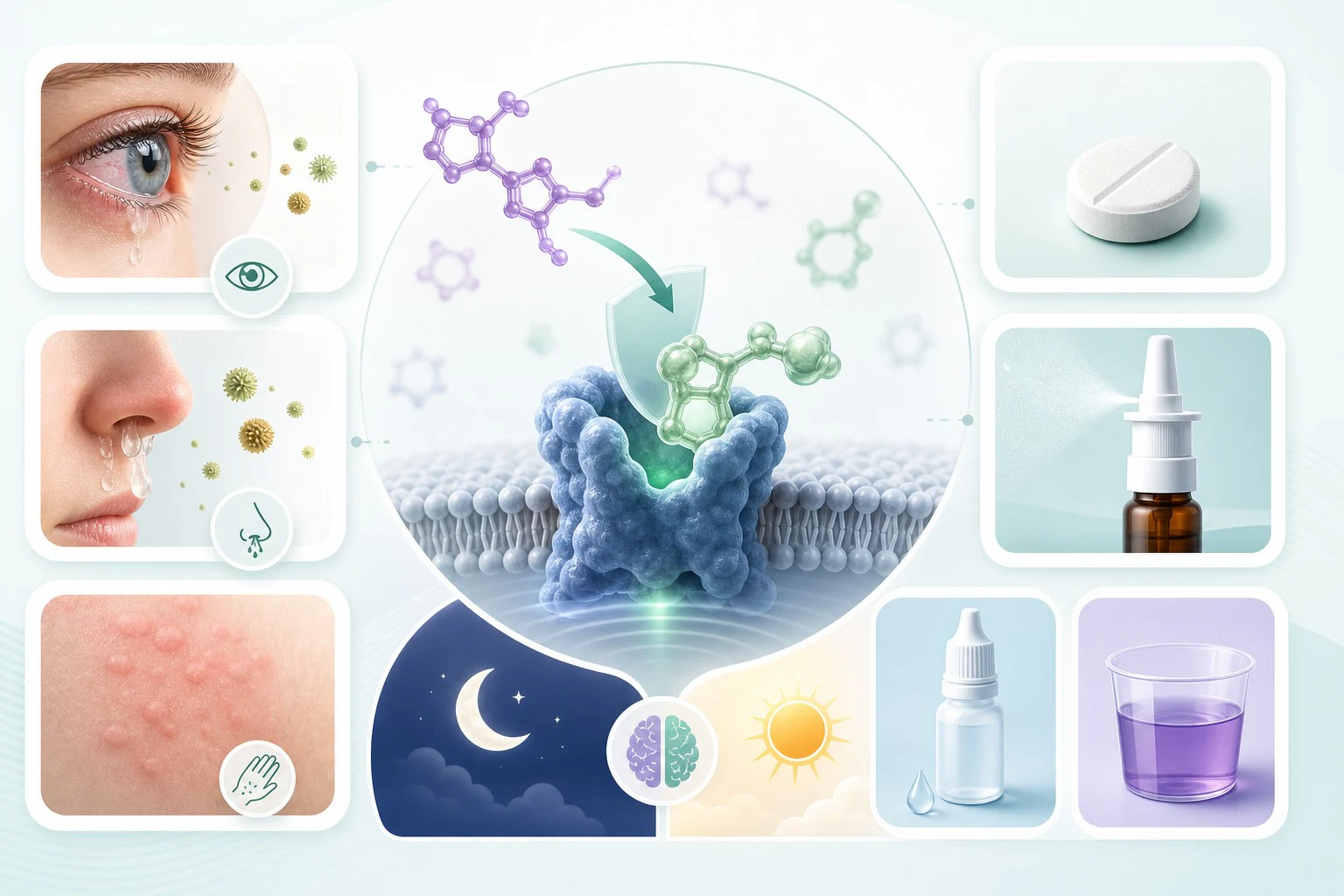
Antihistamines are medicines that block histamine — the chemical your immune system releases during an allergic reaction — which is what stops the sneezing, itching, runny nose and watery eyes that histamine causes.
When you meet an allergen you're sensitive to, immune cells release histamine, which attaches to targets called H1 receptors on nearby tissue and triggers the familiar symptoms. Antihistamines work by occupying those receptors so histamine can't, calming the reaction. They're most effective for the "itchy, sneezy, runny" symptoms and for hives, and less effective on their own for a badly blocked nose — which is where a steroid nasal spray often does more. For the bigger picture of where antihistamines fit, see our allergy treatment guide and allergy medicine overview.
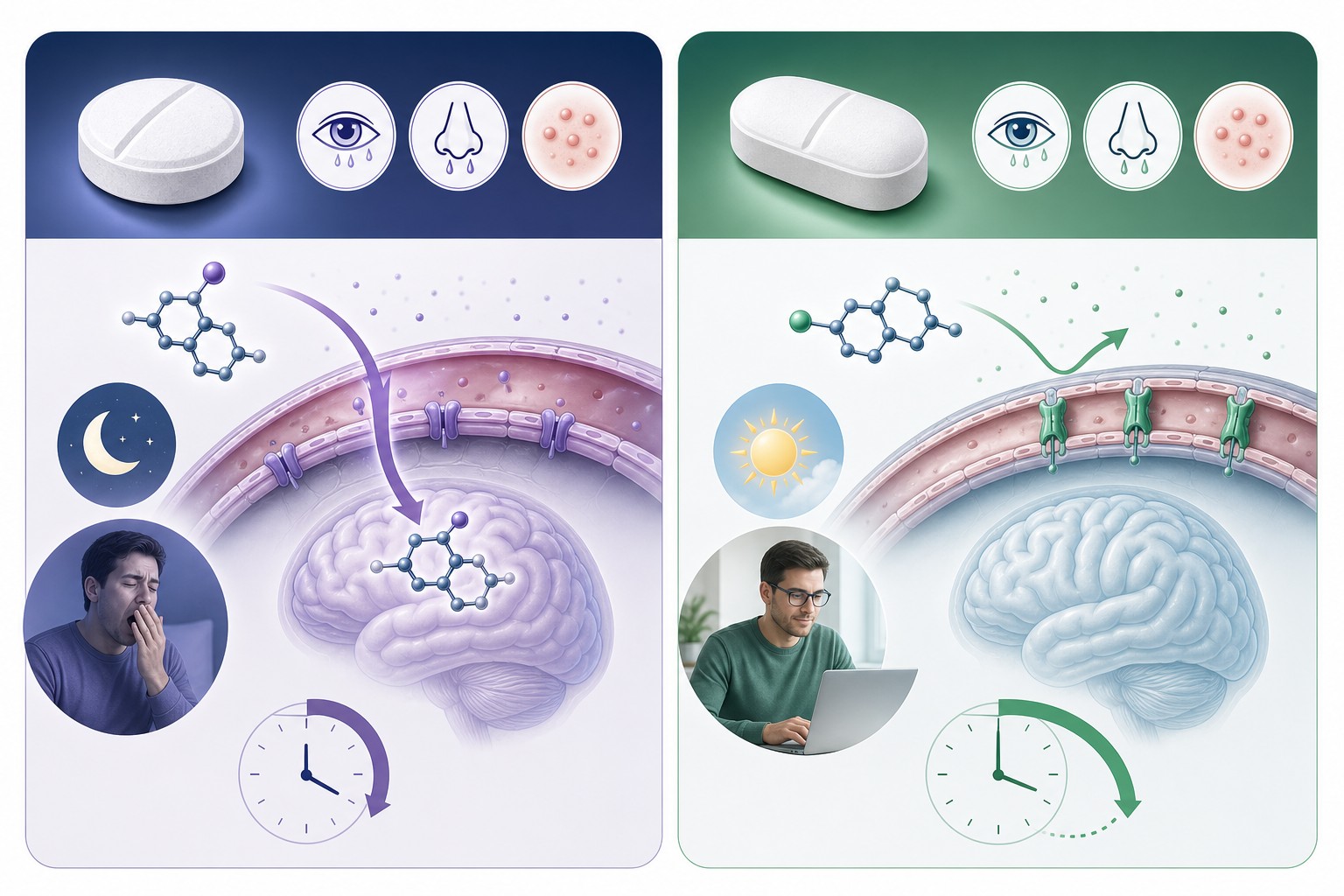
The reason some antihistamines make you sleepy and others don't comes down to the brain. Histamine also acts as a signalling chemical in the brain that helps keep you alert. Older first-generation antihistamines cross the blood–brain barrier easily and block histamine there too, which causes drowsiness. Newer second-generation antihistamines were specifically designed to stay mostly out of the brain, so they calm allergy symptoms in the body while leaving you far more alert — the key reason they're preferred for daytime use.
First vs. second generation antihistamines
The single most useful thing to know is that antihistamines come in two generations, and the difference is mostly about drowsiness. Older "first-generation" medicines cross into the brain and commonly cause sleepiness; newer "second-generation" ones were designed to avoid that.
| First generation | Second generation | |
|---|---|---|
| Examples | Diphenhydramine (Benadryl), chlorpheniramine | Cetirizine (Zyrtec), fexofenadine (Allegra), loratadine (Claritin), levocetirizine (Xyzal) |
| Drowsiness | Common, often strong | Much less; some options essentially non-drowsy |
| How long it lasts | Shorter — often needs repeating through the day | Longer — usually once daily |
| Best for | Occasional use; sometimes at night | Everyday, daytime allergy control |
| Reaching the brain | Highly fat-soluble; crosses the blood–brain barrier readily1 | Peripherally selective, with minimal central penetration1 |
| Driving | In a randomised simulator trial, driving after diphenhydramine was poorer than after alcohol at 0.1% blood alcohol2 | Fexofenadine performed similarly to placebo in the same trial2 |
| Older adults | Beers Criteria: potentially inappropriate in older adults1 | The generation those criteria recommend instead1 |
For most people managing seasonal or year-round allergies, a second-generation, non-drowsy antihistamine is the sensible default. First-generation options still have a place, but their drowsiness makes them a poor fit for daytime use or anyone who needs to drive or concentrate. This is also the formal position: current evidence-based guidelines endorse second-generation antihistamines as first-line therapy for allergic rhinitis and urticaria.1 For the full breakdown, including how to spot which generation is in a product, see first- vs. second-generation antihistamines.
Forms of antihistamines
Antihistamines don't only come as tablets. Matching the form to your symptom can improve relief:
- Oral tablets, capsules and liquids — the most common form, good for overall symptoms like sneezing, itching and a runny nose.
- Antihistamine nasal sprays (e.g., azelastine) — act directly in the nose and can help congestion and drip. See nasal sprays for allergies.
- Antihistamine eye drops — target itchy, watery eyes directly. See itchy eyes relief.
Some people use a combination — for example, an oral antihistamine plus eye drops during a heavy pollen week.
What else are antihistamines used for?
Beyond hay fever, antihistamines help with several histamine-driven problems, which is why they're such a common household medicine. Typical uses include:
- Allergic rhinitis — seasonal and year-round nasal allergy symptoms (their most common use). See allergic rhinitis.
- Hives and itchy skin — oral antihistamines are a mainstay for hives (urticaria) and general allergic itching.
- Allergic conjunctivitis — itchy, watery eyes, especially with antihistamine eye drops.
- Mild allergic reactions — they can ease minor symptoms, but are not a treatment for severe reactions (see the safety note later).
Older first-generation antihistamines are sometimes used short-term as a sleep aid because they cause drowsiness, but that's a different purpose from allergy control and shouldn't be a reason to pick them for daytime symptoms.
Common over-the-counter antihistamines compared
The popular second-generation antihistamines all relieve the same core symptoms, but they differ slightly in how fast they work and how likely they are to cause mild drowsiness. This is an overview, not a dosing guide — always follow the label and ask a pharmacist, especially for children, during pregnancy, or if you take other medicines.
| Generic (brand) | Generation | Drowsiness | Good to know | Time to peak · half-life | What the label says about drowsiness |
|---|---|---|---|---|---|
| Cetirizine (Zyrtec) | Second | Low, but slightly more likely than the others | Often fast-acting. Compared head-to-head in Claritin vs. Zyrtec. | Peaks ~1 hour · half-life ~8.3 hours4 | "Drowsiness may occur"; avoid alcoholic drinks5 |
| Fexofenadine (Allegra) | Second | Lowest — least sedating | A strong pick if you're sensitive to drowsiness. See Zyrtec vs. Allegra. | Peaks ~1.5 hours (tablet) · half-life ~14.4 hours6 | No drowsiness warning on the label7 |
| Loratadine (Claritin) | Second | Low | Widely used for everyday relief. See Claritin vs. Allegra. | Symptom relief at ~75 minutes in a challenge study8 | Warns of drowsiness only if you take more than directed9 |
| Levocetirizine (Xyzal) | Second | Low | Closely related to cetirizine; often taken in the evening. | Not covered by the labels cited here | "Drowsiness may occur"; label says take it in the evening10 |
| Diphenhydramine (Benadryl) | First | High | Sedating and short-acting; better suited to occasional use than daily allergy control. | Peaks ~1.5 hours · half-life ~9 hours in adults3 | "Drowsiness may occur"; avoid alcohol and take care driving11 |
Still weighing options? Our best antihistamine guide breaks down which tends to suit which situation. Each ingredient also has its own page: cetirizine, fexofenadine, loratadine, levocetirizine and diphenhydramine. For the three-way view, see Claritin vs. Zyrtec vs. Allegra, and for the closest pair, Zyrtec vs. Xyzal.
How fast do antihistamines work — and how long do they last?
Most second-generation antihistamines start easing symptoms within about an hour, and a single dose is usually designed to last through the day. That's why they work well taken once daily during your allergy season.
They also tend to work best when used consistently and, ideally, started before heavy allergen exposure — for example, at the start of your pollen season rather than after symptoms peak. First-generation options act quickly too but wear off sooner and bring more drowsiness. For how this fits a wider plan, see seasonal allergies.
The published figures put numbers on "about an hour". Cetirizine reaches peak blood levels at roughly 1 hour, fexofenadine at about 1.5 hours for the tablet, and in a controlled ragweed challenge plain loratadine tablets improved symptoms significantly versus placebo at 75 minutes.468 The differences are tens of minutes, not hours — and they stop mattering entirely once you are taking a dose daily, because the drug reaches a steady level in your blood.
Duration is where they separate more clearly. Fexofenadine has the longest average elimination half-life of the common options at about 14.4 hours, against roughly 8.3 hours for cetirizine; diphenhydramine sits near 9 hours but its symptom relief fades much sooner, which is why its label directs dosing every 4 to 6 hours.34611
How to choose the right antihistamine
Pick based on your main symptom, your sensitivity to drowsiness, and how your body responds — and don't be afraid to switch if the first one isn't a good fit.
You need daytime focus
Choose the least sedating option (fexofenadine is generally considered the least drowsy).
Itchy, watery eyes lead
Add antihistamine eye drops alongside or instead of a tablet.
Congestion is the problem
An antihistamine alone may not be enough — pair it with a steroid nasal spray.
Hives or skin itching
Oral antihistamines are a mainstay; see hives.
If one second-generation antihistamine doesn't help much, another often will — people respond differently. A pharmacist can help you match a product to your symptoms and other medicines. For the full comparison, see best antihistamine.
Antihistamines vs. other allergy medicines
Antihistamines are one tool among several. Here's how they compare with the other main options:
| Medicine | Best for | Note |
|---|---|---|
| Antihistamines | Sneezing, itching, runny nose, hives | Less effective alone for heavy congestion |
| Steroid nasal sprays | Congestion and nasal inflammation | Work best used daily; full effect after several days |
| Decongestants | Short-term stuffiness | Short-term use only; ask a pharmacist if you have high blood pressure |
Many people get the best results by combining an antihistamine with a nasal spray. See the full ladder in our treatment & relief guide.
What about "natural" antihistamines?
You'll see foods and supplements — such as quercetin, vitamin C, stinging nettle, butterbur and bromelain — described as "natural antihistamines." Some have modest supporting evidence, but overall the research is limited and mixed, and none is a proven replacement for a standard antihistamine when you need reliable relief.
Supplements aren't automatically safe, either: they can interact with medicines and vary a lot in quality, so it's worth checking with your doctor or pharmacist before adding them — especially for children, during pregnancy, or alongside other medicines. If you'd like to explore drug-free options, our natural allergy remedies guide covers what the evidence actually says and how to use these approaches sensibly alongside proven relief.
Antihistamine side effects and safety
Second-generation antihistamines are generally well tolerated, but like any medicine they can have side effects. The most common include mild drowsiness (more with first-generation options), dry mouth, and sometimes a headache. First-generation antihistamines can also cause blurred vision, constipation and, in some people — especially older adults — confusion or dizziness.
To use any antihistamine safely: read and follow the label, avoid combining products that contain the same or similar ingredients, and check with a pharmacist before mixing with other medicines, alcohol, or if you have another health condition. This guide doesn't cover doses — the label and your pharmacist are the right source for that.
One practical point worth flagging: because first-generation antihistamines can cause significant drowsiness and slowed reactions, they can affect driving and operating machinery — an effect that alcohol makes worse. If you need to stay sharp, a non-drowsy second-generation option is the safer choice, and it's wise to see how any new antihistamine affects you before driving on it. The evidence here is stronger than most people expect: in a randomised, placebo-controlled crossover trial in the Iowa Driving Simulator, driving performance was poorest after diphenhydramine — worse than after alcohol at roughly 0.1% blood alcohol concentration, while fexofenadine was similar to placebo. Critically, how drowsy participants said they felt did not predict how badly they drove, so feeling alert is not evidence that you are safe to drive.2 If you ever feel unusually drowsy, confused or unwell after taking one, stop and check with a pharmacist or doctor.
Do antihistamines stop working over time?
Genuine tolerance to antihistamines is uncommon, so if one seems to have "stopped working," there's usually another explanation: your allergen exposure has increased, a new trigger has appeared, or the medicine isn't the best match for your main symptom (for example, taking an antihistamine when congestion — better treated by a nasal spray — is the real problem).
Rather than simply taking more, it's usually more effective to try a different second-generation option, add the right medicine for your leading symptom, or check in with a pharmacist or doctor. Persistent symptoms despite treatment are a reason to review the plan — see when to see a doctor.
Can you take antihistamines every day, long-term?
For many people, taking a second-generation antihistamine daily during their allergy season — or year-round for persistent allergies — is a normal, established way to stay comfortable. Non-drowsy antihistamines are widely used this way, and daily use is common for conditions like chronic hives and year-round allergic rhinitis.
That said, a few sensible principles apply: stick to the amount on the label rather than increasing it if symptoms flare, don't double up on products that contain a similar ingredient, and if you find you need an antihistamine every day for a long time, it's worth a conversation with a doctor. Ongoing symptoms can be a sign that something else — like a nasal spray or, in some cases, allergen immunotherapy — would control them better. First-generation antihistamines are not a good choice for long-term daily use because of their sedative and other effects.
If you take cetirizine or levocetirizine daily for months
There is one long-term-use warning worth knowing before you stop. The FDA has required a warning that stopping cetirizine (Zyrtec) or levocetirizine (Xyzal) after long-term daily use — typically months to years — can cause rare but severe itching within a few days, in people who had no itching before they started.12 Reviewing reports received between April 2017 and July 2023, the FDA identified 209 cases worldwide. Symptoms settled in most people who restarted the medicine, and in some who then tapered off it.12
Loratadine and fexofenadine are not part of this warning. If you have been on cetirizine or levocetirizine daily for a long stretch and want to come off it, speak to a clinician or pharmacist rather than stopping on your own — and note that switching between those two does not avoid it, because they are the same active molecule. See Zyrtec vs. Xyzal.
Who should be careful with antihistamines?
Antihistamines are widely used and generally safe, but some groups should take extra care and check with a doctor or pharmacist first.
- Children: products and suitable options differ by age — ask a pharmacist or pediatrician rather than splitting adult products. The age bands are further apart than the shelf suggests: children's loratadine and children's fexofenadine are labelled from age 2, cetirizine says ask a doctor under 6, and both levocetirizine and diphenhydramine say do not use under 6.9101113 See children's allergy medicine and allergies in children.
- During pregnancy or breastfeeding: some options are generally preferred over others, but this is a decision to make with your healthcare provider.
- Older adults: first-generation antihistamines are often best avoided because of drowsiness, confusion and fall risk; non-drowsy options are usually preferred. This is a formal recommendation: the American Geriatrics Society Beers Criteria classes first-generation antihistamines as potentially inappropriate medications in older adults and recommends second-generation options instead, with dosing adjusted for kidney function.1 Note too that the cetirizine and fexofenadine labels both say ask a doctor for adults 65 and over, while loratadine's carries no age-specific flag.579 See allergies in older adults.
- People on other medicines or with health conditions: interactions are possible — a quick pharmacist check is worthwhile.
Tips to get the most from your antihistamine
- Start early. If your allergies are predictable, begin before your season peaks rather than waiting until you're miserable.
- Be consistent. For ongoing symptoms, regular daily use usually works better than occasional doses.
- Match the medicine to the symptom. Add a nasal spray for congestion or eye drops for itchy eyes instead of expecting a tablet to do everything.
- Give it a fair trial, then switch if needed. If one second-generation option doesn't help much, another often will.
- Check interactions. Ask a pharmacist before combining with other medicines or alcohol.
- Read the label every time. Especially for children's products and combination products that include a decongestant.
Important: antihistamines are not for severe reactions
Antihistamines do not treat anaphylaxis
A severe, whole-body allergic reaction (anaphylaxis) is a medical emergency, and antihistamines are not an effective treatment for it. The first-line treatment is epinephrine (an auto-injector such as EpiPen or Auvi-Q).
Call 911 (or your local emergency number) immediately for trouble breathing; swelling of the face, lips, tongue or throat; widespread hives; chest tightness; dizziness or fainting. Use a prescribed epinephrine auto-injector right away if available — do not wait, and do not substitute an antihistamine. See our allergy safety guide.
Antihistamines: frequently asked questions
What is the best antihistamine for allergies?
What's the difference between first and second generation antihistamines?
Do antihistamines make you drowsy?
Do antihistamines stop working over time?
Can antihistamines treat a severe allergic reaction?
How fast does each antihistamine work?
Which antihistamine lasts the longest?
Is it safe to drive after taking an antihistamine?
Which antihistamines should older adults avoid?
Is it safe to take an antihistamine every day for years?
How we create and review this guide
This guide is written for a general audience using patient-education material from the authoritative sources below, not blogs or forums:
- American Academy of Allergy, Asthma & Immunology (AAAAI)
- American College of Allergy, Asthma & Immunology (ACAAI)
- Mayo Clinic
- U.S. Food and Drug Administration (FDA)
- U.S. National Library of Medicine (MedlinePlus)
Sources for the specific figures on this page
- StatPearls, NCBI Bookshelf (NIH). Antihistamines (opens in a new tab). First-generation agents crossing the blood–brain barrier versus second-generation peripheral selectivity, anticholinergic effects, guidelines endorsing second-generation agents as first-line for allergic rhinitis and urticaria, and the 2024 American Geriatrics Society Beers Criteria classing first-generation antihistamines as potentially inappropriate in older adults.
- Weiler JM, et al. Effects of fexofenadine, diphenhydramine, and alcohol on driving performance: a randomized, placebo-controlled trial in the Iowa Driving Simulator (opens in a new tab). Annals of Internal Medicine, 2000;132(5):354–363. Driving was poorest after diphenhydramine, worse than after alcohol at approximately 0.1% blood alcohol; fexofenadine was similar to placebo; drowsiness ratings did not predict impairment.
- StatPearls, NCBI Bookshelf (NIH). Diphenhydramine (opens in a new tab). Peak plasma concentration around 1.5 hours and terminal half-life roughly 9 hours in adults.
- DailyMed, U.S. National Library of Medicine. Cetirizine hydrochloride — full prescribing information (opens in a new tab). Time to maximum concentration of approximately 1 hour, mean elimination half-life of 8.3 hours, and dose-related somnolence in about 14% of patients aged 12 and over.
- DailyMed, U.S. National Library of Medicine. Cetirizine hydrochloride 10 mg — Drug Facts label (opens in a new tab). Once-daily directions, "drowsiness may occur", the alcohol warning, and the "ask a doctor" flags for children under 6, adults 65 and over, and liver or kidney disease.
- StatPearls, NCBI Bookshelf (NIH). Fexofenadine (opens in a new tab). Peak plasma concentration at about 1.5 hours for the tablet and a mean elimination half-life of 14.4 hours.
- DailyMed, U.S. National Library of Medicine. Fexofenadine hydrochloride 180 mg — Drug Facts label (opens in a new tab). The absence of any drowsiness warning, "children under 12 years of age: do not use", and "adults 65 years of age and older: ask a doctor".
- Ellis AK, et al. Onset of action for loratadine tablets for the symptomatic control of seasonal allergic rhinitis in adults challenged with ragweed pollen in the Environmental Exposure Unit (opens in a new tab). Allergy, Asthma & Clinical Immunology, 2018. Significant symptom improvement versus placebo at 75 minutes.
- DailyMed, U.S. National Library of Medicine. Claritin (loratadine) 10 mg — Drug Facts label (opens in a new tab), and children's loratadine 5 mg chewable (opens in a new tab). Once-daily directions from age 6 for the adult tablet and from age 2 for the children's chewable, the drowsiness-if-exceeding-the-dose warning, and the absence of any 65-and-over flag.
- DailyMed, U.S. National Library of Medicine. Levocetirizine dihydrochloride 5 mg — Drug Facts label (opens in a new tab). Once daily in the evening, "children under 6 years of age: do not use", and "do not use if you have kidney disease".
- DailyMed, U.S. National Library of Medicine. Diphenhydramine hydrochloride 25 mg — Drug Facts label (opens in a new tab). Dosing every 4 to 6 hours with no more than 6 doses in 24 hours, "children under 6 years of age: do not use", "do not use to make a child sleepy", and the alcohol, sedative and driving warnings.
- U.S. Food and Drug Administration. Drug Safety Communication: FDA requires warning about rare but severe itching after stopping long-term use of the oral allergy medicines cetirizine or levocetirizine (Zyrtec, Xyzal and other trade names) (opens in a new tab). 209 cases identified worldwide from reports received between 25 April 2017 and 6 July 2023.
- DailyMed, U.S. National Library of Medicine. Children's fexofenadine hydrochloride 30 mg/5 mL — Drug Facts label (opens in a new tab). Dosing from age 2, given every 12 hours.
Medical disclaimer: This guide is for general education and isn't a substitute for personalized medical advice. It doesn't provide dosing. Always read the product label and talk to a pharmacist or doctor before starting, stopping or combining any medicine.
 MD
MDMedically reviewed
Dr. Hannah H. Walford, MD
Allergist and Immunologist
- Website role
- Owner, Medical Director and Medical Reviewer of Allergy Relief Guide
- Professional affiliation
- Stanford Health Care / Menlo Medical Clinic, Menlo Park, California
- Areas of expertise
- Food allergy, eczema, allergic rhinitis, sinusitis and asthma
Dr. Hannah H. Walford is a board-certified allergist and immunologist experienced in caring for adults and children with allergic conditions. Her areas of expertise include food allergy, eczema, allergic rhinitis, sinusitis and asthma. She provides medical leadership and review oversight for the educational health content published by Allergy Relief Guide.
Medical content is provided for education and is not a substitute for diagnosis or individualized medical care.
Compare specific antihistamines
Deciding between brands? These head-to-head guides go deeper:
Best antihistamine
Which option tends to suit which situation.
Claritin vs. Zyrtec
Two of the most popular options, compared.
Zyrtec vs. Allegra
Speed vs. lowest drowsiness.
Claritin vs. Allegra
Everyday relief options side by side.
Nasal sprays
The better choice for stubborn congestion.
Treatment & relief
Where antihistamines fit the full plan.
First vs. second generation
How to tell which is in the box.
Benadryl vs. Zyrtec
An older sedating option against a modern one.
Zyrtec vs. Xyzal
Cetirizine and its active half, compared.
All three compared
Loratadine, cetirizine and fexofenadine side by side.
Children's allergy medicine
What each label allows, by age.
Antihistamine side effects
What to expect and what to watch for.
Antihistamines and alcohol
Why the combination matters.
Not sure which antihistamine to pick?
Match the option to your main symptom and your sensitivity to drowsiness — our comparison guide makes the choice simple.
See the best antihistamine guide