
Antihistamines and Alcohol: Risks and Who Should Avoid It
Mixing antihistamines and alcohol is generally discouraged because both depress the central nervous system, and their effects add together. This is most pronounced with sedating first-generation antihistamines like diphenhydramine, where the combination can cause pronounced drowsiness and impair coordination, reaction time, and judgment — sometimes more than people realize. Non-drowsy second-generation antihistamines interact less, but caution still applies. Official medicine labeling notes the additive effect, and the safest approach is to avoid drinking while taking a sedating antihistamine.
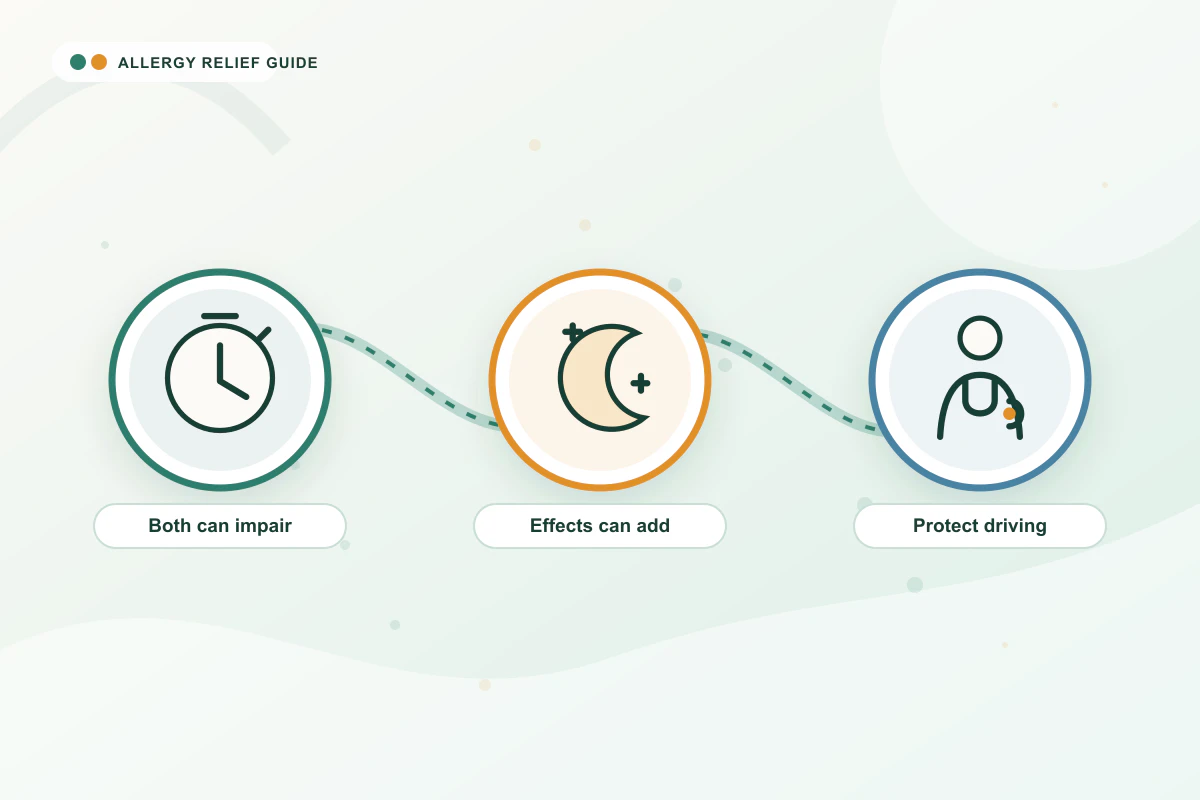
Quick answer
Mixing antihistamines and alcohol is generally discouraged because both depress the central nervous system and their effects add together. This is most pronounced with sedating first-generation antihistamines like diphenhydramine, where the combination can cause pronounced drowsiness and impair coordination, reaction time, and judgment. Non-drowsy second-generation antihistamines interact less, but caution still applies. The safest approach is to avoid drinking while taking a sedating antihistamine.
What you need to know
- Both alcohol and antihistamines depress the central nervous system, so combining them produces additive sedation and impairment.
- The interaction is strongest with sedating first-generation antihistamines like diphenhydramine.
- Impairment of coordination, reaction time, and judgment can be greater than a person feels, which is especially risky for driving.
- Non-drowsy second-generation antihistamines (loratadine, fexofenadine, cetirizine) interact less, but combining them with alcohol can still increase drowsiness in some people.
- Official medicine labeling notes that diphenhydramine has additive effects with alcohol and other CNS depressants.
- Older adults and anyone taking other sedating medicines (sleep aids, opioids, anti-anxiety medicines) are at higher risk from the combination.
Why the Combination Matters
Alcohol is a central nervous system depressant, and so are sedating antihistamines. When taken together, their depressant effects add up — a process clinicians call additive CNS depression. That can mean more drowsiness, slower reaction time, poorer coordination and balance, and impaired judgment than either would cause alone. Official labeling for diphenhydramine specifically notes additive effects with alcohol and other CNS depressants, and medical references warn that combining antihistamines with alcohol, benzodiazepines, or opioids increases sedation and fall risk.
First- vs. Second-Generation and Alcohol
| Antihistamine type | Examples | Interaction with alcohol |
|---|---|---|
| First-generation (sedating) | diphenhydramine | Strongest — pronounced additive drowsiness and impairment; combining is generally discouraged |
| Second-generation (non-drowsy) | loratadine, fexofenadine | Less interaction, but caution still applies; some added drowsiness is possible |
| Second-generation, more sedating in some people | cetirizine | Can add to alcohol's drowsiness in people who feel sedated by it |
The bottom line is that a “non-drowsy” label reduces but doesn't eliminate the concern, and any sedation you'd feel from the antihistamine can be amplified by alcohol.
The Hidden Risk: Impairment You Don't Feel
A particular danger is that the combination can impair driving-related skills — lane-keeping, reaction time, and hazard awareness — more than a person subjectively feels. In other words, you may not feel very drowsy while your actual performance is significantly reduced. This is why the safest approach around driving or operating machinery is to avoid the combination entirely rather than judge by how alert you feel.
Who's Most at Risk
- People taking sedating first-generation antihistamines like diphenhydramine
- Older adults, who are more sensitive to sedation and at higher risk of falls
- Anyone also taking other CNS depressants such as sleep aids, opioids, benzodiazepines, or certain anti-anxiety medicines
- People who need to drive or operate machinery
If you want daytime allergy relief with less sedation, see our do antihistamines make you sleepy? guide for lower-sedation options.
Falls and blood pressure, not just sleepiness
Most warnings about this combination stop at drowsiness, which makes it sound like the worst outcome is an early night. The review of alcohol and medication interactions cited below describes a different order of risk.
It notes that antihistamines may cause drowsiness, sedation and low blood pressure, or hypotension, especially in elderly patients — and that alcohol “can substantially enhance the sedating effects of these agents and may thereby increase, for example, a person’s risk of falling or impair his or her ability to drive or operate other types of machinery”.
Falling is the outcome that tends to get left out, and it is the one that turns an unpleasant evening into a fracture. Sedation plus a drop in blood pressure plus standing up quickly is a specific mechanism, not a vague caution, and it does not require anyone to be visibly drunk.
The review also states plainly that these interactions are more pronounced in elderly people. That lines up with the wider guidance on this drug class: the StatPearls antihistamines review notes the 2024 American Geriatrics Society Beers Criteria classifies first-generation antihistamines as potentially inappropriate for older adults, recommending second-generation agents instead. Adding alcohol to a medicine already flagged for that age group compounds a known problem.
- Risk is not limited to drowsiness; low blood pressure and falls belong on the list
- Effects are more pronounced in older people, per the same source
- Get up slowly rather than quickly if you have taken a sedating antihistamine
- First-generation agents are already flagged as potentially inappropriate in older adults
- See our antihistamine side effects guide for the wider cautions
What “no documented interaction” actually means
The non-drowsy options look like a way around the problem, and the position is genuinely better — but it is more nuanced than a green light, and the nuance is worth stating precisely.
The same review notes that newer antihistamines such as cetirizine and loratadine were developed to minimise drowsiness and sedation, and that no documented interactions exist with nonsedating antihistamines. It then adds that people taking them “still should be warned against using alcohol”.
Two things follow. No documented interaction is not the same as a proven absence of any effect; it means the specific interaction has not been documented. And separately, the second-generation group is not uniformly non-sedating: the StatPearls review describes fexofenadine as exhibiting minimal sedation while noting cetirizine and levocetirizine may cause mild drowsiness in some patients. If you are one of those people, alcohol is being added to a medicine that already makes you sleepy.
The practical reading is that switching to a second-generation antihistamine reduces the risk rather than removing the question. How your own body responds still decides it — see our guide to which antihistamines cause drowsiness.
When to seek care
Routine
You want to understand whether an occasional drink is okay with your allergy medicine — a pharmacist can advise based on the specific product.
Prompt (within days)
You regularly need both alcohol and a sedating antihistamine and want a safer plan, or you're on other sedating medications.
Urgent (same day)
Excessive drowsiness, confusion, or unsteadiness after combining antihistamines and alcohol.
Emergency (call 911)
Severe sedation, slowed or difficult breathing, unresponsiveness, or a fall with injury after combining antihistamines and alcohol is an emergency. Call 911.
Practical next steps
Safe general steps
- Avoid alcohol while taking a sedating first-generation antihistamine like diphenhydramine
- If you'll be drinking, ask a pharmacist about a lower-sedation second-generation option for your allergies
- Don't drive or operate machinery if you've combined an antihistamine with alcohol
- Read product labels for “may cause drowsiness” and alcohol warnings
Actions that need medical guidance
- Combining antihistamines and alcohol if you take other sedating medications
- Managing allergies and alcohol use as an older adult
- Finding a lower-interaction allergy option for your situation
Don't attempt without professional advice
- Don't judge your safety to drive by how drowsy you feel — impairment can exceed the sensation
- Don't combine alcohol with a sedating antihistamine plus another CNS depressant
- Don't assume a “non-drowsy” label means alcohol is fully safe to combine
Frequently asked questions
Can you drink alcohol while taking antihistamines?
Why is mixing Benadryl and alcohol dangerous?
Is it safer to drink with a non-drowsy antihistamine?
Can antihistamines and alcohol affect driving?
Who is most at risk from mixing antihistamines and alcohol?
How long should I wait to drink after taking an antihistamine?
Is falling really a risk from mixing these?
Does this matter more for older adults?
Is it safe to drink with a non-drowsy antihistamine?
Are all second-generation antihistamines equally non-sedating?
What should I do if I have already taken one and want a drink?
Sources
- Drugs.com (FDA labeling) — Diphenhydramine Alcohol/Food Interactions
- StatPearls (NCBI/NIH) — Antihistamines
- PMC (NIH) — Alcohol and Medication Interactions
Medical disclaimer: This guide is for general education and isn't a substitute for personalized medical advice. It doesn't provide dosing. Always talk to a qualified healthcare professional about your symptoms and treatment.
 MD
MDMedically reviewed
Dr. Hannah H. Walford, MD
Allergist and Immunologist
- Website role
- Owner, Medical Director and Medical Reviewer of Allergy Relief Guide
- Professional affiliation
- Stanford Health Care / Menlo Medical Clinic, Menlo Park, California
- Areas of expertise
- Food allergy, eczema, allergic rhinitis, sinusitis and asthma
Dr. Hannah H. Walford is a board-certified allergist and immunologist experienced in caring for adults and children with allergic conditions. Her areas of expertise include food allergy, eczema, allergic rhinitis, sinusitis and asthma. She provides medical leadership and review oversight for the educational health content published by Allergy Relief Guide.
Medical content is provided for education and is not a substitute for diagnosis or individualized medical care.
Continue building your allergy plan
Explore related guides to understand the full picture, from triggers to treatment to safety.
See the full antihistamines guide