Allergy Testing: Types, What to Expect and Results
The tests that pinpoint exactly what you react to — how each one works, how to prepare, and what your results really mean.
Quick answer: how allergy testing works
Short answer: a skin prick test places drops of allergen on the skin and reads the bumps in about 15 to 20 minutes. A specific IgE blood test measures allergy antibodies from one blood draw and needs no medication pause. Both show sensitisation, not a guaranteed allergy, so a specialist reads them alongside your symptom history.
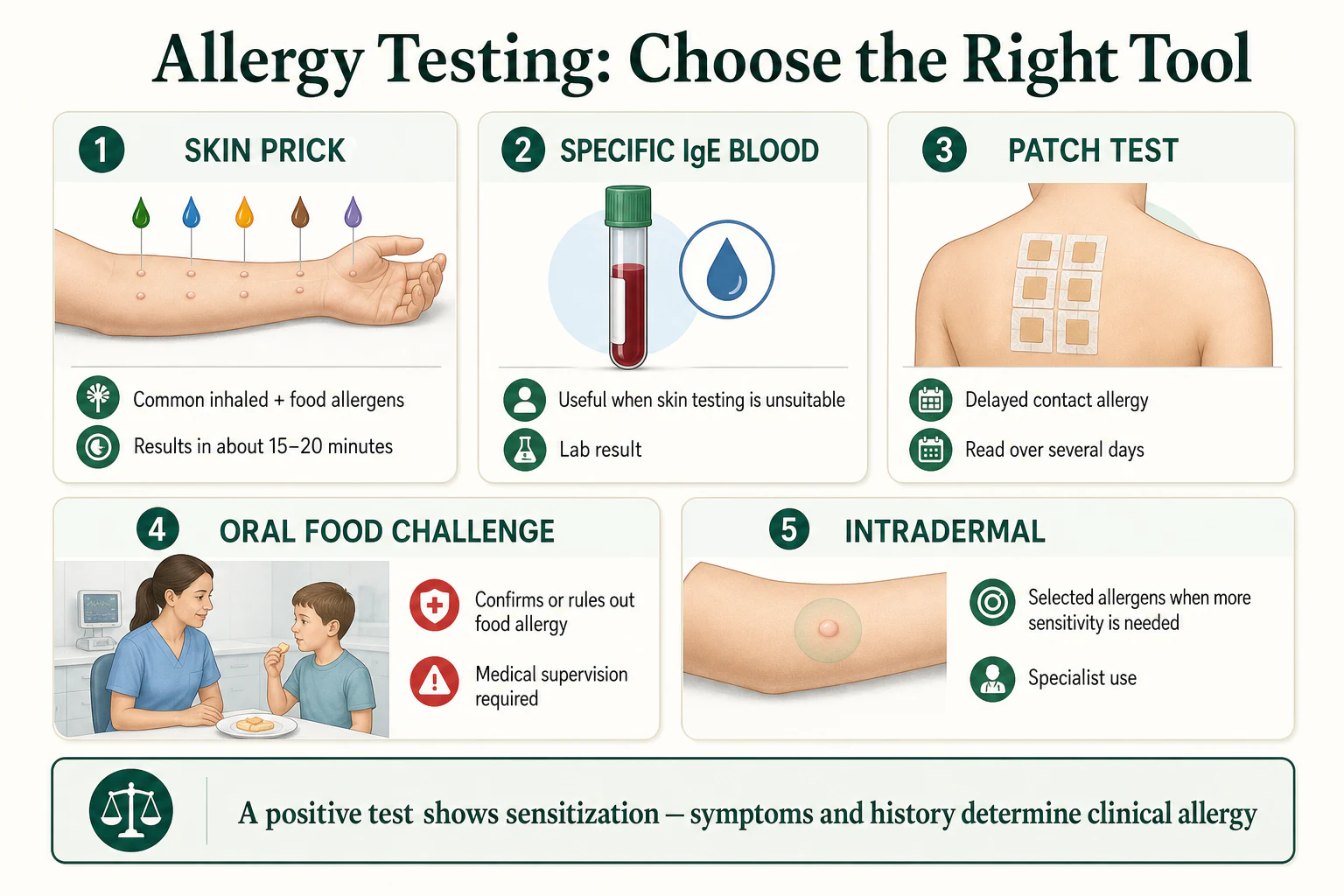
Allergy testing identifies which substances trigger your symptoms, so you can avoid them and target treatment. The two main methods are the skin prick test (a drop of allergen on the skin, lightly pricked; a raised bump in 15–20 minutes signals sensitivity) and the specific IgE blood test (which measures allergy antibodies from a blood sample). Other tests include the intradermal test, the patch test for contact allergies, and the supervised oral food challenge for food allergy. Crucially, a positive test shows sensitization, not a guaranteed allergy — results must be read alongside your symptoms by a specialist. This is general information, not a substitute for medical advice.
What is allergy testing and why get it?
Allergy testing is how a doctor confirms which allergens your immune system reacts to — pollen, dust mites, pet dander, mold, foods, insect venom or medicines. Your symptoms and history point to likely culprits; testing narrows them down for certain.
Knowing your exact triggers is worth it because it makes everything that follows more effective: you can focus your avoidance efforts where they matter, choose the right treatment, and decide whether immunotherapy (allergy shots or tablets) could help. It's especially valuable when symptoms are hard to control, year-round, or when a food or venom allergy is suspected. Most testing is done or overseen by a board-certified allergist.
Types of allergy tests
There are several tests, each suited to different situations. Here's how they compare.
| Test | Best for | Results |
|---|---|---|
| Skin prick test | Common environmental & food allergies | 15–20 minutes |
| Intradermal test | When prick is negative but suspicion is high (e.g. venom, drugs) | 15–20 minutes |
| Specific IgE blood test | When skin testing isn't safe or practical | Days (lab) |
| Patch test | Delayed skin (contact) allergies | Read over 2–4 days |
| Oral food challenge | Confirming or ruling out a food allergy (gold standard) | Same day, supervised |
The skin prick and blood tests are by far the most common for everyday allergies like hay fever; the others are used in specific situations.
Skin prick vs. blood test: which is right?
Neither is simply "better" — they suit different people and situations.
Skin prick test
Fast, inexpensive, results in 15–20 minutes, and can screen many allergens at once. Often the first choice. Downsides: you must stop antihistamines beforehand, and it's less reliable on skin with severe eczema.
Blood (IgE) test
A single blood draw, with no need to stop antihistamines. Preferred when skin testing isn't safe or practical — severe eczema, a high risk of a serious reaction, or unavoidable medicines. Results take days and it can cost more.
Doctors sometimes use both together to build a clearer picture. The right choice depends on your history, skin, medicines and which allergies are suspected — an allergist will guide you.
What to expect during the test
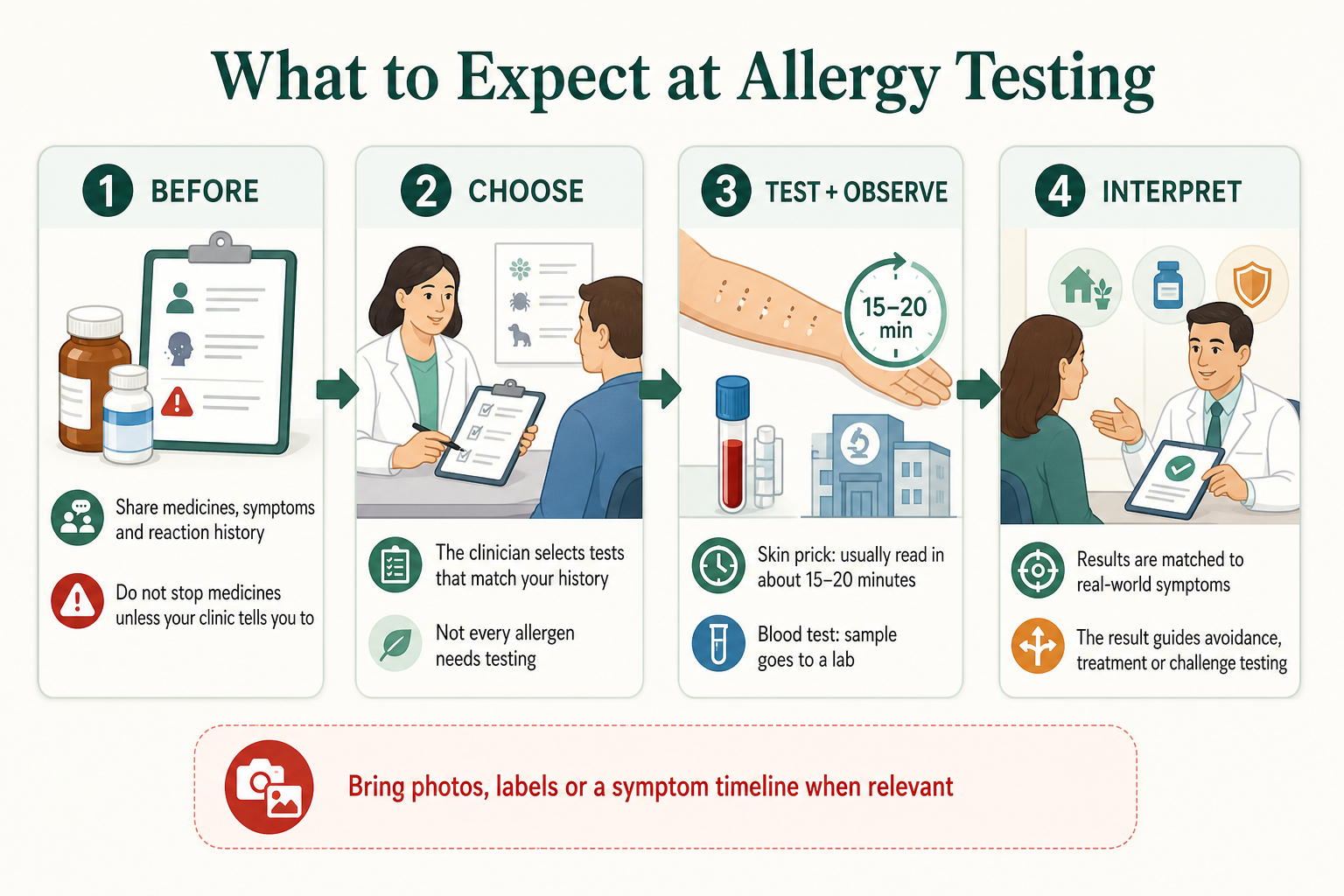
Allergy testing is quick and generally well tolerated. For a skin prick test, a nurse places small drops of different allergen extracts on your forearm or back, then lightly pricks the skin through each drop with a tiny lancet — more of a scratch than a needle. If you're sensitive, a raised, itchy bump like a mosquito bite appears within about 15–20 minutes. Positive and negative control drops are included to check the test is working.
A blood test is simply a standard blood draw that takes a few minutes; the sample goes to a lab. Neither test is particularly painful — skin testing may cause temporary itching and redness that settles within a couple of hours. Because a serious reaction is possible (though rare), skin tests and food challenges are done in a medical setting with emergency treatment on hand.
How to prepare
The main thing to know: antihistamines can block a skin test and cause a false negative.
- Stop antihistamines several days before a skin prick test — your provider will tell you exactly which medicines (including some cold and sleep products) to pause and for how long.
- Keep taking asthma and other prescribed medicines unless told otherwise.
- A blood test needs no special preparation — antihistamines don't affect it, which is one reason it's used when you can't stop them.
- Bring a symptom history: when reactions happen, what seems to trigger them, and any suspected foods.
Which medicines interfere, and for how long
Antihistamines suppress the skin reaction the test is trying to produce, so taking one can turn a real allergy into a negative result. Cleveland Clinic describes stopping antihistamines three to seven days before a skin test. The exact window depends on the medicine and on your clinic, which is why the instruction you are given at booking overrides any general guide, including this one.
| Medicine | Effect on a skin prick test | What usually happens |
|---|---|---|
| Oral antihistamines (cetirizine, loratadine, fexofenadine, diphenhydramine) | Suppress the wheal — the main cause of a false negative | Paused for several days beforehand |
| Antihistamine nasal sprays and eye drops | Can blunt the response | Usually paused; ask how long |
| Multi-symptom cold, flu and sleep products | Often contain a hidden antihistamine | Check the active ingredients panel |
| Asthma inhalers and other prescribed medicines | Do not block the test | Cleveland Clinic advises continuing asthma medicine |
| Steroid nasal sprays | Act in the nose, not the skin | Usually continued |
| Any medicine, before a blood test | No effect — the test is done on a sample in a lab | Nothing to stop |
Never stop a prescribed medicine on your own
Some medicines that can affect testing are prescribed for other conditions, and stopping them without advice can be more dangerous than a delayed diagnosis. Take your full medicine list to the appointment and let the clinic decide what pauses and what continues. If a needed medicine cannot be paused, that is precisely when a blood test is used instead.
This is also why the controls matter. A skin test includes a positive control (histamine, which should produce a bump in everyone) and a negative control (a neutral liquid, which should not). If the positive control stays flat, an antihistamine is probably still in your system and the whole test may need repeating. More detail in our skin prick test guide.
Understanding your results
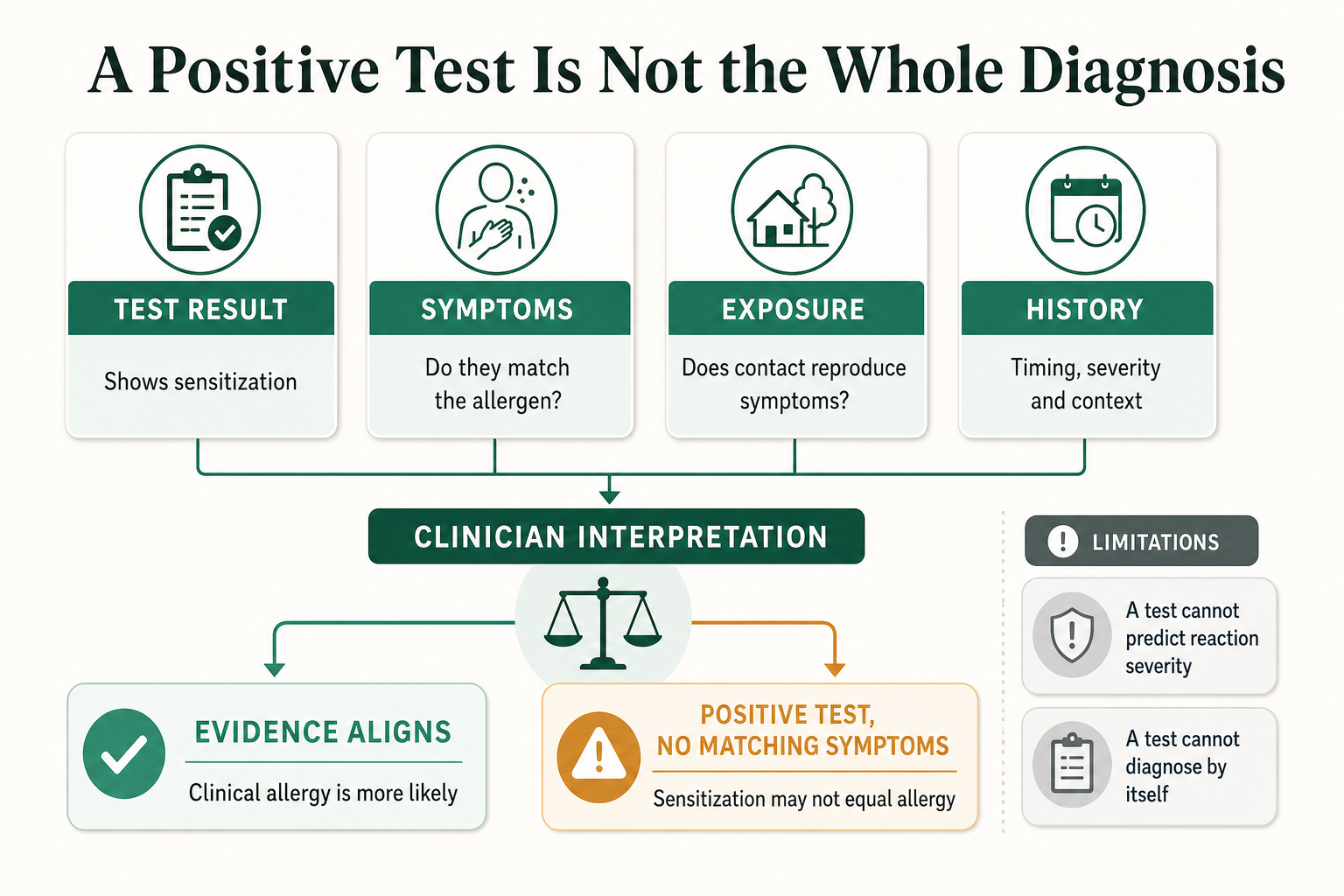
This is the part people most often misread: a positive test means sensitization, not automatically an allergy. It shows your immune system has made antibodies to an allergen — but plenty of sensitized people have no symptoms at all. That's why a result only means something when it matches your real-world reactions.
Two things a test can't tell you
1. A positive result isn't proof of an allergy — it must line up with your symptom history. 2. The size of a skin reaction doesn't predict how severe a future reaction will be. A big bump doesn't mean a dangerous allergy, and a small one doesn't rule out a serious reaction. This is exactly why results should be interpreted by a specialist, not self-diagnosed.
Borderline or unclear results — especially for foods — are often settled with a supervised oral food challenge, the most definitive test.
What the numbers on a blood test do and do not mean
An IgE number is a measurement, not a verdict. Two different results often get confused on a lab report:
- Total IgE measures all the IgE antibody in your blood. MedlinePlus notes that a high total IgE suggests allergy but does not identify which allergen or how serious it is. It can also rise for reasons that have nothing to do with allergy.
- Specific IgE measures antibody to one named allergen — birch pollen, peanut, cat. This is the number that can be matched to your history.
A higher number does not mean a more dangerous reaction. MedlinePlus states plainly that the level does not predict how serious an allergy may be. The same is true of a skin test: a larger bump is not a warning of a worse reaction, and a small one does not rule out a serious one. What raises or lowers the odds that a result is clinically real is how well it fits your actual symptoms.
False positives are common enough to expect. MedlinePlus notes results can indicate an allergy you do not have, and that recent food intake, smoking and parasitic infection can raise IgE without any allergy being present. This is the single biggest reason to have results interpreted rather than read off a portal. Our allergy blood test guide goes through a report line by line.
Sensitised is not the same as allergic
Sensitisation means your immune system has made antibodies to something. Allergy means you get symptoms when you meet it. Plenty of people are sensitised to things they eat or touch every day without trouble. Acting on a positive result alone — especially by cutting out foods — can cause real harm for no benefit.
How accurate is allergy testing — and what does it cost?
No allergy test is perfect, which is why results are always read alongside your history. Skin tests can give false positives — showing sensitivity to something that doesn't actually bother you — and are less reliable on skin with severe eczema. They can also give false negatives if you didn't stop antihistamines. Blood tests avoid the antihistamine problem but can be slightly less sensitive. Used together with your symptom story, though, they're a reliable way to identify triggers.
Cost varies widely by test type, how many allergens are checked, and your insurance. Many plans cover testing when it's medically indicated, but it's worth checking your coverage and any out-of-pocket costs with your insurer beforehand.
Allergy testing for children
Children can be tested at almost any age when symptoms warrant it. Skin prick testing is generally suitable from around six months, while blood tests can be slightly less accurate in very young children. The decision to test should be guided by your child's symptoms, not age alone.
Because children can outgrow some allergies — particularly certain food allergies — periodic retesting is often used to track changes over time. A pediatric allergist can advise on timing. More in allergies in children.
Allergy tests to avoid
Not every "allergy test" advertised online is legitimate. Major allergy organisations advise against several unproven methods, which can waste money and lead to unnecessary, even harmful, food restrictions:
- IgG or "food sensitivity" blood tests — IgG antibodies reflect exposure, not allergy, and aren't a valid test for food allergy or intolerance.
- Hair analysis — hair contains no useful information about allergies.
- Applied kinesiology (muscle testing), "electrodermal" and cytotoxic tests — no scientific basis.
Stick to validated testing ordered and interpreted by a board-certified allergist. If a test promises to diagnose dozens of "sensitivities" from a home kit, be sceptical.
The professional position on this is unusually blunt. The American Academy of Allergy, Asthma & Immunology says of IgG food panels that the test "has never been scientifically proven to be able to accomplish what it reports to do," and that the presence of IgG is likely a normal response to eating a food — higher IgG4 levels may even be associated with tolerance of that food rather than a problem with it. AAAAI recommends against using IgG testing to diagnose food allergy, intolerance or "sensitivity."
There is a second, subtler trap: ordering too much of a legitimate test. AAAAI's Choosing Wisely guidance advises against an indiscriminate battery of IgE tests, because screening for dozens of allergens you have no history of reacting to produces clinically irrelevant positives, and those positives lead to food avoidance that was never necessary. Testing works best when it is aimed at a specific question raised by your symptoms — which is also why a targeted panel chosen by an allergist beats a broad one chosen by a website. See at-home allergy test kits for how the direct-to-consumer versions compare.
Testing for drug and insect-sting allergy
These two sit apart from everyday hay-fever testing, because getting the answer wrong has larger consequences in both directions.
Drug allergy. A label in your medical record such as "penicillin allergy" changes which antibiotics you can be given for the rest of your life, often pushing you toward broader, costlier alternatives. Many of those labels turn out to be wrong — a childhood rash, a stomach upset, or a reaction that has since faded. Formal evaluation, which may combine skin testing with a supervised challenge, can remove an inaccurate label. Read penicillin allergy and drug allergy.
Insect venom. After a serious sting reaction, testing identifies which venom you react to and opens the door to venom immunotherapy, which is highly effective at reducing the risk of another severe reaction. Skin testing for venom sometimes needs the more sensitive intradermal method when the prick test is negative but the history is convincing. See insect sting allergy.
Both are specialist evaluations rather than something to arrange from a home kit, and both are usually done where emergency treatment is immediately available.
After your results: what happens next
A confirmed diagnosis turns guesswork into a plan. Depending on what's found, your doctor may recommend targeted avoidance of your triggers, the right allergy medicine for your symptoms, and — for suitable candidates — immunotherapy (allergy shots or under-the-tongue tablets) that can reduce your reaction over time. If a food or venom allergy carries a risk of a severe reaction, you may be prescribed an epinephrine auto-injector and an action plan. See the full picture in our treatment & relief guide.
Go deeper on each step
Each part of the testing process has its own guide. Use this to jump to whichever question you are actually at.
| Your question | Where it is answered |
|---|---|
| What actually happens during a skin test? | Skin prick allergy test |
| How do I read a blood-test report? | Allergy blood test (specific IgE) |
| Are home test kits worth it? | At-home allergy test kits |
| What will this cost me? | Allergy test cost and insurance |
| How do I find a good allergist? | How to find a good allergist |
| What should I bring and expect at the appointment? | Allergist appointment: what to expect |
| What do I do once I know my triggers? | Allergy treatment and allergy shots |
When to get tested
Consider allergy testing if your symptoms are hard to control, last most of the year, disrupt your sleep or daily life, or if you don't know what's triggering them. Testing is also important after any suspected food, medicine or insect-sting reaction, and for anyone considering immunotherapy. See when to see a doctor for allergies.
After a severe reaction, seek care
If you've had a severe, whole-body reaction — trouble breathing; swelling of the face, lips, tongue or throat; or feeling faint — that's anaphylaxis. Call 911 and use a prescribed epinephrine auto-injector, then see an allergist for testing and an emergency plan. See our allergy safety guide.
Allergy testing: frequently asked questions
What are the main types of allergy tests?
Is a skin prick test or blood test better?
How do I prepare for allergy testing?
Does a positive allergy test mean I'm allergic?
How long do I have to stop antihistamines before a skin test?
Does a bigger reaction mean a worse allergy?
Are IgG or food sensitivity tests worth doing?
Why not just test for everything at once?
How long do allergy test results take?
Is allergy testing safe?
How we create and review this guide
This guide is written for a general audience using patient-education material from the authoritative sources below, not blogs or forums:
- American Academy of Allergy, Asthma & Immunology (AAAAI)
- American College of Allergy, Asthma & Immunology (ACAAI)
- Cleveland Clinic
- Mayo Clinic
- U.S. National Library of Medicine (MedlinePlus)
Sources for the specific figures on this page
- Cleveland Clinic. Allergy Testing (opens in a new tab). Stopping antihistamines three to seven days before a skin test, continuing asthma medicine, wheals appearing within about 15 minutes, patch tests taking several days, laboratory blood results taking a week or longer, and anaphylaxis as a rare risk managed with epinephrine on hand.
- MedlinePlus, U.S. National Library of Medicine. Allergy Blood Test (opens in a new tab). The difference between total and specific IgE, the statement that the level does not predict how serious an allergy may be, and false positives including those caused by recent food intake, smoking or parasitic infection.
- American Academy of Allergy, Asthma & Immunology. The myth of IgG food panel testing (opens in a new tab). IgG food panel testing never having been scientifically proven to do what it reports, IgG likely representing a normal response to food exposure with higher IgG4 possibly associated with tolerance, and the recommendation against using IgG testing to diagnose food allergy or intolerance.
- American Academy of Allergy, Asthma & Immunology. Choosing Wisely recommendations (opens in a new tab). The recommendation against performing unproven diagnostic tests such as IgG testing or an indiscriminate battery of IgE tests in the evaluation of allergy.
- Small P, Kim H. Allergic rhinitis (opens in a new tab). Allergy, Asthma & Clinical Immunology 2011. The wheal-and-flare response appearing within 15 to 20 minutes, and skin prick testing being generally more sensitive and more cost-effective than allergen-specific IgE blood testing while giving immediate results.
Medical disclaimer: This guide is for general education and isn't a substitute for personalized medical advice. Allergy testing should be ordered and interpreted by a qualified healthcare professional.
 MD
MDMedically reviewed
Dr. Hannah H. Walford, MD
Allergist and Immunologist
- Website role
- Owner, Medical Director and Medical Reviewer of Allergy Relief Guide
- Professional affiliation
- Stanford Health Care / Menlo Medical Clinic, Menlo Park, California
- Areas of expertise
- Food allergy, eczema, allergic rhinitis, sinusitis and asthma
Dr. Hannah H. Walford is a board-certified allergist and immunologist experienced in caring for adults and children with allergic conditions. Her areas of expertise include food allergy, eczema, allergic rhinitis, sinusitis and asthma. She provides medical leadership and review oversight for the educational health content published by Allergy Relief Guide.
Medical content is provided for education and is not a substitute for diagnosis or individualized medical care.
Related guides
Allergy symptoms
Signs that suggest it's time to test.
Allergic rhinitis
The nasal-allergy condition, diagnosed and treated.
Food allergies
When a food challenge is the definitive test.
Treatment & relief
What to do once you know your triggers.
Skin prick test
The appointment, step by step.
Allergy blood test
Reading a specific IgE report.
Test cost & insurance
What to expect to pay.
Find an allergist
Who should order and read the test.
Know your triggers, then treat them
Once testing confirms what you react to, our guide covers every relief option.
Go to the treatment & relief guide