Allergic Rhinitis (Hay Fever): Symptoms, Causes and Relief
The nasal-allergy condition behind most sneezing, congestion and itchy eyes — what it is, why it happens, and how to bring it under control.
Quick answer: what is allergic rhinitis?
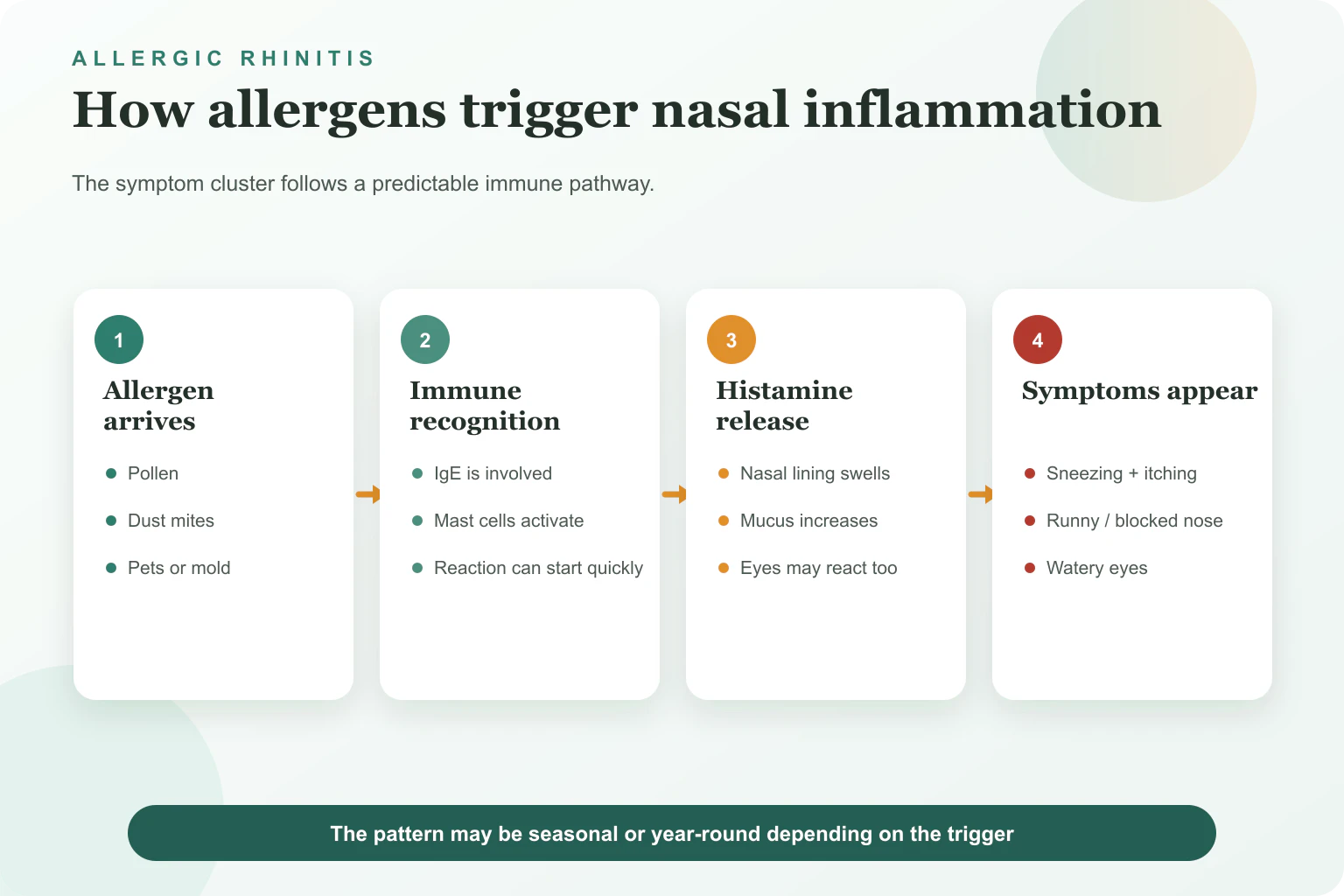
Short answer: allergic rhinitis is an allergic reaction inside the nose. Breathing in pollen, dust mites, pet dander or mold triggers histamine release, which swells the nasal lining and causes sneezing, itching, a runny or blocked nose and itchy eyes. It cannot usually be cured, but trigger control, a daily steroid nasal spray and immunotherapy control it well.
Allergic rhinitis is inflammation of the inside of the nose caused by an allergic reaction. When you breathe in something you're allergic to — pollen, dust mites, pet dander or mold — your immune system releases histamine and other chemicals that inflame the nasal lining, causing sneezing, an itchy or runny nose, congestion, and often itchy, watery eyes. It's commonly called hay fever, though it has nothing to do with hay and doesn't cause a fever. It can be seasonal (worse in pollen season) or perennial (year-round), and while it usually can't be cured, it can be managed well with trigger avoidance, medicine, and — for some people — immunotherapy.
What is allergic rhinitis?
"Rhinitis" simply means inflammation of the nasal passages; "allergic" tells you the cause is an allergy rather than an infection. It's one of the most common chronic conditions in the world, affecting about a quarter of US adults and nearly one in five US children, yet it's often brushed off as "just hay fever."
Here's the mechanism: the first time you meet a particular allergen, your immune system can quietly become sensitised to it, producing IgE antibodies. On later exposures, those antibodies trigger mast cells to release histamine and other chemicals within minutes — inflaming and swelling the lining of your nose, sinuses and eyes. That single reaction explains the whole cluster of symptoms, and why they can appear so quickly after you step outside or stroke a cat. For the wider view of allergy symptoms in general, see our allergy symptoms guide.
Symptoms of allergic rhinitis
The classic signs affect the nose and eyes and tend to appear together. Common symptoms include:
- Sneezing, often in bursts
- An itchy nose, and sometimes an itchy throat or palate
- A runny nose (clear mucus)
- Nasal congestion and blocked airflow
- Itchy, watery, red eyes (allergic conjunctivitis)
- Postnasal drip and throat clearing
- Reduced sense of smell during heavy weeks
- Tiredness and poor sleep from congestion
Less obvious signs include dark circles under the eyes ("allergic shiners"), a crease across the nose from frequent rubbing, headaches from sinus pressure, and daytime fatigue. Because these overlap with a cold, timing is the giveaway — see allergies vs. a cold.
Seasonal vs. perennial allergic rhinitis
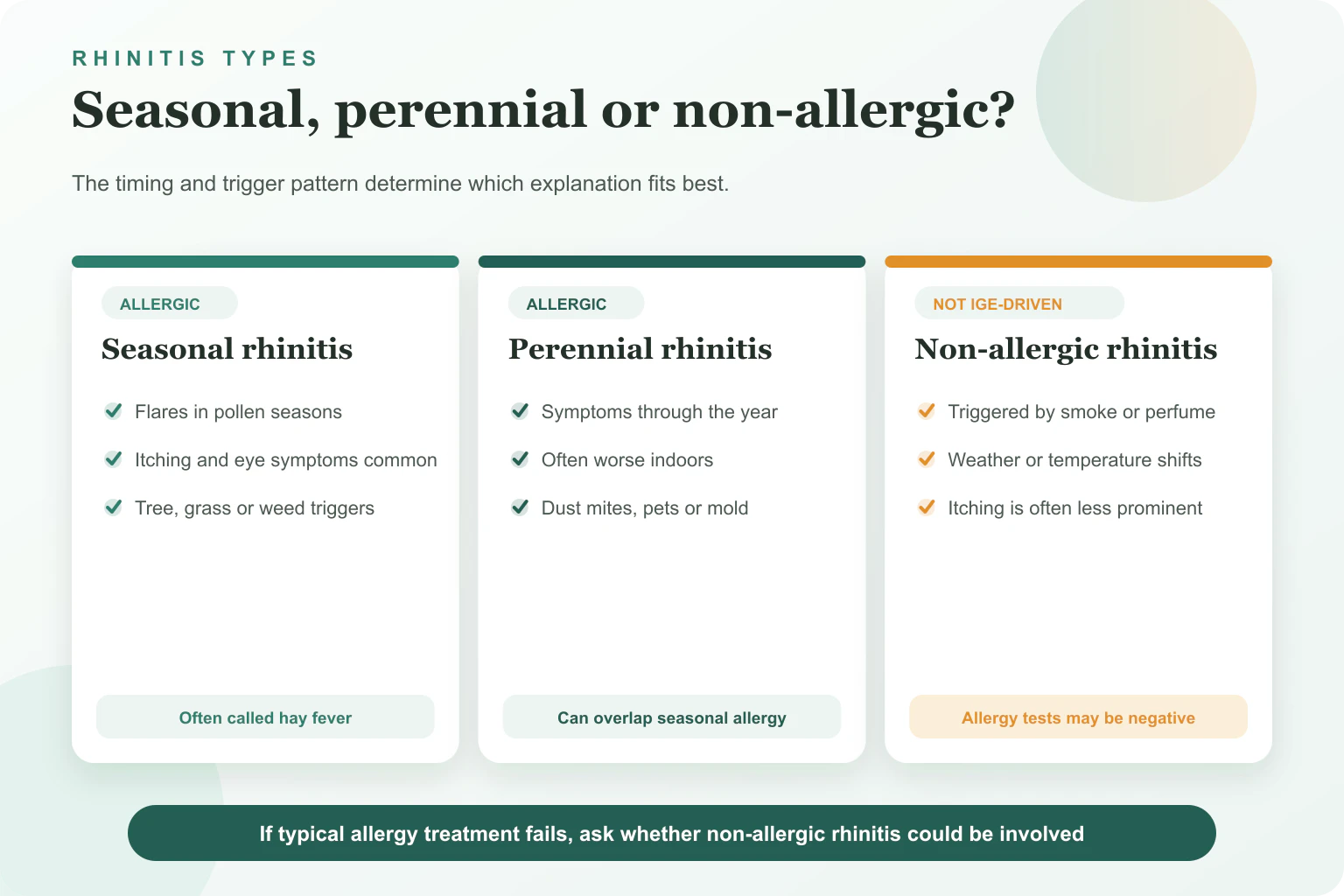
Allergic rhinitis is usually grouped by when it happens. Knowing which type you have shapes both the likely trigger and the plan.
| Seasonal | Perennial (year-round) | |
|---|---|---|
| When | Certain times of year | All year |
| Typical triggers | Tree, grass & weed pollen | Dust mites, pet dander, mold |
| Also known as | Hay fever | — |
| Pattern clue | Flares each spring/fall | Constant, may worsen indoors |
Plenty of people have both — year-round symptoms from an indoor trigger that ramp up during pollen season. Explore the seasonal side in seasonal allergies and the indoor side in indoor allergies.
How doctors classify allergic rhinitis
Beyond seasonal and perennial, clinicians grade allergic rhinitis by how long symptoms last and how much they interfere with your life. This is the ARIA framework (Allergic Rhinitis and its Impact on Asthma), and it matters to you because it is what decides whether an antihistamine is enough or whether a daily steroid nasal spray is the right starting point.
| Axis | Category | What it means |
|---|---|---|
| Duration | Intermittent | The episode of inflammation lasts under about six weeks |
| Persistent | Symptoms continue on and on, often through the year | |
| Severity | Mild | You sleep normally and can do your usual work, school and activities |
| Moderate-to-severe | Symptoms disturb sleep or daily activities, or are simply bothersome |
Why the label changes the plan: for mild, short-lived symptoms an oral antihistamine often suffices. For persistent or moderate-to-severe symptoms, an intranasal corticosteroid is a first-line option and is generally more effective than an antihistamine at controlling nasal congestion. If you have been reaching for tablets every day for months without much benefit, that pattern is itself the signal to change approach — see allergy medicine and nasal spray for allergies.
Classification is a conversation starter, not a self-diagnosis
These categories help a clinician choose treatment; they are not something you need to score yourself on. Bring the pattern — how many days a week, whether it wakes you, whether it stops you doing things — and let them place it.
Allergic vs. non-allergic rhinitis
Not all rhinitis is allergic. Non-allergic rhinitis causes similar nasal symptoms — congestion, runny nose, postnasal drip — but isn't driven by an allergic reaction, so allergy testing comes back negative and itching and eye symptoms are usually less prominent.
Its triggers tend to be irritants and changes rather than allergens: strong smells and perfumes, smoke, weather or temperature shifts, spicy food, hormonal changes, and overuse of decongestant nasal sprays (which can cause rebound congestion). The distinction matters because antihistamines — the mainstay for allergic rhinitis — are often less helpful for the non-allergic type, where avoiding irritants and using a saline rinse or a prescribed nasal spray may work better. If your "allergies" don't respond to typical allergy treatment, this is worth raising with a doctor, who can confirm the type with allergy testing.
Some patterns point strongly one way or the other. None of these is proof on its own, but together they are what a clinician weighs before deciding whether testing is worthwhile.
| Clue | Points toward allergic | Points toward non-allergic |
|---|---|---|
| Age symptoms began | Childhood or young adulthood — about 80% start before age 20 | First appearing after about age 35 |
| Family history | Allergy, asthma or eczema in the family | No family history of allergy |
| Pattern through the year | Clear seasonality, or a reproducible trigger such as cats | No seasonality; grumbling all year |
| What sets it off | Pollen, dust mites, pet dander, mold | Perfume and fragrance, smoke, weather and temperature change, spicy food |
| Itching and eyes | Itchy nose, palate and throat; itchy watery eyes common | Itch and eye symptoms usually mild or absent |
| Other signs | Allergic shiners, nasal crease, allergic conjunctivitis | Ear fullness, sinus pressure, muffled hearing |
| Response to antihistamines | Usually helps | Often disappointing |
| Allergy testing | Positive to a relevant allergen | Negative — the diagnosis is made by excluding allergy |
One caution worth knowing: a positive allergy test on its own does not confirm the diagnosis. It has to match your actual symptom pattern, because people can carry sensitisation to something that never troubles them in daily life.
What causes allergic rhinitis?
It's caused by inhaling something your immune system treats as a threat. The usual culprits are:
- Pollen from trees, grasses and weeds (the seasonal trigger). See pollen allergy.
- Dust mites living in bedding and soft furnishings. See dust mite allergy.
- Pet dander from cats, dogs and other animals.
- Mold spores, indoors and out, especially in damp conditions.
Risk is higher if allergies or asthma run in your family, and symptoms can develop at any age — sometimes appearing for the first time in adulthood after a move or a new pet.
Why it matters: complications and the asthma link
Allergic rhinitis is more than a nuisance — left uncontrolled, it can affect sleep, concentration and quality of life, and it's closely tied to several other conditions. Doctors often describe the nose and lungs as "one airway," because the same allergic process can affect both.
Poorly controlled allergic rhinitis is linked to and can worsen asthma, and is associated with sinus infections, nasal polyps, ear problems, and allergic conjunctivitis. It also disrupts sleep, which feeds daytime fatigue and, in children, can affect school performance. The encouraging flip side: getting the rhinitis under control often improves these related problems too — which is why it's worth treating properly rather than pushing through.
How allergic rhinitis is diagnosed
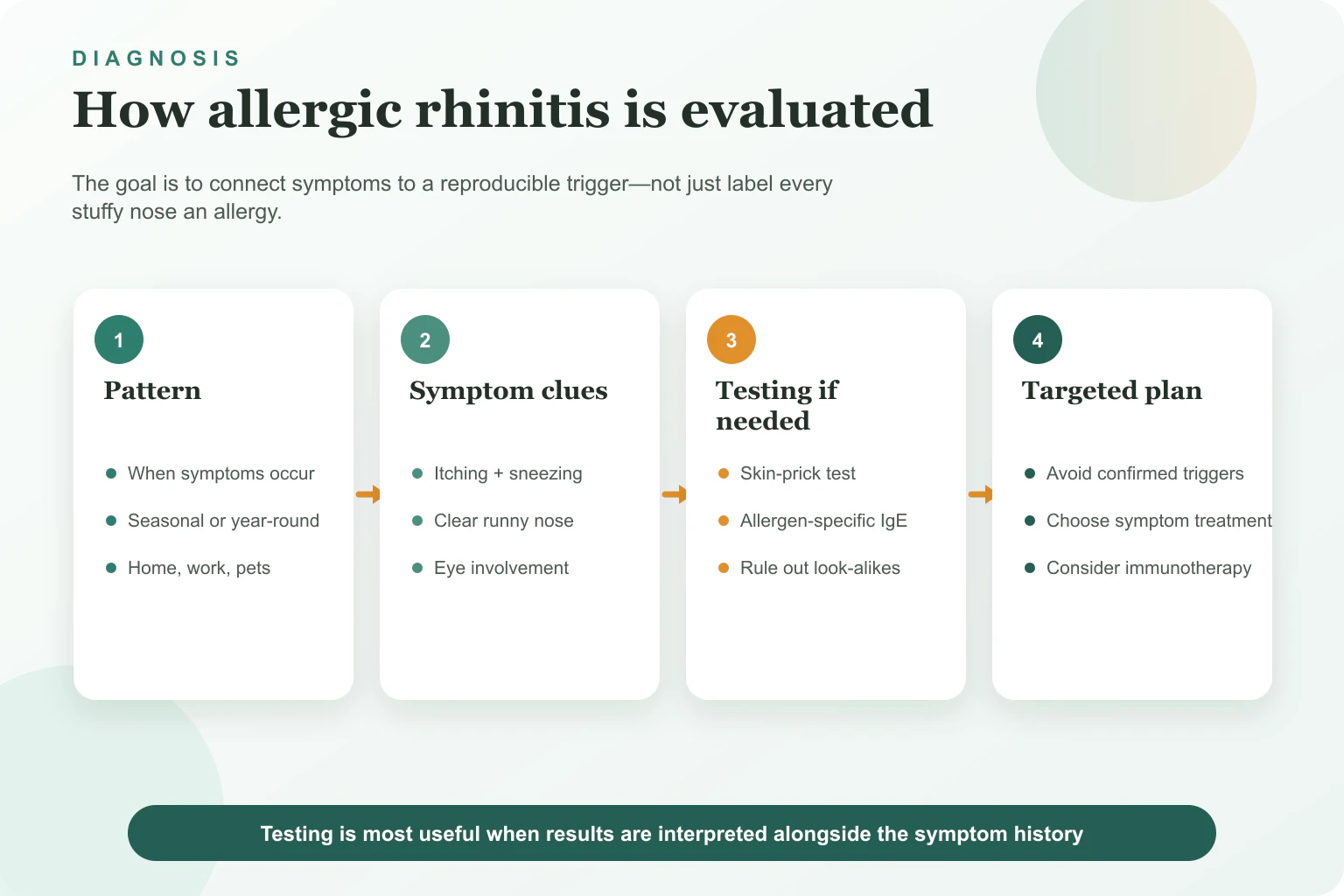
Diagnosis starts with your symptom pattern and is confirmed, when needed, by allergy testing. A doctor will ask when symptoms happen, what seems to set them off, and whether they follow a seasonal or year-round pattern.
To pinpoint the exact trigger, they may arrange a skin-prick test or a blood test that measures allergen-specific IgE. Confirming the trigger makes avoidance far more effective and guides whether immunotherapy could help. Learn what to expect in our allergy testing guide.
Treatment and relief
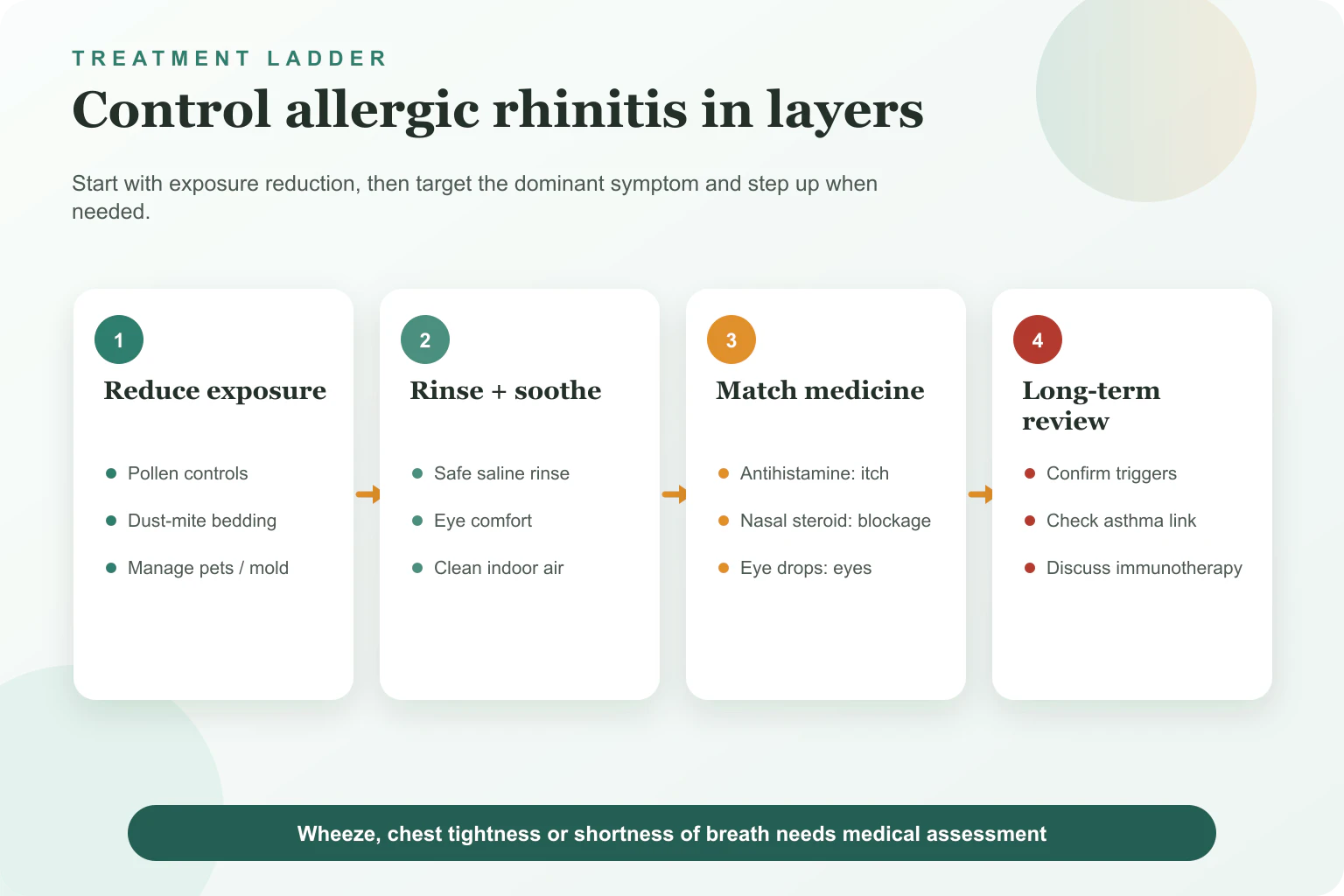
Treatment works in layers: reduce your exposure to the trigger, ease symptoms with the right medicine, and — for stubborn cases — consider immunotherapy. Medicines don't cure allergic rhinitis, but they control it well. This is general information, not dosing advice.
- Avoid the trigger. Keep windows closed on high-pollen days, use allergen-proof bedding for dust mites, and manage pets and mold. This alone can cut symptoms substantially.
- Antihistamines. Non-drowsy oral antihistamines ease sneezing, itching and a runny nose. Compare options in antihistamines and best antihistamine.
- Steroid nasal sprays. The most effective option for congestion and inflammation, used daily. See nasal sprays for allergies.
- Add-ons. Antihistamine eye drops for itchy eyes, saline rinses, and — under a doctor — options like leukotriene modifiers. Decongestants help short-term only (rebound congestion with overuse).
- Immunotherapy. Allergy shots or under-the-tongue tablets are the only treatment that targets the cause and can reduce reactions long-term; they're doctor-supervised and take time.
See the complete, step-by-step plan in our treatment & relief guide.
What treatment guidelines recommend first
If you take one thing from the treatment section above, make it this: for ongoing nasal symptoms, the steroid nasal spray does more than the tablet. The American College of Allergy, Asthma & Immunology describes intranasal corticosteroids as the single most effective drug class for treating allergic rhinitis.
The 2017 practice-parameter update from the Joint Task Force of the AAAAI and ACAAI, published in Annals of Internal Medicine, is more specific still. For people aged 12 and over starting treatment for seasonal allergic rhinitis, it recommends an intranasal corticosteroid on its own rather than routinely combined with an oral antihistamine — a strong recommendation. And when a steroid spray alone is not enough for moderate-to-severe symptoms, the suggested addition is an intranasal antihistamine rather than a tablet.
That runs against a common habit of adding a second pill when the first stops seeming to work. Two practical readings: give a steroid spray a fair trial used daily and with correct technique before judging it, and if you need more, change the route rather than stacking tablets. The detail sits in nasal spray for allergies, antihistamines and allergy medicine.
Guidelines describe groups, not individuals
These recommendations reflect what works best across large populations with seasonal allergic rhinitis. Your own history, other conditions and medicines can move the answer, and none of this is dosing advice. A pharmacist or doctor can fit it to you.
Reducing allergic rhinitis flare-ups
Consistent habits prevent many flare-ups before they start — often more reliably than treating symptoms after they appear.
- Track the daily pollen forecast and keep windows closed on high-count days; use air conditioning.
- Shower and change clothes after being outdoors so you don't carry pollen to bed.
- Use allergen-proof covers and wash bedding weekly in hot water to limit dust mites.
- Run a HEPA air purifier and control indoor humidity to discourage mold.
- Keep pets out of the bedroom if animal dander is a trigger.
- If your symptoms are seasonal and predictable, ask a pharmacist about starting daily medicine before your season begins.
How long does allergic rhinitis last, and does it go away?
Duration follows the trigger, not the calendar. Seasonal allergic rhinitis lasts as long as the pollen you react to is in the air, which for a single pollen typically means several weeks rather than a few days. React to more than one pollen and those windows overlap, so spring through fall can feel like one long season. Perennial allergic rhinitis, driven by dust mites, pet dander or mold, has no natural end point because the trigger never leaves.
Whether it fades with age is genuinely variable, and honest sources say so. Allergic rhinitis usually begins early — roughly 80% of people develop it before age 20. Some people find symptoms soften or settle in later adulthood; others develop new sensitivities and find their season lengthens instead. Adult-onset allergic rhinitis is real, and moving house, a new pet or a new job can start it at any age.
Three things are worth separating:
- A flare lasts hours to days after an exposure.
- A season lasts weeks to months, tracking the pollen calendar — see the allergy season calendar and pollen counts.
- The underlying sensitivity can last years, and is the only part immunotherapy addresses.
That last distinction is the useful one. Medicines control the flare and the season; allergy shots and under-the-tongue tablets are the only treatments aimed at the sensitivity itself, and their benefit can persist after the course finishes. If you are treating symptoms most months of the year, that is the conversation to have.
Allergic rhinitis in children
Allergic rhinitis is common in children and often under-recognised, partly because the signs can look like frequent colds. Watch for persistent nose-rubbing (the "allergic salute"), mouth-breathing, dark under-eye circles, an ongoing clear runny nose without a fever, and symptoms that return each year.
Because untreated symptoms can disrupt a child's sleep, concentration and school days — and because suitable treatments differ by age — it's best to see a pediatrician rather than use adult products by guesswork. More in allergies in children.
When to see a doctor
See a doctor if over-the-counter medicine isn't controlling your symptoms, if they disrupt your sleep or daily life, if they last most of the year, or if you're unsure of the trigger. An allergist can confirm the cause and tailor a stronger plan, including prescription options and immunotherapy. More on timing in when to see a doctor for allergies.
When it's an emergency
Ordinary allergic rhinitis isn't dangerous, but a severe, whole-body allergic reaction (anaphylaxis) — usually from foods, medicines or insect stings rather than inhaled allergens — is a medical emergency. Call 911 for trouble breathing or swelling of the face, lips, tongue or throat, and use a prescribed epinephrine auto-injector if available. See our allergy safety guide and anaphylaxis.
Allergic rhinitis: frequently asked questions
What is allergic rhinitis?
Is allergic rhinitis the same as hay fever?
What's the difference between seasonal and perennial allergic rhinitis?
Can allergic rhinitis be cured?
How is allergic rhinitis classified?
What is the most effective treatment for allergic rhinitis?
How long does allergic rhinitis last?
Does hay fever go away as you get older?
How do I know if it is allergic rhinitis or non-allergic rhinitis?
Can allergic rhinitis affect asthma?
How we create and review this guide
This guide is written for a general audience using patient-education material from the authoritative sources below, not blogs or forums:
- American Academy of Allergy, Asthma & Immunology (AAAAI)
- American College of Allergy, Asthma & Immunology (ACAAI)
- Mayo Clinic
- U.S. National Institute of Allergy and Infectious Diseases (NIH / NIAID)
- U.S. National Library of Medicine (MedlinePlus)
Sources for the specific figures on this page
- Akhouri S, House SA. Allergic Rhinitis (opens in a new tab). StatPearls, NCBI Bookshelf. Prevalence of approximately 15% by physician diagnosis and up to 30% based on nasal symptoms, the IgE-mediated mechanism with mast-cell degranulation within minutes of exposure, and intranasal steroids as first-line treatment.
- Small P, Kim H. Allergic rhinitis (opens in a new tab). Allergy, Asthma & Clinical Immunology 2011. The ARIA classification of rhinitis as intermittent (under about six weeks) or persistent, and as mild or moderate-to-severe based on sleep and daily activities; intranasal corticosteroids as first-line for persistent or moderate-to-severe symptoms; and allergic rhinitis and asthma as a combined airway inflammatory disease.
- American College of Allergy, Asthma & Immunology. Hay fever (allergic rhinitis) (opens in a new tab). Intranasal corticosteroids described as the single most effective drug class for treating allergic rhinitis, and rebound swelling from prolonged decongestant nasal spray use.
- Wallace DV, Dykewicz MS, Oppenheimer J, Portnoy JM, Lang DM. Pharmacologic Treatment of Seasonal Allergic Rhinitis: Synopsis of Guidance From the 2017 Joint Task Force on Practice Parameters (opens in a new tab). Annals of Internal Medicine 2017;167(12):876–881. Intranasal corticosteroid monotherapy recommended over combination with an oral antihistamine for people aged 12 and over, and intranasal corticosteroid plus intranasal antihistamine as an option in moderate-to-severe disease.
- Quillen DM, Feller DB. Diagnosing Rhinitis: Allergic vs. Nonallergic (opens in a new tab). American Family Physician 2006;73(9):1583–1590. Allergic rhinitis beginning before age 20 in about 80% of people, the value of family history and identified triggers, and allergic shiners and conjunctivitis as signs favouring an allergic cause.
- American College of Allergy, Asthma & Immunology. Allergy facts and figures (opens in a new tab). National Health Interview Survey data for 2021, including hay fever reported in 18.9% of US children.
- MedlinePlus, U.S. National Library of Medicine. Hay Fever (opens in a new tab). Patient-facing summary of pollen-triggered allergic rhinitis, symptom relief with medicines and nasal sprays, safe water for nasal rinsing, and allergy shots for long-term relief.
Medical disclaimer: This guide is for general education and isn't a substitute for personalized medical advice. It doesn't provide dosing. Always talk to a qualified healthcare professional about your symptoms and treatment.
 MD
MDMedically reviewed
Dr. Hannah H. Walford, MD
Allergist and Immunologist
- Website role
- Owner, Medical Director and Medical Reviewer of Allergy Relief Guide
- Professional affiliation
- Stanford Health Care / Menlo Medical Clinic, Menlo Park, California
- Areas of expertise
- Food allergy, eczema, allergic rhinitis, sinusitis and asthma
Dr. Hannah H. Walford is a board-certified allergist and immunologist experienced in caring for adults and children with allergic conditions. Her areas of expertise include food allergy, eczema, allergic rhinitis, sinusitis and asthma. She provides medical leadership and review oversight for the educational health content published by Allergy Relief Guide.
Medical content is provided for education and is not a substitute for diagnosis or individualized medical care.
Related guides
Allergy symptoms
The full list of signs and what they mean.
Seasonal allergies
The seasonal (pollen) form, season by season.
Treatment & relief
Every option, from home care to immunotherapy.
Allergies vs. a cold
Tell rhinitis apart from a virus.
Antihistamines
How they work and which to choose.
Testing & diagnosis
Confirm exactly what you react to.
Allergy medicine
Which type to take for which symptom.
Nasal sprays
The first-line option, compared by label.
Allergic asthma
When the same inflammation reaches the chest.
Allergies & sinusitis
How blocked sinuses get infected.
Ready to get your symptoms under control?
Our step-by-step guide covers every relief option, from avoidance and OTC medicine to immunotherapy.
Go to the treatment & relief guide