
Pollen Allergy: Symptoms, Triggers and Relief
Why wind-blown tree, grass and weed pollen sets off sneezing and itchy eyes — and how to cut your exposure and feel better.
Quick answer: what is a pollen allergy?
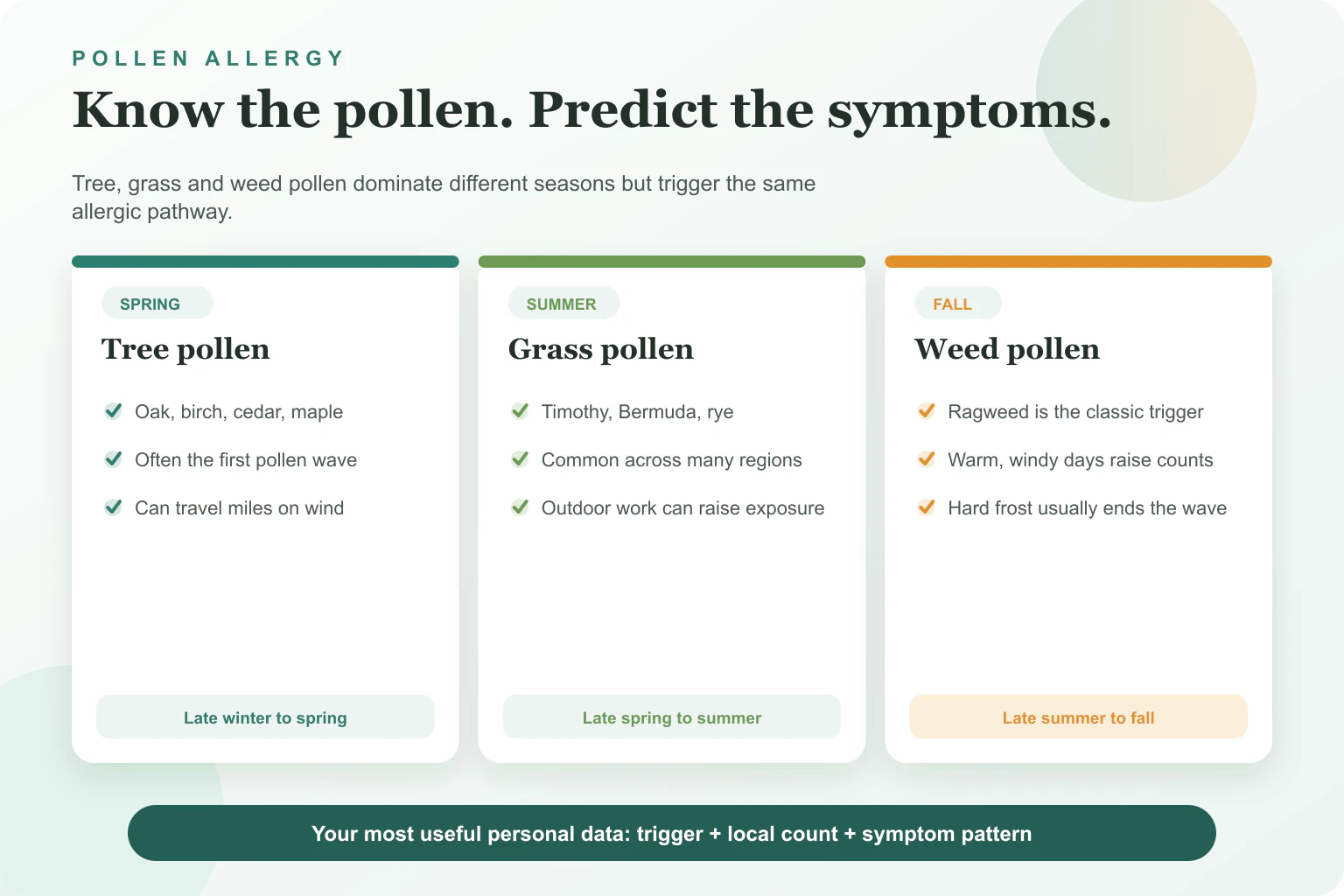
Short answer: pollen allergy is a reaction to the wind-blown pollen of trees, grasses and weeds — not the showy flowers people blame. Trees drive spring, grasses summer, weeds like ragweed the fall. Track your season, cut exposure, and start daily medicine before the pollen arrives rather than after symptoms peak.
A pollen allergy is an allergic reaction to the fine powder that trees, grasses and weeds release into the air to fertilise other plants. When you breathe it in, your immune system treats it as a threat and releases histamine, causing sneezing, a runny or blocked nose and itchy, watery eyes. It's the most common cause of seasonal allergies — often called hay fever or seasonal allergic rhinitis. Symptoms follow the pollen seasons: tree pollen in spring, grass in summer, and weeds like ragweed in fall. You can't avoid pollen entirely, but tracking counts, reducing exposure and the right medicine make a big difference.
What is pollen — and why it causes allergies
Pollen is a fine, powdery grain that plants produce to fertilise others of the same species. The pollen that triggers allergies comes from plants that rely on the wind to spread it: trees, grasses and weeds make small, light, dry grains that drift for miles and land in your eyes, nose and lungs.
Interestingly, brightly flowering plants like roses usually aren't the problem — their pollen is heavy and sticky, carried by insects rather than the wind, so it rarely reaches your airways in large amounts. If you have a pollen allergy, your immune system misreads these harmless grains as a threat and releases histamine, which drives the familiar symptoms. The medical name is seasonal allergic rhinitis.
The three types of pollen allergy
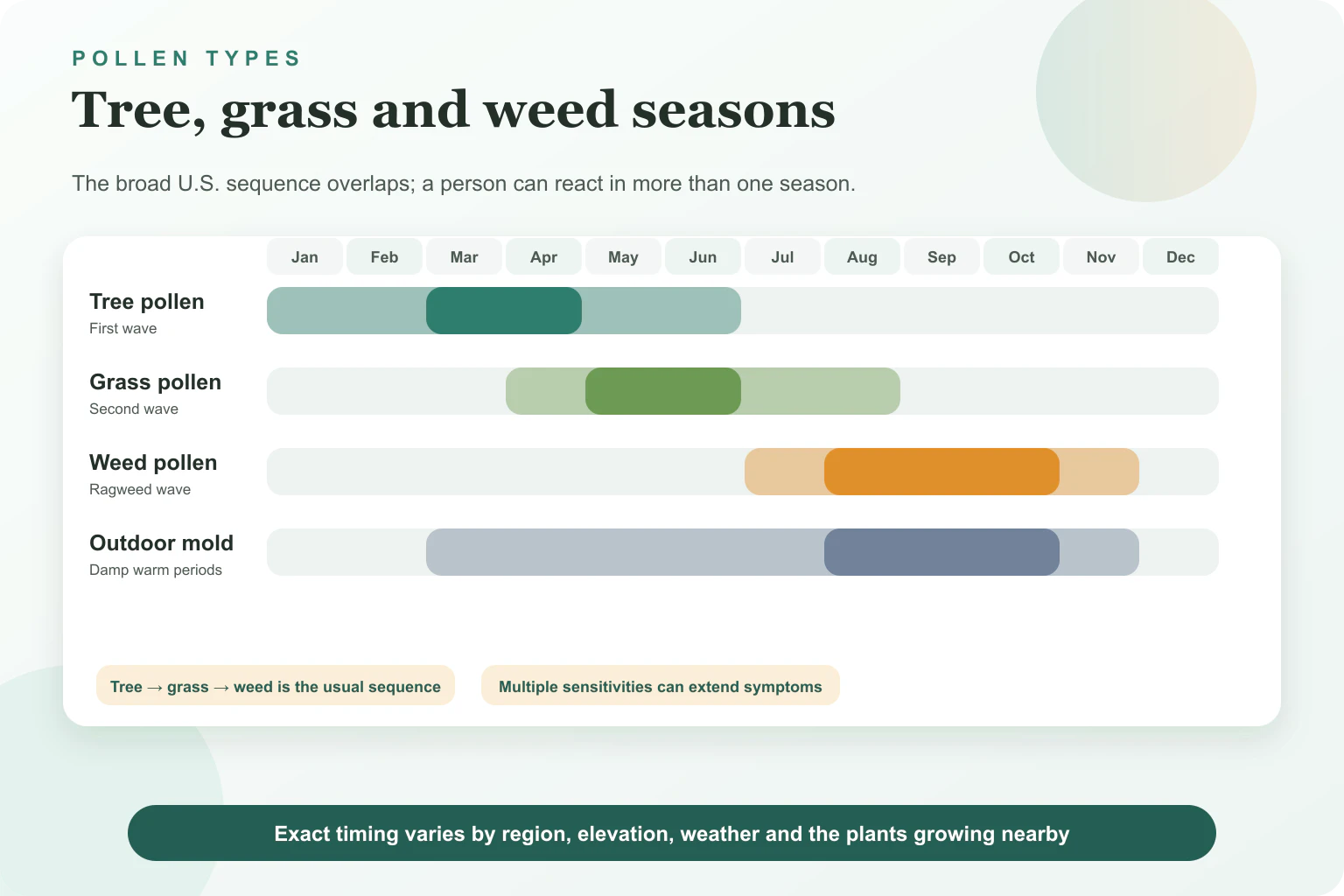
Almost all pollen allergies trace back to trees, grasses or weeds — and each has its own season. Knowing which one affects you helps you predict and prepare for your worst weeks.
Tree pollen
The first pollen each year. Drives most spring symptoms; in warm regions trees can start as early as December–January.
Grass pollen
Peaks in late spring and summer, and is one of the most common triggers worldwide.
Weed pollen
Dominates late summer and fall — ragweed is the classic culprit, producing huge amounts of pollen.
| Pollen type | Main season | Examples |
|---|---|---|
| Tree | Late winter – spring | Oak, birch, cedar, maple |
| Grass | Late spring – summer | Timothy, Bermuda, rye |
| Weed | Late summer – fall | Ragweed, sagebrush, pigweed |
Timing shifts with your region and the weather. See the full breakdown in our allergy season calendar, plus spring allergies, fall allergies and ragweed allergy.
Each of the three has its own guide, because the seasons, the plants and the food cross-reactions differ. Read tree pollen allergy for the spring wave, grass pollen allergy for early summer, and ragweed allergy for late summer and fall. If you react to more than one group, treat them as separate seasons with separate start dates rather than one long stretch to push through.
Pollen allergy symptoms
Symptoms appear only when the pollen you react to is in the air, so they come and go with the seasons. The most common are:
- Sneezing, often repeatedly
- Runny nose with clear mucus
- Nasal congestion and a blocked nose
- Itchy nose, throat and roof of the mouth
- Itchy, watery, red eyes
- Postnasal drip and a cough
- Tiredness and disturbed sleep
- Wheezing or breathlessness if you have asthma
Because these overlap with a cold, the seasonal, itchy pattern is the giveaway — see allergies vs. a cold and our full allergy symptoms guide.
Pollen counts and forecasts: how to use them
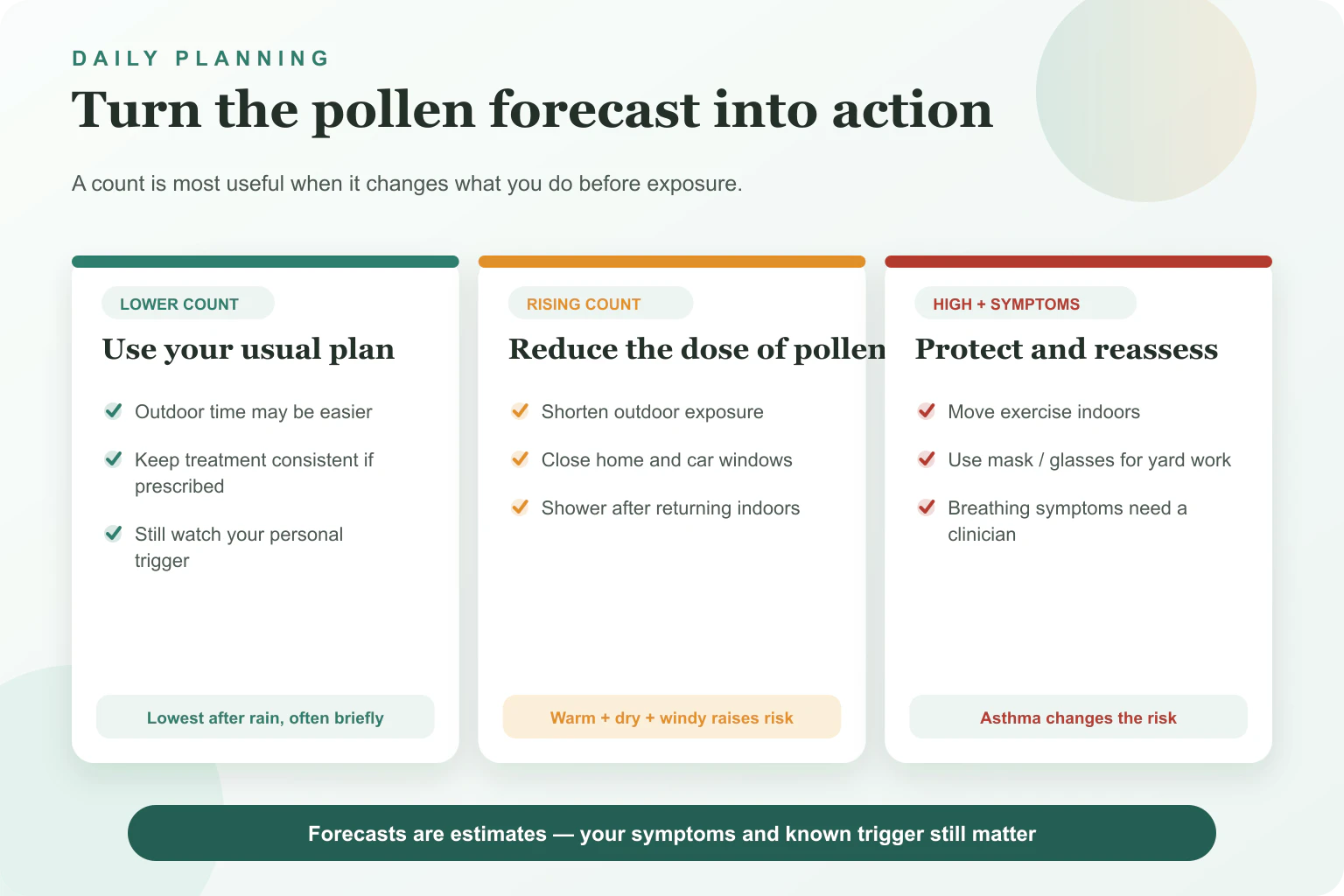
A pollen count measures how many pollen grains are in the air, and it's one of the most useful tools for planning your days. Official counts are gathered by air samplers and reported by networks such as the AAAAI's National Allergy Bureau; many weather apps also show a pollen forecast.
Two practical points. First, forecasts are estimates — like a weather forecast — so you may still react on a "low" day. Second, timing matters: pollen tends to be highest in the early morning and on warm, dry, windy days, and lowest after rain, which washes it out of the air. Checking the count lets you time outdoor activities and start medicine before a bad stretch.
There is a third point worth knowing, and it is the one most people miss. The Allergy & Asthma Network points out that daily pollen counts often represent collections made 24 to 48 hours earlier. So today's number can describe yesterday's air. That is not a reason to ignore it — it is a reason to read it as a trend and let current weather fill in the rest.
The Network also advises starting allergy medicine about one to two weeks before your pollen season begins, and notes how far local timing can shift: mountain cedar is an early bloomer that can cause symptoms in December in Texas and Oklahoma, long before anyone else considers it allergy season. Our pollen count guide explains what the numbers mean, and allergy season by region covers how the calendar moves across the country.
Why pollen seasons feel longer than they used to
If it seems like your allergies last longer each year, you're not imagining it. A warming climate is lengthening pollen seasons and pushing pollen counts higher, with plants starting to release pollen earlier and continuing later into the year.
Allergists link this to more intense, longer-lasting symptoms — and to more people being diagnosed with a pollen allergy for the first time, including in adulthood. It's a good reason to have a reliable relief plan rather than hoping a short season passes quickly.
How much has actually changed
The trend has been measured, and the version you usually hear quoted is slightly wrong. A 2021 study in PNAS analysed 60 North American pollen monitoring stations across 821 site-years from 1990 to 2018:
| What changed | How much, 1990–2018 | Share attributed to human-caused climate change |
|---|---|---|
| Season start date | About 20 days earlier | Roughly 35–66% |
| Season length | About 8 days longer | Roughly 19–35% |
| Pollen concentration | Up about 21% | Roughly 4–8% |
You will often read that pollen seasons are "20 days longer." They are not. They begin about 20 days earlier and run about 8 days longer — which is why the change is felt mostly as an earlier start rather than an endless season.
The attribution deserves the same care. Climate change accounts for a large share of the shift in timing, but only a small share of the rise in pollen concentration, which has other contributors. For you the practical consequence is a scheduling one: if you still start medicine in the same week you did a decade ago, you may now be starting late. More in why pollen seasons are getting longer and why are my allergies so bad this year?
How to reduce your pollen exposure
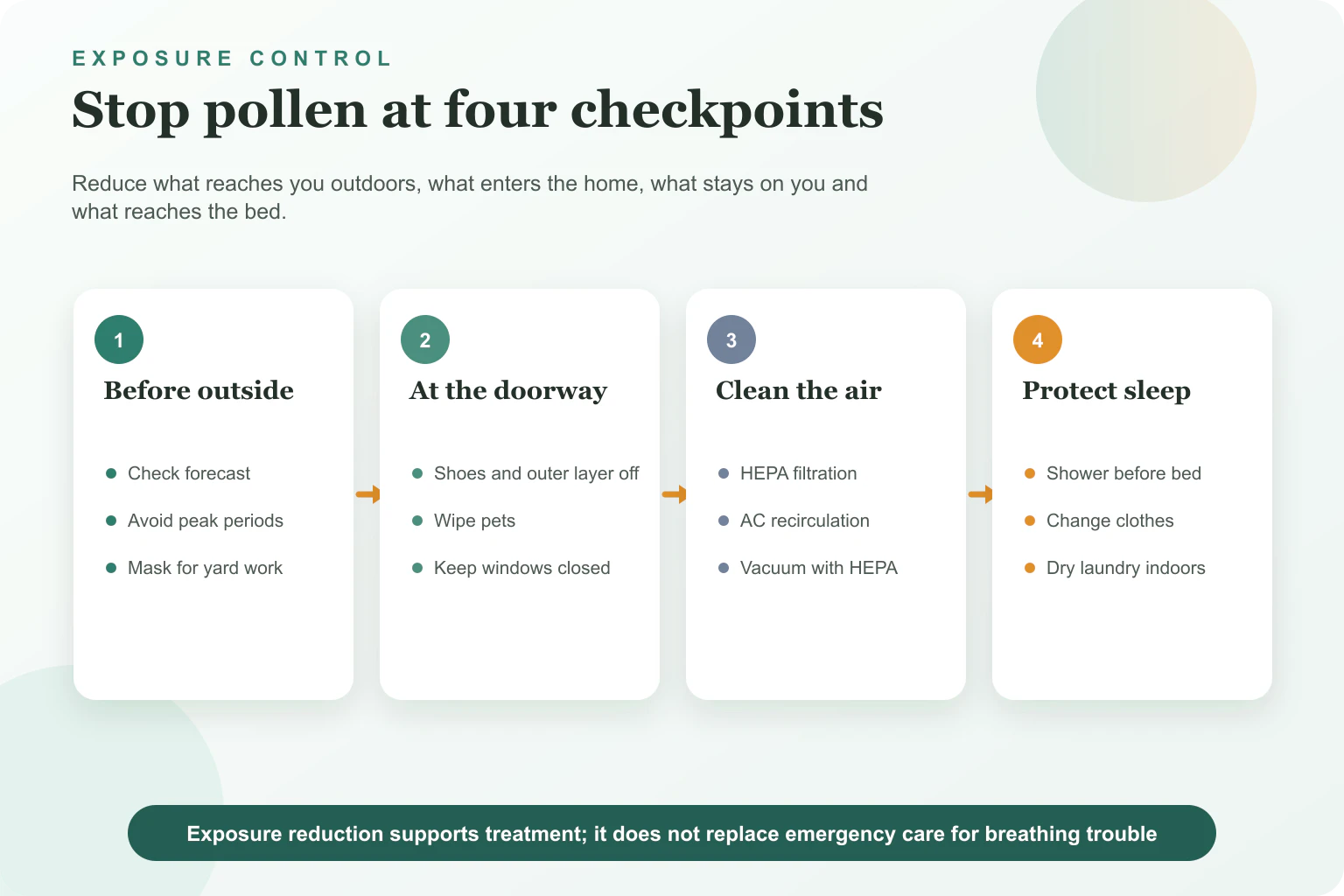
You can't avoid pollen completely, but cutting your exposure is the foundation of relief and makes any medicine work better.
- Check the daily pollen forecast and plan around high-count days and early mornings.
- Keep windows and doors closed during your season; use air conditioning rather than window fans.
- Run a HEPA air purifier indoors, and vacuum with a HEPA-filter cleaner.
- Shower and change clothes after being outdoors so you don't carry pollen to bed.
- Dry laundry indoors during peak season — outdoor drying collects pollen.
- Wear wraparound sunglasses, and a mask for mowing, gardening or yard work.
- Avoid mowing the lawn and raking leaves yourself when counts are high.
Treatment and relief
Alongside reducing exposure, the right medicine controls pollen allergy well for most people. This is general information, not dosing advice — a pharmacist can help you choose.
- Antihistamines — non-drowsy options ease sneezing, itching and a runny nose. See antihistamines.
- Steroid nasal sprays — the most effective option for congestion, used daily. See nasal sprays.
- Saline nasal rinses — flush pollen from your nose (use distilled, sterile or previously boiled water). See natural remedies.
- Antihistamine eye drops — for itchy, watery eyes. See itchy eyes.
- Immunotherapy — allergy shots or under-the-tongue tablets can reduce your reaction long-term; grass and ragweed tablets exist.
Start before your season. Many people get better control by beginning daily allergy medicine about one to two weeks before their pollen season usually starts, rather than waiting for symptoms to peak. See the full plan in our treatment & relief guide.
On that last point, it is worth being specific. ACAAI states that the only FDA-approved sublingual immunotherapy tablets are for ragweed, northern pasture grasses such as timothy, and dust mites — so a tablet may or may not exist for your particular trigger. The first dose is taken in the office and the rest at home, an epinephrine auto-injector is prescribed in case of a severe reaction, and treatment continues for three years or longer. Grass and ragweed tablets are taken before and during the season; dust mite tablets year-round. Allergy shots cover a far wider range of allergens and run three to five years. Compare both in allergy shots and sublingual immunotherapy.
When pollen allergy shows up in your mouth
If raw apple, melon or celery makes your lips and mouth itch during your season, that is usually your pollen allergy — not a new food allergy. It is called pollen food allergy syndrome, or oral allergy syndrome, and it is one of the most commonly misread consequences of reacting to pollen.
The American College of Allergy, Asthma & Immunology explains the mechanism plainly: the immune system recognises proteins in certain raw fruits and vegetables that closely resemble pollen proteins, and directs an allergic response at the food. Which foods depends on which pollen you react to:
| If your trigger is | Raw foods that commonly cross-react |
|---|---|
| Birch pollen (spring trees) | Apple, almond, carrot, celery, cherry, hazelnut, kiwi, peach, pear, plum |
| Grass pollen (summer) | Celery, melon, orange, peach, tomato |
| Ragweed pollen (fall) | Banana, cucumber, melon, sunflower seeds, zucchini |
Three features make it recognisable. Symptoms stay local — itchy mouth, scratchy throat, sometimes mild lip or tongue swelling. They settle quickly once the food is swallowed or removed from the mouth. And the same food is normally fine cooked, because heating distorts the protein enough that the immune system stops recognising it. A raw peach bothers you; a cooked one does not.
When it stops being minor
ACAAI notes that although uncommon, symptoms can progress beyond the mouth, with anaphylaxis reported in about 1.7% of affected people. Hives elsewhere, vomiting, trouble breathing or faintness are no longer a local reaction. Speak to an allergist about whether you should carry an epinephrine auto-injector. More in oral allergy syndrome and food allergy vs. intolerance.
Three pollen myths worth clearing up
- "Local honey cures pollen allergies." The pollen bees collect from flowers usually isn't the wind-blown pollen that triggers hay fever, and studies haven't shown a reliable benefit.
- "Move to the desert and you'll be cured." There's no pollen-free zone — desert plants produce pollen too, and you can become sensitised to new local species.
- "Only take medicine when you feel bad." Most preventive allergy medicines, especially steroid nasal sprays, work best taken consistently, ideally starting before your season.
Pollen allergy and asthma
For some people, pollen doesn't just affect the nose and eyes — it triggers the lungs too. When pollen sets off wheezing, chest tightness or breathlessness, that's allergic asthma, the most common form of asthma. Pollen allergy and asthma often travel together, and controlling the allergy can help calm the asthma.
Breathing symptoms need a doctor, not home remedies
If pollen brings on coughing, wheezing, chest tightness or shortness of breath, see a healthcare provider rather than treating it yourself. And although inhaled pollen rarely causes a severe whole-body reaction, call 911 for any trouble breathing or swelling of the face, lips, tongue or throat. See our allergy safety guide.
Go deeper on your pollen
| If this is you | Guide |
|---|---|
| Spring is your worst season | Tree pollen and spring allergies |
| Early summer is your worst season | Grass pollen and summer allergies |
| Late summer and fall | Ragweed and fall allergies |
| Symptoms carry on through winter | Winter allergies and indoor allergies |
| Eyes are the worst part | Eye allergies and allergy eye drops |
| A cough that will not settle | Allergy cough |
| Exhaustion during your season | Allergy fatigue |
| Pollen reaches your chest | Allergic asthma |
| Smoke or poor air quality days | Air quality and allergies |
| Choosing a medicine | Allergy medicine |
| Rinsing and filtering at home | Saline rinsing, HEPA filters, air purifiers and bedroom setup |
| Children with seasonal symptoms | Allergies in children |
When to see a doctor
See a doctor if over-the-counter medicine isn't controlling your symptoms, if they disrupt your sleep or daily life, or if you're not sure which pollen affects you. A simple allergy test can confirm your exact triggers, and an allergist can tailor a stronger plan, including immunotherapy. More on timing in when to see a doctor for allergies.
Pollen allergy: frequently asked questions
What are the symptoms of a pollen allergy?
When is pollen at its worst?
How can I reduce my pollen exposure?
Can you develop a pollen allergy as an adult?
Are pollen seasons really getting longer?
How accurate is a daily pollen count?
Why does raw fruit make my mouth itch during pollen season?
Is there an under-the-tongue tablet for my pollen allergy?
When should I start my pollen allergy medicine?
How we create and review this guide
This guide is written for a general audience using patient-education material from the authoritative sources below, not blogs or forums:
- American Academy of Allergy, Asthma & Immunology (AAAAI) & National Allergy Bureau
- Asthma and Allergy Foundation of America (AAFA)
- American College of Allergy, Asthma & Immunology (ACAAI)
- Mayo Clinic
- U.S. Centers for Disease Control and Prevention (CDC)
Sources for the specific figures on this page
- Anderegg WRL, Abatzoglou JT, Anderegg LDL, Bielory L, Kinney PL, Ziska L. Anthropogenic climate change is worsening North American pollen seasons (opens in a new tab). PNAS 2021. Sixty North American pollen stations across 821 site-years, 1990–2018: seasons starting about 20 days earlier, lengthening about 8 days, and concentrations rising about 21%, with human forcing attributed roughly 35–66% of start-date trends, 19–35% of season-length trends and 4–8% of annual concentration trends.
- Allergy & Asthma Network. Pollen allergy (opens in a new tab). Starting allergy medication about one to two weeks before pollen season begins; daily counts often representing collections made 24 to 48 hours earlier; tree, grass and weed season timing including mountain cedar in December in Texas and Oklahoma; and exposure-reduction measures.
- American College of Allergy, Asthma & Immunology. Pollen food allergy syndrome (opens in a new tab). Cross-reacting proteins in pollen and raw foods; the birch, grass and ragweed cross-reaction lists; symptoms staying local and subsiding quickly; cooked foods normally tolerated because heating distorts the protein; and anaphylaxis reported in about 1.7% of affected people.
- American College of Allergy, Asthma & Immunology. Immunotherapy with allergy tablets (opens in a new tab). FDA-approved sublingual tablets limited to ragweed, northern pasture grasses such as timothy, and dust mites; the first dose taken in the office; an epinephrine auto-injector prescribed for home use; treatment continued three years or longer; and seasonal versus year-round dosing.
- American College of Allergy, Asthma & Immunology. Hay fever (allergic rhinitis) (opens in a new tab). Intranasal corticosteroids described as the single most effective drug class for allergic rhinitis, and rebound swelling from prolonged decongestant nasal spray use.
Medical disclaimer: This guide is for general education and isn't a substitute for personalized medical advice. It doesn't provide dosing. Always talk to a qualified healthcare professional about your symptoms and treatment.
 MD
MDMedically reviewed
Dr. Hannah H. Walford, MD
Allergist and Immunologist
- Website role
- Owner, Medical Director and Medical Reviewer of Allergy Relief Guide
- Professional affiliation
- Stanford Health Care / Menlo Medical Clinic, Menlo Park, California
- Areas of expertise
- Food allergy, eczema, allergic rhinitis, sinusitis and asthma
Dr. Hannah H. Walford is a board-certified allergist and immunologist experienced in caring for adults and children with allergic conditions. Her areas of expertise include food allergy, eczema, allergic rhinitis, sinusitis and asthma. She provides medical leadership and review oversight for the educational health content published by Allergy Relief Guide.
Medical content is provided for education and is not a substitute for diagnosis or individualized medical care.
Related guides
Seasonal allergies
The bigger picture, season by season.
Allergy season calendar
When each pollen peaks through the year.
Ragweed allergy
The fall weed-pollen heavyweight.
Treatment & relief
Every option, step by step.
Tree pollen allergy
The spring wave, tree by tree.
Grass pollen allergy
The early-summer trigger.
Pollen counts
What the daily number actually means.
Oral allergy syndrome
When pollen allergy reaches your mouth.
Get ahead of your pollen season
See exactly when tree, grass and weed pollen peak so you can start relief early.
View the allergy season calendar