Air Purifiers for Allergies: Do They Help and What to Look For
A portable air purifier with a true HEPA filter can reduce airborne allergens like pollen, pet dander, dust-mite debris, and mold spores, and studies have found modest improvements in allergy and asthma symptoms. Two specs matter most: a true HEPA filter (captures at least 99.97% of particles at 0.3 microns) and a high enough CADR (clean air delivery rate) for your room size. But no purifier removes everything, and it works best alongside — not instead of — reducing allergens at the source. It also does nothing for allergens that have settled into bedding or carpet.
Quick answer
A portable air purifier with a true HEPA filter can reduce airborne allergens like pollen, pet dander, dust-mite debris, and mold spores, and studies show modest symptom improvements. Two specs matter most: a true HEPA filter (captures at least 99.97% of particles at 0.3 microns) and a high enough CADR (clean air delivery rate) for your room size. No purifier removes everything, and it works best alongside reducing allergens at the source, not instead of it.
What you need to know
- A portable air purifier with a true HEPA filter can reduce airborne allergens such as pollen, pet dander, dust-mite debris, and mold spores.
- Studies have found modest improvements in allergy and asthma symptoms and lower indoor fine-particle levels with HEPA purifiers.
- A “true HEPA” filter captures at least 99.97% of particles that are 0.3 microns in size — and most common allergens are larger than that, so they're captured well.
- CADR (clean air delivery rate) reflects both filter quality and airflow; the EPA and American Lung Association recognize it as the measure of effectiveness, and it must match your room size.
- No air purifier removes all indoor pollutants, and it doesn't clean allergens that have settled into bedding, carpet, or upholstery.
- Purifiers work best as part of a plan that also reduces allergens at the source — cleaning, bedding covers, and managing humidity and pets.
Do Air Purifiers Actually Help Allergies?
Yes, with realistic expectations. Portable air cleaners with HEPA filters have been shown to lower indoor concentrations of fine particles, and studies have found improvements in one or more allergy or asthma symptoms, though the effects are generally modest rather than dramatic. A purifier only cleans the air passing through it, so it helps most with airborne allergens in the room where it's running — it can't undo allergen exposure from surfaces you touch or bedding you sleep on. That's why it's best treated as one tool within a broader approach to reducing indoor allergens.
The Two Specs That Matter: HEPA and CADR
| Spec | What it means | Why it matters |
|---|---|---|
| True HEPA filter | Captures at least 99.97% of particles at 0.3 microns in size | Most allergens (pollen, dander, dust-mite debris, mold spores) are larger than 0.3 microns, so a true HEPA filter captures them efficiently |
| CADR (clean air delivery rate) | The volume of particle-free air delivered per minute, reflecting both filter quality and airflow | Recognized by the EPA and American Lung Association as the measure of effectiveness; a CADR too low for your room makes the unit ineffective |
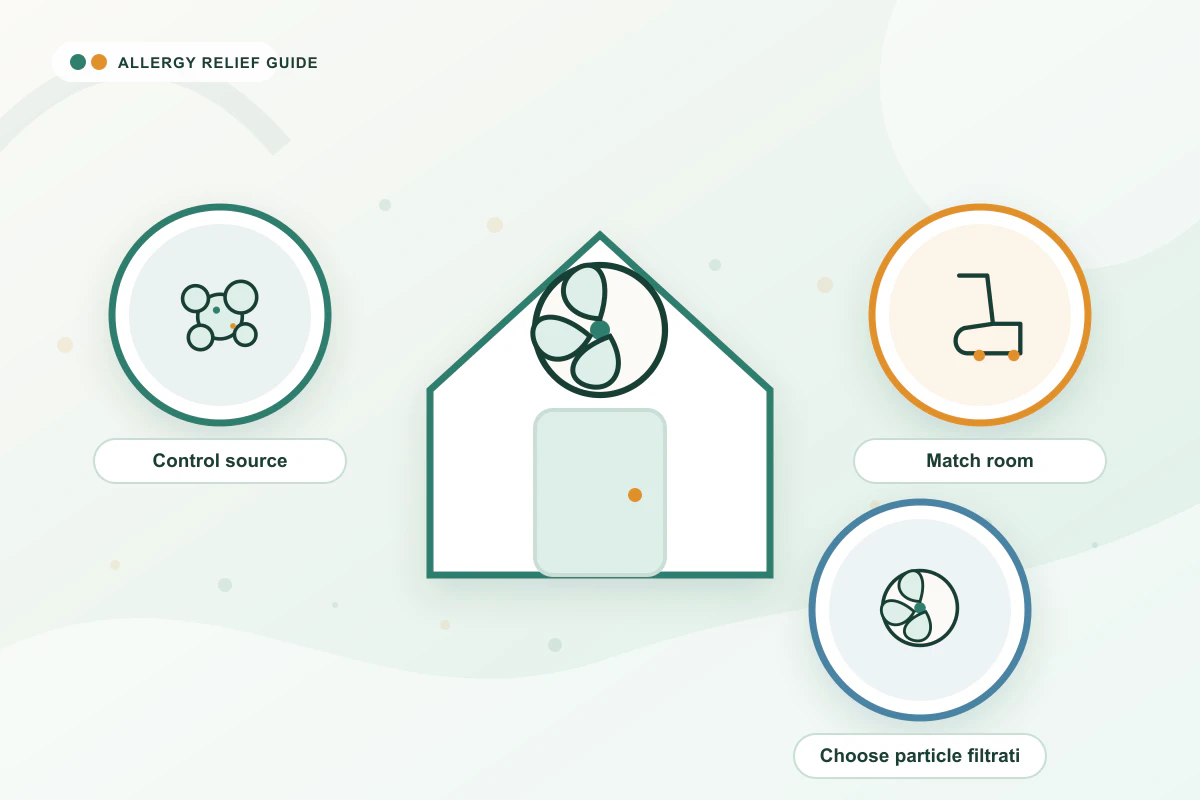
A common marketing trap is implying that any "HEPA" filter cleans a whole room. In reality, cleaning depends on both the filter and how much air moves through it — which is exactly what CADR captures. Match the CADR to your room's size, using the manufacturer's or EPA's sizing guidance.
What to Look For and What to Skip
- A true HEPA filter and a CADR rated for your room's square footage
- A size and noise level you'll actually keep running in the room you spend the most time in (often the bedroom)
- Realistic replacement-filter costs, since filters need periodic changing
- Be cautious with ozone-generating “air purifiers” — ozone is a lung irritant and isn't recommended for cleaning indoor air
The EPA notes that no air cleaner eliminates all indoor pollutants, and that filtration treats symptoms of a problem rather than its source — for example, it won't fix an underlying mold issue.
Use It as Part of a Bigger Plan
An air purifier works best alongside source control: reducing the allergens getting into your air in the first place. That includes dust-mite-proof bedding covers, regular cleaning, managing pet access to bedrooms, and controlling humidity to discourage dust mites and mold. For the full indoor picture, see our indoor allergens guide, our allergy-proof bedroom guide, and our HEPA filter guide for more on filtration specifics.
When to seek care
Routine
You want to reduce indoor airborne allergens as part of managing mild, ongoing symptoms.
Prompt (within days)
Indoor allergy symptoms that persist despite a purifier and basic allergen reduction — consider a clinician's advice on treatment.
Urgent (same day)
Worsening breathing symptoms indoors, especially if you have asthma.
Emergency (call 911)
Severe breathing difficulty or an asthma attack that isn't responding to your reliever inhaler — call 911. An air purifier is not a treatment for a reaction.
Practical next steps
Safe general steps
- Choose a true-HEPA unit with a CADR matched to your room size
- Run it in the room where you spend the most time, often the bedroom
- Pair it with source control: bedding covers, cleaning, humidity and pet management
- Replace filters on schedule so it keeps working
Actions that need medical guidance
- Whether persistent indoor symptoms need medical treatment beyond allergen reduction
- Managing indoor triggers if you have asthma
- Choosing priorities if you have multiple indoor allergens
Don't attempt without professional advice
- Don't rely on a purifier alone — it doesn't clean allergens settled in bedding, carpet, or upholstery
- Don't buy based on “HEPA” alone without checking CADR for your room size
- Don't use ozone-generating air cleaners, which can irritate the lungs
Frequently asked questions
Do air purifiers help with allergies?
What is a true HEPA filter?
What does CADR mean on an air purifier?
Where should I put an air purifier for allergies?
Can an air purifier replace other allergy measures?
Are ozone air purifiers safe for allergies?
Sources
- U.S. EPA — Guide to Air Cleaners in the Home
- Asthma and Allergy Foundation of America — Air Cleaners: What You Need to Know
- MedlinePlus (NIH/NLM) — Allergic rhinitis - self-care
Medical disclaimer: This guide is for general education and isn't a substitute for personalized medical advice. It doesn't provide dosing. Always talk to a qualified healthcare professional about your symptoms and treatment.
 MD
MDMedically reviewed
Dr. Hannah H. Walford, MD
Allergist and Immunologist
- Website role
- Owner, Medical Director and Medical Reviewer of Allergy Relief Guide
- Professional affiliation
- Stanford Health Care / Menlo Medical Clinic, Menlo Park, California
- Areas of expertise
- Food allergy, eczema, allergic rhinitis, sinusitis and asthma
Dr. Hannah H. Walford is a board-certified allergist and immunologist experienced in caring for adults and children with allergic conditions. Her areas of expertise include food allergy, eczema, allergic rhinitis, sinusitis and asthma. She provides medical leadership and review oversight for the educational health content published by Allergy Relief Guide.
Medical content is provided for education and is not a substitute for diagnosis or individualized medical care.
Continue building your allergy plan
Explore related guides to understand the full picture, from triggers to treatment to safety.
See the full indoor allergens guide