The Best Antihistamine for Allergies: Picks by Need, Symptom and Age
There's no single winner for everyone — but there is a best pick for your needs. Here's how the popular options compare and which to choose.

Quick answer: the best antihistamine for most people
For everyday allergies, start with a second-generation antihistamine, because guidelines put them first for allergic rhinitis and hives. The labels separate them cleanly: fexofenadine (Allegra) carries no drowsiness warning at all but must be taken with water, never fruit juice; cetirizine (Zyrtec) says "drowsiness may occur" and about 14% reported it; loratadine (Claritin) is the one with no food, drink or age-65 flag.
For everyday allergies, the best choice for most people is a second-generation, non-drowsy antihistamine: cetirizine (Zyrtec) tends to be fast and strong, fexofenadine (Allegra) is the least likely to make you drowsy, and loratadine (Claritin) is a reliable middle-ground. Older diphenhydramine (Benadryl) works but causes significant drowsiness, so it's better kept for occasional use. The truly "best" one is individual — it depends on your main symptom and how sensitive you are to drowsiness — so if the first doesn't suit you, another often will. This is general information, not dosing or personal medical advice; a pharmacist can help you choose.
Best antihistamine by need
The fastest way to choose is to start from what matters most to you. Here are sensible picks by situation — all general guidance, not a substitute for a pharmacist's advice.
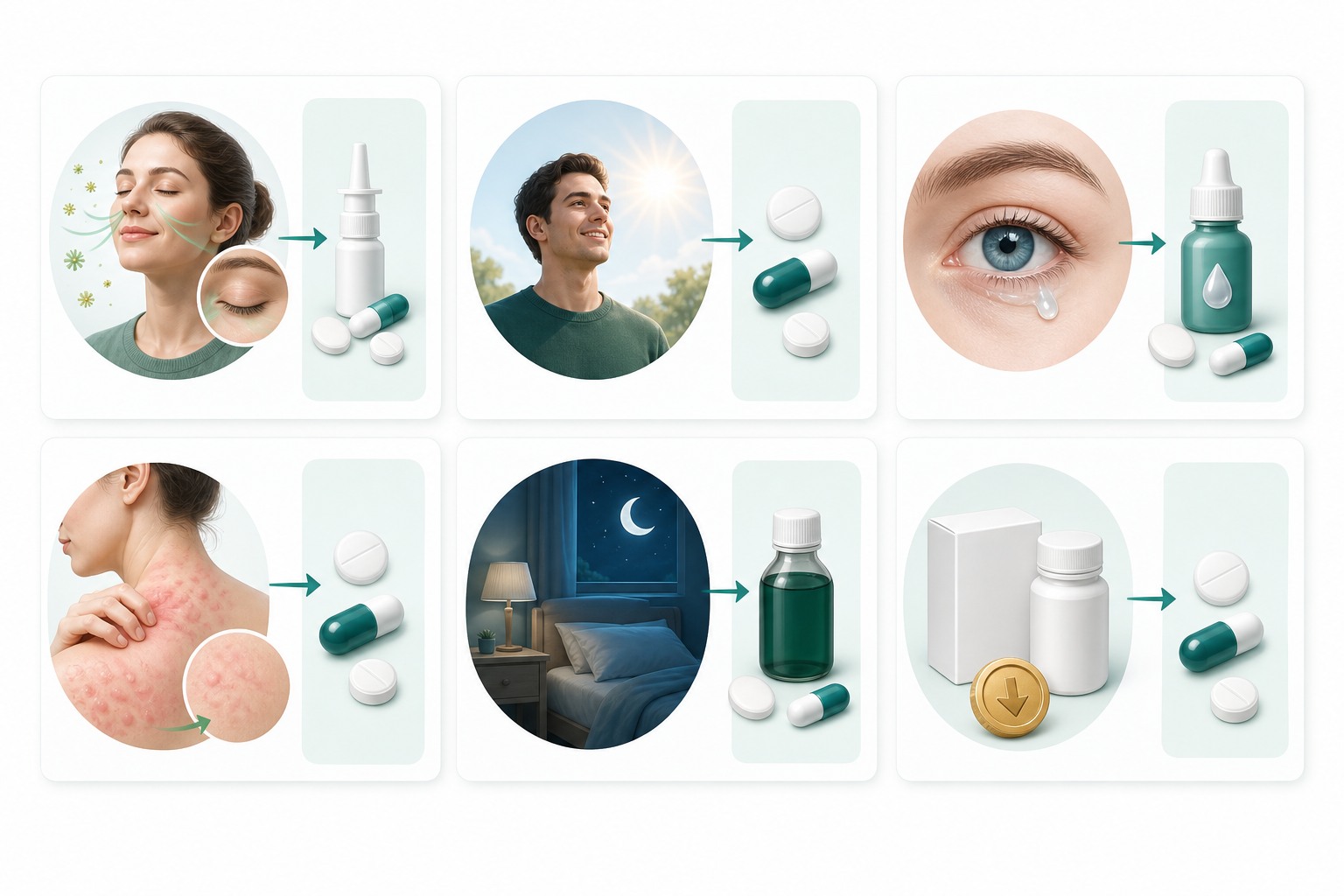
Cetirizine (Zyrtec)
Fast, effective everyday relief; mostly non-drowsy for most people.
Fexofenadine (Allegra)
Least sedating — a strong pick when you must stay alert.
Loratadine (Claritin)
Reliable, low-drowsiness, widely available middle-ground.
Antihistamine eye drops
Target the eyes directly; pair with a tablet if needed.
Diphenhydramine (Benadryl)
Works, but sedating — better for short-term than daily use.
Store-brand generics
Generic cetirizine, fexofenadine or loratadine match the brand-name active ingredient.
What makes an antihistamine "the best" for you?
Four things decide which antihistamine suits you best: your main symptom, how much drowsiness you can tolerate, how fast you need relief, and cost.
- Your main symptom. Antihistamines shine for sneezing, itching, a runny nose and hives, but do less for a badly blocked nose — where a steroid nasal spray usually wins.
- Drowsiness tolerance. Second-generation options are far less sedating than first-generation ones; among them, fexofenadine is generally the least drowsy.
- Speed vs. staying power. Some feel faster; all the second-generation options are designed to last through the day.
- Cost. Store-brand generics contain the same active ingredient as the big brands, usually for much less.
For the science behind how they work and the generations, see our main antihistamines guide.
The popular antihistamines compared
All the second-generation options relieve the same core symptoms; the differences are in drowsiness and how fast they feel. This is an overview, not a dosing guide — follow the label and ask a pharmacist, especially for children, during pregnancy, or with other medicines.
| Generic (brand) | Drowsiness | Feels fast? | Best for | What the label says about drowsiness | Time to peak · half-life |
|---|---|---|---|---|---|
| Cetirizine (Zyrtec) | Low (slightly more than the others) | Often yes | Strong everyday relief. See Claritin vs. Zyrtec. | "Drowsiness may occur"; avoid alcoholic drinks. About 14% of people aged 12 and over reported it in trials, dose-related45 | Peaks ~1 hour · half-life ~8.3 hours5 |
| Fexofenadine (Allegra) | Lowest | Yes | Staying alert. See Zyrtec vs. Allegra. | No drowsiness warning on the label; marked non-drowsy. Crosses into the brain minimally73 | Peaks ~1.5 hours (tablet) · half-life ~14.4 hours3 |
| Loratadine (Claritin) | Low | Moderate | Balanced daily use. See Claritin vs. Allegra. | Warns of drowsiness only if you take more than directed6 | Symptom relief at ~75 minutes in a challenge study10 |
| Levocetirizine (Xyzal) | Low | Often yes | An evening option related to cetirizine. | Closely related to cetirizine; the FDA itching-after-stopping warning covers both9 | Not covered by the labels cited here |
| Diphenhydramine (Benadryl) | High | Yes | Occasional/short-term use only. | Sedating by design: crosses the blood-brain barrier readily and is strongly anticholinergic2 | Peaks ~1.5 hours · half-life ~9 hours in adults2 |
Why second-generation options come first
The single biggest decision on this page is not which brand you pick — it is which generation. That one is not really a matter of taste.
First-generation antihistamines such as diphenhydramine (Benadryl) are highly fat-soluble and cross into the brain readily, acting on receptors there as well as in the body; second-generation options are far more selective and barely enter the brain.1 That single difference produces the sedation, slowed reaction time and anticholinergic effects — dry mouth, urinary retention, constipation, blurred vision — that the older drugs are known for.1
Current evidence-based guidelines put second-generation antihistamines first for allergic rhinitis and hives, on the grounds of efficacy, tolerability and fewer central effects.1 That is why every "best overall" pick on this page is a second-generation option, and why Benadryl appears only as an occasional-use entry.
Sedation is not the same as sleep quality
A first-generation antihistamine will make most people drowsy, but drowsiness and restorative sleep are not the same thing, and next-day grogginess and impaired reaction time are well described. If you are reaching for Benadryl mainly to get to sleep, that is a conversation worth having with a pharmacist or doctor rather than a long-term habit.
A closer look at the top three
Cetirizine (Zyrtec) — best for strong, fast everyday relief
Cetirizine is often the one people reach for when they want noticeable relief quickly. It tends to be among the most effective of the non-drowsy options for sneezing, itching and a runny nose. The small trade-off is that it's slightly more likely than fexofenadine or loratadine to cause mild drowsiness in some people — so it's worth seeing how it affects you before a big day. Compared directly in Claritin vs. Zyrtec.
What the label adds: blood levels peak at about 1 hour and the average elimination half-life is roughly 8.3 hours.5 The consumer label states "drowsiness may occur", tells you to avoid alcoholic drinks, and directs adults 65 and over, children under 6, and anyone with liver or kidney disease to ask a doctor.4 One further point matters if you plan to take it every day for months: the FDA has required a warning that stopping cetirizine or levocetirizine after long-term daily use can cause rare but severe itching within days.9
Fexofenadine (Allegra) — best when you must stay alert
Fexofenadine is generally regarded as the least sedating antihistamine, which makes it a favourite for work, study or driving days. It's effective for the usual nasal and eye symptoms. One practical tip often noted on the label: fruit juices can reduce how well it's absorbed, so water is the better choice. See Zyrtec vs. Allegra.
What the label adds: its Drug Facts label carries no drowsiness warning at all, which is the strongest signal available that it is the least sedating of the group.7 Blood levels peak at about 1.5 hours for the tablet, and it has the longest average half-life of the three at roughly 14.4 hours.3 The absorption caveat is real and has two halves: grapefruit, orange and apple juice reduce uptake by interfering with a gut transport protein, and aluminium or magnesium antacids should be kept a few hours apart from your dose.38 Note also that the 180 mg adult tablet says do not use under 12.7
Loratadine (Claritin) — best balanced all-rounder
Loratadine is a dependable middle-ground: low for drowsiness, widely available, and gentle enough for everyday use. Some people find it a touch less powerful than cetirizine, but it's an excellent starting point, especially if you're sensitive to drowsiness. See Claritin vs. Allegra.
What the label adds: loratadine is the least demanding of the three. It has no food or drink restriction, no antacid rule, and — unlike cetirizine and fexofenadine — no "ask a doctor" flag for adults 65 and over.6 In a controlled ragweed challenge, plain loratadine tablets improved symptoms significantly versus placebo at 75 minutes, so the "slower" reputation is softer than it sounds.10 It is also the simplest routine for a family: once daily at every labelled age, from 2 upward with the children's chewable.6
Generic vs. brand name: is there a difference?
For antihistamines, store-brand generics contain the same active ingredient as the big-name brands and work the same way — usually at a fraction of the price. A box labelled "cetirizine" is the same medicine as Zyrtec; "loratadine" is the same as Claritin; "fexofenadine" is the same as Allegra.
What can differ are inactive ingredients (fillers, dyes, coatings), which occasionally matter to people with specific sensitivities, and the format (tablet, dissolvable, liquid, or a combination product with an added decongestant). The simplest way to save money is to check the active ingredient on the label and pick the cheapest version of it — but read carefully so you don't accidentally buy a combination product you didn't intend. A pharmacist can point you to the right generic in seconds.
Best antihistamine by symptom
Matching the option to your leading symptom often matters more than the brand:
| Main symptom | Best approach |
|---|---|
| Sneezing & runny nose | Any second-generation oral antihistamine. |
| Itchy, watery eyes | Antihistamine eye drops, alone or with a tablet. |
| Hives & itchy skin | Oral second-generation antihistamine. See hives. |
| Nasal congestion | Antihistamines do less here — add a steroid nasal spray. |
| Need to stay alert | Choose the least sedating option (fexofenadine). |
For the full step-by-step approach across every allergy symptom, see our treatment & relief guide and allergy symptoms guide.
Age limits and label flags at a glance
"Best" changes once you are buying for a child or an older parent, and the labels are not interchangeable here. This is what the Drug Facts labels actually say.
| Option | Youngest labelled age | How often | Adults 65 and over |
|---|---|---|---|
| Loratadine (Claritin) | From 2 with the children's 5 mg chewable; the 10 mg tablet is 6 and over6 | Once daily at every labelled age6 | No age-specific flag6 |
| Cetirizine (Zyrtec) | Under 6 — ask a doctor4 | Once daily4 | Ask a doctor4 |
| Fexofenadine (Allegra) | From 2 with the children's liquid; the 180 mg tablet says do not use under 127 | Once daily for 180 mg; the 60 mg tablet and children's liquid are every 12 hours7 | Ask a doctor7 |
All three labels also tell people with kidney disease to ask a doctor, and the loratadine and cetirizine labels add liver disease.467 Always buy the children's product rather than splitting an adult tablet — see children's allergy medicine.
Best antihistamine for children, pregnancy and older adults
For these groups the "best" antihistamine is the one your healthcare professional confirms is appropriate — so check first rather than choosing from the shelf.
- Children: several second-generation antihistamines have child-specific products; suitability depends on age, so ask a pharmacist or pediatrician instead of dividing adult products. See allergies in children.
- During pregnancy or breastfeeding: some options are generally preferred, but this should be decided with your healthcare provider.
- Older adults: non-drowsy second-generation options are usually preferred; first-generation antihistamines are often best avoided because of drowsiness, confusion and fall risk. This is not just convention: the American Geriatrics Society Beers Criteria classes first-generation antihistamines as potentially inappropriate medications in older adults, and recommends second-generation options instead, with dose adjustment based on kidney function.1 Diphenhydramine specifically is described as strongly anticholinergic and a high-risk medicine in older patients because of fall risk from dizziness, sedation and low blood pressure.2 Among the second-generation options, loratadine is the only one of the three whose label carries no "ask a doctor" flag for adults 65 and over.6 See allergies in older adults.
When an antihistamine isn't the best choice
An antihistamine isn't always the answer. If your main problem is a stubbornly blocked nose, a steroid nasal spray usually does more; if symptoms are severe or last most of the year despite treatment, it's worth seeing a doctor to confirm your triggers with allergy testing and consider stronger options, including allergen immunotherapy.
And no antihistamine is a substitute for emergency care in a severe reaction — see the safety note below.
Antihistamines do not treat a severe reaction
A severe, whole-body allergic reaction (anaphylaxis) is a medical emergency. Antihistamines are not an effective treatment for it — the first-line treatment is epinephrine (an auto-injector such as EpiPen). Call 911 immediately for trouble breathing; swelling of the face, lips, tongue or throat; widespread hives; or feeling faint, and use a prescribed epinephrine auto-injector right away if available. See our allergy safety guide.
Best antihistamine: frequently asked questions
What is the best antihistamine for allergies?
What's the best non-drowsy antihistamine?
What's the best antihistamine for hives?
Which is better — Zyrtec, Claritin or Allegra?
Is Benadryl a good antihistamine to use regularly?
What is the best antihistamine for older adults?
What is the best antihistamine for a child?
Which antihistamine works fastest?
Are store-brand generics as good as the brands?
Why does Allegra have to be taken with water?
Is it safe to take an antihistamine every day?
How we create and review this guide
This guide is written for a general audience. Medical review for this site is provided by Dr. Hannah H. Walford, MD, an allergist and immunologist, under our medical review policy. The picks below are editorial guidance based on FDA-approved product labelling and recognised clinical references, not paid placements, and are not personalised recommendations. They draw on authoritative sources:
- American Academy of Allergy, Asthma & Immunology (AAAAI)
- American College of Allergy, Asthma & Immunology (ACAAI)
- Mayo Clinic
- U.S. Food and Drug Administration (FDA)
- U.S. National Library of Medicine (MedlinePlus)
Sources for the specific figures on this page
- StatPearls, NCBI Bookshelf (NIH). Antihistamines (opens in a new tab). First-generation agents crossing the blood-brain barrier versus second-generation peripheral selectivity, anticholinergic adverse effects, guidelines endorsing second-generation agents as first-line for allergic rhinitis and urticaria, and the 2024 American Geriatrics Society Beers Criteria classing first-generation antihistamines as potentially inappropriate in older adults with second-generation agents recommended instead.
- StatPearls, NCBI Bookshelf (NIH). Diphenhydramine (opens in a new tab). Peak plasma concentration around 1.5 hours, terminal half-life roughly 9 hours in adults, antimuscarinic effects, and its description as a high-risk medication in older patients because of fall risk from dizziness, sedation and hypotension.
- StatPearls, NCBI Bookshelf (NIH). Fexofenadine (opens in a new tab). Peak plasma concentration at about 1.5 hours for the tablet, mean elimination half-life of 14.4 hours, minimal blood-brain barrier penetration, and reduced bioavailability with grapefruit, apple and orange juice via P-glycoprotein inhibition.
- DailyMed, U.S. National Library of Medicine. Cetirizine hydrochloride 10 mg — Drug Facts label (opens in a new tab). Once-daily directions, "drowsiness may occur", the alcohol warning, and the "ask a doctor" flags for adults 65 and over, children under 6, and liver or kidney disease.
- DailyMed, U.S. National Library of Medicine. Cetirizine hydrochloride — full prescribing information (opens in a new tab). Time to maximum concentration of approximately 1 hour, mean elimination half-life of 8.3 hours, and dose-related somnolence in about 14% of patients aged 12 and over.
- DailyMed, U.S. National Library of Medicine. Claritin (loratadine) 10 mg — Drug Facts label (opens in a new tab), and children's loratadine 5 mg chewable (opens in a new tab). "Adults and children 6 years and over: 1 tablet daily", the children's chewable from age 2, the liver or kidney disease flag, the absence of any 65-and-over flag, and the drowsiness-if-exceeding-the-dose warning.
- DailyMed, U.S. National Library of Medicine. Fexofenadine hydrochloride 180 mg — Drug Facts label (opens in a new tab), and children's fexofenadine 30 mg/5 mL (opens in a new tab). Once-daily directions with water, "children under 12 years of age: do not use", the children's liquid from age 2 every 12 hours, "adults 65 years of age and older: ask a doctor", the kidney-disease flag, the fruit-juice and antacid instructions, and the absence of any drowsiness warning.
- MedlinePlus, U.S. National Library of Medicine. Fexofenadine (opens in a new tab). The fruit-juice instruction and the aluminium/magnesium antacid spacing instruction.
- U.S. Food and Drug Administration. Drug Safety Communication: FDA requires warning about rare but severe itching after stopping long-term use of the oral allergy medicines cetirizine or levocetirizine (Zyrtec, Xyzal and other trade names) (opens in a new tab). 209 cases identified worldwide from reports received between 25 April 2017 and 6 July 2023.
- Ellis AK, et al. Onset of action for loratadine tablets for the symptomatic control of seasonal allergic rhinitis in adults challenged with ragweed pollen in the Environmental Exposure Unit (opens in a new tab). Allergy, Asthma & Clinical Immunology, 2018. Significant symptom improvement versus placebo at 75 minutes.
Medical disclaimer: This guide is for general education and isn't a substitute for personalized medical advice. It doesn't provide dosing. Always read the product label and talk to a pharmacist or doctor before starting, stopping or combining any medicine.
 MD
MDMedically reviewed
Dr. Hannah H. Walford, MD
Allergist and Immunologist
- Website role
- Owner, Medical Director and Medical Reviewer of Allergy Relief Guide
- Professional affiliation
- Stanford Health Care / Menlo Medical Clinic, Menlo Park, California
- Areas of expertise
- Food allergy, eczema, allergic rhinitis, sinusitis and asthma
Dr. Hannah H. Walford is a board-certified allergist and immunologist experienced in caring for adults and children with allergic conditions. Her areas of expertise include food allergy, eczema, allergic rhinitis, sinusitis and asthma. She provides medical leadership and review oversight for the educational health content published by Allergy Relief Guide.
Medical content is provided for education and is not a substitute for diagnosis or individualized medical care.
Compare specific brands head-to-head
Claritin vs. Zyrtec
Loratadine vs. cetirizine, compared.
Zyrtec vs. Allegra
Strength vs. lowest drowsiness.
Claritin vs. Allegra
Two everyday non-drowsy options.
Antihistamines guide
How they work and the full picture.
Nasal sprays
Better for stubborn congestion.
Treatment & relief
The complete allergy plan.
All three compared
Loratadine, cetirizine and fexofenadine side by side.
First vs. second generation
Why Benadryl sits in a different category.
Zyrtec vs. Xyzal
Cetirizine against levocetirizine.
Antihistamine side effects
What to expect and what to watch for.
Children's allergy medicine
Choosing by age, safely.
Still torn between two brands?
Our head-to-head comparisons break down speed, drowsiness and who each one suits.
Compare Claritin vs. Zyrtec