
Allergy Season Calendar: When Each Allergy Peaks
Tree, grass, weed and mold — a month-by-month map of when each one is in the air, so you can prepare before symptoms hit.
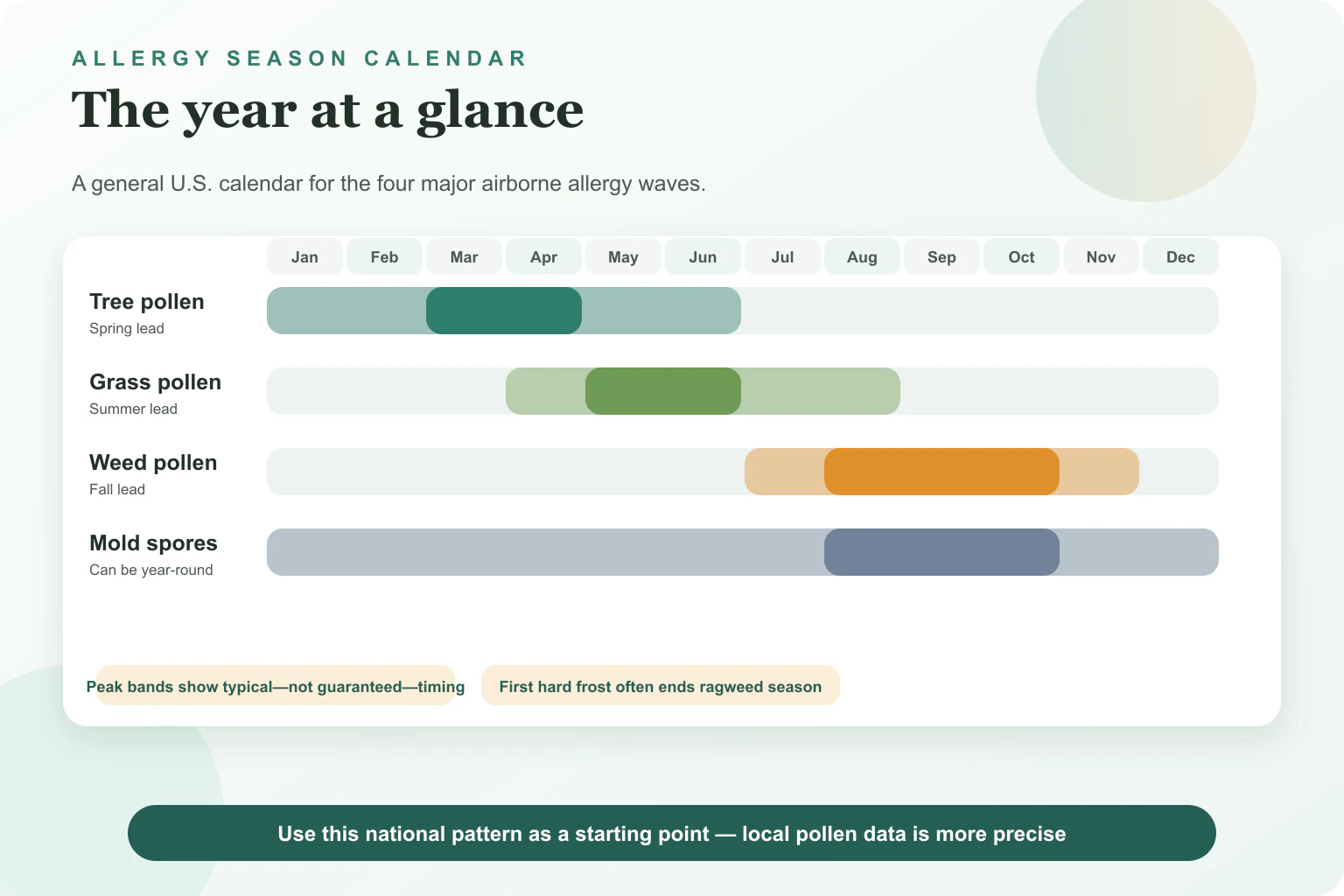
Quick answer: when is allergy season?
Short answer: across the US, pollen is in the air from roughly February to November. Trees run late winter to spring, grasses late spring to summer, weeds like ragweed late summer to the first hard frost, and mold year-round. Your personal season is only the weeks your own trigger is airborne — usually far shorter than the whole calendar.
In most of the U.S., allergy season runs from about February through November. Tree pollen dominates late winter and spring, grass pollen peaks in late spring and summer, and weed pollen like ragweed takes over in late summer and fall until the first hard frost. Mold can trigger symptoms year-round. Which weeks are worst for you depends on which pollen you react to and where you live — so the calendar below breaks it down by trigger and by month.
Allergy season by trigger
Each allergen has its own window. Find your trigger to see when to expect symptoms.
| Allergen | Season | Peak | Notes |
|---|---|---|---|
| Tree pollen | Late winter – spring | April | First pollen of the year; oak, birch, cedar, maple |
| Grass pollen | Late spring – summer | May – June | Timothy, Bermuda, rye, Kentucky blue |
| Weed pollen | Late summer – fall | September | Ragweed dominant; ends at first frost |
| Mold spores | Year-round | Late summer – fall | Thrives in damp; spikes with fallen leaves |
Learn each in depth: spring (tree), pollen allergy, ragweed, fall allergies and indoor & mold.
Allergy season month by month
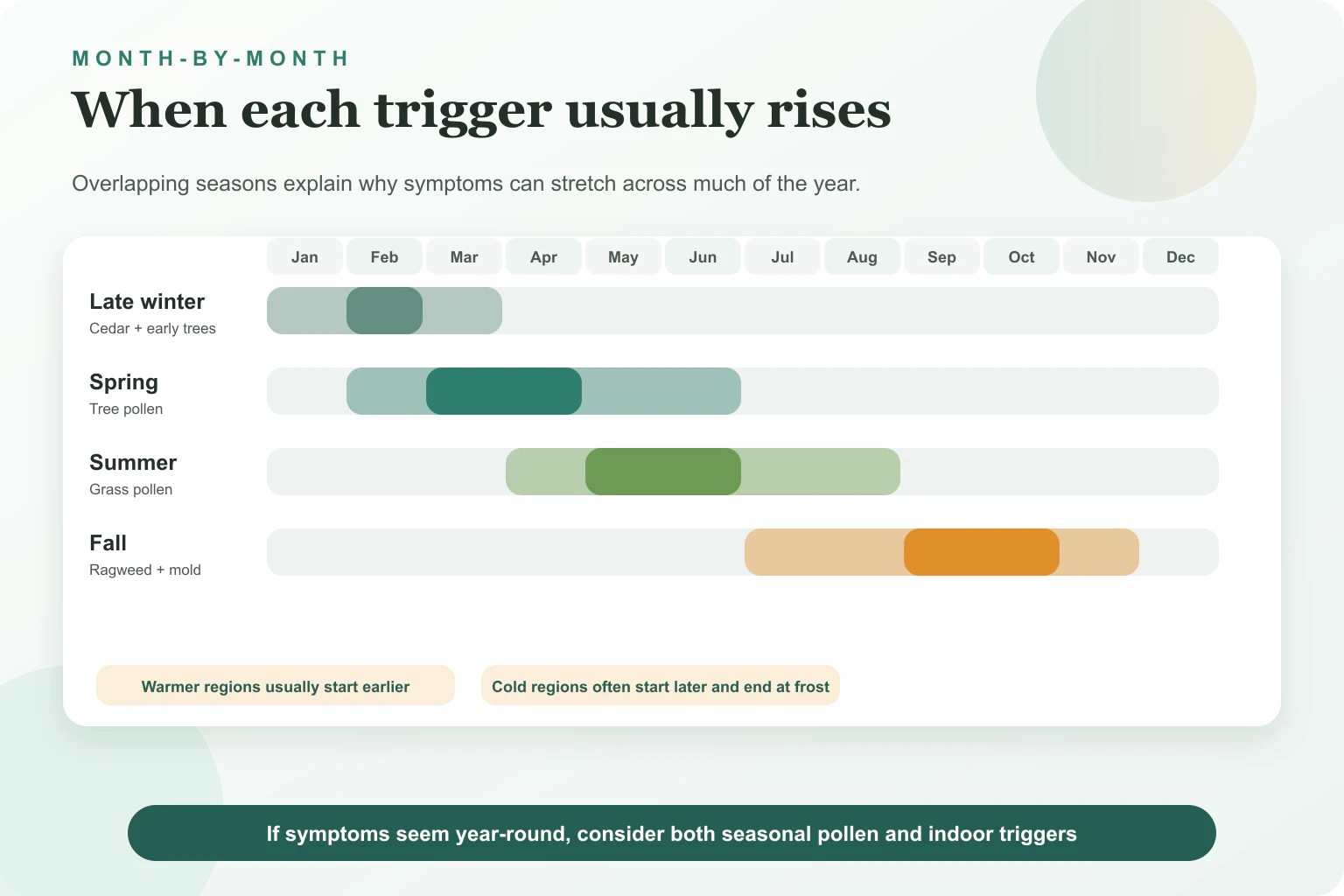
Here's what's typically in the air across the year in much of the U.S. Timing shifts earlier in warm regions and later in cold ones.
| Month | Main allergens |
|---|---|
| January | Low overall; earliest trees (alder, maple); mountain cedar in the South |
| February | Tree pollen begins; cedar still high in the South |
| March | Tree pollen rising (elm, maple, ash, poplar) |
| April | Tree pollen peaks (oak, birch, pine, mulberry) |
| May | Tree fading, grass rising — overlap "double whammy" |
| June | Grass pollen peaks (Timothy, Bermuda, rye) |
| July | Grass continues; mold spores rising; early weeds |
| August | Ragweed & weed season begins; mold high |
| September | Ragweed peaks — worst month for weed allergy |
| October | Ragweed easing; mold from fallen leaves |
| November | Low; late weeds & mold until the first hard frost |
| December | Lowest; early cedar/tree pollen in the South; indoor allergens |
Season by season: what to expect
The tables show the timing; here's the context behind each stretch of the year.
Spring (tree pollen)
From roughly February to May, trees drive symptoms — oak, birch, cedar, maple and more release light, wind-borne pollen that peaks in April. Counts run highest in the early morning, so you can wake up stuffy after a fine evening. This is the classic "hay fever" stretch; see spring allergies.
Summer (grass pollen and mold)
As trees fade, grass takes over from about May through July, peaking in May–June with Timothy, Bermuda, rye and Kentucky bluegrass. Warm, humid weather also lifts mold-spore counts, and mowing the lawn sends both grass pollen and mold into the air — a reliable symptom trigger.
Fall (ragweed and weeds)
Late summer into fall belongs to weed pollen, above all ragweed, which peaks in September and lingers until the first hard frost. Ragweed counts are often highest around midday, and the pollen travels hundreds of miles, so you can react without a plant in sight. Damp fallen leaves add a mold burden too; see fall allergies and ragweed.
Winter (mostly indoor)
Outdoor pollen is lowest in winter, so year-round symptoms in December and January usually point to indoor triggers — dust mites, pet dander and indoor mold — rather than pollen. The main exception is the South, where mountain cedar can spike ("cedar fever") from December. See indoor allergies.
What are the worst months for allergies?
It depends entirely on which pollen you react to. For tree-pollen allergies, April is usually the worst; for grass, May and June; and for ragweed and other weeds, late August through September. If you're sensitive to more than one, May can feel brutal because tree and grass pollen overlap. Confirming your specific trigger — through symptom timing or allergy testing — tells you exactly which weeks to prepare for.
When does allergy season end?
For pollen, the season ends when the plants stop releasing it — and weed pollen, including ragweed, keeps going until the first hard frost. That's often October or November in northern areas, and later in warmer regions. Because your symptoms last as long as you're exposed, a longer, warmer autumn can stretch weed season well past its usual finish.
Mold is the exception: it doesn't follow a neat pollen calendar and can cause symptoms year-round, peaking in damp conditions and around decaying autumn leaves. And once outdoor pollen fades, indoor triggers like dust mites and pet dander can keep year-round symptoms going — see indoor allergies.
How long does allergy season last?
Across all triggers combined, allergy season can span roughly February through November — eight or nine months of potential exposure in much of the U.S. But that doesn't mean any one person suffers that whole time. Most people react to only one or two allergens, so your personal season is usually just the weeks when your trigger is in the air — a few weeks to a couple of months. Pinning down which pollen affects you is what turns a vague, months-long worry into a short, predictable window you can plan around.
How allergy season varies by region
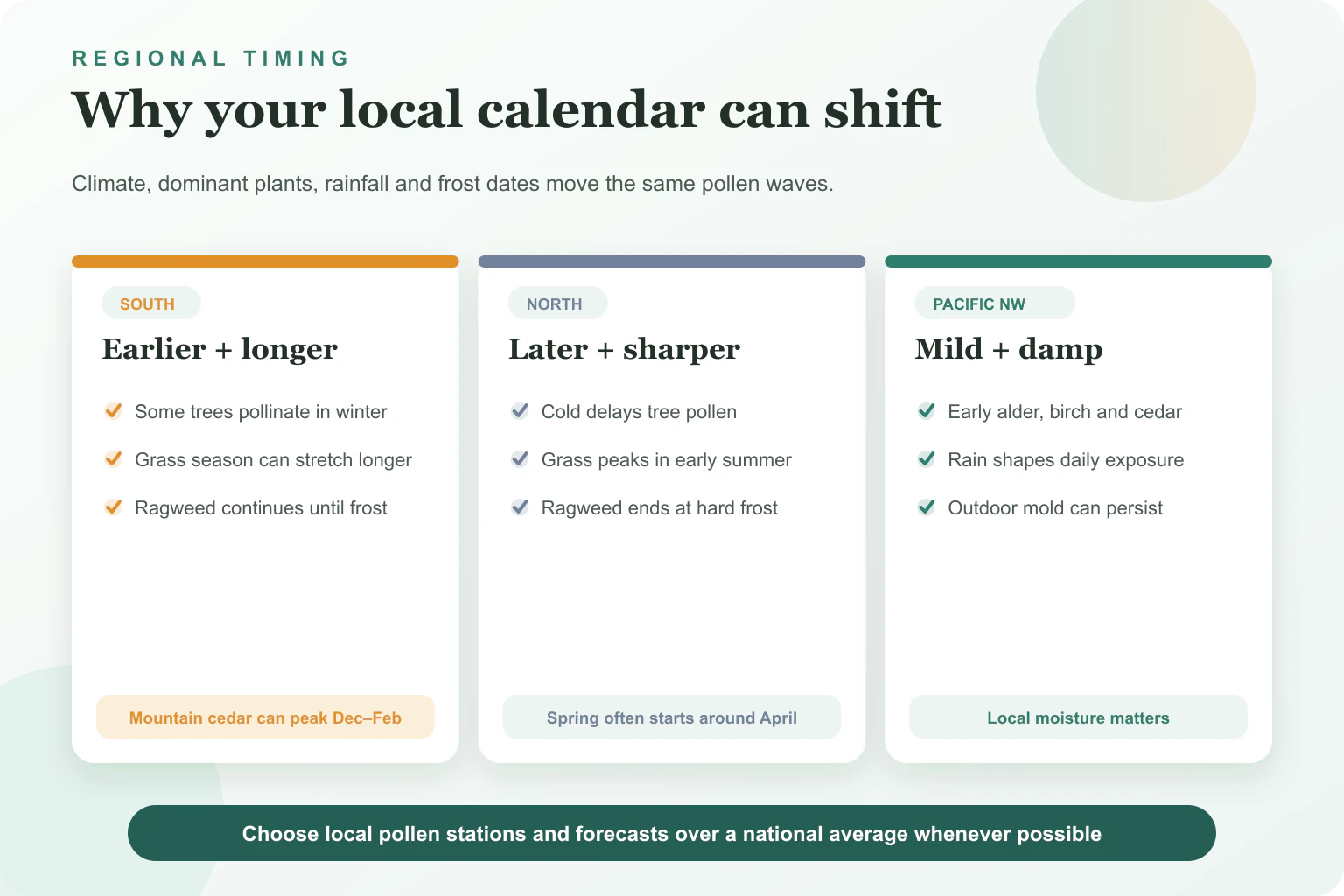
The calendar above is a national average — your local season can run weeks earlier or later.
South & warm climates
Earliest and longest seasons. In parts of Texas, mountain cedar peaks in December–February ("cedar fever"); trees, grass and ragweed then stretch through much of the year.
North & cold climates
Cold winters delay the start — tree pollen often waits until April, grass peaks in early summer, and ragweed runs August to the first frost.
Pacific Northwest
Mild, wet climate means early tree pollen (alder, birch, cedar from February) and year-round mold from frequent rain.
Everywhere
Ragweed pollen can travel hundreds of miles, so you can react even if it doesn't grow locally.
Why allergy season is getting longer
Pollen seasons across North America are starting earlier and lasting longer, with higher pollen counts — a shift linked to a warming climate. Milder winters mean fewer hard freezes to hold plants back, so trees pollinate sooner and weed seasons run later into the fall. That's one reason more people are being diagnosed with seasonal allergies for the first time, sometimes well into adulthood.
How much the calendar has actually shifted
The change has been measured, and the way it is usually quoted is slightly wrong. A 2021 study in PNAS analysed 60 North American pollen monitoring stations across 821 site-years from 1990 to 2018:
| What changed | How much, 1990–2018 | Share attributed to human-caused climate change |
|---|---|---|
| Season start date | About 20 days earlier | Roughly 35–66% |
| Season length | About 8 days longer | Roughly 19–35% |
| Pollen concentration | Up about 21% | Roughly 4–8% |
You will often read that pollen seasons are "20 days longer." They are not. They begin about 20 days earlier and run about 8 days longer. For a calendar page that distinction matters more than anywhere else: the practical effect is that the whole grid above shifts left, rather than stretching at the far end.
The attribution deserves reading carefully too. Climate change accounts for a large share of the shift in timing, but only a small share of the rise in pollen concentration, which has other contributors. Either way, if you still mark your season by the month you used to react in, that mark may now be late. More in why pollen seasons are getting longer and why are my allergies so bad this year?
Time of day and weather matter too
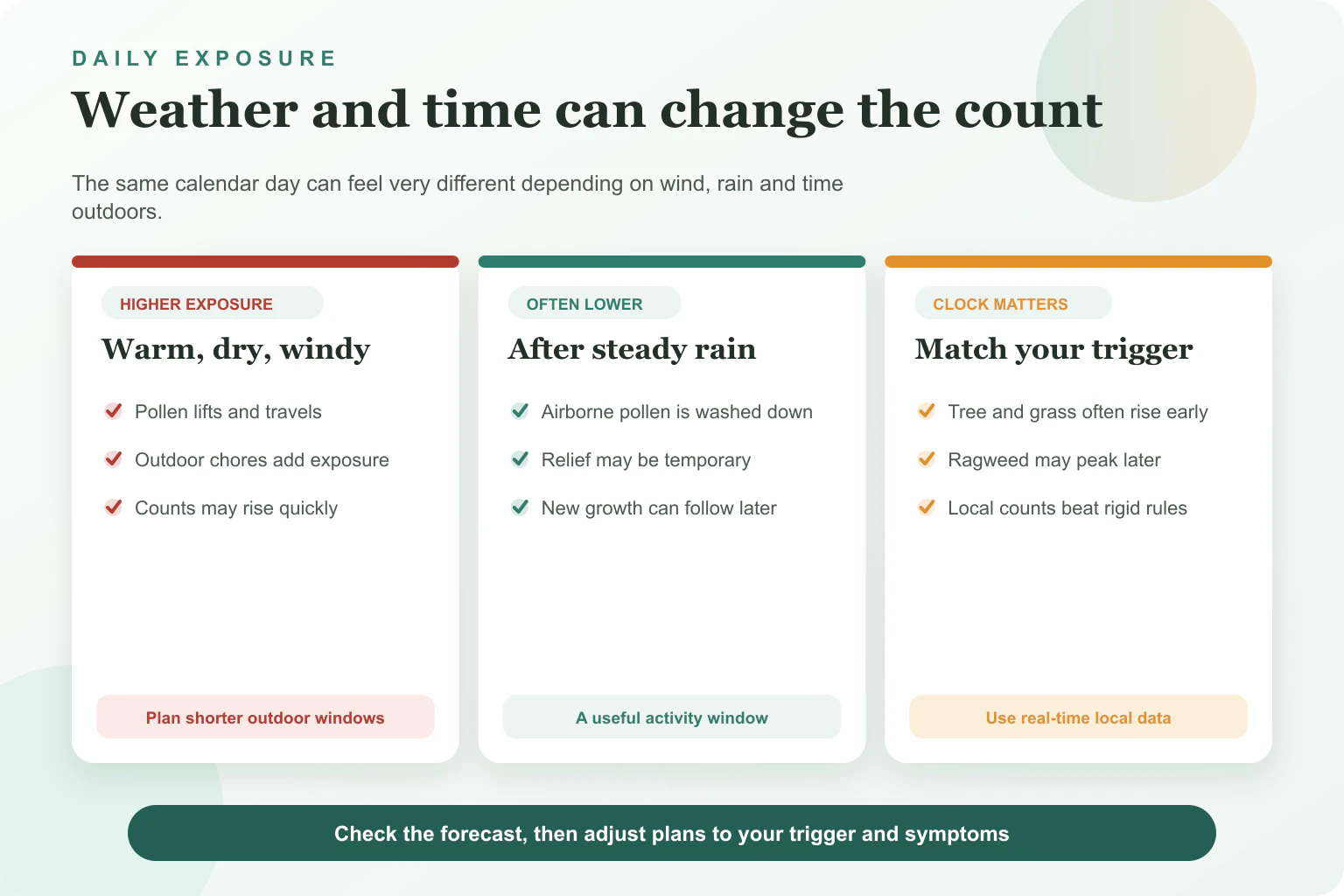
Even within your season, exposure rises and falls with the clock and the forecast. Tree and grass pollen counts tend to be highest in the early morning, while ragweed often peaks midday, around 10 a.m. to 3 p.m. Warm, dry, windy days send counts soaring; rain washes pollen from the air, giving temporary relief (though it can fuel more growth afterward). Checking the daily pollen forecast lets you time outdoor plans and medication.
One caveat about the forecast itself. The Allergy & Asthma Network notes that daily pollen counts often represent collections made 24 to 48 hours earlier, so today's number can describe yesterday's air. Read it as a trend rather than a live reading, and let current weather fill in the rest. The Network also advises starting allergy medicine about one to two weeks before your pollen season begins — which is exactly what this calendar is for.
Our pollen count guide explains what the numbers mean, and allergy season by region covers how far the timing shifts across the country. Local variation can be extreme: mountain cedar is an early bloomer that can cause symptoms in December in Texas and Oklahoma, months before anyone else considers it allergy season.
Go deeper on your window
Once you know which weeks are yours, each one has a guide of its own.
| Your window | Guide |
|---|---|
| February to May | Spring allergies and tree pollen |
| May to July | Summer allergies and grass pollen |
| August to first frost | Fall allergies and ragweed |
| December and January | Winter allergies, dust mites and indoor allergens |
| Damp weather and leaf litter | Mold allergy |
| Smoke and poor air quality days | Air quality and allergies |
| Raw fruit itches your mouth in season | Oral allergy syndrome |
| Your season reaches your chest | Allergic asthma |
| Working out which symptoms are allergy | Allergy symptoms |
| Choosing a medicine | Allergy medicine |
| Rinsing and filtering at home | Saline rinsing, HEPA filters and air purifiers |
| Treating the cause instead of each season | Allergy shots and under-the-tongue tablets |
How to prepare for your season
The calendar's real value is letting you get ahead of symptoms instead of chasing them.
- Mark your trigger's peak weeks from the tables above.
- Start daily allergy medicine — especially steroid nasal sprays — about one to two weeks before your season begins.
- Track the daily pollen forecast and plan outdoor time for low-count days and after rain.
- Keep windows closed, use air conditioning and a HEPA filter, and shower after being outside.
- If symptoms are hard to control, confirm your triggers with allergy testing.
See the complete plan in our treatment & relief guide and compare medicines in antihistamines.
Allergy season calendar: frequently asked questions
When is allergy season?
What months are worst for allergies?
Does allergy season vary by state?
When does ragweed season end?
Has the allergy calendar shifted over time?
How far ahead of my season should I start medicine?
How accurate is a daily pollen count?
Why do I react to raw fruit during my pollen season?
Can I have allergy symptoms outside pollen season?
How we create and review this guide
This guide is written for a general audience using patient-education material from the authoritative sources below, not blogs or forums. Timing reflects general U.S. patterns:
- American Academy of Allergy, Asthma & Immunology (AAAAI) & National Allergy Bureau
- Asthma and Allergy Foundation of America (AAFA)
- American College of Allergy, Asthma & Immunology (ACAAI)
- Mayo Clinic
- U.S. Centers for Disease Control and Prevention (CDC)
Sources for the specific figures on this page
- Anderegg WRL, Abatzoglou JT, Anderegg LDL, Bielory L, Kinney PL, Ziska L. Anthropogenic climate change is worsening North American pollen seasons (opens in a new tab). PNAS 2021. Sixty North American pollen stations across 821 site-years, 1990–2018: seasons starting about 20 days earlier, lengthening about 8 days, and concentrations rising about 21%, with human forcing attributed roughly 35–66% of start-date trends, 19–35% of season-length trends and 4–8% of annual concentration trends.
- Allergy & Asthma Network. Pollen allergy (opens in a new tab). Starting allergy medication about one to two weeks before pollen season begins; daily counts often representing collections made 24 to 48 hours earlier; tree, grass and weed season timing including mountain cedar in December in Texas and Oklahoma.
- American College of Allergy, Asthma & Immunology. Pollen food allergy syndrome (opens in a new tab). Cross-reacting proteins in pollen and raw foods, the birch, grass and ragweed cross-reaction lists, and cooked foods normally being tolerated because heating distorts the protein.
- American College of Allergy, Asthma & Immunology. Hay fever (allergic rhinitis) (opens in a new tab). Intranasal corticosteroids described as the single most effective drug class for allergic rhinitis, and rebound swelling from prolonged decongestant nasal spray use.
- MedlinePlus, U.S. National Library of Medicine. Hay Fever (opens in a new tab). Pollen-triggered allergy symptoms and the relief options available, including medicines, nasal sprays and allergy shots.
Note: This calendar shows general U.S. timing; your local season depends on region, plant species and weather. For personalized guidance, talk to a healthcare professional. This guide is for general education and doesn't provide dosing.
 MD
MDMedically reviewed
Dr. Hannah H. Walford, MD
Allergist and Immunologist
- Website role
- Owner, Medical Director and Medical Reviewer of Allergy Relief Guide
- Professional affiliation
- Stanford Health Care / Menlo Medical Clinic, Menlo Park, California
- Areas of expertise
- Food allergy, eczema, allergic rhinitis, sinusitis and asthma
Dr. Hannah H. Walford is a board-certified allergist and immunologist experienced in caring for adults and children with allergic conditions. Her areas of expertise include food allergy, eczema, allergic rhinitis, sinusitis and asthma. She provides medical leadership and review oversight for the educational health content published by Allergy Relief Guide.
Medical content is provided for education and is not a substitute for diagnosis or individualized medical care.
Related guides
Seasonal allergies
The full overview of hay fever.
Spring allergies
Tree-pollen season in depth.
Fall allergies
Ragweed and autumn triggers.
Treatment & relief
How to get ahead of your season.
Pollen counts
What the daily number actually means.
Season by region
How far the calendar shifts near you.
Summer allergies
Grass pollen and mold months.
Winter allergies
Why symptoms continue off-season.
Know your season — now get relief
Start the right medicine before your peak weeks with our step-by-step treatment guide.
Go to the treatment & relief guide