Claritin vs. Zyrtec: Speed, Drowsiness and Which One Suits You
Two of the most popular non-drowsy antihistamines, compared on the things that actually matter — drowsiness, speed, strength and who each one suits.

Quick answer: Claritin vs. Zyrtec
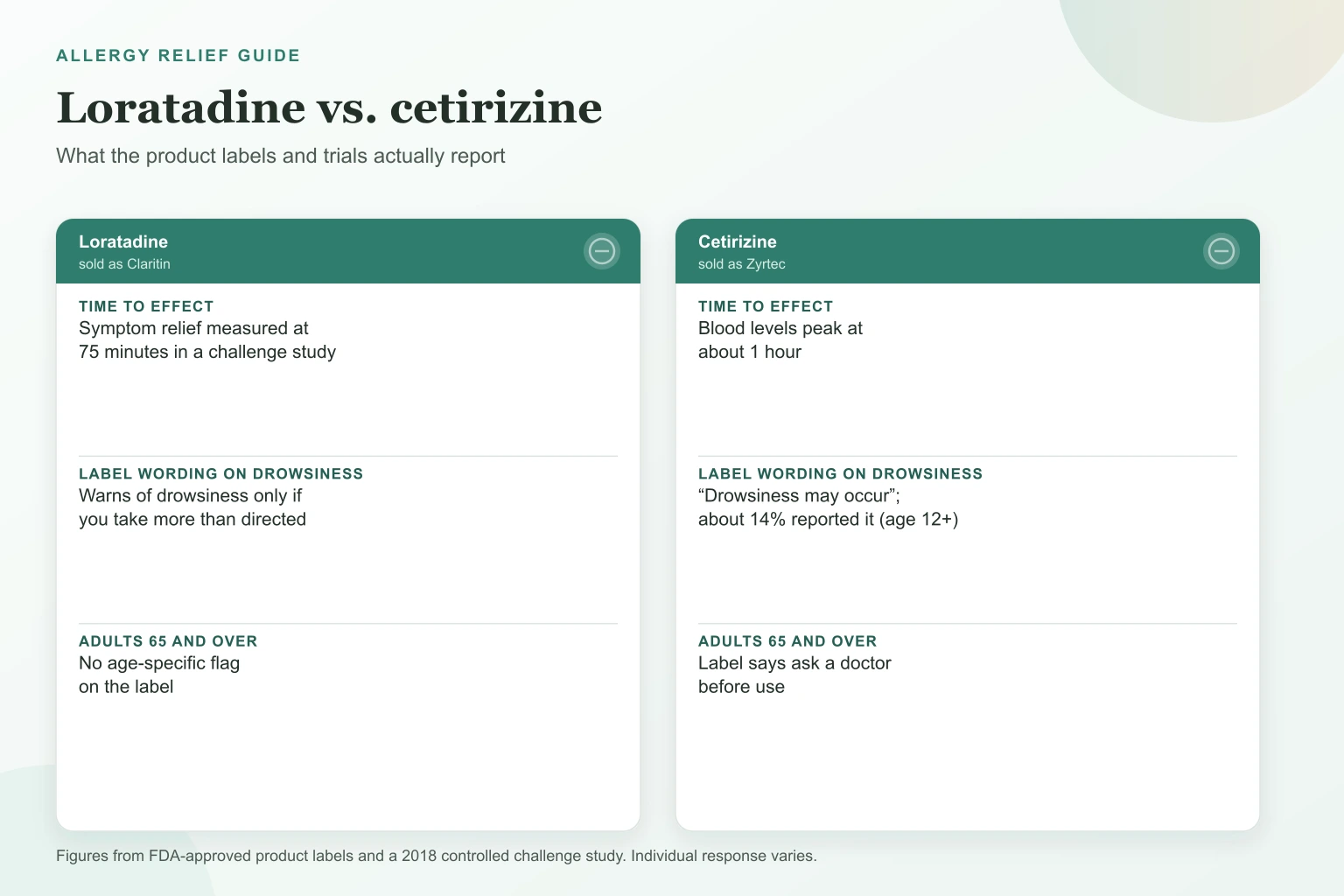
Zyrtec (cetirizine) is absorbed fastest — blood levels peak about 1 hour after a dose — while Claritin (loratadine) tablets were shown to start easing hay fever symptoms at around 75 minutes. Both last a full 24 hours on once-daily dosing. The trade-off is drowsiness: cetirizine caused sleepiness in about 14% of people aged 12 and over in clinical trials, and loratadine is the less sedating of the two.
Both are effective second-generation antihistamines, so the "better" one is individual. Zyrtec (cetirizine) tends to work a little faster and feel stronger, but is slightly more likely to cause mild drowsiness. Claritin (loratadine) is a touch gentler and among the least sedating options. In short: if you want the strongest everyday relief, many people prefer Zyrtec; if staying fully alert matters most, Claritin may suit you better. Both are once-daily, available as low-cost generics, and it's fine to try one and switch if it doesn't suit you. This is general information, not dosing or personal medical advice.
Claritin vs. Zyrtec at a glance
| Claritin | Zyrtec | |
|---|---|---|
| Active ingredient | Loratadine | Cetirizine |
| Generation | Second (non-drowsy) | Second (non-drowsy) |
| Drowsiness | Very low | Low, but slightly higher |
| Speed | Works within hours | Often feels a bit faster |
| Strength (perceived) | Gentle, reliable | Often stronger for tough symptoms |
| How often | Once daily | Once daily |
| Generic available | Yes | Yes |
| Typical onset | Symptom relief measured at about 75 minutes in a ragweed-challenge study | Blood levels peak about 1 hour after a dose |
| How long a dose lasts | 24 hours | 24 hours |
| Drowsiness in trials | The less sedating of the two | Sleepiness reported by about 14% of people aged 12 and over |
| Also used for hives | Has been used for the itching and redness of hives | Listed use includes hives (urticaria) |
| Label says ask a doctor if | You have liver or kidney disease | You have liver or kidney disease, or you are 65 or over |
| Alcohol and sedatives | Can add to any drowsiness | Label says avoid alcoholic drinks; sedatives may increase drowsiness |
| Breastfeeding | Label says ask a health professional | OTC label says not recommended |
| Itching after stopping long-term daily use | Not described for loratadine | FDA warns of rare but severe itching after months to years of daily use |
| "-D" version | Claritin-D adds the decongestant pseudoephedrine | Zyrtec-D adds the decongestant pseudoephedrine |
How fast does each one start working?
Speed is the difference people notice first, and it is where the marketing and the published evidence do not quite line up.
- Zyrtec (cetirizine) is absorbed quickly — the FDA product label reports blood levels peaking at roughly 1 hour after an oral dose, with an average elimination half-life of about 8.3 hours.3
- Claritin (loratadine) is often described as slower. In a controlled ragweed-pollen challenge study, plain loratadine tablets produced a significant improvement in hay fever symptoms compared with placebo at 75 minutes — noticeably earlier than the 3-hour figure quoted from older capsule formulations.5
- Both are labelled for once-daily use and are designed to keep working across a full 24 hours.24
The practical read: for a same-day rescue dose, cetirizine has a small head start, but the gap is closer to tens of minutes than the "1 hour versus 3 hours" comparison you will see in advertising. If you take either one daily through your season, onset stops mattering — steady-state relief is what counts. See how long Zyrtec takes to work for more on timing a first dose.
Neither one is an instant fix
Antihistamines block histamine that has not been released yet — they do not undo swelling and congestion that has already built up. Taking a dose before a known exposure, such as mowing the lawn or visiting a home with a cat, works better than taking one after symptoms peak.
What each one is
Claritin
Active ingredient: loratadine
A second-generation antihistamine known for being gentle and among the least likely to cause drowsiness. A dependable everyday choice.
Best for: people who want reliable relief with minimal chance of feeling sleepy.
Watch-out: some people find it feels slightly less powerful for heavy symptoms.
Zyrtec
Active ingredient: cetirizine
A second-generation antihistamine that many people find fast and strong, making it a favourite when symptoms are stubborn.
Best for: people who want the strongest everyday relief and don't mind a small chance of mild drowsiness.
Watch-out: slightly more likely than Claritin to cause mild sleepiness.
Head-to-head: the differences that matter
Drowsiness
This is the main practical difference. Both are classed as non-drowsy, but a small percentage of people feel mild sleepiness on cetirizine (Zyrtec), while loratadine (Claritin) is among the least sedating antihistamines available. If your day depends on staying sharp, Claritin has the edge — and fexofenadine (Allegra) is worth considering too.
The numbers give this some shape. In the clinical trials behind the cetirizine label, sleepiness was reported by about 14% of people aged 12 and over, and it was dose-related — more common at 10 mg than at 5 mg.3 Loratadine's consumer label treats drowsiness as something that mainly appears if you take more than directed.4 So "non-drowsy" is accurate for most people on either drug, but roughly one in seven people will feel something on cetirizine. If that is you, it usually shows up in the first few days. More on the mechanism in why antihistamines make you drowsy.
Speed and strength
Many people find Zyrtec kicks in a little faster and feels stronger against tougher symptoms, which is why it's often the pick when Claritin isn't quite cutting it. Both are designed to last through the day with once-daily use.
Forms and price
Both come as tablets, dissolvable tablets and liquids, and both are sold as inexpensive store-brand generics (loratadine and cetirizine) that match the branded versions. Price is rarely the deciding factor.
Symptom fit
Both work best for sneezing, itching, a runny nose and itchy eyes, and both do less for heavy congestion — where a steroid nasal spray usually helps more.
Side effects
As close relatives in the same drug class, Claritin and Zyrtec share a similar, generally mild side-effect profile: the most common are a dry mouth, occasional headache, and — mainly with Zyrtec in a minority of people — mild drowsiness. Both are far better tolerated than older first-generation antihistamines, which is why they're the go-to for daily use. As with any medicine, avoid doubling up on products that contain the same ingredient, and check with a pharmacist before combining either with other medicines or alcohol.
Two label details are worth knowing before you pick. The cetirizine consumer label tells you to avoid alcoholic drinks and warns that sedatives and tranquillisers can increase drowsiness, and it says cetirizine is not recommended while breastfeeding.2 The Claritin label asks anyone who is pregnant or breastfeeding to check with a health professional first.4 Both labels tell people with liver or kidney disease to ask a doctor, because how the drug is cleared can change. See antihistamine side effects and antihistamines and alcohol.
Which should you choose?
- Choose Zyrtec (cetirizine) if you want the strongest, fastest everyday relief and a small chance of mild drowsiness is acceptable.
- Choose Claritin (loratadine) if staying fully alert is a priority, or Zyrtec has made you feel drowsy in the past.
- Consider a third option if neither fits — fexofenadine (Allegra) is the least sedating; compare in Zyrtec vs. Allegra and Claritin vs. Allegra, or see our best antihistamine overview.
Because people respond differently, the most reliable "test" is a fair trial: give one a proper go, and if it doesn't suit you, switch. A pharmacist can help you decide based on your symptoms and any other medicines.
Which one is better for hives?
This is the one situation where the two are not interchangeable on paper. Cetirizine (Zyrtec) is described as a treatment for hives — urticaria — as well as hay fever, and a Zyrtec Hives product is sold specifically for that use.1 Loratadine (Claritin) is primarily labelled for hay fever and upper respiratory allergies, though it has also been used for the itching and redness of hives.6
In practice, clinicians often reach for cetirizine or levocetirizine first for itchy skin, partly because they are the more sedating of the second-generation options — which can be an advantage when itching is disturbing sleep. If a standard dose is not controlling the hives, that is a conversation to have with a clinician rather than a reason to keep increasing the dose yourself.
Get medical care rather than self-treating if hives last more than about six weeks, keep coming back, are joined by swelling of the lips, tongue or throat, or come with any trouble breathing. Read more in hives and urticaria and antihistamines for hives.
Claritin-D vs. Zyrtec-D: a different decision
The "-D" boxes look like the same product with a bonus, but they are not the same choice. Both add pseudoephedrine, a decongestant that shrinks swollen nasal blood vessels. That is genuinely useful for blocked-nose congestion, which plain antihistamines do little for — but it brings its own trade-offs.
- Decongestants can raise blood pressure and heart rate, so they are not a casual pick if you have high blood pressure, heart disease, an overactive thyroid or glaucoma.
- They can cause restlessness and make it harder to sleep, which is why the "-D" products are usually taken earlier in the day.
- In the United States they are sold from behind the pharmacy counter and need photo ID.
- They are meant for short stretches, not all-season daily use.
If congestion is your main complaint, a steroid nasal spray is usually the better long-term answer than a daily decongestant. More on the trade-offs in decongestants for allergies.
Can you take Claritin and Zyrtec together — or switch?
Taking two oral antihistamines at once isn't generally recommended without medical advice, because it can add to side effects without reliably improving relief. If one isn't controlling your symptoms, it's usually better to switch to the other, or add a different type of medicine — such as a nasal spray for congestion — rather than doubling up.
Switching between them is straightforward for most people; a pharmacist can advise on timing — there is no washout period to observe, and you can simply start the new one the next day. More detail in taking two antihistamines together. If you regularly need more than a standard approach provides, that's a good reason to see a doctor and review your plan — see when to see a doctor.
Children, pregnancy and older adults
For these groups, check with a healthcare professional before choosing between Claritin and Zyrtec. Both have child-specific products, but suitability depends on age, so ask a pharmacist or pediatrician (see allergies in children). During pregnancy or breastfeeding, the choice should be made with your provider. Older adults generally do well with either non-drowsy option, and should avoid older first-generation antihistamines where possible.
- Children. Both consumer labels direct you to ask a doctor for children under 6, and children's versions are sold at lower strengths. See children's allergy medicine.
- Adults 65 and over. The cetirizine label specifically says ask a doctor for this age group.2 The Claritin label does not carry the same age flag.4 That makes loratadine the simpler over-the-counter starting point for many older adults — see allergies in older adults.
- Pregnancy and breastfeeding. The cetirizine label says it is not recommended while breastfeeding; the Claritin label asks you to check with a health professional.24 See allergy medicine in pregnancy and allergy medicine while breastfeeding.
- Liver or kidney disease. Both labels say to ask a doctor, who may decide a different dose is needed.24
Stopping Zyrtec after long-term use: the itching warning
This is a real difference between the two that most comparisons leave out, and it matters if you take an antihistamine every day for months on end.
The FDA has required a warning that people who stop cetirizine (Zyrtec) or levocetirizine (Xyzal) after long-term daily use can develop rare but severe itching — pruritus — within a few days of stopping, even though they had no itching before they started.7 Reviewing reports received between April 2017 and July 2023, the FDA identified 209 cases worldwide. The pattern was people who had taken the medicine daily for at least a few months, and often for years. Symptoms settled in most people who restarted the medicine, and in some who then tapered off it.7
Loratadine (Claritin) is not part of this warning. If you already know you will be taking an antihistamine daily for a long stretch, that is a reasonable point in Claritin's favour.
What to do if this happens to you
- Do not assume the itching is a new allergy — tell a healthcare professional that you recently stopped a long-term antihistamine.
- Do not restart or taper the medicine on your own plan; ask a clinician or pharmacist how to do it.
- This is rare. It is a reason to be informed, not a reason to avoid cetirizine if it is the drug that works for you.
Neither is for a severe reaction
Neither Claritin nor Zyrtec treats anaphylaxis, a severe whole-body allergic reaction. The first-line treatment is epinephrine (an auto-injector such as EpiPen). Call 911 immediately for trouble breathing; swelling of the face, lips, tongue or throat; widespread hives; or feeling faint, and use a prescribed epinephrine auto-injector right away if available. See our allergy safety guide.
What to do if neither one works
If you have given both a fair trial — a couple of weeks of consistent daily use each, during your symptom season — and you are still struggling, the answer is usually not a third antihistamine. Work through this instead:
- Check you are treating the right problem. Facial pain and pressure, thick discoloured mucus and a fever point away from allergy. Compare the patterns in allergies vs. a sinus infection.
- Add a different type of medicine, not another of the same. Congestion and nasal inflammation respond much better to a steroid nasal spray; itchy, watery eyes often need allergy eye drops.
- Reduce the exposure driving it. Medicine works harder when the trigger is still in the room — see indoor allergens and allergy-proofing a bedroom.
- Find out what you are actually reacting to. Allergy testing turns guesswork into a plan.
- Ask about longer-term treatment. Allergy shots and under-the-tongue immunotherapy aim at the underlying sensitivity rather than the day's symptoms. An allergist can tell you whether you are a candidate.
Persistent symptoms that need daily medicine for months, disturb your sleep, or affect work or school are a reasonable reason to be seen — see when to see a doctor for allergies.
The bottom line
You can't really go wrong — both Claritin and Zyrtec are proven, once-daily, non-drowsy antihistamines that relieve the same core allergy symptoms. The decision comes down to a simple trade-off: Zyrtec often delivers slightly stronger, faster relief at the cost of a small chance of mild drowsiness, while Claritin trades a little of that punch for being about as non-drowsy as antihistamines get.
If you're starting fresh and want maximum everyday relief, try Zyrtec first; if alertness is your priority, start with Claritin. Either way, give it a fair trial and switch if it doesn't suit you — and if neither controls your symptoms, that's the signal to look at a nasal spray or speak to a doctor rather than keep experimenting.
Claritin vs. Zyrtec: frequently asked questions
Which is better, Claritin or Zyrtec?
Is Claritin or Zyrtec less drowsy?
Does Claritin or Zyrtec work faster?
Can you take Claritin and Zyrtec together?
How long does it take for Claritin to work?
Is Zyrtec or Claritin better for hives?
Why do I get itchy after stopping Zyrtec?
Is it safe to switch from Zyrtec to Claritin?
Can children take Claritin or Zyrtec?
Which is safer for adults over 65?
What's the difference between Claritin-D and Zyrtec-D?
How we create and review this guide
This guide is written for a general audience using patient-education material from the authoritative sources below, not blogs or forums:
- American Academy of Allergy, Asthma & Immunology (AAAAI)
- American College of Allergy, Asthma & Immunology (ACAAI)
- Mayo Clinic
- U.S. Food and Drug Administration (FDA)
- U.S. National Library of Medicine (MedlinePlus)
Sources for the specific figures on this page
- MedlinePlus, U.S. National Library of Medicine. Cetirizine (opens in a new tab). Uses including hives, once-daily dosing, drowsiness and alcohol warnings, and itching after stopping long-term use.
- DailyMed, U.S. National Library of Medicine. Cetirizine hydrochloride 10 mg tablet — Drug Facts label (opens in a new tab). Once-daily directions, "ask a doctor" flags for adults 65 and over and for liver or kidney disease, alcohol and sedative warnings, and the breastfeeding statement.
- DailyMed, U.S. National Library of Medicine. Cetirizine hydrochloride — full prescribing information (opens in a new tab). Time to maximum concentration of approximately 1 hour, mean elimination half-life of 8.3 hours, dose-related somnolence reported in about 14% of patients aged 12 and over, and post-marketing reports of pruritus after discontinuation.
- DailyMed, U.S. National Library of Medicine. Claritin (loratadine) 10 mg — Drug Facts label (opens in a new tab). Indications, 24-hour once-daily directions, the "ask a doctor" flag for liver or kidney disease, the pregnancy and breastfeeding statement, and the drowsiness-if-exceeding-the-dose warning.
- Ellis AK, et al. Onset of action for loratadine tablets for the symptomatic control of seasonal allergic rhinitis in adults challenged with ragweed pollen in the Environmental Exposure Unit: a post hoc analysis of total symptom score (opens in a new tab). Allergy, Asthma & Clinical Immunology, 2018. Significant symptom improvement versus placebo at 75 minutes.
- MedlinePlus, U.S. National Library of Medicine. Loratadine (opens in a new tab). Listed uses, forms, once-daily dosing, side effects and the liver or kidney disease precaution.
- U.S. Food and Drug Administration. Drug Safety Communication: FDA requires warning about rare but severe itching after stopping long-term use of the oral allergy medicines cetirizine or levocetirizine (Zyrtec, Xyzal and other trade names) (opens in a new tab). 209 cases identified worldwide from reports received between 25 April 2017 and 6 July 2023. Also listed on the FDA's medical product safety information index (opens in a new tab). The corresponding labelling change is visible in the cetirizine prescribing information cited at note 3.
Medical disclaimer: This guide is for general education and isn't a substitute for personalized medical advice. It doesn't provide dosing. Always read the product label and talk to a pharmacist or doctor before starting, stopping or combining any medicine.
 MD
MDMedically reviewed
Dr. Hannah H. Walford, MD
Allergist and Immunologist
- Website role
- Owner, Medical Director and Medical Reviewer of Allergy Relief Guide
- Professional affiliation
- Stanford Health Care / Menlo Medical Clinic, Menlo Park, California
- Areas of expertise
- Food allergy, eczema, allergic rhinitis, sinusitis and asthma
Dr. Hannah H. Walford is a board-certified allergist and immunologist experienced in caring for adults and children with allergic conditions. Her areas of expertise include food allergy, eczema, allergic rhinitis, sinusitis and asthma. She provides medical leadership and review oversight for the educational health content published by Allergy Relief Guide.
Medical content is provided for education and is not a substitute for diagnosis or individualized medical care.
More antihistamine comparisons
Zyrtec vs. Allegra
Strength vs. the least-drowsy option.
Claritin vs. Allegra
Two gentle, non-drowsy everyday options.
Best antihistamine
Top picks by need, all compared.
Antihistamines guide
How they work and the full picture.
Cetirizine
The active ingredient in Zyrtec, on its own.
Loratadine
The active ingredient in Claritin, on its own.
Zyrtec vs. Xyzal
Cetirizine against its close relative levocetirizine.
First vs. second generation
Why Benadryl sits in a different category.
Want to weigh a third option?
Allegra (fexofenadine) is the least-drowsy pick — see how it stacks up.
Compare Zyrtec vs. Allegra