
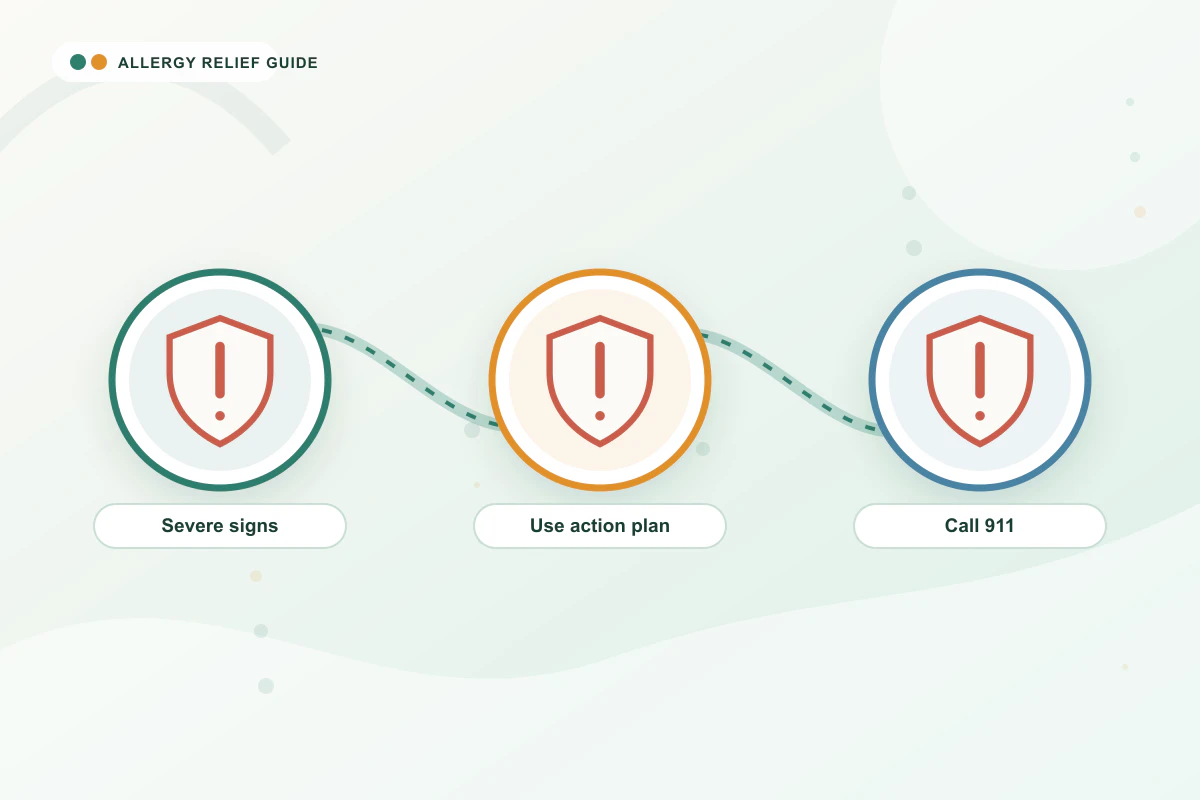
The signs that mean a reaction is serious
Most allergic reactions stay mild: a runny nose, itchy eyes, a few hives, an itchy mouth after a certain food. What makes a reaction an emergency is either a single severe sign such as difficulty breathing or throat swelling, or symptoms appearing in more than one body system at the same time.
That second pattern is the one people miss. Hives on their own are usually not an emergency; hives together with vomiting, or hives together with a cough and a feeling of throat tightness, is a different situation and should be treated as anaphylaxis.
- Breathing: wheezing, coughing, noisy or difficult breathing, chest tightness
- Throat: tightness, hoarseness, trouble swallowing, a lump-in-the-throat feeling
- Face: swelling of the lips, tongue, eyes or face
- Skin: widespread hives, flushing, or sudden intense itching
- Circulation: dizziness, fainting, pale or blue-tinged skin, a weak rapid pulse
- Gut: vomiting, cramping or diarrhea alongside any of the above
- A sudden sense that something is badly wrong
What to do, in order
The sequence matters more than the speed of any single step. Epinephrine works on the airway swelling and the drop in blood pressure that make anaphylaxis dangerous, and it works best given early rather than held back until things look severe.
Delay is the main thing that turns a survivable reaction into a critical one, so the safer error is to use epinephrine for a reaction that turns out to be moderate than to wait and see on one that is not.
- Use the epinephrine auto-injector immediately, into the outer mid-thigh
- Call 911 or your local emergency number, and say the word anaphylaxis
- Lie the person down and raise their legs; let them sit up if breathing is hard
- Never let them stand up suddenly or walk it off, even if they feel better
- Stay with them and be ready to give a second dose if symptoms do not improve
- Go to an emergency department even if the reaction settles completely
Why antihistamines are not enough
Antihistamines help with itching, hives and a runny nose. They do not open a closing airway and they do not raise a falling blood pressure, which are the two things that make anaphylaxis life-threatening. Reaching for one first costs time that epinephrine needs.
Using an antihistamine after epinephrine, on advice, is reasonable for the itching and hives. Using it instead of epinephrine is the mistake that shows up repeatedly in accounts of severe outcomes.
After a dose of epinephrine
Feeling better is not the end of the episode. Symptoms can return after an apparent recovery, sometimes hours later, which is why emergency assessment is advised even when a dose appears to have resolved everything.
A second dose may be needed if symptoms do not improve or come back before help arrives; follow the instructions supplied with your device. Nobody having a severe reaction should drive themselves, and used devices should be taken to the hospital so staff can see what was given and when.
Who is at higher risk
Anyone with a diagnosed severe allergy is at risk, but some factors make a bad outcome more likely and are worth knowing about in advance.
Asthma is the one most often underestimated. Poorly controlled asthma alongside a food or sting allergy is a well-recognized risk combination, which is a practical reason to keep asthma treatment on track rather than a separate issue.
- A previous severe reaction, though a mild history does not guarantee a mild next one
- Asthma, particularly when it is poorly controlled
- Peanut, tree nut, shellfish and insect sting allergies
- Teenagers and young adults, who take more exposure risks and carry devices less consistently
- Being far from medical help, or alone when a reaction starts
Being ready before it happens
Preparation is what makes the difference between a frightening event and a dangerous one. Most of it is simple and only needs doing once, then checking occasionally.
An anaphylaxis action plan from your allergist, written down and shared with the people around you, matters more than any single item on this list, because in a real reaction the person affected is often not the one making the decisions.
- Carry two auto-injectors; one dose is not always enough
- Check expiry dates and replace devices before they lapse
- Make sure family, friends, school or colleagues know where they are and how to use them
- Keep a written anaphylaxis action plan and share it
- Wear medical identification if you have had a severe reaction
- Practise with a trainer device so the real one is not the first you handle
Frequently asked questions
How quickly does anaphylaxis start?
Usually within minutes of exposure, and typically within two hours. A faster onset generally means a more severe reaction, but a slow start does not make a reaction safe. Treat the pattern of symptoms, not the clock.
Should I use epinephrine if I am not certain it is anaphylaxis?
Yes. Guidance for people prescribed an auto-injector is to use it when a serious reaction is suspected rather than wait for certainty. Delay is the main danger, and using it for a reaction that turns out to be moderate is the safer error.
Can I take an antihistamine instead?
No. Antihistamines help itching and hives but do not open a closing airway or raise a falling blood pressure. They are not a treatment for anaphylaxis, and reaching for one first costs time that epinephrine needs.
Do I still need the emergency department if I feel fine after epinephrine?
Yes. Symptoms can return after an apparent recovery, sometimes hours later, so emergency assessment is advised even when a dose seems to have resolved everything. Do not drive yourself, and take the used device with you.
Why do I need two auto-injectors?
Because one dose does not always control a reaction. If symptoms do not improve or return before help arrives, a second dose may be needed, and having only one device removes that option at the worst moment.
Does having asthma change my risk?
Yes. Asthma, particularly when poorly controlled, is a recognized risk factor for a more severe allergic reaction. Keeping asthma treatment on track is part of allergy safety rather than a separate concern.
Are hives alone an emergency?
Usually not. Hives on their own are commonly a mild reaction. Hives together with breathing trouble, throat tightness, vomiting, or dizziness involve more than one body system and should be treated as anaphylaxis.
Why should someone not stand up during a severe reaction?
Because standing or sitting up suddenly can worsen a drop in blood pressure. Lie the person down with their legs raised, or let them sit up if breathing is difficult, and do not let them walk around even if they say they feel better.
Medical note: This page describes general warning signs and emergency steps. It does not replace an anaphylaxis action plan from your own allergist, and it is not a substitute for calling emergency services.
 MD
MDMedically reviewed
Dr. Hannah H. Walford, MD
Allergist and Immunologist
- Website role
- Owner, Medical Director and Medical Reviewer of Allergy Relief Guide
- Professional affiliation
- Stanford Health Care / Menlo Medical Clinic, Menlo Park, California
- Areas of expertise
- Food allergy, eczema, allergic rhinitis, sinusitis and asthma
Dr. Hannah H. Walford is a board-certified allergist and immunologist experienced in caring for adults and children with allergic conditions. Her areas of expertise include food allergy, eczema, allergic rhinitis, sinusitis and asthma. She provides medical leadership and review oversight for the educational health content published by Allergy Relief Guide.
Medical content is provided for education and is not a substitute for diagnosis or individualized medical care.
Know the warning signs before you need them
Anaphylaxis is easier to act on when the signs and the sequence are already familiar. Read the full guidance on severe reactions and how epinephrine is used.
Read the anaphylaxis guide