
Allergies vs. a Cold: How to Tell the Difference
Same sniffles, different causes. Four quick tells — and a full side-by-side table — to work out what you're actually dealing with.
Quick answer: is it allergies or a cold?
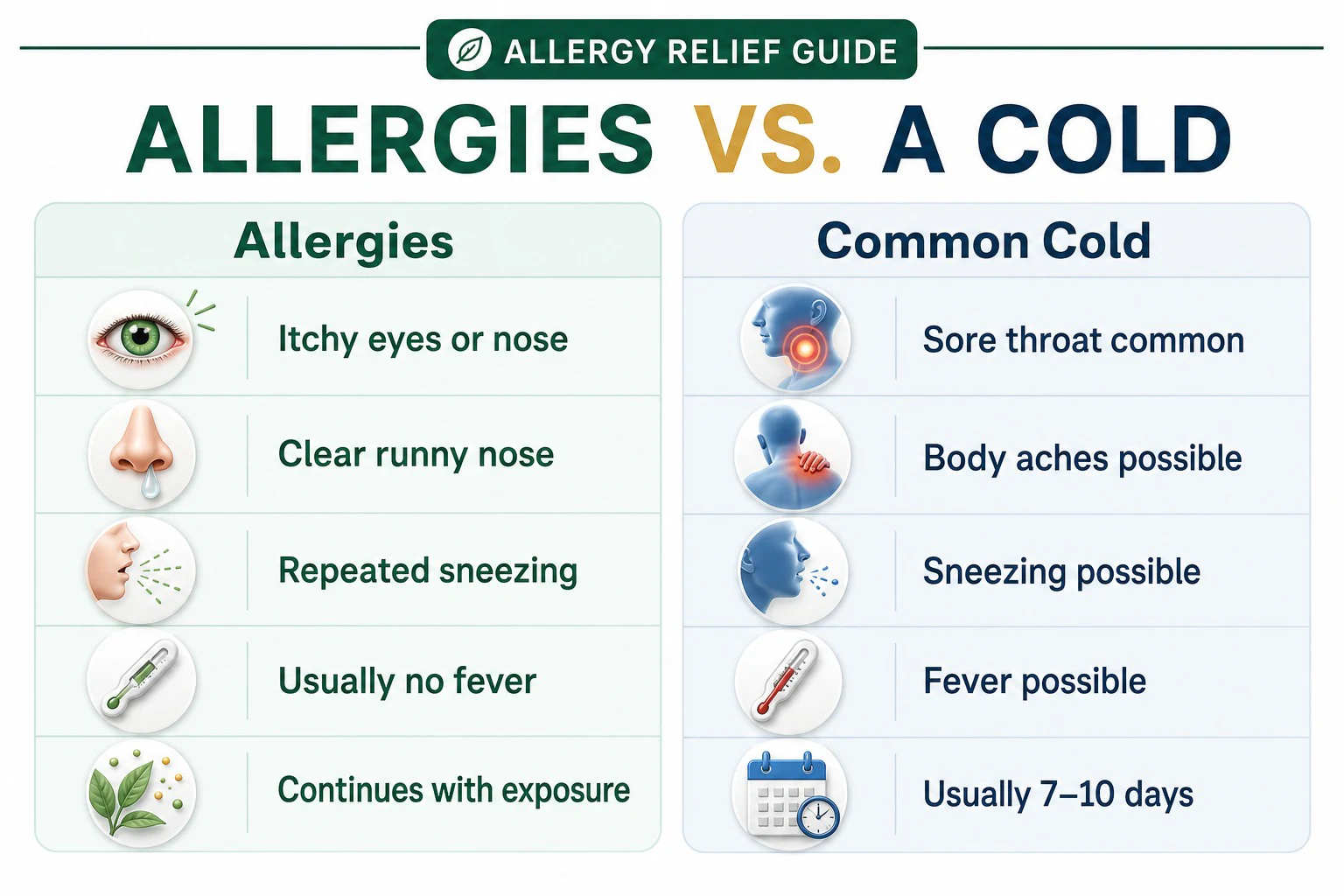
Short answer: itching and no fever, dragging on for weeks, means allergies. A gradual illness with a mild fever, aches or sore throat that clears in one to two weeks means a cold. Allergies are not contagious and repeat on a schedule; colds spread between people and strike at random.
The fastest way to tell them apart is itching, fever and timing. Allergies commonly cause itchy eyes, nose and throat, never a fever, and last as long as you're exposed to the trigger — often weeks. A cold builds gradually over a day or two, can bring a mild fever, body aches or a sore throat, and clears in about 7 to 10 days. Another giveaway: allergies aren't contagious and tend to return at the same time each year or around a specific trigger, while colds spread between people and can strike any time. The table below breaks it down symptom by symptom.
Allergies vs. a cold at a glance
Use this side-by-side comparison to spot the pattern. No single row is proof on its own — look at the overall picture.
| Feature | Allergies | Common cold |
|---|---|---|
| Cause | Immune reaction to an allergen (pollen, dust, dander) | A virus |
| Contagious? | No | Yes |
| Onset | Sudden, right after exposure | Gradual, over 1–2 days |
| Itchy eyes, nose or throat | Common (a signature sign) | Rare |
| Fever | Never | Sometimes (usually mild) |
| Body aches | No | Sometimes |
| Sore throat | Infrequent (can feel scratchy) | Common |
| Cough | Sometimes (from postnasal drip) | Common |
| Mucus | Usually clear and watery | Can thicken and turn yellow/green |
| Duration | Weeks to months, while exposed | About 7–10 days |
| Timing pattern | Same season yearly, or around a trigger | Any time; often spreads between people |
The four quickest tells
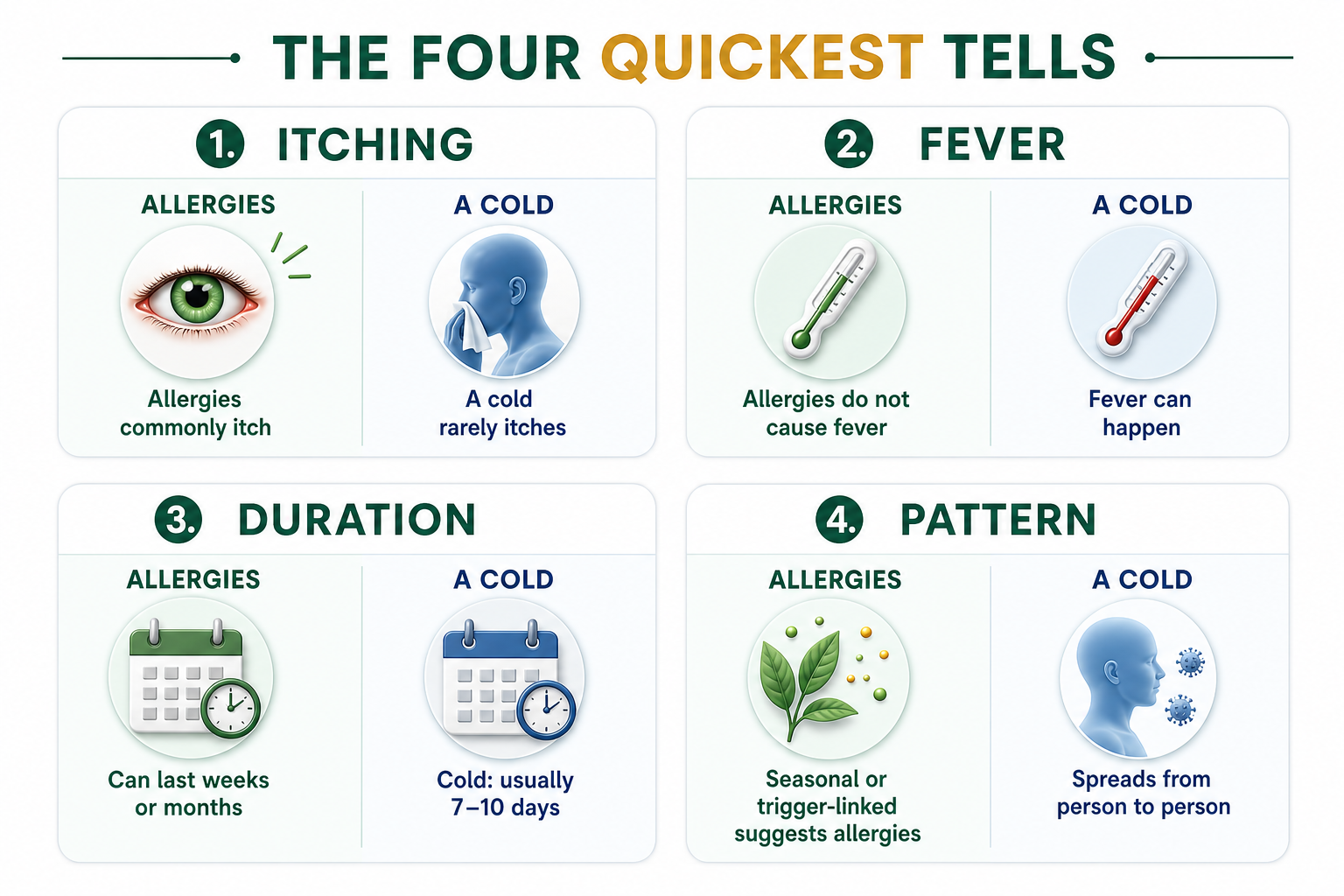
If you only check four things, check these — together they sort out most cases.
1. Itching
Itchy eyes, nose or throat strongly suggest allergies. Colds rarely itch.
2. Fever
Any fever points to a cold or other infection — allergies never cause one.
3. Duration
Still going after two weeks (with no fever)? Think allergies. Colds fade in about 7–10 days.
4. Pattern
Symptoms every spring, or only outdoors or around a pet? That's the fingerprint of an allergy.
Why they feel alike but aren't
Allergies and colds share symptoms because both inflame the same passages — your nose, sinuses and throat — but the trigger behind that inflammation is completely different.
A cold is an infection: a virus enters your respiratory tract, and the congestion, sneezing and sore throat are your immune system fighting it off. Because a virus is involved, colds are contagious and run a predictable course before your body clears them. Allergies aren't an infection at all. Your immune system mistakes a harmless substance — pollen, dust mites, mold or pet dander — for a threat and releases histamine, which drives the sneezing, itching and congestion. Because there's no virus, allergies aren't contagious, and they continue for as long as the trigger is around. This is also why allergy symptoms include itching that colds usually don't.
A 30-second self-test
Ask yourself these questions — the more "yes" answers in a column, the more likely that's your answer.
Probably allergies if…
- Your eyes, nose or throat itch
- You have no fever and no body aches
- Symptoms flare outdoors, or around pets or dust
- They've lasted more than two weeks
- They return at the same time each year
Probably a cold if…
- Symptoms built up over a day or two
- You have a mild fever, aches or a sore throat
- Mucus has thickened or changed colour
- Others around you have been unwell
- It's easing within about a week to ten days
Could it be the flu, a sinus infection or COVID-19?
Allergies and colds aren't the only look-alikes. A few quick pointers:
- Flu usually hits harder and faster than a cold, with a higher fever, marked body aches, headache and exhaustion.
- Sinus infection often brings facial pain and pressure, and thicker discoloured mucus that lingers, sometimes after a cold.
- COVID-19 can share many of these symptoms; testing is the only reliable way to rule it in or out, and a change in taste or smell is a notable clue.
The common thread: fever, body aches, or symptoms that don't match your usual allergy pattern all point away from allergies and are worth checking with a healthcare provider.
What mucus colour does and does not tell you
Thick yellow or green mucus is a normal part of how a cold progresses. On its own it is not evidence that you have a bacterial infection or that you need antibiotics. This is worth stating plainly, because it is one of the most common reasons people ask for an antibiotic they cannot benefit from.
The colour is useful in one narrow way and misleading in another:
- Useful: mucus that starts clear and watery and later thickens and darkens fits the arc of a viral cold. Allergy mucus tends to stay clear and watery for as long as the exposure lasts, without that progression.
- Misleading: the shade itself does not identify the cause. A cold is a viral infection, and MedlinePlus is explicit that antibiotics will not help a cold, because antibiotics work on bacteria and not on viruses. The NHS makes the same point — antibiotics will neither relieve cold symptoms nor speed recovery.
What actually justifies a second look
Not the colour, but the shape of the illness: cold-like symptoms lasting beyond about 10 days without improving, or symptoms that clearly improve and then get worse again, or a high or persistent fever. Those patterns are the reason to see a clinician, and they are covered in allergies vs. sinus infection. Colour alone is not on that list.
One caveat in the other direction: if your nasal discharge is only ever clear, that does not confirm allergies either. Plenty of viral colds stay clear throughout. Read the whole picture — itching, fever, duration and pattern — rather than any single row of the table above.
Can allergies turn into a cold — or a sinus infection?
Allergies can't literally become a cold, because a cold is a virus and allergies aren't — but untreated allergies can make you more prone to other problems.
Ongoing nasal inflammation and congestion from allergies can block your sinuses and set the stage for a secondary sinus infection, and it can leave the airway irritated so a cold virus feels worse when you do catch one. This is part of why the two get confused: an allergy flare and a cold can overlap or follow one another during spring and fall, when pollen is high and viruses are still circulating. If your "cold" keeps coming back at the same time each year, that pattern itself is a strong hint that allergies are the real driver — and treating them can head off the downstream trouble. Learn more in our allergic rhinitis and postnasal drip guides.
Can you have a cold and allergies at the same time?
Yes — you can have both at once, and it's more common than you'd think, especially in spring and fall when pollen counts are high and cold viruses are still circulating. Having allergies doesn't protect you from catching a cold, and the two can stack on top of each other, which is a big reason symptoms feel so confusing at those times of year.
The tell-tale sign that a virus has joined your allergies: you normally have a predictable seasonal pattern, and then suddenly develop a fever, body aches or a sore throat on top of it. In that case, treat each part — allergy medicine for the allergy symptoms, plus rest and fluids for the cold — and ask a pharmacist to help you avoid doubling up on overlapping ingredients.
How often colds actually happen — and why that matters here
Knowing the normal rate of colds is one of the most useful ways to catch allergies that are hiding in plain sight. If someone seems to have far more "colds" than the typical number, and those colds cluster in the same weeks each year, the pattern is doing the diagnosing.
| Typical colds per year | Typical duration | |
|---|---|---|
| Adults | About 2 to 4 | Most improve in 1 to 2 weeks |
| Children | About 6 to 10 | Often longer than in adults |
Two practical readings follow. First, a lingering cough is not automatically a sign something is wrong: a cough can take up to about three weeks to clear completely after a cold, well after the rest of the illness has gone. If a cough persists without a fever and returns every season, though, allergy cough is worth considering.
Second, children genuinely do get a lot of colds, which is exactly why allergic rhinitis in children is so often missed. Six to ten colds a year is normal; ten "colds" a year that all arrive in spring, come without fever, and involve rubbing the nose and eyes is a different story. That is the pattern to raise with a pediatrician — see allergies in children and allergies in toddlers.
How treatment differs
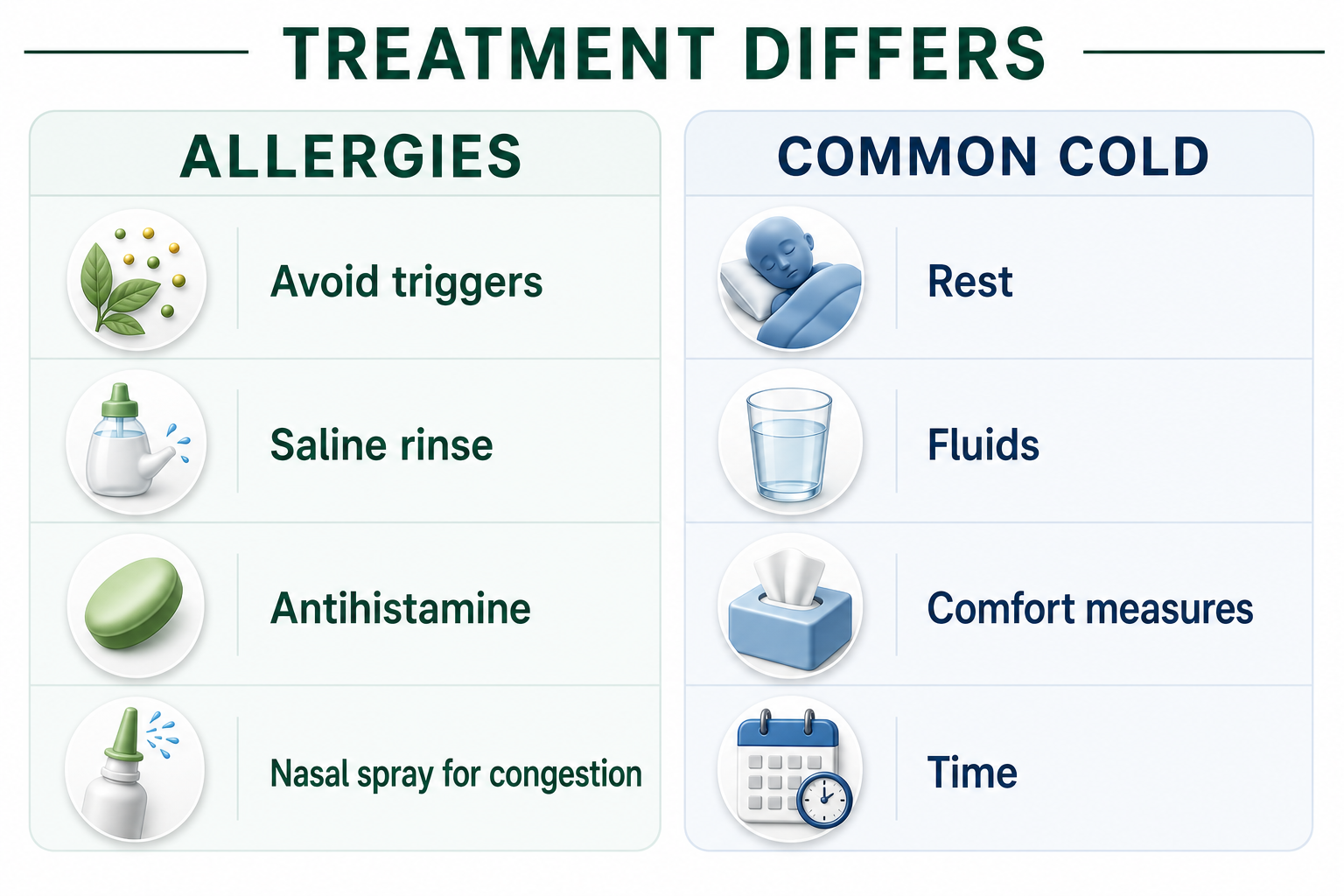
Because the causes differ, so does the fix — which is exactly why telling them apart matters.
For allergies: reduce exposure to the trigger, rinse your nose with saline, and use allergy medicine such as a non-drowsy antihistamine for sneezing and itching or a steroid nasal spray for congestion. See the full plan in our treatment & relief guide.
For a cold: there's no cure, so the aim is comfort — rest, fluids, and simple symptom relief while the virus runs its course. Antibiotics don't help a cold, because it's viral, not bacterial.
One reason the distinction is practical: allergy medicine won't shorten a cold, and cold remedies won't fix an ongoing allergy. Matching the treatment to the cause saves you time and discomfort.
Telling them apart in children
Children get both colds and allergies often, and the same tells apply — but the signs are easier to miss. With allergies, watch for frequent nose-rubbing (the so-called "allergic salute"), dark circles under the eyes, mouth-breathing, itchy or watery eyes, and symptoms that appear at the same time each year without a fever.
A cold in a child is more likely to bring a mild fever and a sore throat, build up gradually, and clear within a week or two. Because young children can't always describe itching, and because colds are so frequent at that age, ongoing allergies are easily mistaken for "back-to-back colds" — a pattern worth raising with a pediatrician. More in our guide to allergies in children.
Ruling out the other look-alikes
Allergies and colds are the two most common candidates, but they are not the only ones. Each of these has its own comparison guide.
| What you are trying to rule out | Guide |
|---|---|
| COVID-19 | Allergies vs. COVID-19 |
| Sinus infection | Allergies vs. sinus infection |
| Whether allergies can cause your fever | Can allergies cause a fever? |
| A cough that will not stop | Allergy cough |
| A sore or scratchy throat | Allergy sore throat |
| Facial pain and pressure | Allergy headache vs. sinus headache |
| Blocked or popping ears | Allergies and ear pressure |
| Mucus down the back of the throat | Postnasal drip |
| Wheeze or chest tightness | Allergic asthma |
| Confirming it is allergy at all | Allergy testing |
If it does turn out to be allergy, allergy medicine and nasal sprays cover which treatment matches which symptom.
When to see a doctor
See a healthcare provider if cold-like symptoms last longer than about 10 days, if they improve and then get worse, if a fever is high or lasts more than a few days, or if allergy symptoms aren't controlled by over-the-counter medicine. Recurring "colds" at the same time every year are often undiagnosed allergies worth investigating with allergy testing. More detail in when to see a doctor for allergies.
When it's an emergency
Seek emergency care for any severe reaction or breathing difficulty. Call 911 for trouble breathing; swelling of the face, lips, tongue or throat; or feeling faint — these are signs of anaphylaxis, not an ordinary cold or allergy, and need immediate help. See our allergy safety guide.
The bottom line
Remember the three fastest signals. Itching plus no fever, dragging on for weeks, points to allergies. A gradual illness with a possible fever, body aches or a sore throat that clears in about a week points to a cold. Allergies are your immune system reacting to a trigger and aren't contagious; a cold is a virus and is.
When symptoms don't fit either pattern — a high or lasting fever, or anything that keeps getting worse — check with a healthcare provider. Getting the cause right matters because it points you to the treatment that actually works: allergy relief for allergies, rest and time for a cold.
Allergies vs. a cold: frequently asked questions
How do I know if it's a cold or allergies?
Do allergies cause a fever?
How long do allergies last compared to a cold?
Are allergies contagious like a cold?
Can you have a cold and allergies at the same time?
Does green or yellow mucus mean I need antibiotics?
How many colds is it normal to get in a year?
Why is my cough still there weeks after the cold went?
Do antibiotics help a cold?
Can allergies cause a sore throat like a cold does?
How we create and review this guide
This guide is written for a general audience using patient-education material from the authoritative sources below, not blogs or forums:
- American Academy of Allergy, Asthma & Immunology (AAAAI)
- American College of Allergy, Asthma & Immunology (ACAAI)
- Mayo Clinic
- U.S. National Institutes of Health (NIH)
- U.S. Centers for Disease Control and Prevention (CDC)
Sources for the specific figures on this page
- MedlinePlus, U.S. National Library of Medicine. Common Cold (opens in a new tab). More than 200 viruses causing colds with rhinoviruses the most common, recovery after a week or two with some symptoms lasting 10 to 14 days, and the statement that antibiotics will not help a cold because they treat bacterial rather than viral infections.
- InformedHealth.org, Institute for Quality and Efficiency in Health Care, via NCBI Bookshelf. Overview: Common colds (opens in a new tab). Adults averaging 2 to 4 colds a year and children 6 to 10, colds typically resolving within one to two weeks, a cough sometimes taking up to three weeks to disappear completely, and antibiotics being ineffective because colds are viral.
- National Health Service (UK). Common cold (opens in a new tab). Feeling better in about 1 to 2 weeks, and antibiotics not being recommended because colds are caused by viruses and antibiotics will not relieve symptoms or speed recovery.
- American College of Allergy, Asthma & Immunology. Hay fever (allergic rhinitis) (opens in a new tab). The itching, sneezing, clear rhinorrhoea and eye symptoms that characterise allergic rhinitis, and intranasal corticosteroids as the most effective drug class for it.
- MedlinePlus, U.S. National Library of Medicine. Hay Fever (opens in a new tab). Pollen-triggered allergy symptoms and the relief options available, including medicines, nasal sprays and allergy shots.
Medical disclaimer: This guide is for general education and isn't a substitute for personalized medical advice. Always talk to a qualified healthcare professional about your symptoms.
 MD
MDMedically reviewed
Dr. Hannah H. Walford, MD
Allergist and Immunologist
- Website role
- Owner, Medical Director and Medical Reviewer of Allergy Relief Guide
- Professional affiliation
- Stanford Health Care / Menlo Medical Clinic, Menlo Park, California
- Areas of expertise
- Food allergy, eczema, allergic rhinitis, sinusitis and asthma
Dr. Hannah H. Walford is a board-certified allergist and immunologist experienced in caring for adults and children with allergic conditions. Her areas of expertise include food allergy, eczema, allergic rhinitis, sinusitis and asthma. She provides medical leadership and review oversight for the educational health content published by Allergy Relief Guide.
Medical content is provided for education and is not a substitute for diagnosis or individualized medical care.
Related guides
Allergy symptoms
The full list of signs and what they mean.
Allergic rhinitis
The nasal-allergy condition behind most symptoms.
Seasonal allergies
Why symptoms flare each spring and fall.
Treatment & relief
How to treat allergies, step by step.
Allergies vs. COVID-19
Which symptoms actually separate them.
Allergies vs. sinus infection
When congestion becomes something else.
Can allergies cause a fever?
The single most decisive tell.
Allergy medicine
If it turns out to be allergy after all.
Fairly sure it's allergies?
Find the fastest relief for your symptoms with our step-by-step treatment guide.
Go to the treatment & relief guide