
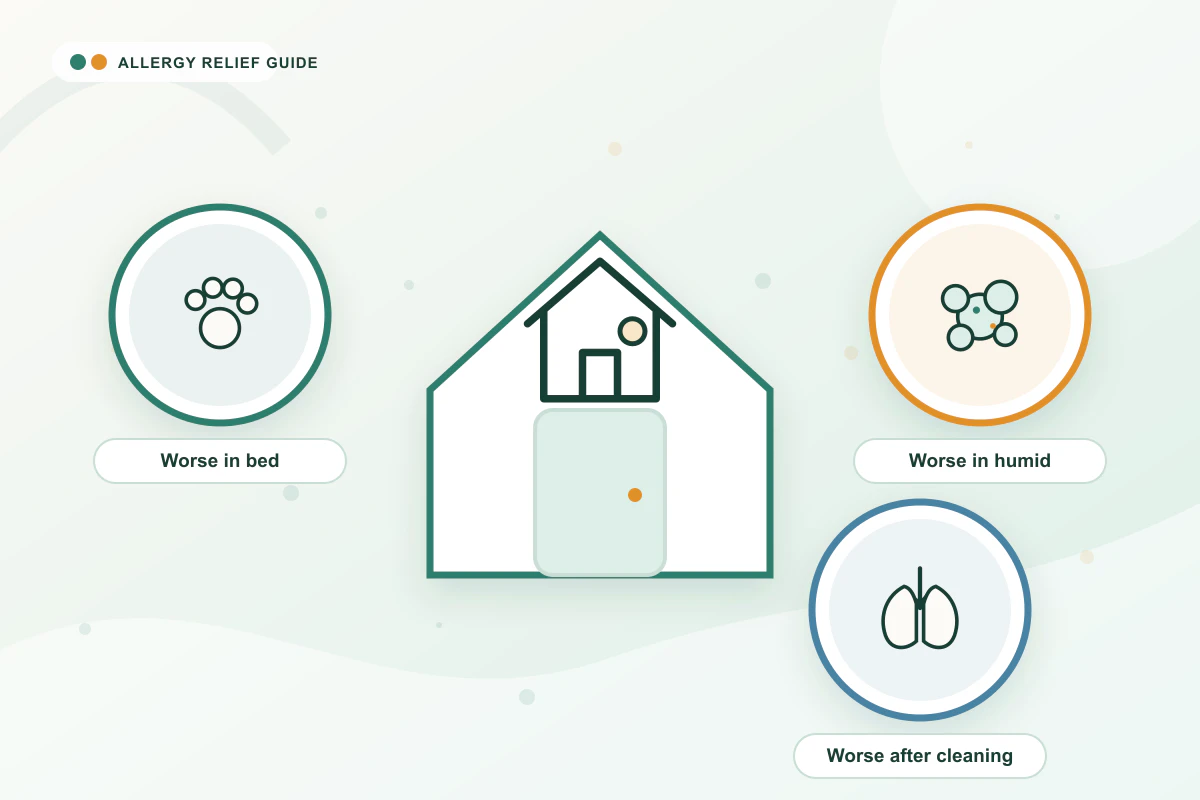
Why indoor symptoms behave differently
Pollen allergy has an obvious rhythm: it arrives with a season, tracks the weather and eases indoors with the windows shut. Indoor allergy has none of that shape, which is why people so often assume they have a long-running cold instead.
The pattern to look for is exposure that repeats rather than exposure that peaks. Symptoms that persist all year, that are worse on waking or after vacuuming, that ease when you are away from home for a few days and return within hours of getting back, point at something in the building rather than something in the air outside.
- Symptoms continue through winter, when pollen counts are low
- Mornings are the worst part of the day, before you have gone anywhere
- Cleaning, bed-making or vacuuming sets symptoms off
- A holiday clears things up, and coming home undoes it
- The pollen count and how you feel do not line up
The four triggers that account for most of it
Indoor allergy is a short list. Working out which item on it applies to you changes what is worth doing, because the controls for one are close to useless for another.
It is also common to react to more than one, which is part of why partial measures can feel disappointing: dealing with the cat while leaving a damp bathroom untouched leaves half the problem in place.
- Dust mites: microscopic, live in bedding, mattresses, upholstery and carpet, feed on shed skin and need humidity
- Pet dander: from skin, saliva and urine rather than hair, so no breed is genuinely non-allergenic
- Mold: needs moisture, so it follows leaks, condensation, bathrooms, basements and damp walls
- Cockroach allergen: significant in some housing, concentrated in kitchens and around food and water
Start with the bedroom
If you only change one room, change the one you spend roughly a third of your life in, with your face pressed into it. A mattress and pillows are a warm, humid, skin-rich environment, which is precisely what dust mites need.
The measures that matter here are unglamorous and mostly one-off. Allergen-proof encasings on the mattress and pillows put a barrier between you and the reservoir, and washing bedding weekly in hot water deals with what accumulates on top of it.
- Allergen-proof encasings on the mattress, pillows and duvet
- Wash bedding weekly at a hot temperature rather than a cool wash
- Keep pets out of the bedroom entirely, not just off the bed
- Reduce soft furnishings, heavy curtains and under-bed clutter that hold dust
- Avoid drying laundry indoors, which pushes bedroom humidity up
Humidity is the most useful single lever
Dust mites do not drink; they absorb moisture from the air, and they struggle when it is dry. Mold needs moisture to grow at all. One control therefore works against two of the four main triggers at once, which is unusual enough to be worth prioritising.
Aiming for roughly 30 to 50 percent indoor humidity is the usual target. A cheap hygrometer is worth more than guesswork here, because rooms differ and the damp one is rarely the one you would pick.
- Use extractor fans in the bathroom and kitchen, and let them run on
- Fix leaks and condensation promptly rather than cleaning the mold repeatedly
- Consider a dehumidifier in a persistently damp room
- Ventilate, but not on high-pollen days if you also react to pollen
- Do not over-humidify in winter, which suits mites as much as it suits you
What air purifiers can and cannot do
A HEPA filter captures very fine airborne particles, which makes it genuinely useful for the allergens that stay suspended: cat and dog dander, and mold spores. Running one in the bedroom is a reasonable addition once the basics are handled.
It is much less useful against dust mite allergen, which travels on relatively heavy particles that settle out of the air quickly and sit in the mattress and carpet rather than floating. A purifier cannot pull allergen out of a mattress, which is why it disappoints people who buy one instead of encasings rather than alongside them.
Where effort gets wasted
Some of the most-recommended indoor measures deliver very little, and knowing which ones saves both money and the false conclusion that nothing works.
- Buying a purifier while skipping mattress and pillow encasings
- Choosing a supposedly hypoallergenic breed; dander, not hair, is the allergen
- Identifying which species of mold is present instead of fixing the moisture
- Vacuuming more often without a sealed or HEPA-filtered machine, which redistributes dust
- Treating one trigger thoroughly while ignoring a second one you also react to
Frequently asked questions
How do I know if my symptoms are indoor rather than seasonal?
Indoor symptoms usually run year-round, are often worst on waking or after cleaning, and do not track the pollen count. A useful test is time away: if a few days elsewhere clears things up and returning home brings them back within hours, the trigger is likely in the building.
What should I do first?
Treat the bedroom and get humidity under control. Allergen-proof encasings on the mattress and pillows, weekly hot washing of bedding, and keeping indoor humidity around 30-50% address the two most common triggers with the least effort.
Will an air purifier fix indoor allergies?
Only partly. A HEPA purifier helps with allergens that stay airborne, such as pet dander and mold spores. It does much less for dust mite allergen, which settles quickly and sits in mattresses and carpets, so it works best alongside encasings rather than instead of them.
Are some dog or cat breeds safe for allergies?
No breed is genuinely non-allergenic. The allergen comes from skin flakes, saliva and urine rather than hair, so a low-shedding animal still produces it. Shedding affects how much is spread around, not whether the allergen exists.
Do I need to find out what kind of mold I have?
Usually not. What matters is that mold is present and that something is keeping the area damp. Fixing the moisture source and cleaning the growth is the action either way; identifying the species rarely changes what you do.
Why are my symptoms worst in the morning?
Because you have spent several hours in close contact with bedding, and because moving around on waking stirs settled allergen back into the air. A morning-heavy pattern is one of the more reliable pointers towards dust mites.
Does getting rid of a pet solve it quickly?
Not immediately. Cat allergen in particular is small, sticky and persistent, and can remain in a home for months after the animal has gone. Thorough cleaning of soft furnishings speeds it up, but the improvement is gradual rather than instant.
Should I remove my carpet?
It can help, since carpet holds far more allergen than a hard floor and is difficult to clean thoroughly. It is a large change though, so it is usually worth doing the bedroom measures and humidity control first and judging the result before pulling up floors.
Medical note: This guide explains general approaches to reducing indoor allergen exposure. Persistent symptoms, or any breathing difficulty, should be assessed by a healthcare professional who can confirm what you actually react to.
 MD
MDMedically reviewed
Dr. Hannah H. Walford, MD
Allergist and Immunologist
- Website role
- Owner, Medical Director and Medical Reviewer of Allergy Relief Guide
- Professional affiliation
- Stanford Health Care / Menlo Medical Clinic, Menlo Park, California
- Areas of expertise
- Food allergy, eczema, allergic rhinitis, sinusitis and asthma
Dr. Hannah H. Walford is a board-certified allergist and immunologist experienced in caring for adults and children with allergic conditions. Her areas of expertise include food allergy, eczema, allergic rhinitis, sinusitis and asthma. She provides medical leadership and review oversight for the educational health content published by Allergy Relief Guide.
Medical content is provided for education and is not a substitute for diagnosis or individualized medical care.
Find the trigger that is actually yours
Indoor control works best once you know which allergen you react to. Testing narrows it down so the effort goes where it will make a difference.
Read the allergy testing guide