Nasal Spray for Allergies: Which Type Is Best for Your Symptoms
Allergists call nasal sprays the single most effective allergy medicine — if you pick the right type and use it well. Here's how.
Quick answer: which nasal spray do you need?
Short answer: a steroid nasal spray is the most effective single option for allergy nose symptoms and is what specialist guidelines recommend first, used daily. Choose an antihistamine spray when you need relief within minutes, saline any time, and a decongestant spray only for a few days. Match the spray to your main symptom, then give it time to work.
For most people, a steroid (corticosteroid) nasal spray is the most effective option and is considered first-line — it eases congestion, sneezing, a runny nose and itching, but must be used every day and takes days to a couple of weeks to reach full effect. An antihistamine nasal spray works within minutes and suits sneezing, itching and a runny nose. Decongestant sprays clear a blocked nose fast but only for short-term use. Saline sprays are drug-free. For moderate-to-severe symptoms, a steroid and an antihistamine spray work best together. Match the spray to your main symptom. This is general information, not dosing advice.
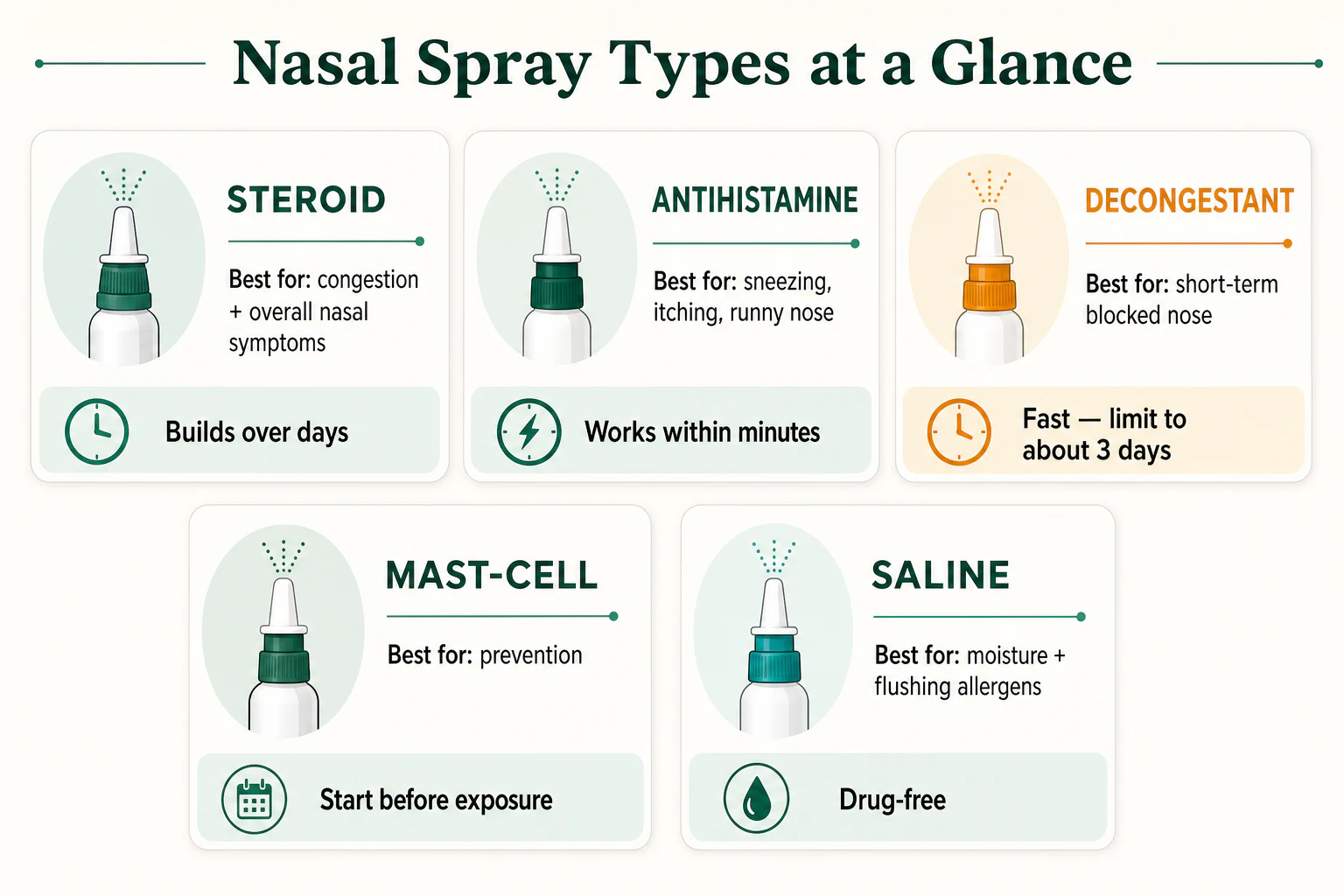
The types of nasal spray at a glance
Five main types line the pharmacy shelf. Here's what separates them.
| Type | Best for | How fast | Daily use? |
|---|---|---|---|
| Steroid | Congestion + all nasal symptoms | Days to 2 weeks | Yes (needs it) |
| Antihistamine | Sneezing, itching, runny nose | Minutes | Yes |
| Decongestant | Short-term blocked nose | Minutes | No — max ~3 days |
| Mast-cell (cromolyn) | Prevention | 1–2 weeks | Yes |
| Saline | Moisture, flushing pollen | Instant soothing | Yes (drug-free) |
Which nasal spray works best?
Steroid nasal sprays outperform the other spray types for allergic rhinitis, and specialist guidance is unusually direct about it. The American College of Allergy, Asthma & Immunology calls intranasal corticosteroids the single most effective drug class for treating allergic rhinitis, because they act on the inflammation behind congestion, sneezing, itching and a runny nose rather than on histamine alone.
The 2017 practice-parameter update from the Joint Task Force of the AAAAI and ACAAI, published in Annals of Internal Medicine, went further and made three points that change how many people should actually use these products:
- Start with the steroid spray on its own. For people aged 12 and over beginning treatment for seasonal allergic rhinitis, the guidance is to use an intranasal corticosteroid alone rather than routinely combining it with an oral antihistamine — a strong recommendation. Adding a tablet by default is not what the evidence supports.
- A steroid spray is preferred to a montelukast-type tablet. For people aged 15 and over, an intranasal corticosteroid is recommended over a leukotriene receptor antagonist for initial treatment — also a strong recommendation.
- If one spray is not enough, add the second spray, not a pill. For moderate-to-severe symptoms in people aged 12 and over, a clinician may recommend an intranasal corticosteroid combined with an intranasal antihistamine. This is a weaker recommendation, but it points the add-on in a specific direction.
Two practical consequences follow. If you have been taking a daily antihistamine tablet and getting little benefit for a blocked nose, the more evidence-based next step is usually a steroid spray rather than a different pill. And if a steroid spray alone is not controlling things, an antihistamine spray is the better addition than an oral antihistamine. Compare the tablet options in our antihistamines guide and antihistamine picks by need.
Guidelines describe averages, not individuals
These recommendations describe what works best across large groups of people with seasonal allergic rhinitis. They do not replace advice for your own situation, and they do not cover every cause of a blocked nose. If a steroid spray does not suit you, or your symptoms are not typical of allergy, a clinician can reassess — see allergic rhinitis for how the condition is diagnosed.
Steroid (corticosteroid) nasal sprays
These are the most effective nasal spray for allergies and the first-line choice for allergic rhinitis. They calm inflammation directly in the nose, easing the whole range of symptoms — congestion, sneezing, runny nose and itch — which no other single spray does as well. Common OTC options include fluticasone (Flonase), triamcinolone (Nasacort), budesonide (Rhinocort) and mometasone (Nasonex); head-to-head, there's little meaningful difference between them.
The trade-off is speed: they work best used every day and take a few days to about two weeks to reach full effect, so consistency matters more than with a pill. They aren't habit-forming. If you're starting one at the beginning of your season, pairing it with an oral antihistamine for the first week can bridge the gap.
Antihistamine nasal sprays
These block histamine right in the nose and work fast — often within minutes. That makes them great for quick relief and for sneezing, itching and a runny nose. Azelastine (Astepro) is available over the counter; olopatadine and others are prescription. They can be used daily, and because they act locally they cause fewer whole-body effects than pills — though a temporary bitter taste is common.
One tip: if you already take an oral antihistamine, adding an antihistamine spray can pile on side effects like drowsiness — it's usually better to switch to the spray than to use both.
What the over-the-counter labels actually say
The differences between the familiar brands are mostly on the label, not in how well they work. Age limits, which symptoms each product is allowed to claim, and how long the label says to wait are the details that decide most real choices.
| Product (active ingredient) | Type | Youngest age on label | Symptoms named on the label | Label wording on timing |
|---|---|---|---|---|
| Flonase Allergy Relief (fluticasone propionate) | Steroid | 4 years | Nasal congestion, runny nose, sneezing, itchy nose, itchy and watery eyes | Relief may start the first day; full effect after several days of regular once-a-day use |
| Nasacort Allergy 24HR (triamcinolone acetonide) | Steroid | 2 years | Nasal congestion, runny nose, sneezing, itchy nose | May take up to one week of daily use to feel the most symptom relief |
| Budesonide nasal spray (Rhinocort) | Steroid | 6 years | Nasal symptoms of seasonal or perennial allergic rhinitis | Used daily; give it days rather than doses |
| Astepro Allergy (azelastine) | Antihistamine | 6 years | Nasal congestion, runny nose, sneezing, itchy nose | Dosed once or twice daily; up to 24-hour relief |
| NasalCrom (cromolyn sodium) | Mast-cell stabiliser | 2 years | Nasal allergy symptoms, used to prevent and relieve | Started before or at the beginning of exposure; builds over 1–2 weeks |
Labels change. Always read the carton you actually buy, and check dosing there rather than here — this page does not provide dosing.
Flonase vs. Nasacort: does it matter which you pick?
For symptom control the practical difference is small; the label differences are what usually decide it. Both are once-daily steroid sprays used the same way. Flonase Allergy Relief is labelled from age 4 and is the one of the two whose label names itchy, watery eyes among the symptoms it treats. Nasacort Allergy 24HR is labelled from age 2, the lowest starting age of the common over-the-counter steroid sprays. If eye symptoms are part of your picture, that label difference is a reasonable tie-breaker; if you are treating a young child, the age limit decides it. Otherwise price, scent and how the spray feels in your nose matter more than potency. For eye symptoms specifically, see allergy eye drops and itchy, watery eyes.
The label warning people miss on antihistamine sprays
Because azelastine acts inside the nose, it is often described as free of the whole-body effects of tablets. The over-the-counter Drug Facts label is more cautious than that: it warns that drowsiness may occur, tells users to be careful when driving or operating machinery, and to avoid alcohol, sedatives and tranquillisers. A temporary bitter taste is also listed. None of this makes it a poor choice — it is fast and it works — but treat it as a medicine that can make you sleepy, at least until you know how it affects you. More in do antihistamines make you sleepy?
Decongestant nasal sprays
Decongestant sprays such as oxymetazoline (Afrin) shrink swollen nasal tissue for fast relief of a blocked nose — but they're strictly short-term. They don't treat the underlying allergy, and they're the one type with a real catch.
The 3-day rule
Don't use a decongestant nasal spray for more than about three days in a row. Longer use can cause rebound congestion (rhinitis medicamentosa), where your nose gets more blocked once you stop — tempting you to keep using it in a hard-to-break cycle. They're also best avoided if you have high blood pressure or glaucoma. For ongoing allergies, a steroid or antihistamine spray is the right tool instead.
Already stuck on a decongestant spray? How to come off it
Rebound congestion is common, it is reversible, and the uncomfortable part is usually short. ACAAI describes the pattern — rhinitis medicamentosa, or rebound swelling — as a consequence of prolonged use of non-prescription decongestant nasal sprays. The nose blocks up again as each dose wears off, so people spray more often, and the cycle keeps itself going.
What usually helps, and what a clinician will typically suggest:
- Stop the decongestant spray rather than slowly reducing it. Some people find it easier to stop in one nostril first, so they can still breathe through the other side while the first settles.
- Start a steroid nasal spray at the same time. It treats the underlying swelling the decongestant was masking, and it is the main reason people get through the first week.
- Use saline generously for comfort and to stop the nose drying out.
- Expect a rough one to two weeks, then steady improvement. Do not restart the decongestant "just for one night" — a couple of days can be enough to restart the cycle.
- Ask a doctor if it is not settling after two to three weeks, or sooner if you cannot sleep. Prescription options exist, and a blockage that never lifts can have a structural cause.
More about this class of medicine, including the tablet versions, in our decongestants for allergies guide.
Saline, mast-cell and combination sprays
Saline sprays and rinses
Drug-free saline moisturises the nose and physically flushes out pollen and mucus. It's safe to use as often as you like, and a pharmacist tip is to use it a few minutes before a medicated spray to reduce the risk of nosebleeds.
Critical safety note for nasal rinses
If you use a rinse (neti pot or squeeze bottle), never use untreated tap or well water. Use distilled, sterile, or previously boiled and cooled water only. In rare cases, tap water has carried a dangerous amoeba (Naegleria fowleri) into the nose. Clean and dry the device after every use. (Ready-made saline sprays don't carry this risk.)
Mast-cell stabiliser (cromolyn)
Cromolyn sodium (NasalCrom) helps prevent the allergic reaction rather than treat it after the fact. It's very well tolerated but takes one to two weeks to build up, so it works best started before your season.
Combination sprays
Prescription combination sprays such as Dymista pair a steroid with an antihistamine (fluticasone and azelastine) in one bottle — effective and fast for moderate-to-severe symptoms, and more convenient than juggling two products.
Which nasal spray for which symptom?
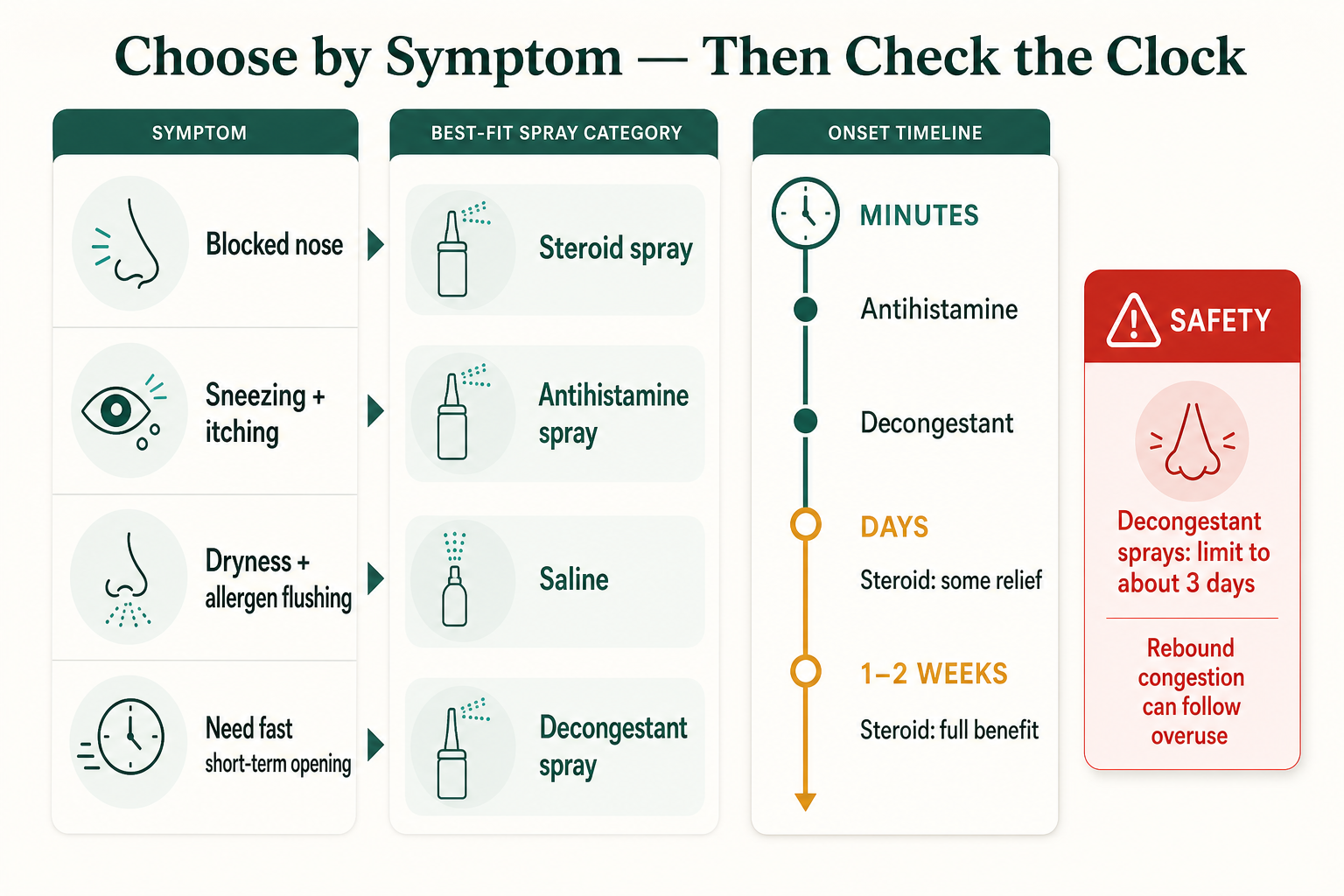
Matching the spray to your main symptom is the fastest route to relief.
| Main symptom | Best first choice |
|---|---|
| Nasal congestion (long-term) | Steroid spray, used daily |
| Sneezing & itching | Antihistamine spray |
| Runny nose | Antihistamine spray (or steroid) |
| Fast relief before an event | Antihistamine spray |
| Severe blocked nose, short-term only | Decongestant spray (max ~3 days) |
| Moderate-to-severe, everything | Steroid + antihistamine (or a combination spray) |
Deciding between sprays and pills? See allergy medicine and antihistamines.
Nasal spray or allergy pill: which should you use?
If your worst symptom is in your nose — especially congestion — a spray is usually the better tool. If symptoms are spread around your body, a tablet reaches further. They are less competitors than instruments with different range.
| What you want treated | Steroid nasal spray | Oral antihistamine |
|---|---|---|
| Blocked nose | The most effective option | Little effect |
| Sneezing and itchy nose | Works well | Works well |
| Runny nose | Works well | Works well |
| Itchy, watery eyes | Some products name eye symptoms on the label | Works well |
| Hives and itchy skin | No effect | The right tool |
| How soon it works | Days to two weeks | Usually within a few hours |
| Whole-body side effects | Minimal | Possible, depending on the medicine |
The guideline point above is worth repeating here, because most people do the opposite by habit: for a first attempt at seasonal nasal allergy in people aged 12 and over, a steroid spray on its own is preferred to a steroid spray plus an oral antihistamine. If you do need a tablet as well — for eye or skin symptoms, for instance — see antihistamines, first- vs. second-generation antihistamines and antihistamines for hives.
Can you use nasal sprays together?
Some combinations are helpful; others aren't. A steroid spray plus an antihistamine spray is a well-established, effective pairing — leave a short gap (around 15 minutes) between the two. A saline spray before a medicated one is also fine and can reduce irritation.
What to avoid: doubling up an oral antihistamine and an antihistamine spray (more side effects for little gain), and relying on a decongestant spray alongside anything for more than a few days. When in doubt, a pharmacist can check your combination is safe.
How to use a nasal spray correctly
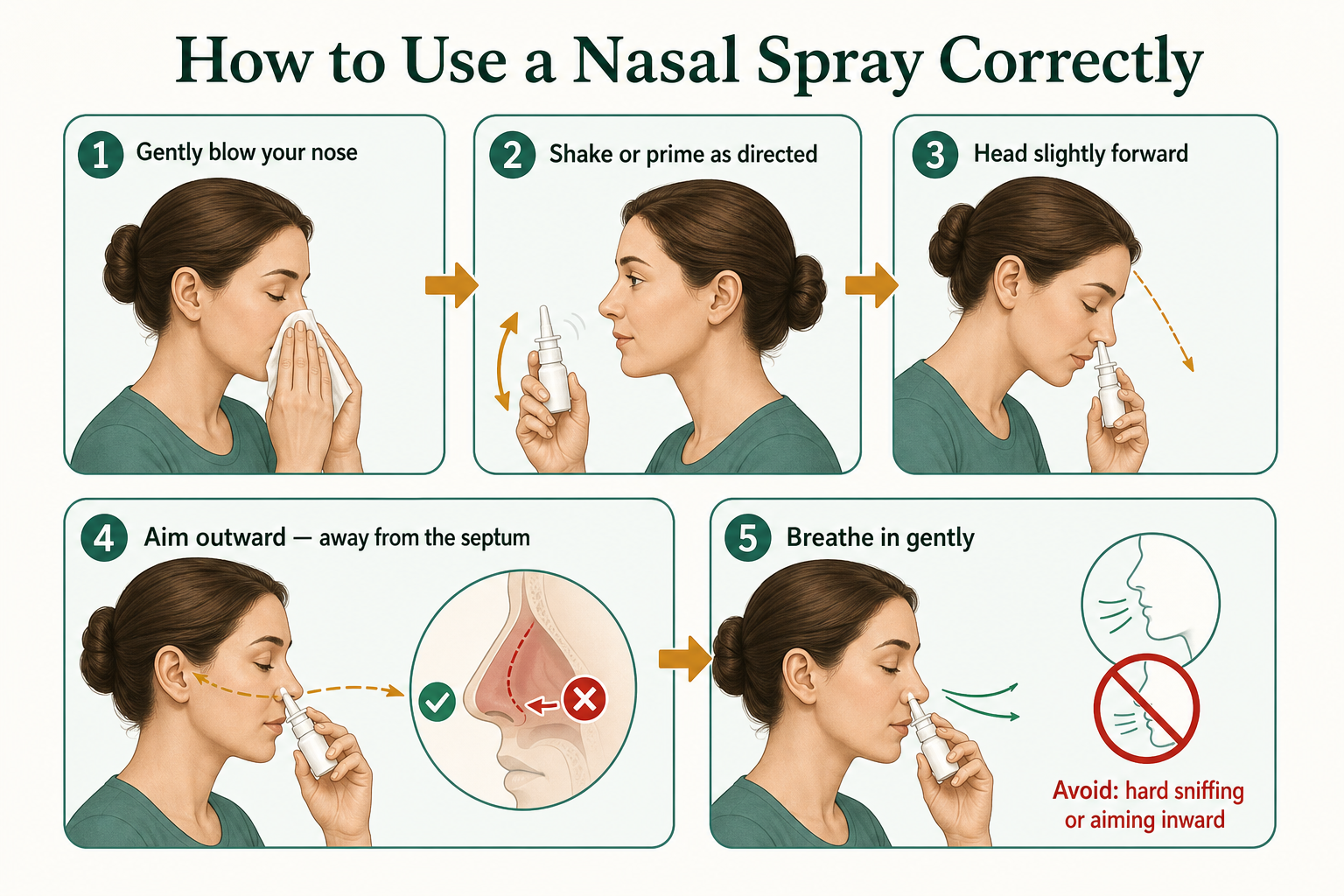
Technique matters — good technique improves results and cuts side effects like nosebleeds.
- Gently blow your nose first, and shake the bottle if directed.
- Tilt your head slightly forward, not back.
- Use your right hand for your left nostril and vice versa, and aim the tip toward the outer wall of your nose, away from the septum (the middle wall). This is the single best trick to prevent nosebleeds.
- Spray while breathing in gently through your nose — sniff softly, don't snort hard.
- Avoid blowing your nose right afterward.
Above all, use steroid and mast-cell sprays consistently every day, not just when symptoms flare — that's the most common reason they seem "not to work."
How long do they take to work?
Speed varies by type, and knowing this stops you giving up too soon. Antihistamine and decongestant sprays act within minutes. Steroid sprays are the slowest — some relief in a day or two, full benefit after daily use for one to two weeks. Cromolyn also takes one to two weeks. Allergists often suggest giving a steroid spray a fair 30-day trial, used daily and correctly, before deciding whether it helps.
Why your nasal spray is not working
Most "it does not work" cases come down to technique, timing or the wrong type — not a faulty product. Work through these before giving up on sprays altogether.
- You have not used it long enough. The Nasacort label says it may take up to one week of daily use to feel the most symptom relief, and the Flonase label describes full effect after several days of regular once-a-day use. Judging a steroid spray after two or three doses is judging it far too early.
- You are using it only when symptoms flare. Steroid and cromolyn sprays are preventive. Used on and off, they never reach the effect they are capable of.
- The spray is hitting the septum. Aiming at the middle wall of the nose irritates the most fragile tissue there and misses the surfaces the medicine needs to reach. This is the most common technique error, and the usual reason for nosebleeds.
- You are sniffing too hard. A sharp sniff pulls the dose straight down the back of the throat. Breathe in gently, and do not blow your nose immediately afterwards.
- The type does not match the symptom. An antihistamine spray will not do much for a nose blocked by inflammation, and a steroid spray will not clear anything in the next ten minutes.
- Rebound congestion is masking the result. If you have been using a decongestant spray for more than a few days, that has to be unwound before anything else can be judged.
- It may not be allergy. Non-allergic rhinitis, a deviated septum, nasal polyps and chronic sinus disease all cause a blocked nose that allergy sprays only partly help. Blockage on one side that never shifts, facial pain, loss of smell or thick discoloured discharge are reasons to be assessed — see allergies vs. sinus infection and allergies and sinusitis.
If technique and timing are right and symptoms still persist beyond two to four weeks, that is a reason to see a clinician rather than to keep switching brands. Allergy testing can confirm what you react to, and allergy shots or sublingual immunotherapy treat the underlying sensitivity instead of the symptoms.
Side effects and who should take care
Nasal sprays are generally very safe, since they act mostly in the nose rather than the whole body. The most common effects are mild: nasal dryness or stinging, a bitter taste (antihistamine and cromolyn sprays) and occasional nosebleeds — all reduced by good technique and saline. Steroid nasal sprays carry far lower risks than steroid tablets.
- Pregnancy & breastfeeding — check with your provider; budesonide (Rhinocort) is often the preferred steroid spray in pregnancy.
- Children — many sprays have minimum ages and child versions; ask a pharmacist or pediatrician. See allergies in children.
- Glaucoma, high blood pressure or recent nasal surgery — take particular care and check first, especially with decongestant sprays.
Is it safe to use a steroid nasal spray every day, long term?
Daily use is how these sprays are meant to be used, and very little of the steroid reaches the rest of the body. The cautions that do exist are printed on the label and are worth knowing rather than worrying about.
- Nosebleeds. The Flonase and Nasacort labels both say to stop use and ask a doctor if you get severe or frequent nosebleeds. Occasional light bleeding usually means the spray is hitting the septum; frequent bleeding needs review.
- Children's growth. Both labels state that the growth rate of some children may be slower while using the product. MedlinePlus advises talking to your child's doctor if a child aged 2 to 11 needs non-prescription fluticasone nasal spray for more than two months a year, or if a child aged 12 or over needs it for more than six months a year.
- Other reasons to stop and ask. The Nasacort label lists exposure to chickenpox, measles or tuberculosis, a fever that will not settle, and changes in vision as reasons to stop use and check with a doctor. Mention it too if you have glaucoma or cataracts, or have had recent nasal surgery or injury.
- Do not stack steroid products unnoticed. If you also use a steroid inhaler for allergic asthma, or steroid eye drops or skin creams, say so — the combined total matters more than any single product.
Which nasal sprays can children use?
Age limits differ by product and are printed on every carton, so check the box rather than assuming. Among the common over-the-counter options, Nasacort Allergy 24HR and NasalCrom are labelled from age 2, Flonase Allergy Relief from age 4, and Astepro Allergy and budesonide nasal spray from age 6. Children should use a steroid spray for the shortest time that controls symptoms, and the Flonase label says not to use it in children for more than two months a year without asking a doctor. More on age-based choices in children's allergy medicine and allergies in children.
Nasal sprays in pregnancy and breastfeeding
Sprays are often preferred in pregnancy precisely because so little is absorbed, but the choice should still be made with your provider. Budesonide has the longest published reassurance record among the steroid sprays and is commonly the first suggestion; saline is drug-free and can be used freely, including for the nasal congestion that pregnancy itself can cause. Decongestant sprays are the ones usually avoided. Read allergy medicine during pregnancy, allergies during pregnancy and allergy medicine while breastfeeding before starting anything new.
When to see a doctor
See a doctor if your symptoms last more than two to four weeks, if OTC sprays stop helping, or if you get frequent sinus infections, facial pain or thick, discoloured discharge. An allergist can confirm your triggers with allergy testing, prescribe stronger or combination sprays, and discuss immunotherapy. More in when to see a doctor for allergies.
Nasal sprays don't treat a severe reaction
No nasal spray treats anaphylaxis, a severe whole-body allergic reaction. The first-line treatment is epinephrine (an auto-injector such as EpiPen). Call 911 for trouble breathing; swelling of the face, lips, tongue or throat; or feeling faint. See our allergy safety guide.
Nasal spray for allergies: frequently asked questions
What is the best nasal spray for allergies?
What's the difference between a steroid and antihistamine nasal spray?
How long does a nasal spray take to work?
Are nasal sprays for allergies addictive?
Is Flonase or Nasacort better for allergies?
Can I use a steroid nasal spray every day, long term?
Should I take an allergy pill as well as a steroid nasal spray?
How do I stop rebound congestion from a decongestant spray?
What age can children start using an allergy nasal spray?
Why is my nasal spray not working?
How we create and review this guide
This guide is written for a general audience using patient-education material from the authoritative sources below, not blogs or forums:
- American Academy of Allergy, Asthma & Immunology (AAAAI)
- American College of Allergy, Asthma & Immunology (ACAAI)
- Mayo Clinic & Cleveland Clinic
- U.S. Food and Drug Administration (FDA)
- U.S. National Library of Medicine (MedlinePlus)
Sources for the specific figures on this page
- DailyMed, U.S. National Library of Medicine. Flonase Allergy Relief (fluticasone propionate) — Drug Facts label (opens in a new tab). The symptoms named on the label including itchy, watery eyes; the age-4 minimum; full effect after several days of regular once-a-day use; the slower-growth statement for children and the two-months-a-year limit.
- DailyMed, U.S. National Library of Medicine. Nasacort Allergy 24HR (triamcinolone acetonide) — Drug Facts label (opens in a new tab). The four nasal symptoms named on the label; the age-2 minimum; "may take up to one week of daily use to feel the most symptom relief"; and the stop-use warnings for severe or frequent nosebleeds, vision changes, persistent fever and chickenpox, measles or tuberculosis exposure.
- DailyMed, U.S. National Library of Medicine. Astepro Allergy (azelastine hydrochloride) — Drug Facts label (opens in a new tab). The four nasal symptoms treated; the age-6 minimum; up to 24-hour relief; and the warnings that drowsiness may occur, to be careful when driving, to avoid alcohol and sedatives, and that a bitter taste may occur.
- DailyMed, U.S. National Library of Medicine. Rhinocort Aqua (budesonide) nasal spray label (opens in a new tab). Indicated for the nasal symptoms of seasonal or perennial allergic rhinitis in adults and children six years of age and older.
- DailyMed, U.S. National Library of Medicine. NasalCrom (cromolyn sodium) nasal spray — Drug Facts label (opens in a new tab). Nasal allergy symptom controller for adults and children 2 years of age and over.
- MedlinePlus, U.S. National Library of Medicine. Fluticasone Nasal Spray (opens in a new tab). The advice to talk to a child's doctor if a child aged 2 to 11 needs non-prescription fluticasone nasal spray for more than 2 months per year, or a child aged 12 or over for more than 6 months per year.
- Wallace DV, Dykewicz MS, Oppenheimer J, Portnoy JM, Lang DM. Pharmacologic Treatment of Seasonal Allergic Rhinitis: Synopsis of Guidance From the 2017 Joint Task Force on Practice Parameters (opens in a new tab). Annals of Internal Medicine 2017;167(12):876–881. The recommendation of intranasal corticosteroid monotherapy over combination with an oral antihistamine for people aged 12 and over; intranasal corticosteroid over a leukotriene receptor antagonist for people aged 15 and over; and intranasal corticosteroid plus intranasal antihistamine as an option in moderate-to-severe disease.
- American College of Allergy, Asthma & Immunology. Hay fever (allergic rhinitis) (opens in a new tab). Intranasal corticosteroids described as the single most effective drug class for allergic rhinitis, and rhinitis medicamentosa or rebound swelling described as a consequence of prolonged decongestant nasal spray use.
- Alhussien AH, Alhedaithy RA, Alsaleh SA. Safety of intranasal corticosteroid sprays during pregnancy: an updated review (opens in a new tab). European Archives of Oto-Rhino-Laryngology 2018. Background for the note that budesonide has the longest published reassurance record among intranasal corticosteroids in pregnancy.
- U.S. Food and Drug Administration. Is Rinsing Your Sinuses With Neti Pots Safe? (opens in a new tab). The requirement to use distilled, sterile or previously boiled and cooled water for nasal rinsing, and to clean and dry the device after each use.
- MedlinePlus, U.S. National Library of Medicine. Saline nasal washes (opens in a new tab). The instruction to use only distilled, boiled or filtered water for a nasal wash, and to clean the device with the same water after every use and let it dry.
Medical disclaimer: This guide is for general education and isn't a substitute for personalized medical advice. It doesn't provide dosing. Always read the product label and talk to a pharmacist or doctor before starting, stopping or combining any medicine.
 MD
MDMedically reviewed
Dr. Hannah H. Walford, MD
Allergist and Immunologist
- Website role
- Owner, Medical Director and Medical Reviewer of Allergy Relief Guide
- Professional affiliation
- Stanford Health Care / Menlo Medical Clinic, Menlo Park, California
- Areas of expertise
- Food allergy, eczema, allergic rhinitis, sinusitis and asthma
Dr. Hannah H. Walford is a board-certified allergist and immunologist experienced in caring for adults and children with allergic conditions. Her areas of expertise include food allergy, eczema, allergic rhinitis, sinusitis and asthma. She provides medical leadership and review oversight for the educational health content published by Allergy Relief Guide.
Medical content is provided for education and is not a substitute for diagnosis or individualized medical care.
Related guides
Allergy medicine
Every type of allergy medicine compared.
Antihistamines
Pills vs sprays, and which to choose.
Allergic rhinitis
The condition nasal sprays treat best.
Treatment & relief
The complete step-by-step plan.
Decongestants
Sprays and tablets, and the three-day rule.
Allergy eye drops
What sprays cannot reach.
Sprays or pills — what's right for you?
Compare every allergy medicine type and match it to your symptoms.
See the allergy medicine guide