Natural Allergy Remedies: What Works and What Doesn't
An honest, allergist-reviewed look at drug-free allergy relief — the steps that genuinely help, the supplements with only limited evidence, and how to stay safe.
Quick answer: the natural remedies that actually help
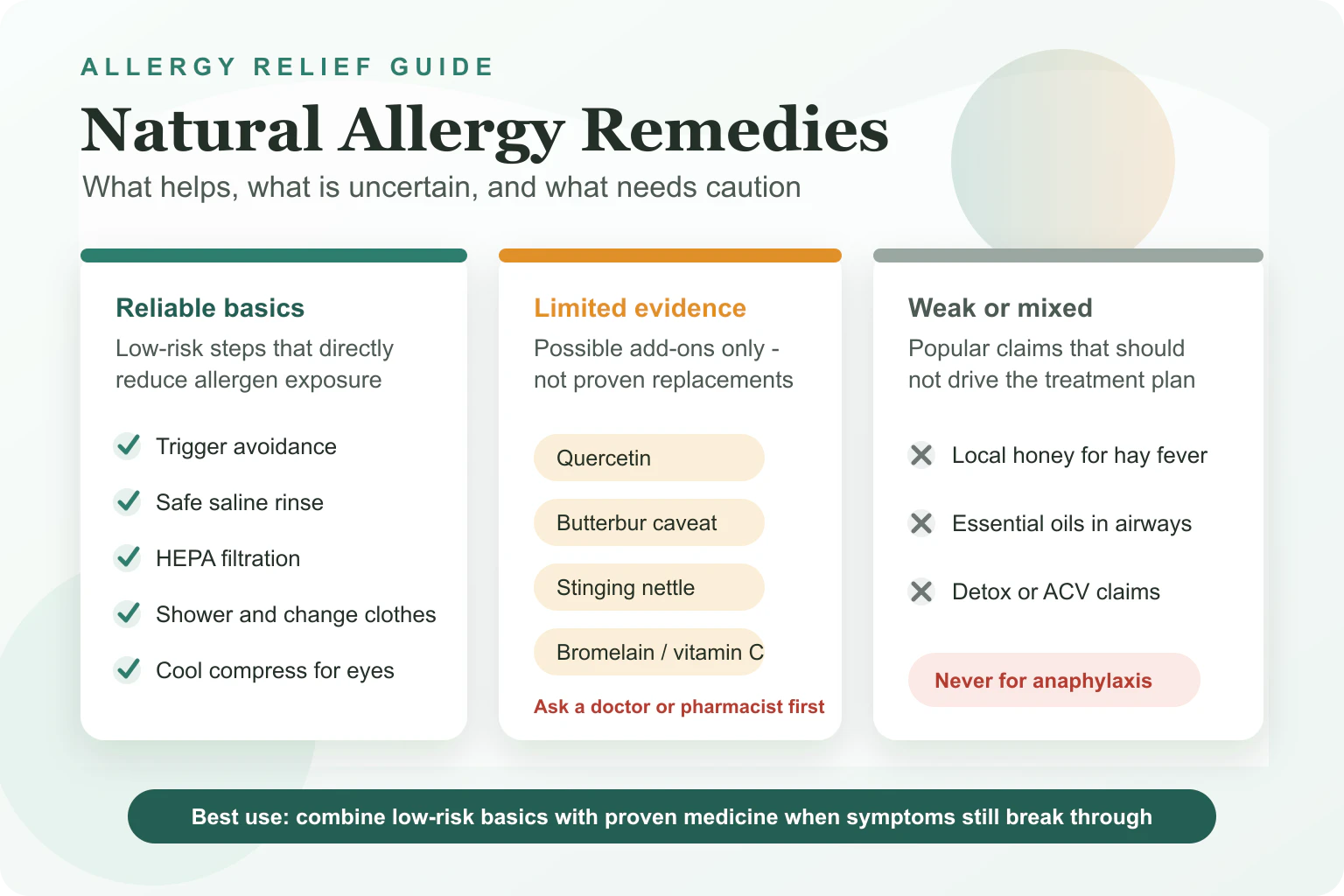
Short answer: avoiding your trigger is the most effective drug-free step, followed by saline nasal rinsing, filtered indoor air, and washing pollen off yourself. Supplements are a distant third — a few have some supporting trials, none is proven, and some carry real risks. No natural remedy treats a severe reaction.
The most effective "natural" allergy remedy is avoiding your trigger. After that, the drug-free steps with the strongest track record are a saline nasal rinse (using distilled or previously boiled water), a HEPA air purifier, showering and changing clothes after being outdoors, and saline drops or a cool compress for itchy eyes. Popular supplements like quercetin, butterbur and local honey have much weaker or mixed evidence, can carry risks, and should be discussed with your doctor. And no natural remedy treats a severe allergic reaction — that's always a medical emergency.
How to think about "natural" allergy relief
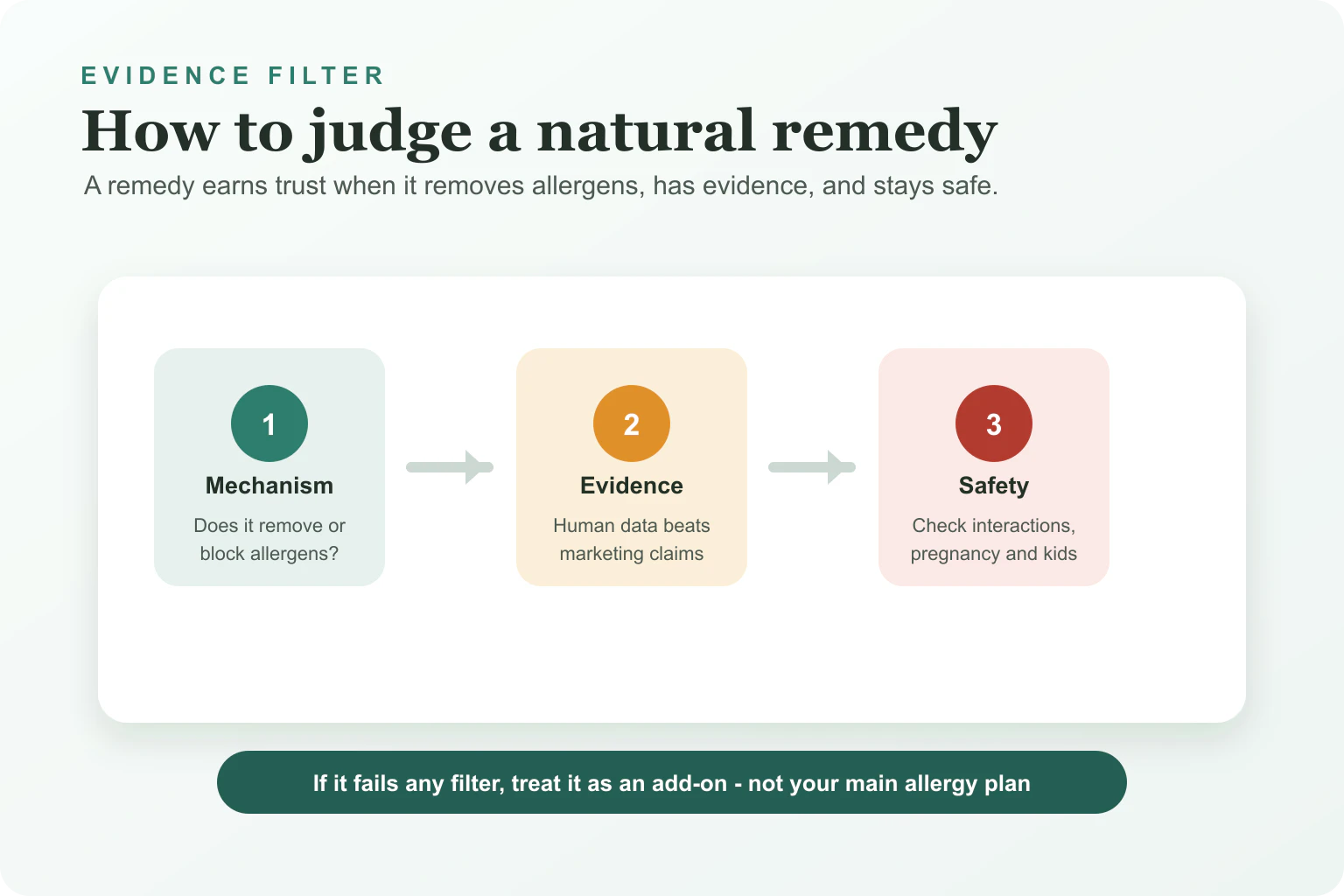
"Natural" doesn't automatically mean effective — or safe. Some drug-free steps are genuinely useful and very low-risk; others are popular but barely supported by research; and a few can cause harm if used carelessly. The honest approach is to lead with what works, be clear about what's uncertain, and use supplements only with a professional's input.
It also helps to set expectations: natural remedies are best at reducing symptoms and preventing flare-ups, not switching them off instantly. If you need fast relief, an antihistamine usually works quicker — and the two can be used together. For the complete picture, see our treatment & relief guide.
Reliable, low-risk basics (the ones worth doing)
Strong Avoid your triggers
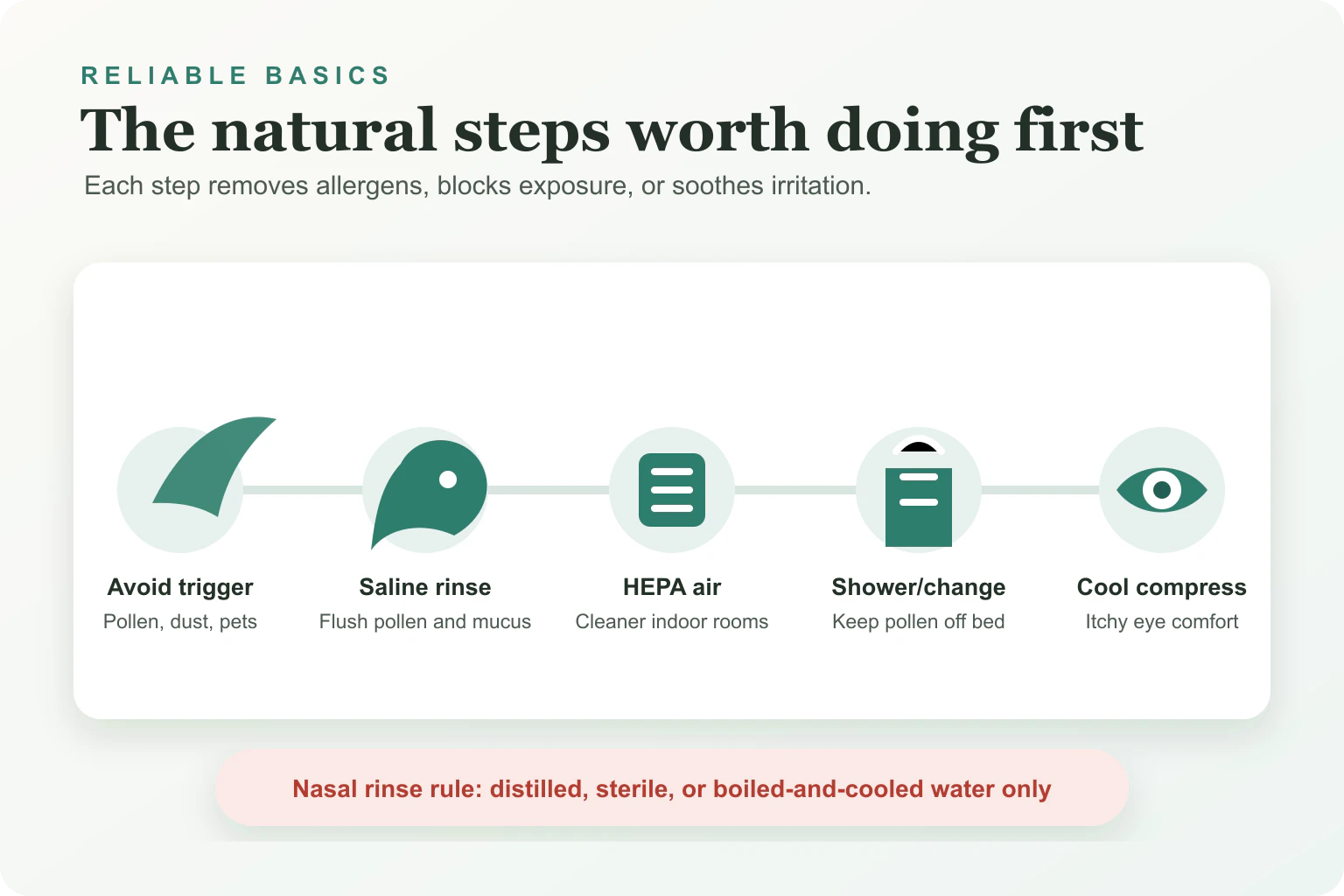
The single most effective natural remedy is reducing your exposure. Keep windows closed on high-pollen days, use air conditioning, manage dust mites with allergen-proof bedding, and keep pets out of the bedroom. Identify exactly what sets you off with allergy testing and avoidance becomes far easier.
Strong Saline nasal rinse
Rinsing your nose with a saline solution physically flushes out pollen, dust and mucus, and eases congestion. It's inexpensive, drug-free, and many people find it reduces how much medicine they need. Use a ready-made kit or a neti pot — but mind the water (see the safety note below).
⚠️ Critical safety note: water for nasal rinses
Never use untreated tap water in a neti pot or saline rinse. Use only distilled or sterile water, or tap water boiled for at least 1 minute (3 minutes at high elevations) and then cooled. Tap water is safe to drink but not to send through your nasal passages, because it can rarely contain the amoeba Naegleria fowleri, which can cause a serious infection. Rinse the device with safe water after each use and let it air-dry. This follows U.S. FDA and CDC guidance.
Strong Clean the air you breathe
A HEPA air purifier lowers indoor pollen and dust in the rooms you use most; run it during your season and change HVAC filters on schedule. Pair it with air conditioning instead of open windows on high-pollen days.
Strong Rinse allergens off you
Shower and change clothes after time outdoors, and shower before bed so you're not sleeping in the day's pollen. Don't dry laundry outside on high-pollen days — sheets and towels act like pollen traps.
Good Soothe itchy eyes
A clean, cool compress and preservative-free saline or lubricating eye drops rinse allergens away and calm irritation without medication. More in relief for itchy, watery eyes.
Supplements and foods: some evidence, real caveats
Several supplements are marketed as "natural antihistamines." A few have some supporting research, but the evidence is generally limited and mixed — and supplements aren't risk-free. Treat these as possible extras, not proven treatments, and talk to your doctor or pharmacist first, especially if you take other medicines, are pregnant, or are considering them for a child. This guide doesn't recommend specific doses.
| Remedy | The idea | Evidence & caveats |
|---|---|---|
| Quercetin | A plant flavonoid said to stabilise the cells that release histamine | Limited Some lab and early studies are promising; human evidence is thin. Found in onions, apples and berries. |
| Butterbur | A shrub extract studied for hay-fever symptoms | Limited Among the better-studied options, but raw butterbur can contain compounds linked to liver damage — only "PA-free" products, and not during pregnancy. Discuss with a doctor. |
| Stinging nettle | A herb traditionally used for allergy symptoms | Limited Popular but weakly supported; generally well tolerated. |
| Bromelain | A pineapple enzyme with anti-inflammatory properties | Limited Sometimes paired with quercetin; little direct allergy evidence. |
| Vitamin C | An antioxidant claimed to act as a mild antihistamine | Limited Fine from a normal diet; supplements are no substitute for proven treatment. |
What the evidence actually says — with the numbers
A page that grades remedies owes you the grades themselves. Here is what the two most relevant bodies have concluded, including where the evidence is weaker than the popularity suggests.
| Approach | What the assessment found | Source |
|---|---|---|
| Saline nasal irrigation | May reduce patient-reported disease severity for up to three months in adults and children, with no reported adverse effects — but across 14 trials and 747 participants the certainty of evidence was rated low to very low | Cochrane 2018 |
| Nasal irrigation | "May be a useful addition to conventional treatment" | NCCIH |
| Butterbur | A 2007 evaluation of six studies and 720 participants indicated it may be helpful | NCCIH |
| Acupuncture | A 2015 evaluation of 13 studies and 2,365 participants found evidence it may be helpful | NCCIH |
| Honey | Only a few studies have examined it in seasonal allergy, and results have been inconsistent | NCCIH |
| Probiotics | Some studies promising, but overall evidence in allergic rhinitis is inconsistent | NCCIH |
| Other nutritional approaches | Evidence either inconsistent or too limited to show helpfulness | NCCIH |
Why saline is still worth doing on "low quality" evidence
This is the distinction that trips people up. Cochrane's low-certainty rating is about how confident we can be in the size of the effect — the trials were small and measured outcomes inconsistently — not a finding that saline does nothing. Combine a probable benefit with essentially no downside, no drug interactions and negligible cost, and rinsing remains an easy yes. A remedy can be worth doing on modest evidence when the risk is near zero; the same logic does not extend to swallowing an unregulated supplement.
One correction worth making explicitly: acupuncture is often written off for allergies, including in earlier versions of this page. NCCIH's assessment of 13 studies covering 2,365 participants found evidence it may be helpful. That is not proof, and it is not a reason to skip proven treatment — but "may be helpful" is a fairer summary than "inconclusive."
Popular remedies with weak or mixed evidence
Weak Local honey
The appealing theory is that eating local honey exposes you to tiny amounts of local pollen and builds tolerance, like a food-based immunotherapy. In practice, studies haven't reliably shown a benefit, partly because the pollen in honey isn't the wind-blown pollen that usually triggers hay fever. It's generally harmless for adults in food amounts, but don't rely on it — and never give honey to a baby under 12 months (risk of infant botulism).
Mixed Essential oils
Oils such as eucalyptus and peppermint are often suggested for congestion. Evidence for treating allergies is weak, and there are real cautions: essential oils aren't tightly regulated for quality, can irritate skin or airways, and should be diluted and patch-tested. Don't add them to a nasal rinse, and never use them for a severe reaction.
Mixed Probiotics
Gut bacteria influence immune signalling, so probiotics are a plausible idea and a heavily marketed one. NCCIH's assessment is that although some studies showed promising results, the overall evidence on probiotics and allergic rhinitis is inconsistent. Fermented foods are a harmless part of a normal diet; supplements are not a substitute for treatment that works, and quality varies widely between products.
Mixed Acupuncture, apple cider vinegar & "detox" ideas
Acupuncture studies are mixed and inconclusive. Apple cider vinegar and various "detox" or "immune-boosting" claims aren't supported by good evidence for allergies. None of these is dangerous in moderation, but they shouldn't replace approaches that actually work.
Butterbur: the safety detail that matters most
Butterbur has the strongest trial record of the herbal options here, which is exactly why the safety caveat needs stating plainly. NCCIH notes that raw butterbur extracts contain pyrrolizidine alkaloids, which can cause liver damage and cancer. Extracts almost completely free of these alkaloids exist — but NCCIH is explicit that no studies have proven the long-term safety even of the reduced-alkaloid products. It should not be used in pregnancy. If you are considering butterbur, that is a conversation with a doctor, not a purchase decision.
Steam, diet and daily habits: a supportive layer
These won't cure allergies, but several can genuinely make you more comfortable or help the proven steps work better.
Steam and humidifiers
Warm steam — from a hot shower or a bowl of just-boiled water — can loosen congestion and soothe irritated nasal passages for a while. A bedroom humidifier can help too, but clean it regularly and don't overdo it: damp air and a dirty tank can grow mold, which makes allergies worse. Steam eases symptoms; it doesn't remove the allergen.
An anti-inflammatory diet and vitamin-C foods
A diet rich in fruit, vegetables, oily fish (omega-3s) and other whole foods supports overall health and may modestly help how your body handles inflammation. Vitamin-C-rich foods — citrus, berries, leafy greens — are a sensible, low-risk choice. Think of diet as a supportive background, not a fast fix.
Hydration, exercise and stress
Staying well hydrated keeps mucus thinner and easier to clear. Regular exercise and stress reduction won't stop an allergic reaction, but there's some evidence they can make seasonal symptoms feel less severe — just consider exercising indoors on high-pollen days.
Go deeper on any of these
Several of the remedies above have a full guide of their own, including the two that get asked about most.
| If you want the detail on | Guide |
|---|---|
| Quercetin, including what the trials actually tested | Quercetin for allergies |
| Whether local honey helps | Does local honey help allergies? |
| Rinsing technique and safe water | Neti pot and saline rinsing |
| Other home remedies compared | Home remedies for allergy relief |
| Filtering indoor air properly | HEPA filters, air purifiers and vacuuming |
| Setting up a low-allergen bedroom | Allergy-proof bedroom and dust mite allergy |
| Eye symptoms without medication | Eye allergies and allergy eye drops |
| When you need something faster | Allergy medicine and fast relief, realistically |
| Treating the cause rather than the symptoms | Allergy shots and under-the-tongue tablets |
| Pregnancy and children | Allergies during pregnancy and children's allergy medicine |
Using supplements safely
"Natural" is not the same as "safe." Supplements can interact with prescription medicines, vary in quality and strength between brands, and aren't suitable for everyone. Before trying any supplement: check with your doctor or pharmacist (especially if you're pregnant, breastfeeding, or giving it to a child or older adult), introduce one thing at a time so you can tell what helps, and stop if you notice any reaction.
How long do natural remedies take to work?
It depends on the remedy. Physical steps that remove or block allergens — a saline rinse, HEPA filtration, showering after being outdoors — can bring relief within minutes to hours. Supplements are much slower: something like quercetin or stinging nettle, if it helps at all, generally needs consistent use over weeks, which is why people who use them often start before their allergy season begins. If you've given a natural approach a fair, consistent trial and symptoms still disrupt your day, that's the point to add a proven medicine or see a doctor rather than keep waiting.
When natural remedies aren't enough
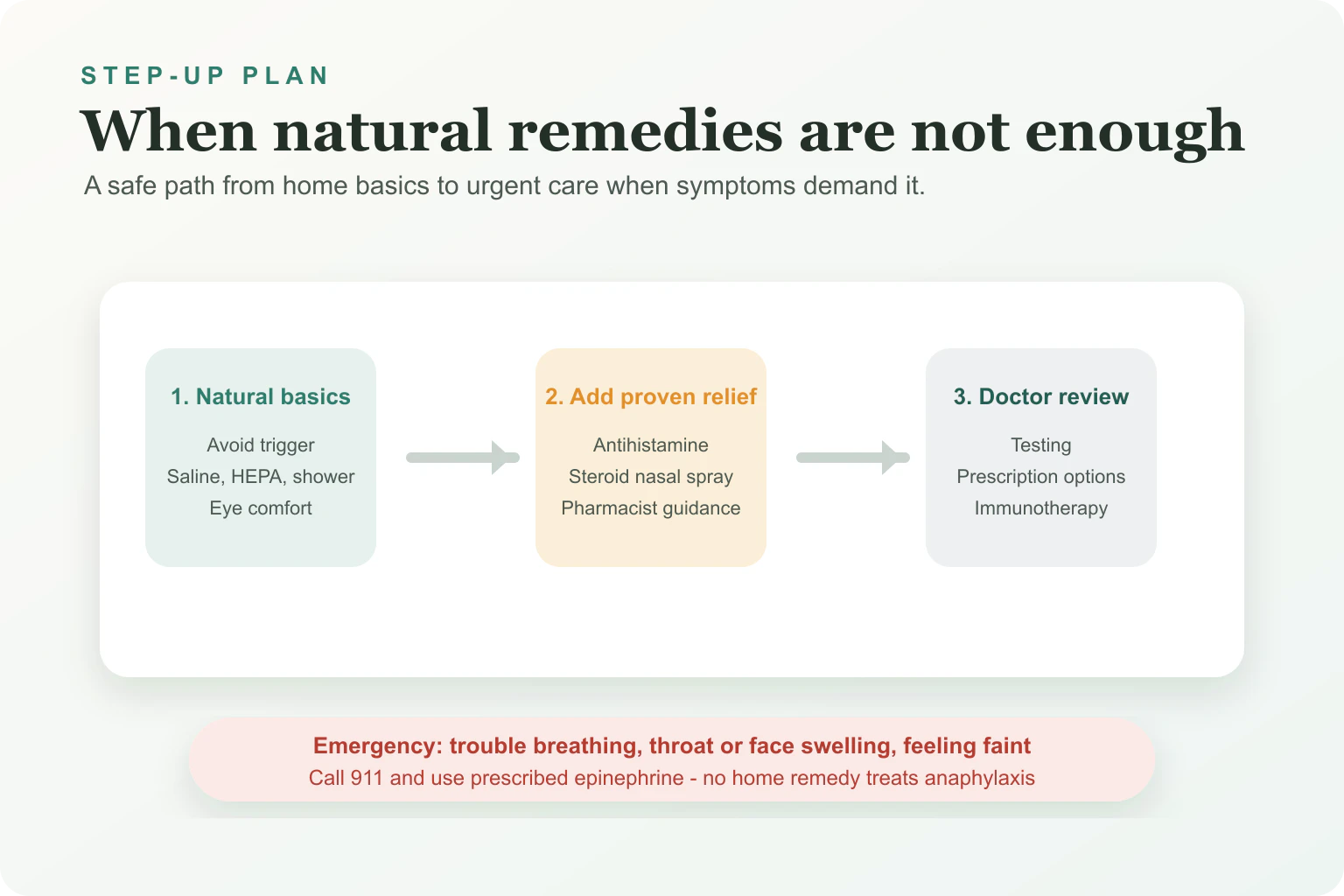
If drug-free steps aren't controlling your symptoms, that's not a failure — it's a signal to add proven treatment. A non-drowsy antihistamine or a steroid nasal spray works faster and more reliably for many people, and can be combined with the natural basics above. Ongoing symptoms are also a reason to see a doctor, who can confirm your triggers and discuss stronger options, including immunotherapy. See our treatment & relief guide.
Never treat a severe reaction with home remedies
A severe, whole-body allergic reaction (anaphylaxis) is a medical emergency that no natural remedy can treat. Call 911 for trouble breathing; swelling of the face, lips, tongue or throat; widespread hives; or feeling faint, and use a prescribed epinephrine auto-injector right away if available. Likewise, any breathing symptoms — coughing, wheezing, chest tightness — need a doctor, not home remedies. See our allergy safety guide.
Natural allergy remedies: frequently asked questions
What is the best natural remedy for allergies?
Does local honey help with allergies?
Are saline nasal rinses safe?
Do supplements like quercetin or butterbur work for allergies?
How long do natural allergy remedies take to work?
Is saline rinsing actually proven to work?
Is butterbur safe to take for hay fever?
Does acupuncture help with allergies?
Do probiotics help allergic rhinitis?
Can natural remedies replace allergy medicine?
How we create and review this guide
This guide is written for a general audience using patient-education material from the authoritative sources below, not blogs or forums. We aim to be honest about the strength of the evidence behind each approach:
- American Academy of Allergy, Asthma & Immunology (AAAAI)
- American College of Allergy, Asthma & Immunology (ACAAI)
- Mayo Clinic
- U.S. National Center for Complementary and Integrative Health (NCCIH)
- U.S. Food and Drug Administration (FDA) & Centers for Disease Control and Prevention (CDC)
Sources for the specific figures on this page
- National Center for Complementary and Integrative Health, National Institutes of Health. Seasonal Allergies at a Glance (opens in a new tab). Nasal irrigation as a possibly useful addition to conventional treatment; a 2007 evaluation of six butterbur studies with 720 participants indicating it may be helpful; raw butterbur extracts containing pyrrolizidine alkaloids that can cause liver damage and cancer, with no studies proving long-term safety even of reduced-alkaloid products; a 2015 evaluation of 13 acupuncture studies with 2,365 participants finding evidence it may be helpful; inconsistent results for honey and for probiotics; and other nutritional approaches having inconsistent or too-limited evidence.
- Head K, Snidvongs K, Glew S, Scadding G, Schilder AGM, Philpott C, Hopkins C. Saline irrigation for allergic rhinitis (opens in a new tab). Cochrane Database of Systematic Reviews 2018. Fourteen randomised trials with 747 participants; saline irrigation may reduce patient-reported disease severity up to three months in adults and children with no reported adverse effects; certainty of evidence rated low to very low because studies were small and outcomes inconsistently measured.
- U.S. Food and Drug Administration. Is Rinsing Your Sinuses With Neti Pots Safe? (opens in a new tab). The requirement to use distilled, sterile or previously boiled and cooled water for nasal rinsing, and to clean and dry the device after each use.
- MedlinePlus, U.S. National Library of Medicine. Saline nasal washes (opens in a new tab). Using only distilled, boiled or filtered water for a nasal wash, and cleaning the device with the same water after every use and letting it dry.
- American College of Allergy, Asthma & Immunology. Hay fever (allergic rhinitis) (opens in a new tab). Intranasal corticosteroids described as the single most effective drug class for allergic rhinitis, for comparison with the drug-free options on this page.
Medical disclaimer: This guide is for general education and isn't a substitute for personalized medical advice. It doesn't provide dosing. Talk to a qualified healthcare professional before starting any supplement or remedy, particularly during pregnancy, for children, or alongside other medicines.
 MD
MDMedically reviewed
Dr. Hannah H. Walford, MD
Allergist and Immunologist
- Website role
- Owner, Medical Director and Medical Reviewer of Allergy Relief Guide
- Professional affiliation
- Stanford Health Care / Menlo Medical Clinic, Menlo Park, California
- Areas of expertise
- Food allergy, eczema, allergic rhinitis, sinusitis and asthma
Dr. Hannah H. Walford is a board-certified allergist and immunologist experienced in caring for adults and children with allergic conditions. Her areas of expertise include food allergy, eczema, allergic rhinitis, sinusitis and asthma. She provides medical leadership and review oversight for the educational health content published by Allergy Relief Guide.
Medical content is provided for education and is not a substitute for diagnosis or individualized medical care.
Related guides
- Allergy treatment & relief — the complete, step-by-step plan.
- Antihistamines and the best antihistamine — when you need faster relief.
- Nasal sprays for allergies — the most effective option for congestion.
- Seasonal allergies and indoor allergies — reduce exposure at the source.
- Itchy, watery eyes — drug-free and medicated relief.
- Quercetin for allergies and does local honey help? — the two most-asked supplements, in detail.
- Neti pot & saline rinsing and home remedies — technique and safe water.
- Allergy medicine — what to add when drug-free steps are not enough.
Want relief that's reliable, fast and safe?
Combine the natural basics with the right medicine — our treatment guide shows you how.
Go to the treatment & relief guide