
Allergy Symptoms: Signs, Causes & When to Worry
What allergy symptoms look and feel like, how to tell them apart from a cold, how long they last, and the severe signs that mean it's time to get help fast.
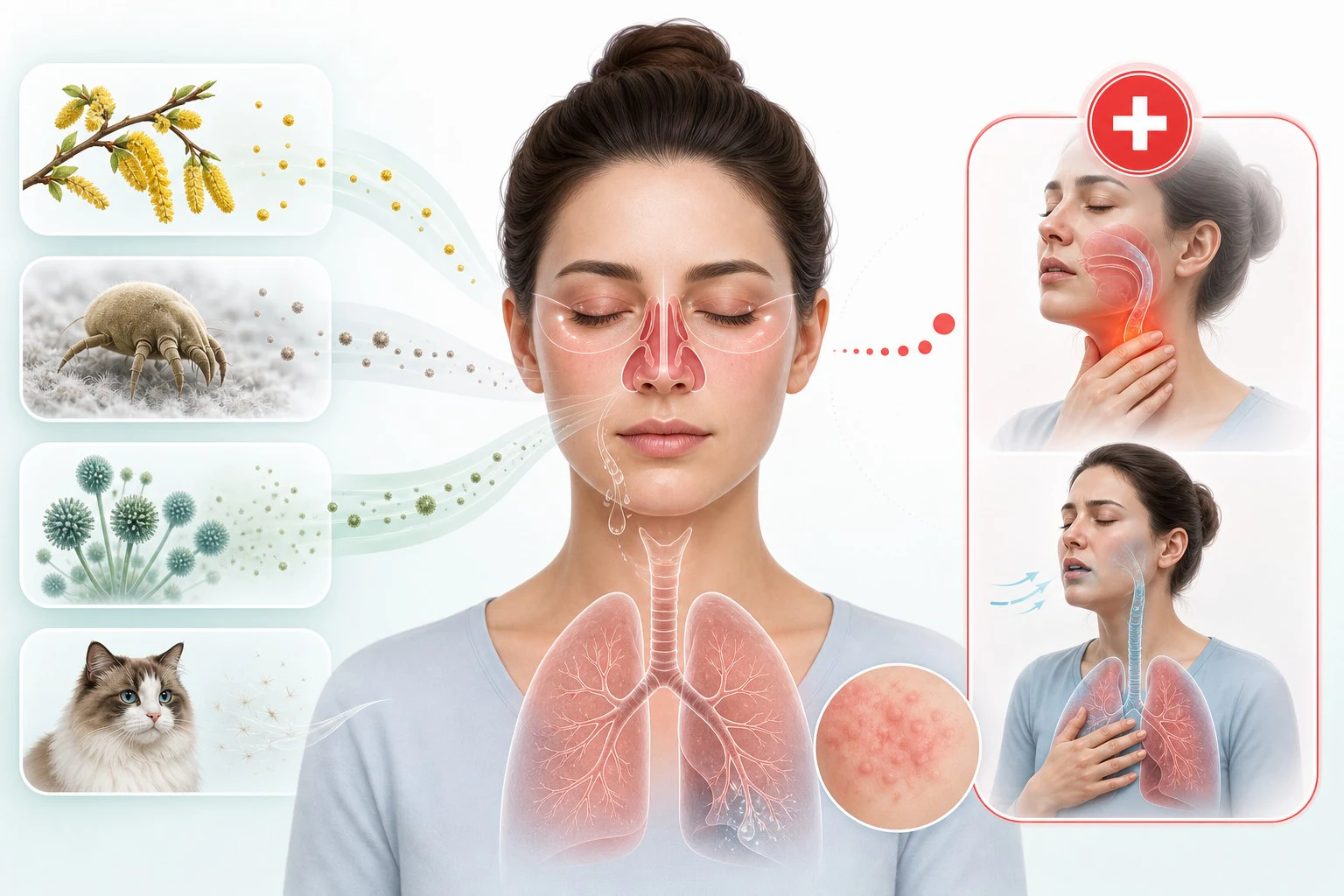
Quick answer: the most common allergy symptoms
Short answer: the core allergy symptoms are sneezing, an itchy or runny nose, congestion and itchy watery eyes, often with postnasal drip, a cough, hives or tiredness. Itching and the absence of fever are the strongest clues that it is allergy rather than infection. Trouble breathing or swelling of the face, lips or throat is an emergency.
The most common allergy symptoms are sneezing, an itchy or runny nose, nasal congestion, and itchy, watery, red eyes. Allergies can also cause postnasal drip, a cough or mild wheeze, skin reactions like hives, and tiredness from disrupted sleep. A key clue: unlike a cold, allergies rarely cause a fever, and symptoms keep returning for as long as you're exposed to the trigger. Severe, whole-body symptoms — trouble breathing or swelling of the face, lips or throat — are a medical emergency.
Common allergy symptoms at a glance
Allergy symptoms depend on how you meet the allergen — whether you breathe it in, touch it, or eat it — but most fall into a handful of familiar groups. Here they are, organised by the part of the body they affect.
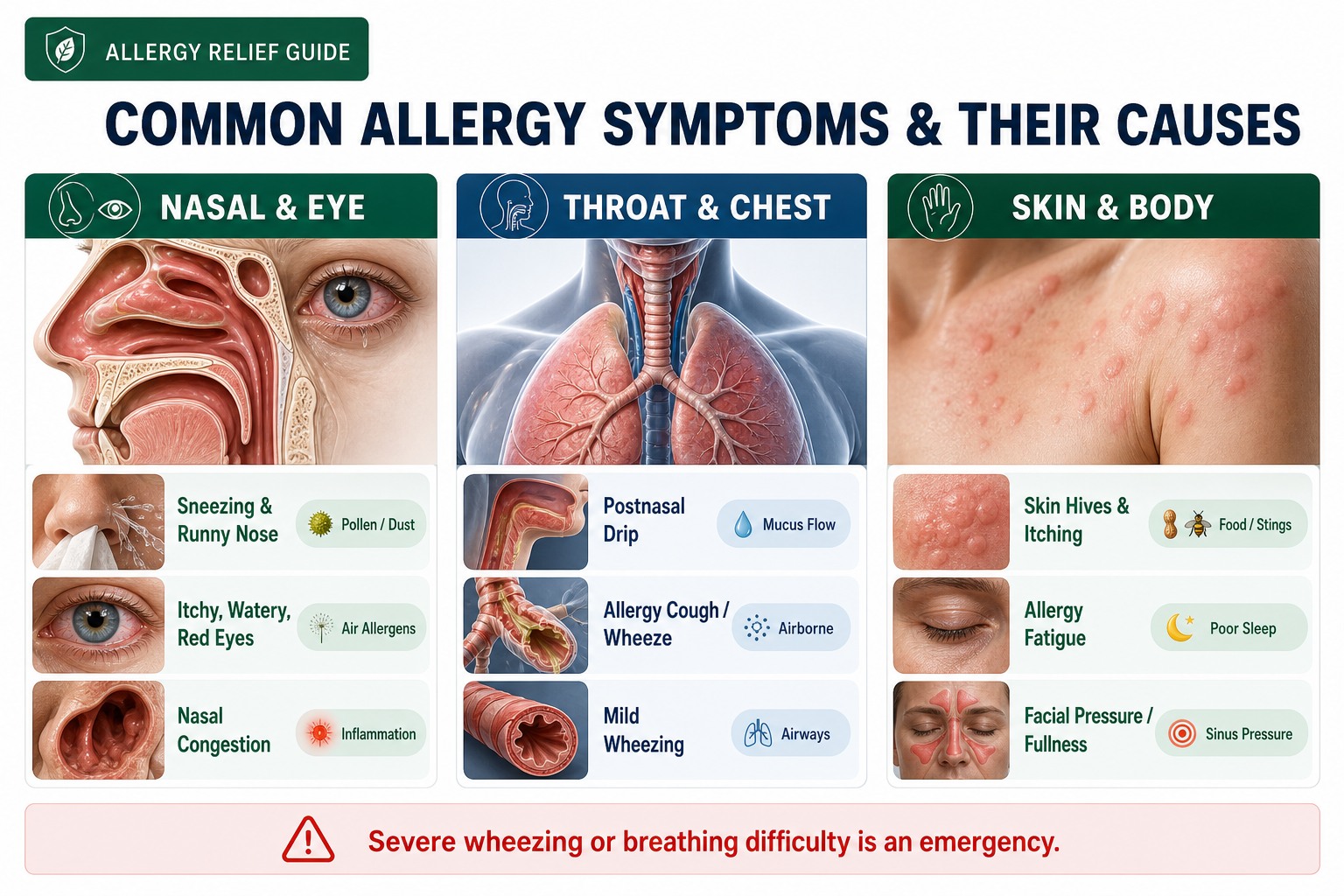
- Sneezing and an itchy nose
- A runny nose or nasal congestion
- Itchy, watery or red eyes
- Postnasal drip and throat clearing
- An allergy cough or mild wheeze
- Skin reactions such as hives or itching
- Tiredness from broken sleep (allergy fatigue)
- Mild facial pressure or a "full head" feeling
Allergy symptoms by body area
Because different allergens reach you in different ways, your symptoms often cluster in one area. Understanding the pattern helps you match relief to what's actually bothering you.
Nose and sinuses
Nasal symptoms are the classic sign of airborne allergies (allergic rhinitis, also called hay fever): repeated sneezing, an itchy nose, a clear runny nose, and congestion that blocks airflow. Many people also get postnasal drip — mucus trickling down the back of the throat — which leads to throat clearing and, sometimes, a cough. Learn more in allergic rhinitis explained.
Eyes
Airborne allergens that touch the eyes cause allergic conjunctivitis: itchy, watery, red or puffy eyes, often alongside the nasal symptoms above. It's usually both eyes at once. See relief for itchy, watery eyes.
Throat and chest
Irritation from postnasal drip or inhaled particles can cause a persistent allergy cough or a mild wheeze. Most nasal allergy coughs are mild — but any real difficulty breathing or a noticeable wheeze deserves prompt medical attention, especially in someone with asthma.
Skin
Contact with an allergen, or a reaction to a food or insect sting, can cause raised, itchy welts (hives), general itching, or an eczema-type rash. Skin symptoms can appear on their own or as part of a wider reaction.
Whole-body and energy
Allergies can leave you feeling drained. This allergy fatigue usually comes from congestion and other symptoms disrupting your sleep, combined with the immune system working overtime. Feeling foggy or low on energy during your allergy season is common.
Less obvious allergy symptoms
Allergies don't always look like classic hay fever. Several symptoms are easy to blame on something else, which is why allergies sometimes go unrecognised for a long time. Watch for:
- Dark circles under the eyes ("allergic shiners") — caused by congestion affecting blood flow around the eyes.
- Reduced sense of smell or taste — a blocked, inflamed nose can dull both.
- Ear fullness or popping — congestion can affect pressure in the ears.
- An itchy throat or the roof of the mouth — common with pollen allergies.
- Headache or facial pressure — from sinus congestion and inflammation.
- Poor sleep or snoring — a stuffy nose at night disrupts rest, feeding daytime tiredness.
On their own, any one of these could have another cause. But when they appear alongside sneezing, an itchy nose or watery eyes — and especially if they follow a seasonal or trigger-based pattern — allergies are a likely explanation worth checking with allergy testing.
An itchy mouth after raw fruit: pollen food allergy syndrome
If your lips or mouth tingle and itch when you eat a raw apple, peach or melon, and it settles within minutes, that is usually pollen food allergy syndrome rather than a new food allergy. It is also called oral allergy syndrome, and it is one of the most commonly misread allergy symptoms there is.
The cause is mistaken identity. The American College of Allergy, Asthma & Immunology explains that the immune system recognises proteins in certain raw fruits and vegetables that closely resemble proteins in pollen, and reacts to them. So this is a pollen allergy expressing itself in your mouth, not a separate food allergy.
| If you react to | Raw foods that commonly cross-react |
|---|---|
| Birch pollen (spring) | Apple, almond, carrot, celery, cherry, hazelnut, kiwi, peach, pear, plum |
| Grass pollen (summer) | Celery, melon, orange, peach, tomato |
| Ragweed pollen (late summer, fall) | Banana, cucumber, melon, sunflower seeds, zucchini |
Three things make it recognisable. Symptoms stay local — itchy mouth, scratchy throat, sometimes mild lip or tongue swelling. They start quickly and, per ACAAI, usually subside soon after the food is swallowed or spat out. And the same food is normally fine cooked, because heating distorts the protein enough that the immune system stops recognising it. That last detail is the clearest giveaway: a raw apple bothers you, apple pie does not.
When it stops being minor
ACAAI notes that although it is uncommon, symptoms can progress beyond the mouth, with anaphylaxis reported in roughly 1.7% of people with this syndrome. Anything beyond mouth and throat itching — hives elsewhere, vomiting, trouble breathing, faintness — is no longer a mild reaction. Speak to an allergist about whether you should carry an epinephrine auto-injector. Read more in oral allergy syndrome and food allergy vs. intolerance.
What causes allergy symptoms?
Allergy symptoms happen when your immune system mistakes a harmless substance — an allergen — for a threat and releases chemicals such as histamine, which trigger inflammation and the symptoms you feel.
The first time you meet an allergen, your body may quietly become "sensitised" to it. On later exposures, the immune system reacts quickly — which is why symptoms can appear within minutes of breathing in pollen or petting an animal. That single mechanism explains why one trigger can cause several symptoms at once. Common triggers include:
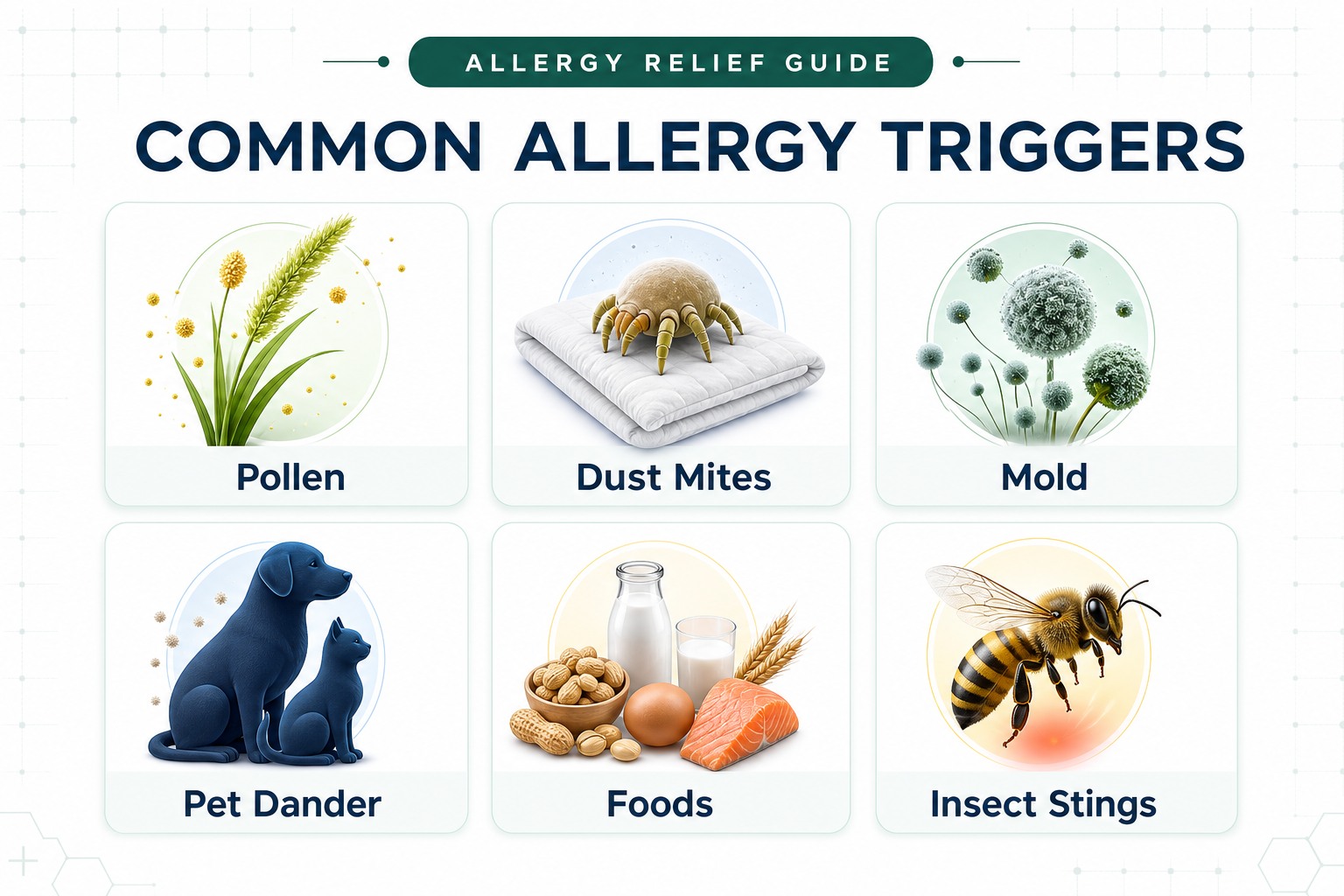
To dig into what may be affecting you, see types of allergies and indoor & environmental allergies.
Allergy symptoms by trigger
The same trigger tends to produce a recognisable set of symptoms, so noticing when and where you react is one of the best clues to what's behind it.
Pollen (seasonal)
Tree, grass and weed pollen mainly cause nasal and eye symptoms — sneezing, a runny or blocked nose, and itchy, watery eyes — that flare outdoors and during specific seasons. Symptoms often peak on dry, windy days and ease after rain. See pollen allergy and seasonal allergies.
Dust mites and mold (indoor)
Indoor triggers tend to cause year-round, lower-grade nasal congestion and sneezing that can be worse in the morning or in certain rooms. Damp spaces point toward mold; bedding and soft furnishings point toward dust mites.
Pet dander
Reactions to cats, dogs and other animals bring on sneezing, congestion and itchy eyes — and sometimes an itchy rash where an animal has licked or scratched you — often within minutes of contact.
Foods and insect stings
These are more likely than airborne triggers to cause skin symptoms (hives, swelling) and, in some people, severe whole-body reactions. Any reaction involving breathing or throat swelling is an emergency (see below). Learn more in food allergies.
Allergy symptoms vs. a cold: how to tell the difference
The quickest way to tell them apart: allergies cause itching (eyes and nose) and no fever, and last as long as you're exposed to the trigger, while a cold builds over a day or two, may bring aches or a mild fever, and clears within about a week to ten days.
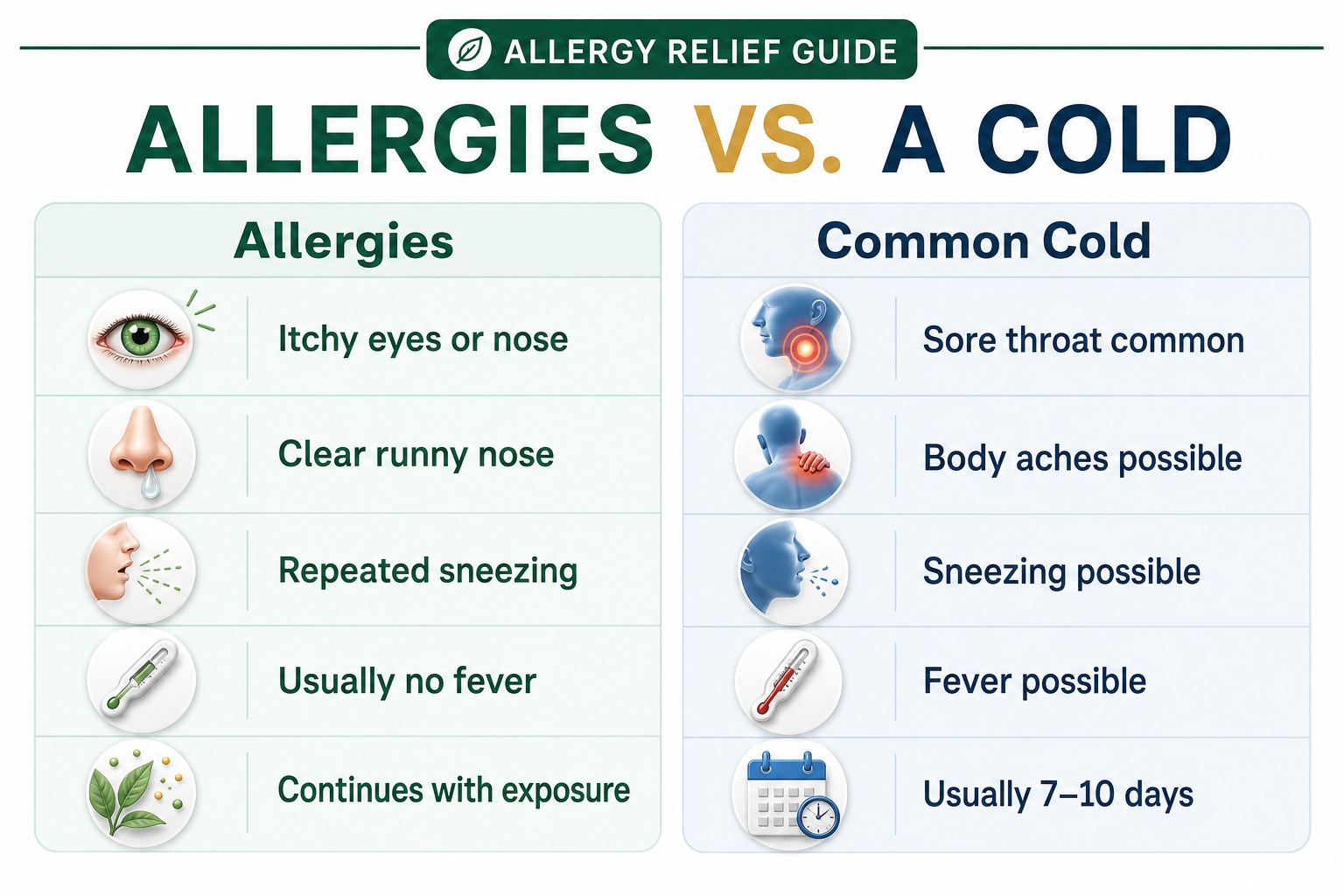
| Feature | Allergies | Common cold |
|---|---|---|
| Onset | Sudden, right after exposure | Gradual, over 1–2 days |
| Itchy eyes / nose | Common | Rare |
| Fever | No | Sometimes (mild) |
| Body aches | No | Sometimes |
| Mucus | Usually clear and watery | Can thicken and turn yellow/green |
| Duration | As long as you're exposed (weeks in season) | About 7–10 days |
| Timing pattern | Returns each season or around a trigger | Any time; often spreads between people |
Still unsure? Our dedicated guide, allergies vs. a cold, walks through the overlaps in more detail.
A few other look-alikes are worth knowing: the flu usually hits harder and faster with fever, aches and exhaustion; a sinus infection often brings facial pain, pressure and thicker discoloured mucus that lingers; and respiratory infections such as COVID-19 can share symptoms too. When there's a fever, body aches, or symptoms that don't fit your usual allergy pattern, it's worth checking with a healthcare provider rather than assuming it's allergies.
Why symptoms can hit hours after the exposure
An allergic reaction is not one event but two, and the second one catches people out. It explains why you can leave the cat, feel fine, and then be blocked up that evening — and why congestion so often feels worse overnight and on waking.
- The early phase, within about 5 to 15 minutes. Mast cells release histamine and other mediators almost immediately after exposure. This is the sneezing, itching and streaming nose you notice straight away, and it is what an antihistamine is designed to blunt.
- The late phase, roughly 4 to 6 hours later. Cytokines draw eosinophils, T-lymphocytes and basophils into the nasal lining, producing swelling. The hallmark late-phase symptom is congestion — a blocked nose from tissue inflammation rather than from histamine.
Two practical consequences follow. First, a blocked nose hours after exposure is not a sign the antihistamine failed; it is a different mechanism, which is why an anti-inflammatory steroid nasal spray usually does more for congestion than a tablet. See nasal spray for allergies and allergy medicine.
Second, repeated exposure keeps restarting both phases, so day-to-day symptoms can blur into a constant background that never fully clears. That is one reason symptoms feel heavier at the end of a long pollen week than at the start of it, and one reason preventive daily treatment tends to work better than treating each flare after it arrives.
Not everyone gets a late phase
The two-phase pattern is typical, not universal, and its size varies from person to person and exposure to exposure. Use it as an explanation for a delayed blocked nose, not as a rule about what your own reactions must do.
How long do allergy symptoms last?
Allergy symptoms last as long as you're exposed to the trigger. Remove the allergen and they usually ease within hours; keep meeting it and they continue.
- Seasonal (pollen): can run for weeks or months during the relevant season. See seasonal allergies.
- Indoor (dust mites, pet dander, mold): often year-round, because the trigger is always around.
- After a one-off exposure: symptoms typically settle within a few hours, though an itchy rash can linger longer.
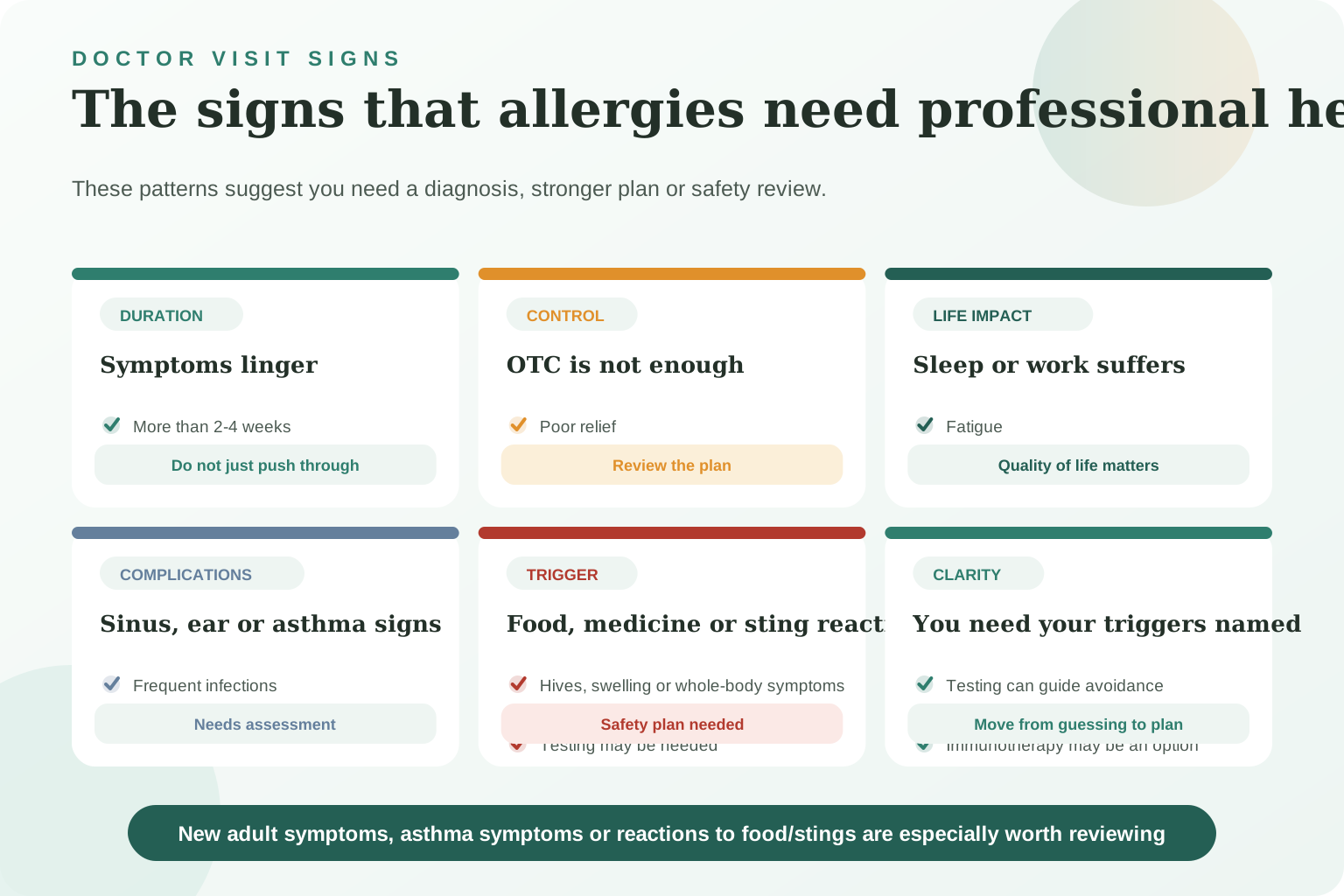
If your symptoms drag on for many weeks, keep coming back, or aren't controlled by over-the-counter options, that's a sign to look at treatment more seriously or see a doctor.
Do allergy symptoms change over time?
Yes — allergies can change throughout life. Some people find childhood allergies fade as they get older, while others develop new allergies as adults, sometimes after moving to a new area with different pollen or getting a new pet. Existing symptoms can also get milder or stronger from year to year depending on how much of the trigger is around and how your immune system changes.
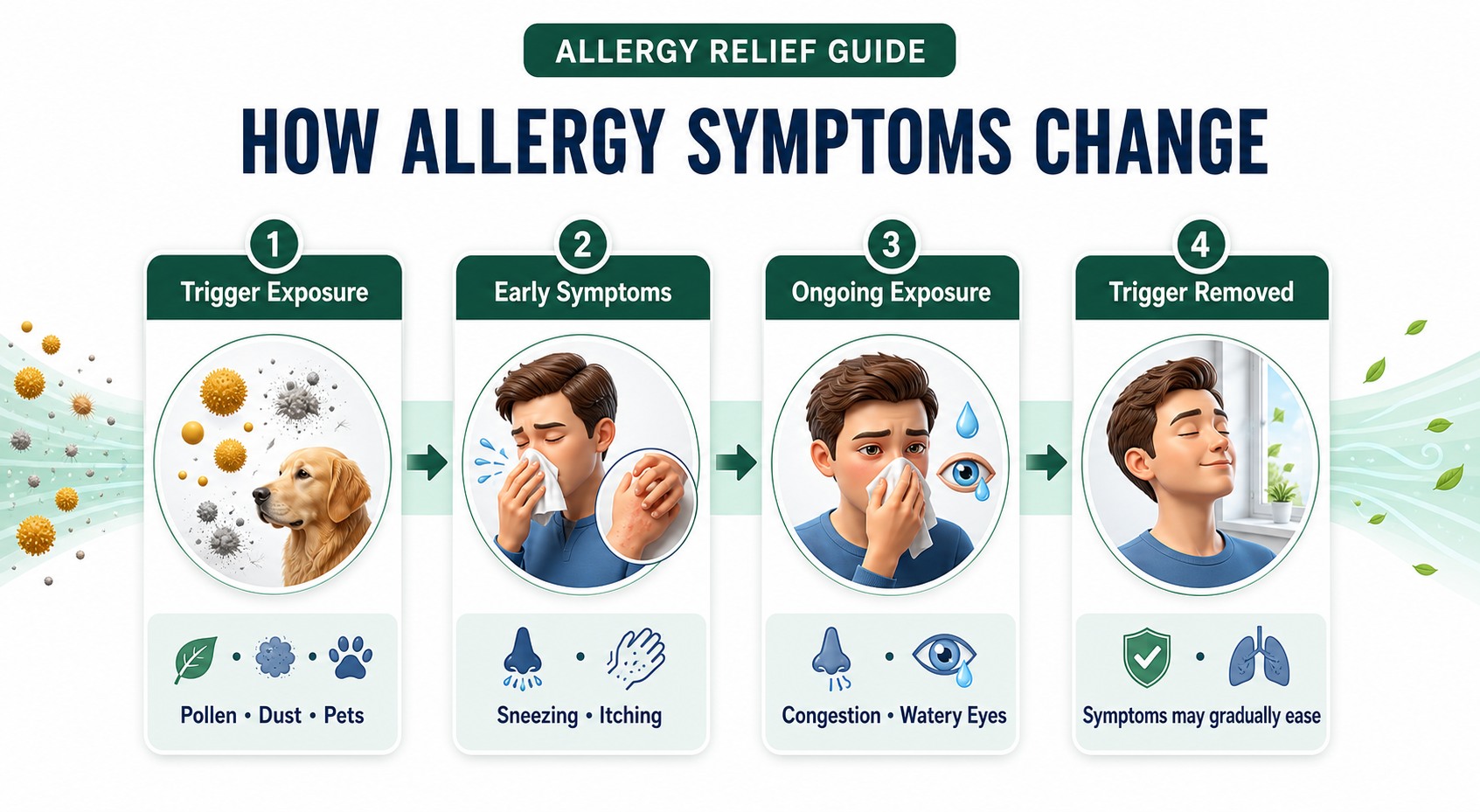
What matters most is the pattern: symptoms that are new, clearly worsening, or spreading to new triggers are worth discussing with a doctor, who can retest and adjust your plan. An accurate, up-to-date picture of your triggers is the foundation for effective treatment.
Allergy symptoms in children
Children often show the same core symptoms as adults — sneezing, a runny or blocked nose, and itchy eyes — but the signs can be easy to miss. Look for frequent nose-rubbing (sometimes called the "allergic salute"), mouth-breathing, dark circles under the eyes, a lingering cough, or trouble sleeping during a particular season.
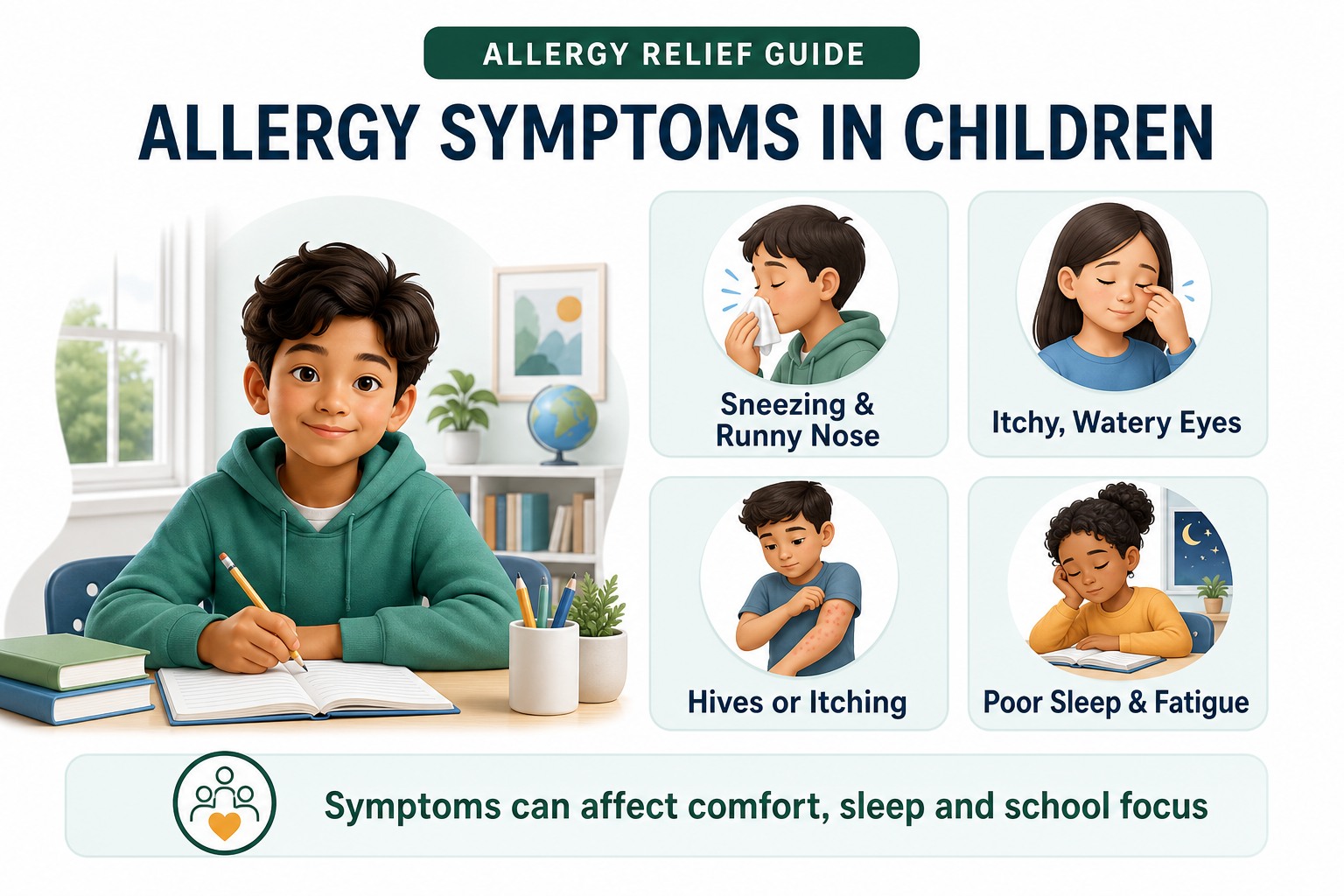
Because symptoms in young children can overlap with colds and other conditions, and because treatment differs by age, it's best to check with a pediatrician rather than guess. More in allergies in children.
It also helps to notice timing and setting: symptoms that appear every year at the same season, worsen at a friend's house with a pet, or ease on holiday away from home can all point to a specific trigger. Untreated nasal allergies in children can affect sleep, concentration and school days, so recognising the pattern early — and getting the right diagnosis — is worth the effort.
Severe allergy symptoms: when it's an emergency
Most allergy symptoms are annoying rather than dangerous — but a severe, whole-body reaction called anaphylaxis is a medical emergency and needs immediate care.
Allergic emergency — act fast
Anaphylaxis can develop within minutes. Call 911 (or your local emergency number) right away if you notice trouble breathing; swelling of the face, lips, tongue or throat; widespread hives; chest tightness; dizziness or fainting; or a sudden sense of dread.
If epinephrine (an auto-injector such as EpiPen or Auvi-Q) has been prescribed, use it immediately — it's the first-line treatment — and still call emergency services. Don't rely on antihistamines in place of epinephrine. See our allergy safety guide.
When to see a doctor (non-emergency)
Book an appointment with a primary care provider or an allergist if symptoms disrupt your sleep or daily life, last for many weeks, keep coming back, aren't controlled by over-the-counter medicine, or you're unsure what's triggering them. See when to see a doctor for allergies.
Symptom by symptom: where to read more
Most single symptoms on this page have a guide of their own. Jump to whichever one is actually bothering you, or to the look-alike you are trying to rule out.
| Symptom or question | Guide |
|---|---|
| Itchy, watery, red eyes | Eye allergies and itchy, watery eyes |
| Cough that will not settle | Allergy cough |
| Sore or scratchy throat | Allergy sore throat |
| Headache or facial pressure | Allergy headache vs. sinus headache |
| Blocked or popping ears | Allergies and ear pressure |
| Mucus down the back of the throat | Postnasal drip |
| Exhaustion and brain fog | Allergy fatigue |
| Raised itchy welts | Hives (urticaria) |
| Itchy rash where something touched the skin | Contact dermatitis |
| Wheeze or chest tightness | Allergic asthma |
| Can allergies actually cause a fever? | Can allergies cause a fever? |
| Is this a sinus infection instead? | Allergies vs. sinus infection |
| Could this be COVID-19? | Allergies vs. COVID-19 |
| Symptoms that started in adulthood | Allergy symptoms in adults |
| Signs in a baby or toddler | Allergies in babies and toddlers |
How allergy symptoms are diagnosed and relieved
If your symptoms point to an allergy, the next steps are to confirm the trigger and choose relief.
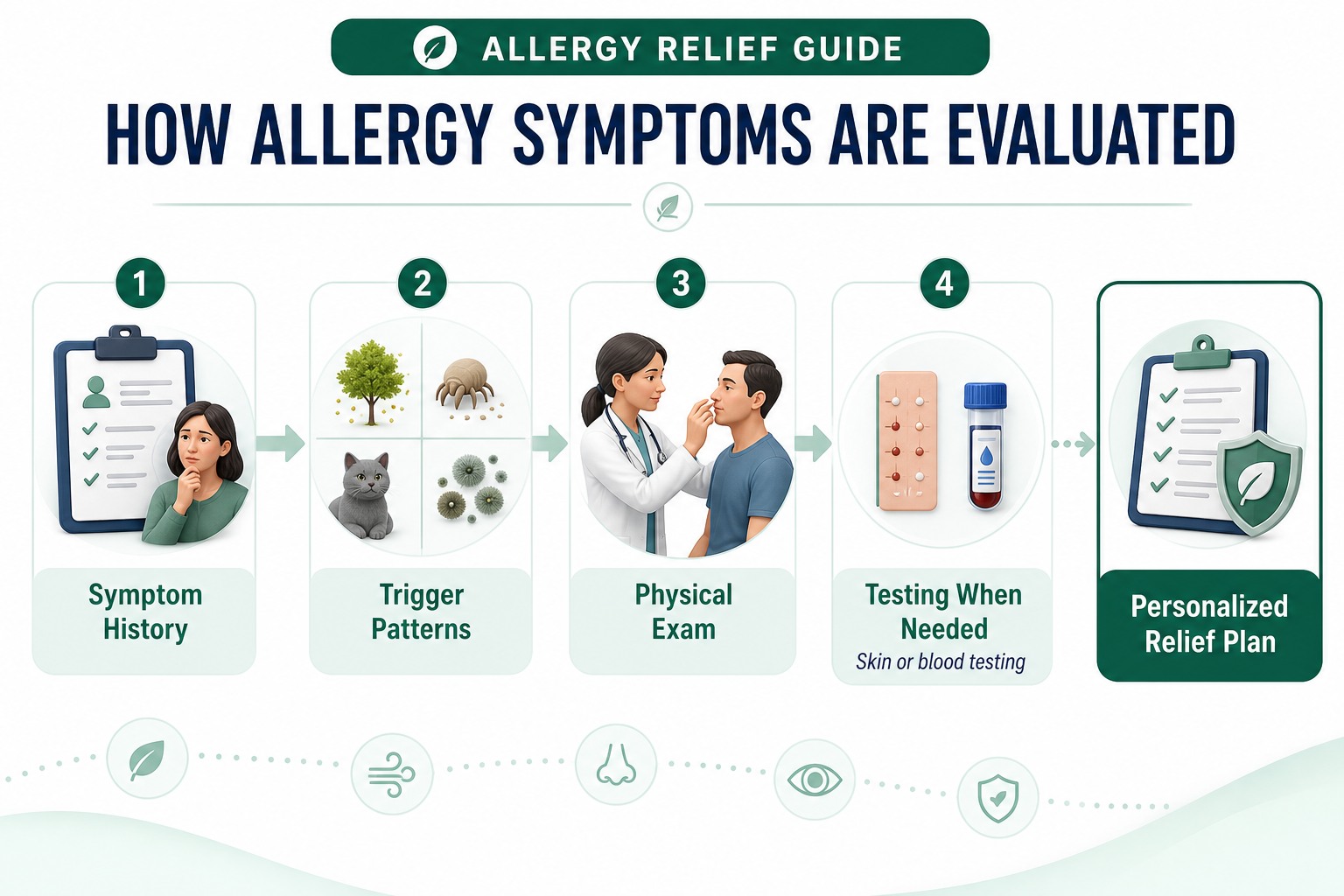
Diagnosis: a doctor can arrange allergy testing — usually a skin-prick or blood test — to identify exactly what you react to, which makes avoidance and treatment far more effective.
Relief: most people manage symptoms by reducing exposure to the trigger, using home care such as a saline rinse, and taking over-the-counter medicine when needed. For the full step-by-step approach, see our allergy treatment & relief guide, or start from the main allergy relief guide.
Track your symptoms: keeping a simple diary — noting when symptoms appear, where you are, the weather or pollen count, and anything you ate or touched — makes appointments far more productive. Over a few weeks, patterns usually emerge that point straight to the trigger, so you and your doctor spend less time guessing and more time on a plan that works.
Allergy symptoms: frequently asked questions
What are the most common allergy symptoms?
How do I know if it's allergies or a cold?
Can allergies cause a cough or fatigue?
How long do allergy symptoms last?
When are allergy symptoms an emergency?
Why do my symptoms get worse hours after I was near the trigger?
Why does my mouth itch when I eat raw apple or melon?
Can allergies cause a fever?
Which allergy symptoms are the least obvious?
Why does congestion respond less well to antihistamines than sneezing does?
How we create and review this guide
This guide is written for a general audience using patient-education material from the authoritative sources below, not blogs or forums:
- American Academy of Allergy, Asthma & Immunology (AAAAI)
- American College of Allergy, Asthma & Immunology (ACAAI)
- Mayo Clinic
- U.S. National Institute of Allergy and Infectious Diseases (NIH / NIAID)
- U.S. Centers for Disease Control and Prevention (CDC)
Sources for the specific figures on this page
- Akhouri S, House SA. Allergic Rhinitis (opens in a new tab). StatPearls, NCBI Bookshelf. The early-phase response within five to 15 minutes of exposure with mast-cell degranulation and histamine release, and the late-phase response four to six hours later in which cytokines recruit eosinophils, T-lymphocytes and basophils into the nasal mucosa, producing oedema and congestion as the hallmark late-phase symptom.
- American College of Allergy, Asthma & Immunology. Pollen food allergy syndrome (opens in a new tab). Cross-reacting proteins in pollen and raw foods; the birch, grass and ragweed cross-reaction lists; symptoms remaining local and subsiding quickly once the food is swallowed or removed; cooked foods usually being tolerated because heating distorts the protein; and anaphylaxis reported in about 1.7% of affected people.
- American College of Allergy, Asthma & Immunology. Hay fever (allergic rhinitis) (opens in a new tab). The nasal, eye and throat symptom pattern of airborne allergy, and intranasal corticosteroids as the most effective drug class for controlling it.
- MedlinePlus, U.S. National Library of Medicine. Hay Fever (opens in a new tab). Patient-facing summary of pollen-triggered allergy symptoms and the relief options available.
Medical disclaimer: This guide is for general education and isn't a substitute for personalized medical advice. Always talk to a qualified healthcare professional about your symptoms.
 MD
MDMedically reviewed
Dr. Hannah H. Walford, MD
Allergist and Immunologist
- Website role
- Owner, Medical Director and Medical Reviewer of Allergy Relief Guide
- Professional affiliation
- Stanford Health Care / Menlo Medical Clinic, Menlo Park, California
- Areas of expertise
- Food allergy, eczema, allergic rhinitis, sinusitis and asthma
Dr. Hannah H. Walford is a board-certified allergist and immunologist experienced in caring for adults and children with allergic conditions. Her areas of expertise include food allergy, eczema, allergic rhinitis, sinusitis and asthma. She provides medical leadership and review oversight for the educational health content published by Allergy Relief Guide.
Medical content is provided for education and is not a substitute for diagnosis or individualized medical care.
Related guides
Keep exploring the allergy relief guide:
Treatment & relief
From home care and OTC medicine to immunotherapy.
Allergies vs. a cold
Tell the two apart quickly and confidently.
Testing & diagnosis
Pinpoint your triggers with skin or blood tests.
Seasonal allergies
Why symptoms flare each spring and fall.
Allergic rhinitis
The nasal condition behind most symptoms.
Allergies in children
Spotting and managing symptoms in kids.
Allergy medicine
Which type suits which symptom.
Oral allergy syndrome
Itchy mouth from raw fruit and veg.
Allergies vs. COVID-19
Which symptoms separate them.
Allergic asthma
When symptoms reach the chest.
Recognise your symptoms? Here's what to do next
Once you know what you're dealing with, our step-by-step guide covers how to relieve and treat it safely.
Go to the treatment & relief guide