
Types of Allergies: Respiratory, Food, Drug, Skin and More
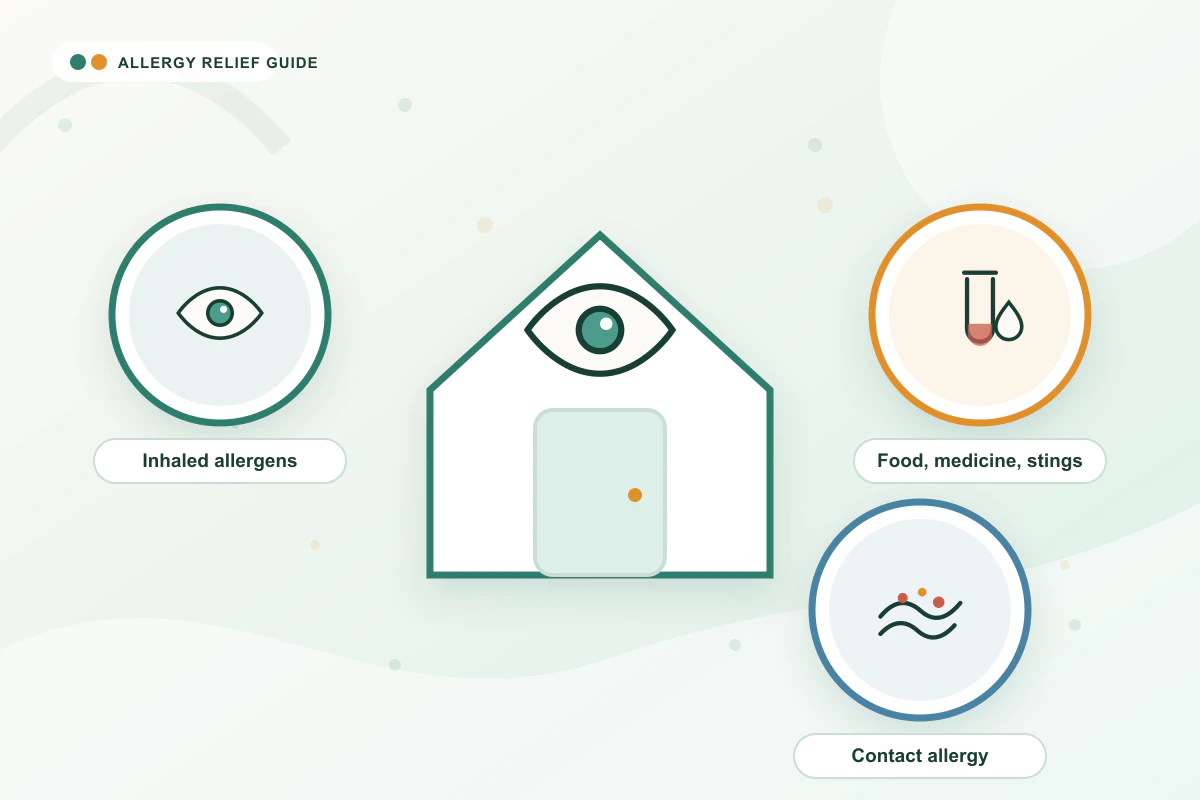
An allergy is your immune system overreacting to a normally harmless substance — an allergen — as if it were a threat. Allergies fall into several broad types based on what triggers them and how you're exposed: respiratory and environmental allergies (pollen, dust mites, mold, pet dander), food allergies, drug allergies, insect-sting allergies, latex allergy, and skin (contact) allergies. Reactions range from mild sneezing or an itchy rash to life-threatening anaphylaxis. This guide maps out the main types and links to detailed guides for each, so you can find what fits your situation.
Quick answer
An allergy is the immune system overreacting to a normally harmless substance (an allergen). Allergies fall into several types by trigger and exposure: respiratory/environmental (pollen, dust mites, mold, pet dander), food, drug, insect-sting, latex, and skin (contact) allergies. Reactions range from mild sneezing or an itchy rash to life-threatening anaphylaxis. This guide maps the main types and links to detailed guides for each.
What you need to know
- An allergy is an immune-system overreaction to a normally harmless substance called an allergen.
- The main types are respiratory/environmental, food, drug, insect-sting, latex, and skin (contact) allergies.
- Respiratory allergies (pollen, dust mites, mold, pet dander) cause allergic rhinitis and can trigger asthma.
- Food, drug, insect-sting, and latex allergies can cause severe, life-threatening reactions (anaphylaxis).
- Skin allergies include contact dermatitis, eczema-related reactions, and hives.
- Diagnosis often involves allergy testing, and a severe reaction (anaphylaxis) is always a medical emergency.
How Allergies Work
An allergy happens when your immune system treats a normally harmless substance — pollen, a food protein, a medication, pet dander — as if it were dangerous. In many allergies, the immune system makes IgE antibodies to the allergen, and on later exposure those antibodies trigger the release of histamine and other chemicals, producing symptoms. Where and how severely you react depends largely on how you meet the allergen: breathed-in allergens hit the nose, eyes, and airways; eaten or injected ones can affect the skin, gut, or whole body. Reactions range from mild and local to a severe, whole-body reaction called anaphylaxis.
The Main Types of Allergies
| Type | Common triggers | Learn more |
|---|---|---|
| Respiratory / environmental | Pollen, dust mites, mold, pet dander | allergic rhinitis, indoor & outdoor allergens |
| Food | Milk, egg, peanut, tree nuts, fish, shellfish, wheat, soy, sesame | food allergies |
| Drug / medication | Penicillin and other medications | drug allergy |
| Insect sting | Bees, wasps, hornets, yellow jackets | insect sting allergy |
| Latex | Natural rubber latex proteins | latex allergy |
| Skin / contact | Nickel, poison ivy, fragrances; plus eczema and hives | contact dermatitis, nickel allergy, hives |
| Sun / light | Ultraviolet light exposure | sun allergy |
Many people have more than one type — and conditions like eczema and asthma often travel with allergies.
Respiratory and Food Allergies: The Big Two
The two categories most people encounter are respiratory (environmental) and food allergies. Respiratory allergies — to pollen, dust mites, mold, and pet dander — cause sneezing, congestion, and itchy eyes (allergic rhinitis), and can trigger asthma; see our allergy symptoms guide. Food allergies involve an immune reaction to a food protein and can range from mild to anaphylaxis; the U.S. recognizes nine major food allergens (milk, egg, fish, shellfish, tree nuts, peanuts, wheat, soy, and sesame). See our food allergies and food allergen labels guides.
Diagnosis and Next Steps
Identifying which allergy you have is what makes treatment effective. An allergist can confirm triggers with skin or blood testing, interpreted alongside your history — see our allergy testing guide. From there, management depends on the type but generally combines reducing exposure to your triggers, medications (like antihistamines and nasal corticosteroid sprays), and, for some allergies, immunotherapy. Anyone at risk of a severe reaction should carry epinephrine. Explore the detailed guides linked above for the type that fits your situation, and see our allergy treatment guide for the options.
Believing you have a food allergy, and having one
An overview of allergy types runs into a problem early: the number of people who think they have a particular allergy and the number who actually do are not the same, and the gap is widest for food.
A large survey of 40,443 US adults, published in JAMA Network Open, put figures on it. It estimated that 10.8 percent of US adults had one or more current convincing food allergies, while 19.0 percent self-reported a food allergy. Close to half of the people who believed they had a food allergy did not have symptoms consistent with one.
That does not mean those people are imagining their reactions. Food intolerance is real and can be thoroughly unpleasant; it simply is not the same mechanism, does not carry the same risk of a severe reaction, and is managed differently. Sorting one from the other is the practical value of a diagnosis rather than a technicality — see food allergy vs. food intolerance.
The same survey found the most prevalent adult food allergies were shellfish at 2.9 percent, milk at 1.9 percent, peanut at 1.8 percent, tree nut at 1.2 percent and fin fish at 0.9 percent. Shellfish topping that list surprises people who assume peanut is always the most common, and it is a reminder that adult and childhood patterns differ.
- Self-reported food allergy: 19.0 percent of US adults
- Convincing food allergy by symptom criteria: 10.8 percent
- Most common in adults: shellfish, milk, peanut, tree nut, fin fish
- A suspected food allergy is worth confirming rather than assuming
- Testing interprets results alongside symptoms — see allergy testing
Allergies are not only a childhood condition
The common mental model is that allergies begin in childhood and are either outgrown or carried into adult life. The first half of that is not reliable.
In the same survey, 48.0 percent of adults with a convincing food allergy reported developing at least one of them as an adult. Nearly half of adult food allergy is not a continuation of something from childhood; it started later.
That matters for how symptoms get interpreted. Someone who has eaten shellfish for thirty years without trouble may not connect a new reaction to the food at all, precisely because they know they are not allergic to it. A previously safe food becoming a problem is a recognised pattern rather than an oddity.
The survey also recorded that severity is not theoretical: nearly 40 percent of food-allergic adults reported at least one severe reaction, and around 38 percent reported a lifetime emergency department visit related to their allergy. A newly developed allergy deserves the same seriousness as a lifelong one — see adult allergy symptoms and our allergy safety guide.
When to seek care
Routine
You have allergy symptoms and want to identify the type and a management plan.
Prompt (within days)
Persistent symptoms without a clear cause, or symptoms not controlled by over-the-counter treatment.
Urgent (same day)
A reaction to a food, medication, or insect sting that involved hives or swelling, or allergy symptoms with breathing changes.
Emergency (call 911)
Signs of anaphylaxis — trouble breathing, swelling of the lips, tongue, or throat, widespread hives with dizziness — use epinephrine if prescribed and call 911.
Practical next steps
Safe general steps
- Identify which type of allergy fits your symptoms and triggers
- Explore the detailed guide for your allergy type (linked above)
- Reduce exposure to your known triggers
- See an allergist for testing if the trigger is unclear or symptoms persist
Actions that need medical guidance
- Confirming your specific allergy with testing
- Any reaction to a food, medication, or insect sting
- Building a treatment plan, including whether immunotherapy fits
Don't attempt without professional advice
- Don't assume all allergies are the same — they're triggered and managed differently
- Don't ignore a reaction with swelling or breathing difficulty — that can be an emergency
- Don't self-diagnose a serious food, drug, or insect allergy — get proper evaluation
Frequently asked questions
What are the main types of allergies?
What is an allergy?
Which allergies can be life-threatening?
What are the most common allergies?
How are allergies diagnosed?
Can you have more than one type of allergy?
How common are food allergies in adults?
Which food allergies are most common in adults?
Can you develop an allergy as an adult?
Does a self-diagnosed food allergy need confirming?
How serious are adult food allergies?
Sources
- MedlinePlus (NIH/NLM) — Allergies
- MedlinePlus (NIH/NLM) — Allergic rhinitis
- MedlinePlus (NIH/NLM) — Food Allergy
- JAMA Network Open / PubMed Central (NIH/NLM) — Prevalence and Severity of Food Allergies Among US Adults
Medical disclaimer: This guide is for general education and isn't a substitute for personalized medical advice. It doesn't provide dosing. Always talk to a qualified healthcare professional about your symptoms and treatment.
 MD
MDMedically reviewed
Dr. Hannah H. Walford, MD
Allergist and Immunologist
- Website role
- Owner, Medical Director and Medical Reviewer of Allergy Relief Guide
- Professional affiliation
- Stanford Health Care / Menlo Medical Clinic, Menlo Park, California
- Areas of expertise
- Food allergy, eczema, allergic rhinitis, sinusitis and asthma
Dr. Hannah H. Walford is a board-certified allergist and immunologist experienced in caring for adults and children with allergic conditions. Her areas of expertise include food allergy, eczema, allergic rhinitis, sinusitis and asthma. She provides medical leadership and review oversight for the educational health content published by Allergy Relief Guide.
Medical content is provided for education and is not a substitute for diagnosis or individualized medical care.
Related guides
Continue building your allergy plan
Explore related guides to understand the full picture, from triggers to treatment to safety.
See the full allergy symptoms guide