
Insect Sting Allergy (Bee & Wasp)
Most bee or wasp stings cause pain, redness, and swelling right at the sting site that fades within a day or two. A true insect sting allergy is different: it can also cause a large local reaction spreading well beyond the sting, or a systemic reaction affecting the whole body, including anaphylaxis. Anaphylaxis after a sting happens in up to about 3.5% of cases and is a medical emergency treated with epinephrine. People with a history of a systemic sting reaction are often candidates for venom immunotherapy, which is effective for the large majority of patients who complete it.
Quick answer
Most bee or wasp stings cause pain, redness, and swelling right at the sting site that fades within a day or two. A true insect sting allergy can also cause a large local reaction spreading well beyond the sting, or a systemic reaction affecting the whole body, including anaphylaxis, which happens in up to about 3.5% of cases and is treated with epinephrine as a medical emergency. People with a history of a systemic sting reaction are often candidates for venom immunotherapy.
What you need to know
- A normal sting reaction is pain, redness, and swelling confined to the sting site, usually resolving within a day or two.
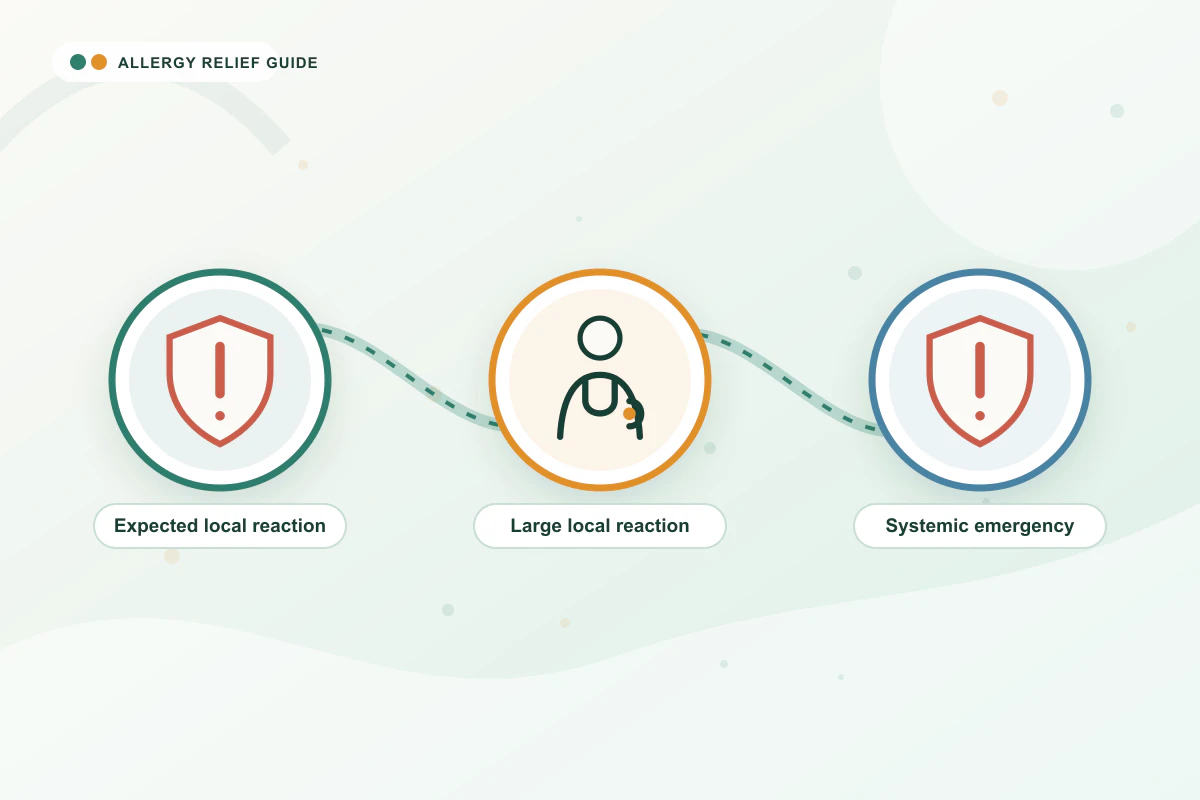
- A large local reaction is swelling that spreads beyond the sting site, sometimes over 10 cm (about 4 inches) across, but stays confined to the area near the sting.
- A systemic reaction affects areas of the body away from the sting site and can range from hives to full anaphylaxis.
- Anaphylaxis after a sting occurs in up to about 3.5% of cases and needs immediate epinephrine and a call to 911.
- Venom immunotherapy is the most effective long-term treatment for people who've had a systemic sting reaction, working in about 80% of bee-venom cases and up to 95% of wasp-venom cases.
- Anyone with a history of a systemic sting reaction should carry an epinephrine auto-injector and wear medical ID jewelry noting the allergy.
Types of Sting Reactions
| Reaction type | What it looks like | Where it happens |
|---|---|---|
| Normal reaction | Pain, redness, and swelling at the sting site, usually gone within a day or two | Confined to the sting site |
| Large local reaction | Swelling that spreads well beyond the sting site, sometimes over 10 cm across, and can last several days | Extends from the sting site but stays in the same general area (for example, an entire swollen forearm after a hand sting) |
| Systemic reaction | Hives, swelling, dizziness, vomiting, or difficulty breathing away from the sting site | Affects parts of the body away from where the sting occurred |
| Anaphylaxis | Difficulty breathing, swelling of the lips, tongue, or throat, widespread hives, dizziness, or loss of consciousness | Whole-body, rapidly progressing, and life-threatening |
A large local reaction, while uncomfortable, doesn't necessarily mean a future sting will cause a systemic reaction. A systemic reaction to a previous sting, on the other hand, is the strongest known risk factor for a more serious reaction to a future sting, which is why it changes the treatment conversation. See our anaphylaxis guide for a full breakdown of severe-reaction symptoms.
Who's More Likely to Have a Serious Reaction
The chance of a systemic or life-threatening reaction relates to several factors: how severe a prior sting reaction was, confirmed venom allergy, certain baseline blood markers an allergist can test for, and underlying conditions such as mastocytosis. Age and other medical conditions can also play a role. An allergist can help assess your individual risk after a systemic reaction, often with venom-specific testing.
Venom Immunotherapy
For people who've had a systemic reaction to a sting, venom immunotherapy (VIT) is considered the most effective treatment available, and its protection can persist even after the treatment course ends. VIT works by giving a series of injections containing small, gradually increasing amounts of purified insect venom, building the immune system's tolerance over time. It's effective in roughly 80% of people treated for bee venom allergy and up to about 95% of those treated for wasp venom allergy. This is a supervised medical treatment, not something to attempt on your own, and an allergist determines whether it's appropriate for your history.
Reducing Your Risk of Being Stung
- Wear light-colored, smooth-finished clothing outdoors, since dark colors and rough textures can attract stinging insects
- Avoid perfumed soaps, lotions, and deodorants when spending time outside during insect season
- Keep food and sweet drinks covered at outdoor gatherings
- Wear shoes outdoors, and be cautious around flowering plants, trash cans, and areas with visible nests
- If several insects are swarming, move indoors or to a sheltered area rather than swatting at them
First Aid for a Sting Without a Known Allergy
- Wash the area with soap and water
- Remove any visible stinger by gently scraping it away (with a fingernail or gauze) rather than squeezing or using tweezers, which can push more venom in
- Apply a cold pack to reduce pain and swelling
- Watch the area over the following hours for spreading swelling or any symptoms away from the sting site
When to seek care
Routine
A normal, localized sting reaction managed with cold packs and monitoring at home.
Prompt (within days)
A large local reaction that's uncomfortable or concerning, or you'd like to discuss venom testing after any past reaction beyond a normal local one.
Urgent (same day)
Swelling that continues to spread significantly over more than a day or two, or a sting near the eyes or in the mouth/throat.
Emergency (call 911)
Difficulty breathing, swelling of the lips, tongue, or throat, widespread hives, dizziness, or fainting after a sting. Use epinephrine if it's been prescribed and call 911 immediately, even if symptoms start to improve.
Practical next steps
Safe general steps
- For a normal reaction, wash the site, remove the stinger, and apply a cold pack
- Watch for symptoms spreading beyond the sting site over the following hours
- Reduce your sting risk with clothing choices and outdoor precautions
- If you've had any reaction beyond a normal local one, ask your clinician about a referral to an allergist
Actions that need medical guidance
- Deciding whether venom testing or immunotherapy is appropriate for you
- Getting an epinephrine auto-injector prescription and learning how to use it
- Evaluating risk factors like baseline tryptase levels or mastocytosis
Don't attempt without professional advice
- Don't squeeze a stinger or use tweezers to remove it — gently scrape it away instead
- Don't assume a large local reaction means future stings will be mild — ask an allergist if it's worth evaluating
- Don't delay calling 911 after using epinephrine, even if symptoms seem to be improving
Frequently asked questions
What's the difference between a normal sting reaction and an allergy?
How common is anaphylaxis from a bee or wasp sting?
Does a large local reaction mean I'll have anaphylaxis next time?
What is venom immunotherapy?
Should I carry an epinephrine auto-injector after a bee sting reaction?
How do I remove a bee stinger safely?
Sources
- PMC (NIH) — Hymenoptera Venom Allergy: How Does Venom Immunotherapy Prevent Anaphylaxis From Bee and Wasp Stings?
- NCBI Bookshelf (NIH) — Insect venom allergies: Short-term and long-term treatment
- AAFA — Stinging Insect Allergy: Bees, Wasps, Hornets, Yellow Jackets
- CDC/NIOSH — Fast Facts: Protecting Yourself from Stinging Insects
Medical disclaimer: This guide is for general education and isn't a substitute for personalized medical advice. It doesn't provide dosing. Always talk to a qualified healthcare professional about your symptoms and treatment.
 MD
MDMedically reviewed
Dr. Hannah H. Walford, MD
Allergist and Immunologist
- Website role
- Owner, Medical Director and Medical Reviewer of Allergy Relief Guide
- Professional affiliation
- Stanford Health Care / Menlo Medical Clinic, Menlo Park, California
- Areas of expertise
- Food allergy, eczema, allergic rhinitis, sinusitis and asthma
Dr. Hannah H. Walford is a board-certified allergist and immunologist experienced in caring for adults and children with allergic conditions. Her areas of expertise include food allergy, eczema, allergic rhinitis, sinusitis and asthma. She provides medical leadership and review oversight for the educational health content published by Allergy Relief Guide.
Medical content is provided for education and is not a substitute for diagnosis or individualized medical care.
Related guides
Continue building your allergy plan
Explore related guides to understand the full picture, from triggers to treatment to safety.
Go to the Allergy Safety guide