
When to See a Doctor for Allergies
Most allergies can be managed at home — but some signs mean it's time for professional help. Here's how to know the difference.
Quick answer: when to see a doctor
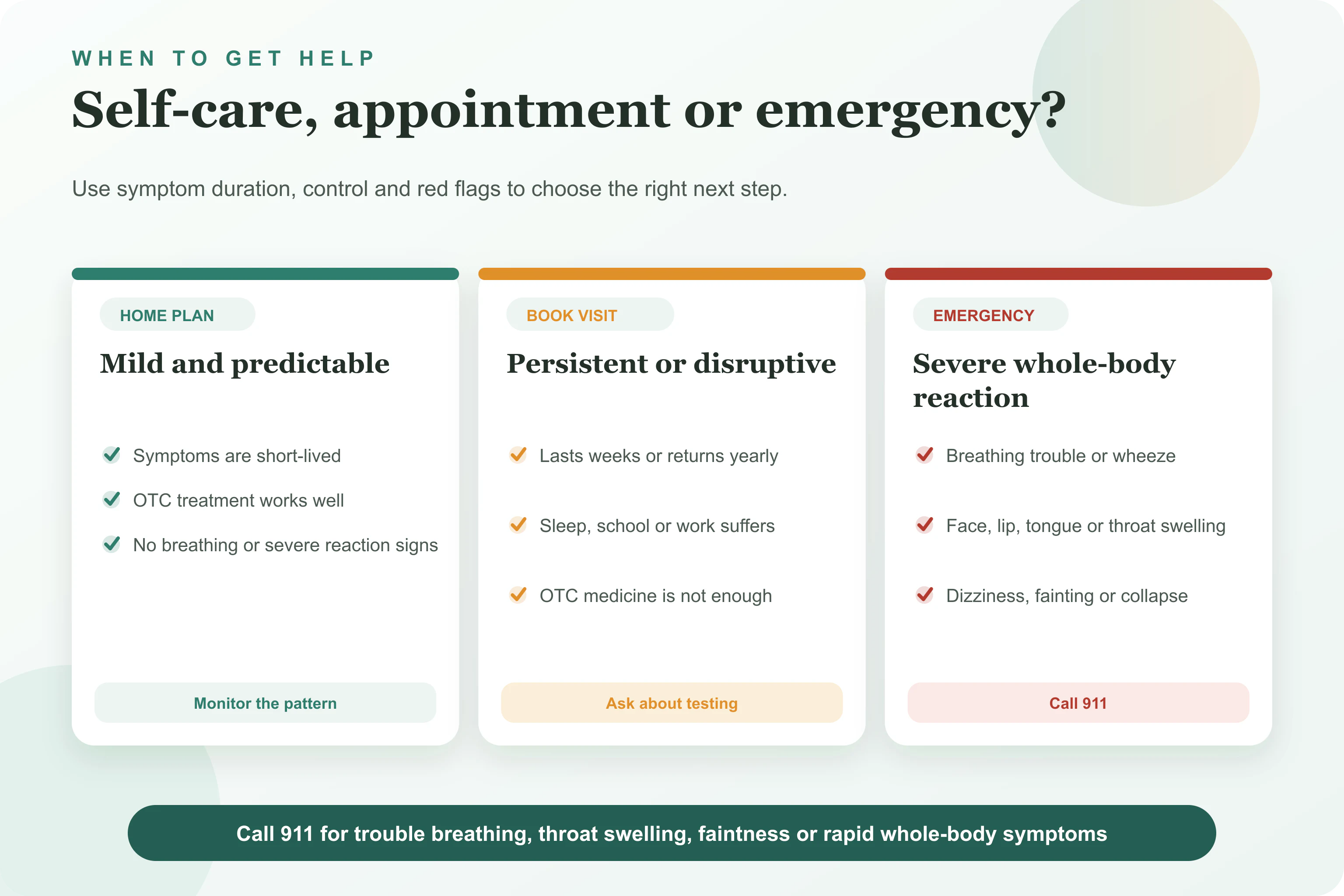
Short answer: book an appointment if symptoms last beyond two to four weeks, come back every year, resist over-the-counter medicine, or cost you sleep. See an allergist if you have had a food, medicine or sting reaction, need testing, or want immunotherapy. Call 911 for trouble breathing or face and throat swelling.
See a doctor for your allergies if symptoms last more than a few weeks or return for several months each year, if over-the-counter medicines aren't controlling them, or if they disrupt your sleep, work or daily life. Also seek help if you have asthma or eczema alongside allergies, get frequent sinus or ear infections, have reacted to a food, medicine or insect sting, or want testing to find your triggers. Call 911 immediately for any severe, whole-body reaction — trouble breathing, or swelling of the face, lips or throat — which may be anaphylaxis. This is general guidance, not personal medical advice.
Signs it's time to see a doctor
It's worth booking an appointment if any of these apply to you:
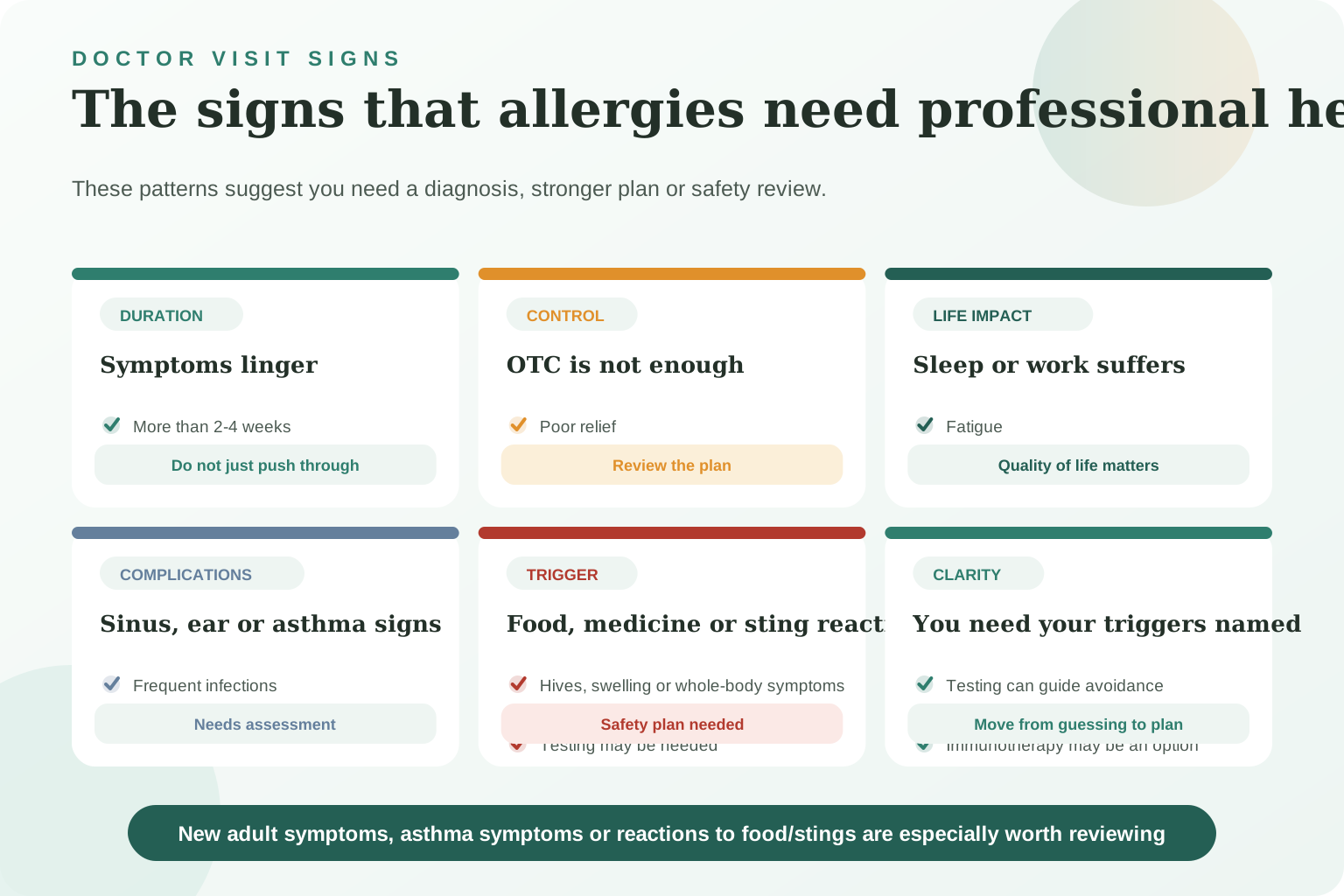
- Your symptoms last more than two to four weeks, or return for several months each year.
- Over-the-counter antihistamines or nasal sprays aren't giving enough relief, or cause side effects like drowsiness.
- Symptoms disrupt your sleep, work, school or daily activities, or you're avoiding things you enjoy.
- You get frequent sinus infections, headaches, ear infections or a constantly blocked nose.
- You also have asthma or eczema, which allergies can worsen.
- You get hives, unexplained rashes or eczema flare-ups that seem linked to something you're exposed to or eat.
- You've had a reaction to a food, medicine or insect sting, or a severe reaction of any kind.
- You want allergy testing to identify exactly what triggers you.
- You take medicine for allergies most days for much of the year.
- Allergies you've always managed fine suddenly feel harder to control, or you develop new symptoms as an adult — allergies can start, change or return at any age, not just in childhood.
- You have other health conditions (such as heart disease, high blood pressure or glaucoma) that can make OTC allergy drugs unsafe — check before using them.
Breathing signs that need attention
Allergies and asthma are closely linked, and breathing symptoms deserve their own checklist. See a doctor if you regularly:
- Wheeze, cough or feel short of breath — especially at night or after exercise.
- Struggle to catch your breath during normal activity.
- Notice your allergy symptoms seem to be triggering chest tightness or a persistent cough.
These can be signs of allergy-triggered (allergic) asthma, which an allergist can diagnose and treat alongside your allergies — often improving both at once.
When it's an emergency — call 911
Some reactions can't wait for an appointment. Call 911 immediately, and use an epinephrine auto-injector if one is available, for any signs of anaphylaxis: trouble breathing or wheezing; swelling of the face, lips, tongue or throat; widespread hives; dizziness or fainting; or a rapid, whole-body reaction after a food, medicine or sting. These are medical emergencies — don't try to manage them at home. See our allergy safety guide.
What to do after using an epinephrine auto-injector
Using the auto-injector is the first step, not the last one, and two details are commonly missed.
- One dose is not always enough. ACAAI notes that two doses may be needed. Its guidance is direct: if you give epinephrine and are not better or getting better within minutes, seek emergency care, and if things get worse, give the second dose. This is why people at risk are usually prescribed two auto-injectors rather than one.
- Go to the emergency department even if you feel better. Symptoms can settle and then return, so improvement after epinephrine is not a reason to stay home. Call 911 and be assessed.
Do not wait to see whether it gets worse
ACAAI describes anaphylaxis symptoms as occurring suddenly and progressing quickly, and notes that early signs can look mild — a runny nose or a rash — before escalating. Epinephrine is the treatment; antihistamines are not a substitute and do not act on the airway or blood pressure. If you are weighing up whether it is "bad enough," that hesitation is itself the argument for using the device. Read anaphylaxis, epinephrine auto-injectors and what to do in an allergy emergency.
How soon should you go?
The urgency depends on the severity of your symptoms.
Right now (911)
Any sign of a severe, whole-body reaction — trouble breathing, throat or facial swelling, faintness. This is an emergency, not an appointment.
Within days to weeks
A reaction to a food, medicine or insect sting (even if it settled), symptoms that are rapidly worsening, or allergies that are triggering asthma.
A routine appointment
Persistent or seasonal symptoms that aren't dangerous but won't clear, or when you simply want testing and a long-term plan.
Don't just push through
Ongoing symptoms quietly erode sleep, focus and quality of life. If you've been "coping" for months, that itself is a reason to get help.
| What you are experiencing | How soon | Where |
|---|---|---|
| Trouble breathing, throat or facial swelling, faintness, widespread hives after a food, medicine or sting | Immediately | Call 911 and use an epinephrine auto-injector if you have one |
| Any reaction to a food, medicine or insect sting, even if it settled on its own | Days to weeks | Allergist — this needs evaluation before the next exposure |
| Allergies triggering wheeze, chest tightness or night-time cough | Days to weeks | Doctor or allergist — possible allergic asthma |
| Symptoms clearly worsening week on week | Days to weeks | Primary care first is reasonable |
| Symptoms beyond two to four weeks, or returning every season, not controlled by over-the-counter medicine | Routine appointment | Primary care or allergist |
| You want testing, or are considering immunotherapy | Routine appointment | Allergist |
| Congestion with facial pain and thick discoloured discharge lasting beyond about 10 days, or improving then worsening | Routine, sooner if severe | Doctor — see allergies vs. sinus infection |
Should you see your regular doctor or an allergist?
Both can help — the right choice depends on how complex your allergies are.
Your primary care doctor
A good first stop for everyday, mild-to-moderate symptoms. They can confirm it's allergies (not an infection), recommend OTC or prescription medicine, and refer you onward if needed.
An allergist / immunologist
A specialist to see when symptoms are moderate-to-severe, don't respond to standard treatment, need testing, involve food/medicine/venom reactions, or when you're considering immunotherapy.
An allergist is a medical doctor with several extra years of training in allergies, asthma and the immune system, certified by the American Board of Allergy and Immunology. Your regular doctor can refer you, or you can often book directly.
Practical tip: many insurance plans require a referral from your primary care doctor for allergist visits to be covered. Check your plan before booking, since starting with your regular doctor can save you an unnecessary bill.
What an allergist can do for you
An allergist looks for the root cause rather than just masking symptoms. They can:
- Confirm whether your symptoms are truly allergies or something else.
- Pinpoint your exact triggers with allergy testing (skin or blood tests).
- Build a personalized plan of avoidance, the right medicines, and environmental changes.
- Offer immunotherapy (allergy shots or under-the-tongue tablets) that can reduce your reaction long-term.
- Manage related conditions like asthma and eczema.
- Prescribe emergency medicine such as an epinephrine auto-injector and teach you an action plan.
Signs to see a doctor for a child
Children — especially under five — can't always describe their symptoms, so the signs can be easy to miss. Consider a doctor's visit if your child has:
- Ongoing snoring, mouth-breathing or a constantly blocked nose
- Frequent ear infections or sinus problems
- Dark circles under the eyes ("allergic shiners") and frequent nose-rubbing
- Poor sleep, daytime tiredness or unusual irritability
- A rash, hives, or any reaction to a food
Treating allergies early in children may also help reduce the chance of asthma developing later. More in allergies in children.
What to expect at your first visit
A first allergy appointment is mostly conversation and simple tests — nothing to dread. Typically it involves:
- A detailed history — when symptoms happen, what triggers them, your home and work environment, family history and any other conditions.
- A focused exam — of your nose, eyes, ears, throat, skin and lungs.
- Allergy testing — often a skin prick test done in the office, or a blood test, to identify your triggers.
- A personalized plan — combining avoidance, the right medicine, and immunotherapy if suitable.
How to prepare for your appointment
A little preparation makes the visit far more useful. Bring:
- Notes on your symptoms — when they started, how often, what makes them better or worse.
- A list of possible triggers (seasons, pets, foods, places) and whether you feel better away from home or on weekends.
- A full list of medicines and supplements you take.
- Your relevant medical and family history.
Heads-up: if a skin test is planned, you'll usually be asked to stop antihistamines for several days beforehand, since they can interfere with the result. Check with the office when you book.
On that last point, Cleveland Clinic describes stopping antihistamines three to seven days before a skin test, while asthma medicine is generally continued. The exact window depends on the medicine and the clinic, so the instruction you are given at booking overrides any general figure. Remember that many cold, flu and sleep products contain a hidden antihistamine. A blood test needs no pause at all, which is one reason it is used when a medicine cannot be stopped. More in skin prick test and allergy blood test.
Questions worth asking at your visit
A short list can help you get more out of a limited appointment. Consider asking:
- What's likely triggering my symptoms, and should I get allergy testing to confirm it?
- Is my current over-the-counter routine right, or would a prescription option work better?
- Am I a candidate for immunotherapy (allergy shots or tablets)?
- Could my symptoms be linked to asthma, sinus problems, or something else that needs its own treatment?
- Do I need an epinephrine auto-injector, given my history?
- What should I do if my symptoms change or get worse?
Writing these down beforehand — along with your symptom diary — makes it much easier to leave with a clear plan instead of just a prescription.
Next steps, whichever applies to you
| Your next question | Guide |
|---|---|
| How do I find a good allergist? | How to find a good allergist |
| What actually happens at the appointment? | Allergist appointment: what to expect |
| What will testing cost me? | Allergy test cost and insurance |
| Which test will they use? | Skin prick test and blood test |
| Is immunotherapy right for me? | Allergy shots and under-the-tongue tablets |
| What should I try before the appointment? | Allergy medicine |
| I reacted to a food | Food allergies |
| I reacted to a medicine | Drug allergy and penicillin allergy |
| I reacted to a sting | Insect sting allergy |
| I keep getting hives | Hives (urticaria) |
| Is this sinusitis rather than allergy? | Allergies and sinusitis |
| What do I do in an emergency? | Allergy emergency and epinephrine auto-injectors |
What a doctor can offer beyond the pharmacy
Seeing a doctor opens up options you can't get over the counter. Alongside guidance on avoiding your triggers, that includes prescription medicines, stronger or combination nasal sprays, treatment for related asthma or eczema, an epinephrine auto-injector and action plan if you're at risk of a severe reaction, and immunotherapy to reduce your allergies over time. Explore the full range in our treatment & relief guide.
When to see a doctor: frequently asked questions
When should you see a doctor for allergies?
Should I see my regular doctor or an allergist?
What happens at a first allergist visit?
When is an allergic reaction an emergency?
Do I need a referral to see an allergist?
What should I do after using an epinephrine auto-injector?
Can I take an antihistamine instead of using epinephrine?
How long before a skin test do I stop antihistamines?
Should I see a doctor if my allergies only started as an adult?
How long should I wait before deciding my allergy medicine is not working?
How we create and review this guide
This guide is written for a general audience using patient-education material from the authoritative sources below, not blogs or forums:
- American College of Allergy, Asthma & Immunology (ACAAI)
- American Academy of Allergy, Asthma & Immunology (AAAAI)
- Cleveland Clinic
- Mayo Clinic
- U.S. National Library of Medicine (MedlinePlus)
Sources for the specific figures on this page
- American College of Allergy, Asthma & Immunology. Anaphylaxis (opens in a new tab). Anaphylaxis symptoms occurring suddenly and progressing quickly with early signs that can seem mild; immediate treatment with epinephrine; two doses sometimes being needed; and the instruction to seek emergency care if you are not better or getting better within minutes, giving the second dose if symptoms worsen.
- Cleveland Clinic. Allergy Testing (opens in a new tab). Stopping antihistamines three to seven days before a skin test, continuing asthma medicine, skin results read within about 15 minutes, laboratory blood results taking a week or longer, and anaphylaxis as a rare risk managed with epinephrine available.
- American College of Allergy, Asthma & Immunology. Allergy shots (immunotherapy) (opens in a new tab). Immunotherapy indicated for allergic conditions affecting the nose, eyes, ears and lungs as well as severe insect sting allergy, with a lasting beneficial effect after therapy is completed.
- American College of Allergy, Asthma & Immunology. Hay fever (allergic rhinitis) (opens in a new tab). Intranasal corticosteroids described as the single most effective drug class for allergic rhinitis, and rebound swelling from prolonged decongestant nasal spray use.
- MedlinePlus, U.S. National Library of Medicine. Hay Fever (opens in a new tab). Patient-facing summary of allergy symptoms, relief with medicines and nasal sprays, and allergy shots for long-term relief.
Medical disclaimer: This guide is for general education and isn't a substitute for personalized medical advice. If you're unsure about your symptoms, contact a healthcare professional; for emergencies, call 911.
 MD
MDMedically reviewed
Dr. Hannah H. Walford, MD
Allergist and Immunologist
- Website role
- Owner, Medical Director and Medical Reviewer of Allergy Relief Guide
- Professional affiliation
- Stanford Health Care / Menlo Medical Clinic, Menlo Park, California
- Areas of expertise
- Food allergy, eczema, allergic rhinitis, sinusitis and asthma
Dr. Hannah H. Walford is a board-certified allergist and immunologist experienced in caring for adults and children with allergic conditions. Her areas of expertise include food allergy, eczema, allergic rhinitis, sinusitis and asthma. She provides medical leadership and review oversight for the educational health content published by Allergy Relief Guide.
Medical content is provided for education and is not a substitute for diagnosis or individualized medical care.
Related guides
Allergy symptoms
Know the signs and what they mean.
Allergy testing
How your triggers are identified.
Anaphylaxis
Recognising a medical emergency.
Treatment & relief
Every option, from home care to shots.
Find an allergist
How to choose the right specialist.
Your first appointment
What to bring and what happens.
Allergy emergency
What to do when a reaction turns severe.
Epinephrine auto-injectors
How and when to use one.
Not sure what's triggering you?
Allergy testing is often the first step a doctor takes. See what to expect.
Learn about allergy testing