
Penicillin Allergy: Symptoms, Testing and Why Labels Are Often Wrong
Penicillin allergy is the most commonly reported drug allergy — but here's the surprising truth: more than 90% of people labeled penicillin-allergic are not actually allergic when tested. Some were mislabeled from the start (a viral rash or a side effect blamed on the drug), and many who were once allergic lose it over time — up to 80% within about 10 years. This matters because an inaccurate label pushes people toward other antibiotics that may be less effective, broader-spectrum, or more expensive. Allergy testing can confirm or safely remove the label, and cephalosporin cross-reactivity is far lower than the old myth suggests.
Quick answer
Penicillin allergy is the most commonly reported drug allergy, but more than 90% of people labeled allergic aren't when tested — some were mislabeled, and many who were allergic lose it over time (up to 80% within 10 years). The label matters because it pushes people toward less-ideal antibiotics. Allergy testing can confirm or safely remove ('de-label') it, and cephalosporin cross-reactivity is far lower than the old myth suggests.
What you need to know
- Penicillin allergy is the most commonly reported drug allergy — up to about 10% of people say they have it.
- But more than 90% of people labeled penicillin-allergic are not actually allergic when tested.
- Many people who were once allergic lose it over time — up to about 80% within 10 years.
- An inaccurate penicillin-allergy label can lead to broader, less effective, or more expensive antibiotics.
- Symptoms of a true allergy range from hives and swelling to anaphylaxis, usually within an hour or two of taking the drug.
- Testing by an allergist can confirm or safely remove ('de-label') the allergy; cross-reactivity with cephalosporins is far lower than once believed.
The Surprising Truth About Penicillin Allergy Labels
Penicillin is the drug people most often report being allergic to — but the label is frequently wrong. Studies consistently find that more than 90% of people carrying a penicillin-allergy label are not truly allergic when properly tested. There are two main reasons. First, many were mislabeled in the first place: a rash during a childhood infection (often from the virus, not the drug), or a common side effect like nausea, gets recorded as an "allergy." Second, true penicillin allergy often fades — up to about 80% of genuinely allergic people lose the allergy within roughly 10 years of avoiding it. For the general topic, see our drug allergy guide.
Why the Label Matters
An incorrect penicillin-allergy label isn't harmless paperwork. When clinicians avoid penicillin-class antibiotics, they often turn to alternatives that can be broader-spectrum (which contributes to antibiotic resistance), less effective for a given infection, or more expensive. Studies have found that removing inaccurate labels through de-labeling programs reduces broad-spectrum antibiotic use and can shorten hospital stays. In short, an accurate penicillin-allergy status leads to better antibiotic choices — which is exactly why allergists encourage testing rather than lifelong avoidance based on an unverified label.
Symptoms of a True Penicillin Allergy
- Hives (raised, itchy welts) and itching
- Swelling, often around the face, lips, or throat
- Wheezing, coughing, or trouble breathing
- In severe cases, anaphylaxis — a rapid, life-threatening reaction
True allergic reactions usually appear within an hour or two of taking the drug, though some are delayed. Symptoms like isolated nausea, diarrhea, or a headache are typically side effects, not an allergy. See our anaphylaxis guide.
Testing, De-labeling, and Cephalosporins
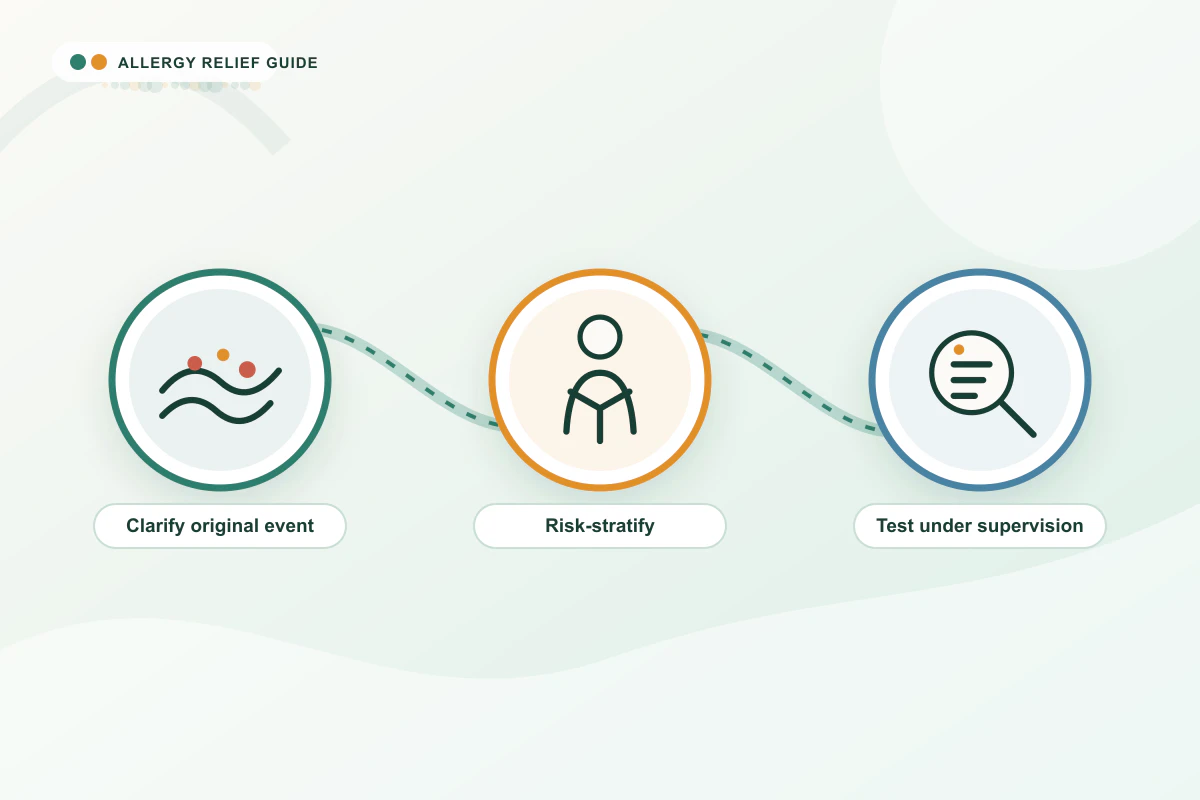
An allergist can evaluate a penicillin-allergy label, often with skin testing and sometimes a supervised challenge, to confirm whether it's real. If it isn't (the usual outcome), the label can be safely removed — "de-labeling" — opening the door to better antibiotic options. On cephalosporins (a related antibiotic class), the feared cross-reactivity is much lower than the traditional teaching suggested: the real rate is well under the old "10%" figure, and for many people it's around 1–2%. That said, decisions about specific antibiotics should be made with your clinician, based on your history. Anyone told they're penicillin-allergic who hasn't been tested is a good candidate for evaluation. See our allergy testing guide.
When to seek care
Routine
You carry a penicillin-allergy label but have never been tested — ask about an allergist evaluation to confirm or remove it.
Prompt (within days)
A mild reaction after an antibiotic (like a rash), to clarify whether it was a true allergy or a side effect.
Urgent (same day)
A reaction with spreading hives or swelling after taking penicillin or a related antibiotic.
Emergency (call 911)
Signs of anaphylaxis after an antibiotic — trouble breathing, swelling of the lips, tongue, or throat, widespread hives with dizziness. Use epinephrine if prescribed and call 911.
Practical next steps
Safe general steps
- If you have an untested penicillin-allergy label, ask your clinician about allergist evaluation
- Note exactly what happened during any past reaction (which drug, what symptoms, how soon)
- Tell all providers about your current penicillin-allergy status until it's clarified
- Don't stop a prescribed antibiotic on your own for a mild suspected reaction — contact the prescriber (unless the reaction is severe)
Actions that need medical guidance
- Whether your penicillin-allergy label can be tested and safely removed
- Whether a past reaction was a true allergy or a side effect
- Which antibiotics, including cephalosporins, are safe for you
Don't attempt without professional advice
- Don't assume a childhood penicillin-allergy label is still accurate — ask about testing
- Don't self-diagnose cross-reactivity with other antibiotics — discuss it with your clinician
- Don't ignore breathing trouble or throat swelling after an antibiotic — treat it as an emergency
Frequently asked questions
Are most people with a penicillin allergy really allergic?
Why does a penicillin-allergy label matter?
What are the symptoms of a true penicillin allergy?
Can penicillin allergy be tested and removed?
If I'm allergic to penicillin, am I allergic to cephalosporins?
Should I get my penicillin allergy tested?
Sources
- ACAAI Patient — Drug Allergies
- MedlinePlus (NIH/NLM) — Drug Reactions
- MedlinePlus (NIH/NLM) — Allergies
Medical disclaimer: This guide is for general education and isn't a substitute for personalized medical advice. It doesn't provide dosing. Always talk to a qualified healthcare professional about your symptoms and treatment.
 MD
MDMedically reviewed
Dr. Hannah H. Walford, MD
Allergist and Immunologist
- Website role
- Owner, Medical Director and Medical Reviewer of Allergy Relief Guide
- Professional affiliation
- Stanford Health Care / Menlo Medical Clinic, Menlo Park, California
- Areas of expertise
- Food allergy, eczema, allergic rhinitis, sinusitis and asthma
Dr. Hannah H. Walford is a board-certified allergist and immunologist experienced in caring for adults and children with allergic conditions. Her areas of expertise include food allergy, eczema, allergic rhinitis, sinusitis and asthma. She provides medical leadership and review oversight for the educational health content published by Allergy Relief Guide.
Medical content is provided for education and is not a substitute for diagnosis or individualized medical care.
Related guides
Continue building your allergy plan
Explore related guides to understand the full picture, from triggers to treatment to safety.
See the types of allergies guide