
Anaphylaxis: Symptoms, Causes and What to Do
A severe allergic reaction is a medical emergency. Knowing the signs — and acting in seconds — saves lives.
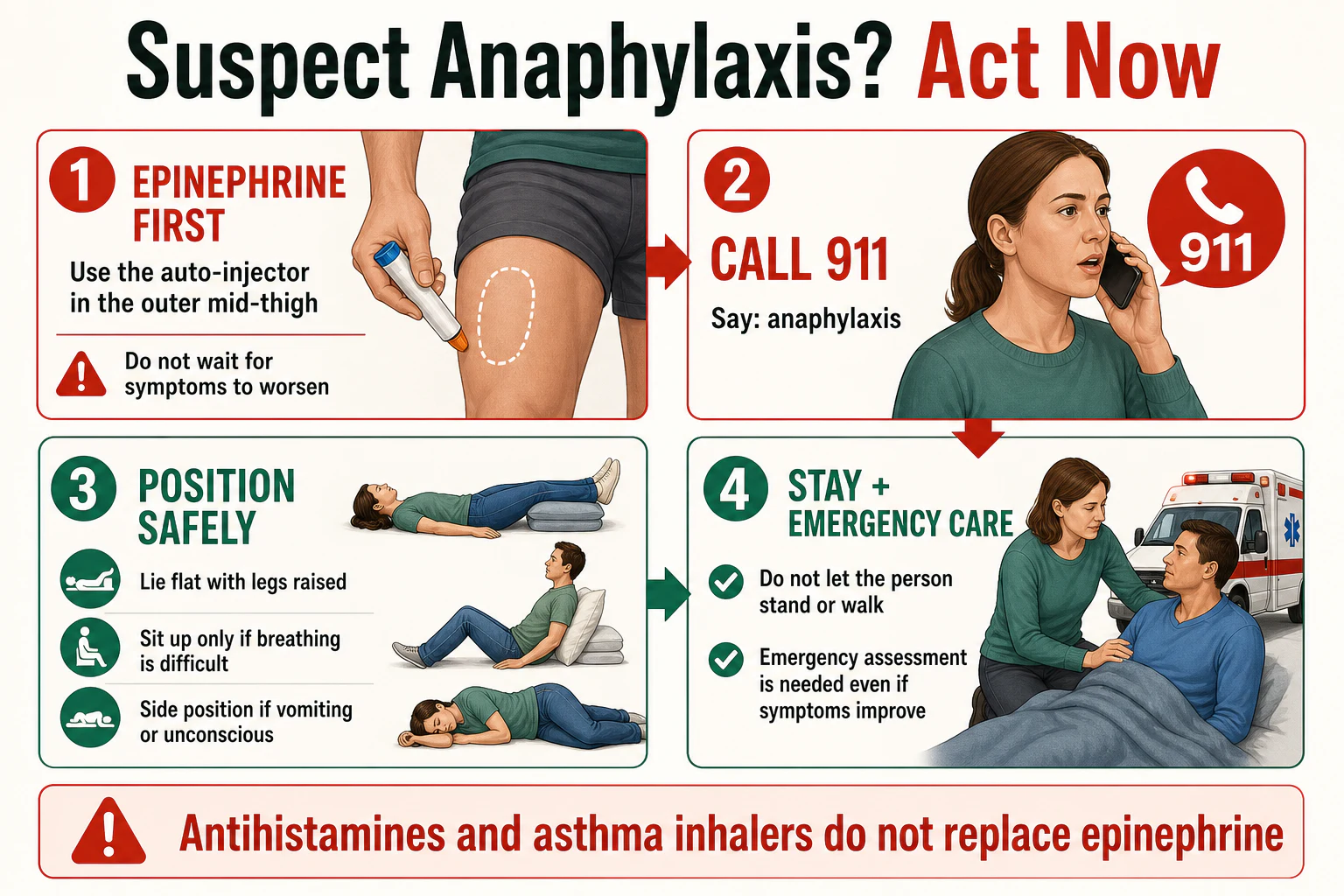
⚠ If you suspect anaphylaxis, act now
Use an epinephrine auto-injector (e.g. EpiPen) into the outer thigh immediately, then call 911.
If there's no auto-injector, call 911 right away. Help the person lie down with legs raised (or sit up if they're struggling to breathe). Go to the emergency department even if they improve — symptoms can come back. Don't wait to see if it passes.
Quick answer: what is anaphylaxis?
Anaphylaxis is a severe, rapid, potentially life-threatening allergic reaction that affects the whole body. It usually starts within minutes of exposure to a trigger — most often a food, insect sting or medicine — and can cause trouble breathing, throat and facial swelling, hives, a dangerous drop in blood pressure, and collapse. Epinephrine (adrenaline) is the only first-line, life-saving treatment; antihistamines can't reverse it. Anyone at risk should carry an auto-injector and use it at the first sign, then get emergency care. This page is general education, not a substitute for emergency medical help.
What is anaphylaxis?
Anaphylaxis is the most severe form of allergic reaction. Instead of staying local — a runny nose, an itchy patch — the immune system's response floods the whole body, releasing a surge of chemicals that make blood vessels leak, airways tighten and blood pressure fall. Without prompt treatment, it can be fatal.
Speed is the defining feature. Symptoms typically begin within minutes of exposure and can peak in around 5 to 30 minutes, though they occasionally start later. Because it moves so fast, recognising anaphylaxis and treating it immediately — rather than waiting to see whether it settles — is what saves lives. With prompt epinephrine, the outlook is usually very good.
How to recognise the symptoms
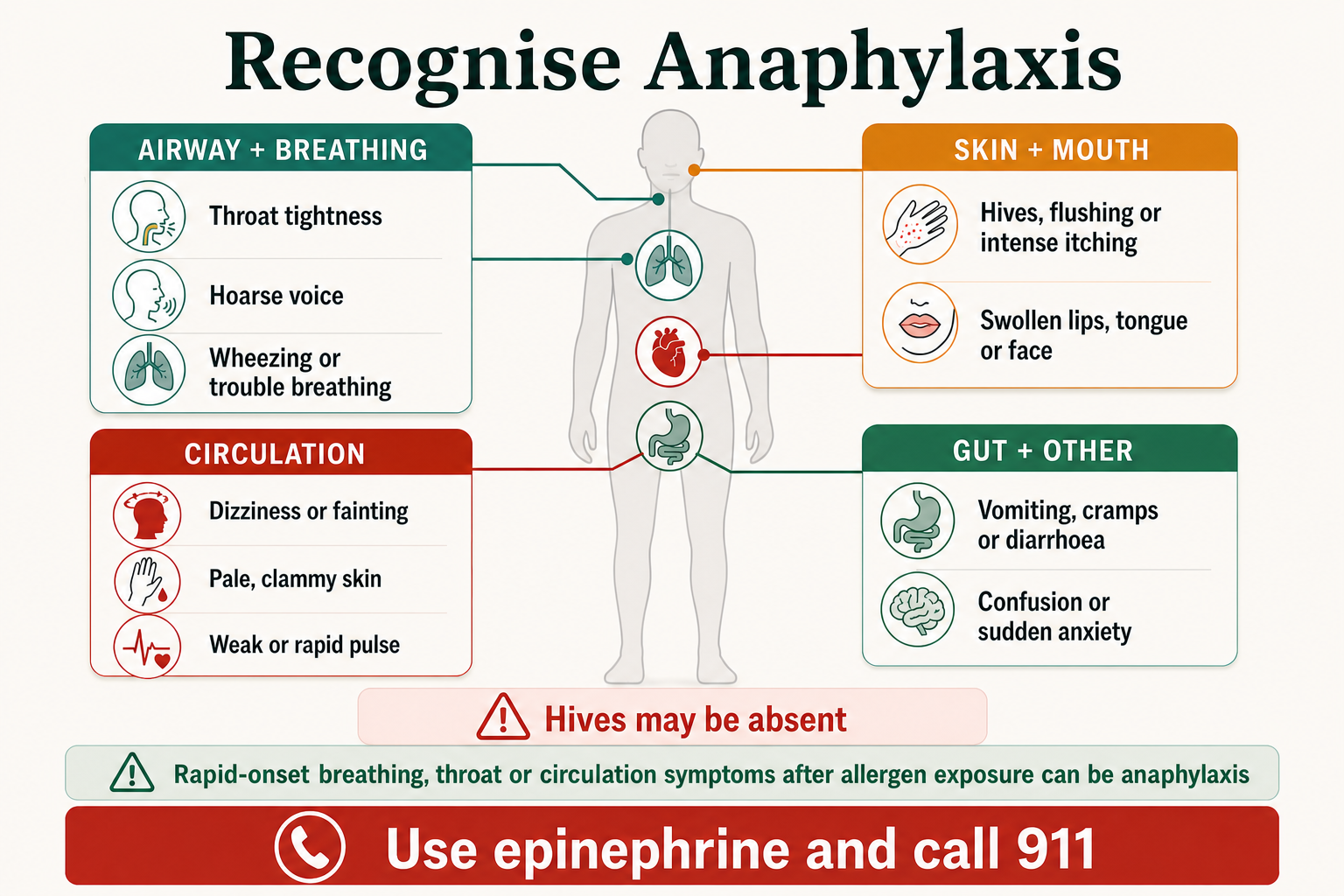
Anaphylaxis usually affects two or more body systems at once — but not always, and no single sign is required. Watch for:
Breathing & throat
- Trouble breathing, wheezing
- Throat tightness or swelling
- Hoarse voice, persistent cough
- Swelling of the tongue or lips
Skin
- Widespread hives (welts)
- Flushing or redness
- Swelling of the face or eyes
- Intense itching
Circulation
- Dizziness or lightheadedness
- Fainting or collapse
- Pale, clammy skin
- Rapid or weak pulse
Gut & other
- Nausea, vomiting
- Stomach cramps, diarrhoea
- A sense of "impending doom"
- Confusion or anxiety
Important: the absence of one common sign — even skin symptoms like hives — does not rule out anaphylaxis. If a known allergen is involved and someone rapidly develops serious breathing, throat, or circulation symptoms, treat it as anaphylaxis and don't delay.
How severe can it get? Reactions can range from mild skin symptoms that stay localized, to a moderate reaction with spreading hives or swelling, to a severe reaction with real breathing difficulty or a drop in blood pressure, up to a life-threatening reaction involving loss of consciousness. Reactions can move between these levels within minutes, which is why any breathing, throat, or circulation symptom should be treated as an emergency rather than watched to see if it worsens.
What to do in an anaphylaxis emergency
Every second counts. Follow these steps:
- Give epinephrine immediately. Use an epinephrine auto-injector (EpiPen, Auvi-Q or similar) into the middle of the outer thigh, or a needle-free epinephrine nasal spray (such as neffy, FDA-approved as an alternative to injectors) if that's what's been prescribed, following the device instructions. It's safe to give even if you're not 100% sure it's anaphylaxis.
- Call 911 (or your local emergency number) right away, and say the word "anaphylaxis." If there's no auto-injector, call 911 first, immediately.
- Position the person. Help them lie flat with legs raised to support blood pressure — but if they're struggling to breathe, let them sit up; if vomiting or unconscious, place them on their side.
- Use a second dose if needed. If there's no improvement after about 5 to 15 minutes and a second auto-injector is available, it can be given while waiting for help.
- Go to hospital. The person must be assessed in an emergency department and monitored, even if they seem fully recovered.
Stay with the person the whole time. Don't let them stand or walk suddenly, and don't wait for symptoms to "prove" it's serious before acting.
Why epinephrine — and not antihistamines
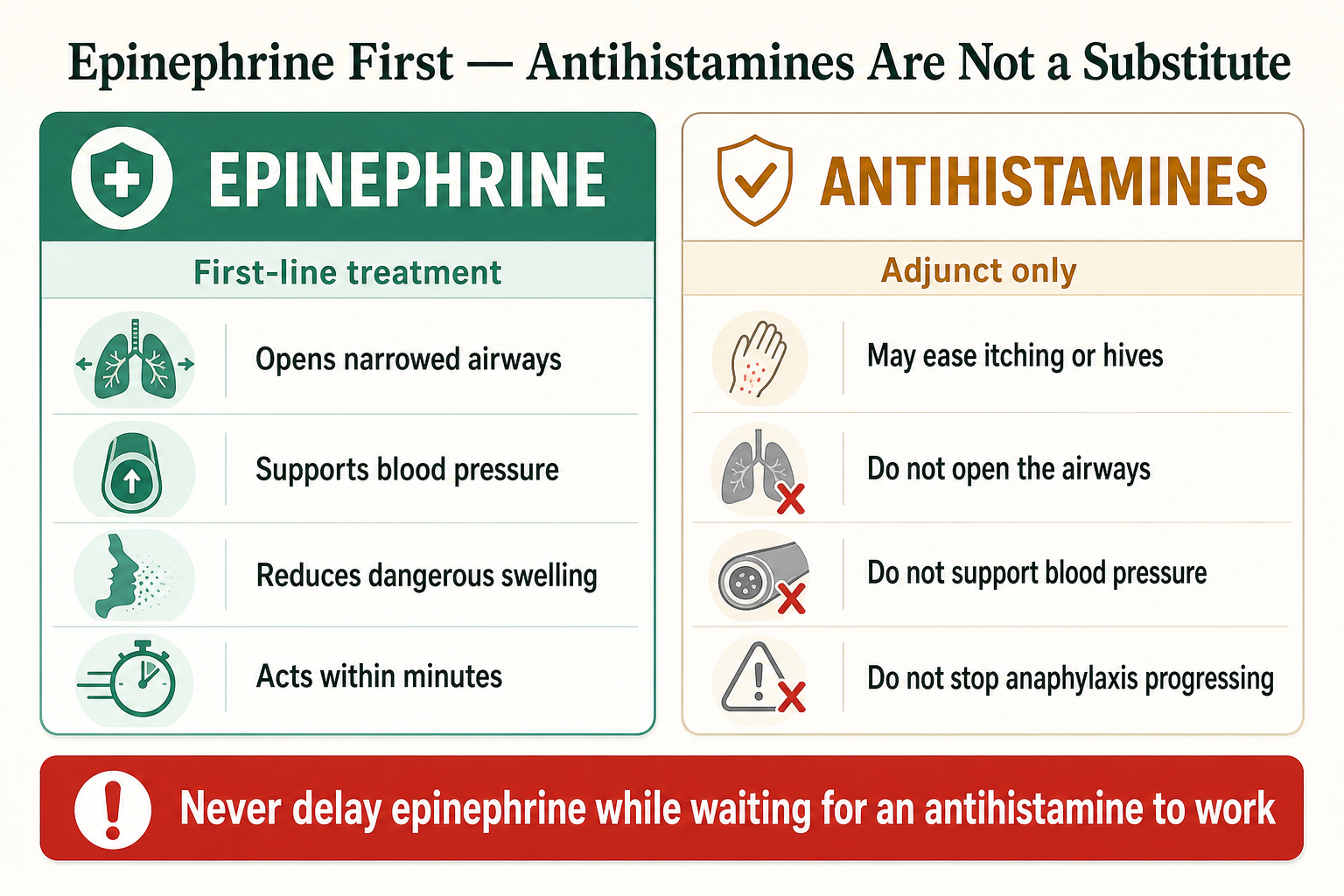
Epinephrine (adrenaline) is the only treatment that reverses anaphylaxis. Within minutes it opens the airways, tightens blood vessels to lift blood pressure, reduces swelling, and calms the reaction at its source. It works fast and, given into the thigh muscle, is very safe — which is why guidelines say to use it even when the diagnosis is uncertain. It's available as an injectable auto-injector or, for some patients, as an FDA-approved needle-free nasal spray; either way, the priority is using whichever device has been prescribed without delay.
Antihistamines (like Benadryl) and steroids are not substitutes. They may ease mild itching or hives, but they don't open the airways, don't support blood pressure, and don't stop anaphylaxis from progressing. Relying on them instead of epinephrine — or waiting for them to work — wastes critical time. Use epinephrine first, every time.
Symptoms can come back: biphasic reactions
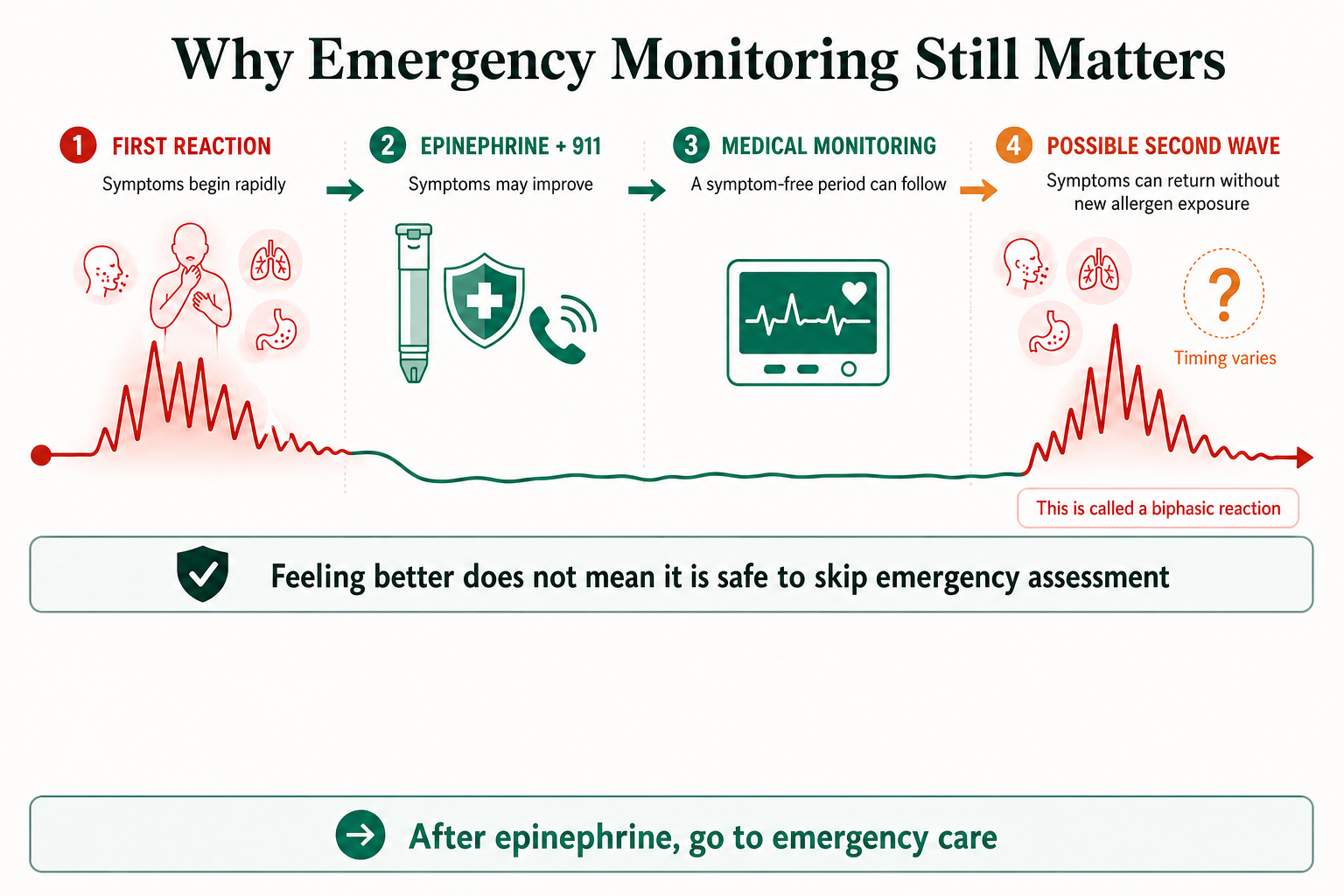
Even after epinephrine works and someone feels better, anaphylaxis symptoms can return hours later — a "biphasic" reaction — without any new exposure to the trigger. This second wave can be just as serious as the first, and researchers estimate it happens in roughly 1 in 5 anaphylaxis cases, typically anywhere from a few hours to about a day after the first reaction improves.
That's the reason emergency assessment is non-negotiable: anyone treated for anaphylaxis should be monitored in a medical setting for several hours so a rebound can be caught and treated. Never skip the hospital trip because symptoms settled — "better" is not the same as "safe."
Common causes and triggers
Almost any allergen can cause anaphylaxis, but a few are responsible for most cases.
- Foods — peanuts, tree nuts, shellfish, fish, milk, eggs, wheat, soy and sesame are the leading triggers. See food allergies.
- Insect stings — bees, wasps, hornets and fire ants.
- Medications — antibiotics such as penicillin, and painkillers like aspirin and other NSAIDs.
- Latex — in gloves, balloons and some medical devices.
- Other — exercise (sometimes combined with food), and in some cases no cause is ever identified (idiopathic).
Once you know your trigger, strict avoidance is the foundation of prevention — even tiny amounts can set off a reaction.
Who is at risk, and life after a diagnosis
Anyone who has had anaphylaxis is at higher risk of it happening again, and the reaction can differ each time. People with food allergies, insect-venom allergy, or a history of severe reactions are most at risk; poorly controlled asthma raises the danger of a serious outcome.
If you've been diagnosed, an allergist will help you build a plan. Key steps: carry two epinephrine auto-injectors at all times, keep them in date, have a written anaphylaxis action plan, consider a medical-alert bracelet, and make sure family, friends, carers or colleagues know how and when to use your injector. Tell your doctor about any other medicines you take, as some (such as certain blood-pressure drugs) can affect a reaction.
Diagnosis and prevention
After an anaphylactic reaction, see a board-certified allergist to confirm the trigger and prevent the next one. They'll take a detailed history and use allergy testing — skin or blood tests, and sometimes a supervised challenge — to pin down what you react to. For some triggers, such as insect venom, immunotherapy can reduce the risk of future severe reactions.
Prevention then rests on strict avoidance of your trigger, always carrying your auto-injectors, and having a clear plan everyone around you understands. See our allergy safety guide.
Anaphylaxis in children
Food allergies make anaphylaxis a particular concern in children. Make sure your child's school, carers and activity leaders have their action plan and in-date auto-injectors, know the symptoms, and understand that epinephrine should be given without hesitation. Age-appropriate auto-injectors are available, and children can be taught to recognise their own early symptoms. A pediatric allergist can guide the plan; more in allergies in children.
Anaphylaxis: frequently asked questions
What are the symptoms of anaphylaxis?
What should you do if someone has anaphylaxis?
Why is epinephrine used instead of antihistamines?
Can anaphylaxis symptoms come back after treatment?
Sources
- MedlinePlus (NIH/NLM) — Anaphylaxis
- ACAAI — Anaphylaxis: Causes, Symptoms & Treatment
- Cleveland Clinic — Anaphylaxis: Causes, Symptoms, Diagnosis & Treatment
- U.S. Food and Drug Administration — FDA Approves First Nasal Spray for Treatment of Anaphylaxis
- FARE (Food Allergy Research & Education) — Anaphylaxis
Medical disclaimer: This guide is for general education and is not a substitute for professional emergency care. If you suspect anaphylaxis, use epinephrine if available and call 911 immediately. It does not provide dosing; follow your auto-injector's instructions and your doctor's action plan.
 MD
MDMedically reviewed
Dr. Hannah H. Walford, MD
Allergist and Immunologist
- Website role
- Owner, Medical Director and Medical Reviewer of Allergy Relief Guide
- Professional affiliation
- Stanford Health Care / Menlo Medical Clinic, Menlo Park, California
- Areas of expertise
- Food allergy, eczema, allergic rhinitis, sinusitis and asthma
Dr. Hannah H. Walford is a board-certified allergist and immunologist experienced in caring for adults and children with allergic conditions. Her areas of expertise include food allergy, eczema, allergic rhinitis, sinusitis and asthma. She provides medical leadership and review oversight for the educational health content published by Allergy Relief Guide.
Medical content is provided for education and is not a substitute for diagnosis or individualized medical care.
Related guides
Allergy safety
Staying safe with serious allergies.
Food allergies
The leading cause of anaphylaxis.
Allergy testing
Confirm your triggers after a reaction.
Hives
When welts are — and aren't — an emergency.
Know your triggers, carry your plan
After any severe reaction, testing and an action plan are essential. See how to stay safe.
Read the allergy safety guide