
Sublingual Immunotherapy (SLIT): How Tablets Work vs. Allergy Shots
Sublingual immunotherapy (SLIT) treats allergies with a tablet placed under the tongue instead of injections. Like allergy shots, it gradually builds tolerance to an allergen, but it's taken once daily at home after a supervised first dose in a clinician's office. In the U.S., FDA-approved SLIT tablets exist for grass pollen, ragweed pollen, and house dust mite, and each tablet treats one allergen. SLIT has a favorable safety profile that allows home dosing, though it may be slightly less effective than shots and can't cover multiple allergens at once.
Quick answer
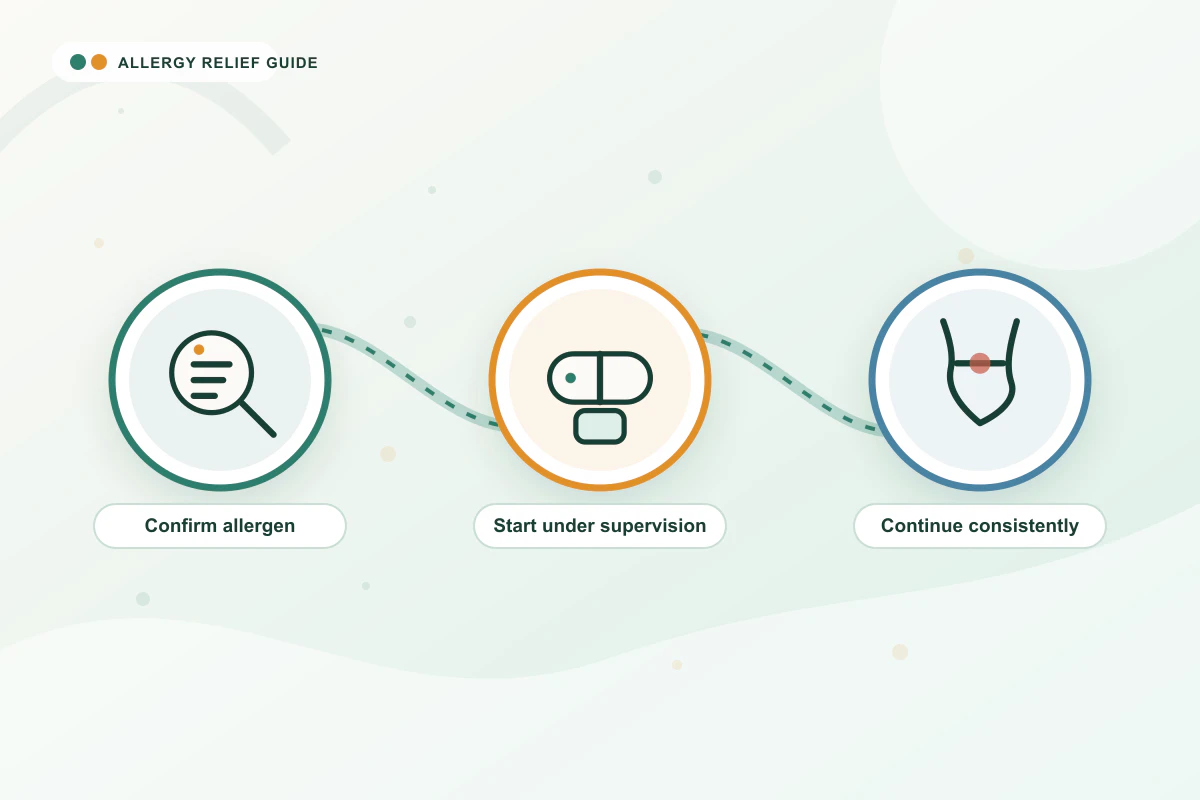
Sublingual immunotherapy (SLIT) treats allergies with a tablet placed under the tongue instead of injections, gradually building tolerance to an allergen. It's taken once daily at home after a supervised first dose in a clinician's office. In the U.S., FDA-approved SLIT tablets exist for grass pollen, ragweed pollen, and house dust mite, and each tablet treats one allergen. SLIT allows home dosing but may be slightly less effective than shots and can't cover multiple allergens at once.
What you need to know
- SLIT delivers an allergen as a tablet under the tongue to build tolerance, an injection-free alternative to allergy shots.
- In the U.S., FDA-approved SLIT tablets are available for grass pollen, ragweed pollen, and house dust mite.
- Each SLIT tablet treats a single allergen, so it can't cover multiple allergies at once the way one allergy shot can.
- The first dose is taken under medical supervision because of a small risk of a severe reaction; after that, tablets are taken once daily at home.
- SLIT tablets carry a boxed warning for severe allergic reactions, and clinicians typically prescribe an epinephrine auto-injector alongside them.
- Compared with allergy shots, SLIT is convenient and has a favorable safety profile, but may be slightly less effective and covers fewer allergens.
How SLIT Works
Sublingual immunotherapy uses the same underlying principle as allergy shots: exposing the immune system to controlled amounts of an allergen over time so it becomes less reactive. The difference is the delivery. Instead of an injection, SLIT uses a tablet placed under the tongue, where it dissolves and the allergen is absorbed. Like shots, it's a long-term treatment aimed at changing the underlying allergic response rather than just relieving symptoms day to day. For the injection-based approach, see our allergy shots guide.
FDA-Approved SLIT Tablets
In the United States, SLIT tablets are FDA-approved for a limited set of inhaled allergens:
- Grass pollen
- Short ragweed pollen
- House dust mite
These are approved for allergic rhinitis (with or without eye symptoms) in appropriately tested, sensitized patients. A key limitation is that each tablet treats one allergen, so SLIT tablets can't cover several different allergies at once the way a single customized allergy shot can. For seasonal allergens, treatment is often started several weeks before the season; dust mite treatment is typically taken year-round.
The Supervised First Dose and Home Use
Because introducing an allergen carries a small risk of a serious reaction, the first dose of a SLIT tablet is taken in a clinician's office where you're observed. After that first supervised dose, the tablets are taken once daily at home. SLIT tablets carry a boxed warning for severe allergic reactions including anaphylaxis, and clinicians generally prescribe an epinephrine auto-injector and train you on how to use it. Mild local reactions, like itching or tingling in the mouth, are common early on. See our anaphylaxis guide for severe-reaction signs.
SLIT Tablets vs. Allergy Shots
| Feature | SLIT tablets | Allergy shots (SCIT) |
|---|---|---|
| How it's given | Tablet under the tongue, once daily | Injection in a clinician's office |
| Where | At home after a supervised first dose | In the office, with a wait afterward |
| Allergens covered | One allergen per tablet; limited FDA-approved options | Can cover multiple allergens at once |
| Effectiveness | Effective; may be slightly less than shots in some comparisons | Well-established, highly effective |
| Safety | Favorable profile enabling home dosing; boxed warning still applies | Small risk of severe reaction, hence office monitoring |
Which fits best depends on your specific allergens, preferences about injections, and your allergist's assessment. For the broader options, see our allergy treatment guide.
When to seek care
Routine
You're interested in an injection-free immunotherapy option and want to know if an FDA-approved tablet fits your allergy.
Prompt (within days)
Mild mouth itching or tingling in the early weeks of SLIT that you want to check on, or questions about your dosing schedule.
Urgent (same day)
A more pronounced or spreading reaction after a dose, or throat discomfort that concerns you.
Emergency (call 911)
Signs of a severe reaction after a dose — trouble breathing, throat tightness or swelling, widespread hives, or dizziness. Use your epinephrine auto-injector and call 911.
Practical next steps
Safe general steps
- Ask an allergist whether an FDA-approved SLIT tablet matches your specific allergy
- Have your first dose under medical supervision as directed
- Keep your prescribed epinephrine auto-injector accessible and know how to use it
- Take the tablet consistently once daily as prescribed
Actions that need medical guidance
- Deciding between SLIT tablets and allergy shots
- Managing SLIT if you have multiple allergies
- What to do about early mouth or throat reactions
Don't attempt without professional advice
- Don't take your first SLIT dose at home — the first dose is supervised for safety
- Don't continue dosing through a significant reaction without contacting your allergist
- Don't expect one tablet to cover several different allergies — each treats one allergen
Frequently asked questions
What is sublingual immunotherapy?
Which allergens have FDA-approved SLIT tablets?
Do you take SLIT tablets at home?
Is SLIT as effective as allergy shots?
Are SLIT tablets safe?
Can one SLIT tablet treat multiple allergies?
Sources
- ACAAI Patient — Immunotherapy with Allergy Tablets (SLIT)
- Cleveland Clinic — Sublingual Immunotherapy (SLIT): Treatment & Results
- ACAAI Patient — Allergy Shots (Subcutaneous Immunotherapy)
Medical disclaimer: This guide is for general education and isn't a substitute for personalized medical advice. It doesn't provide dosing. Always talk to a qualified healthcare professional about your symptoms and treatment.
 MD
MDMedically reviewed
Dr. Hannah H. Walford, MD
Allergist and Immunologist
- Website role
- Owner, Medical Director and Medical Reviewer of Allergy Relief Guide
- Professional affiliation
- Stanford Health Care / Menlo Medical Clinic, Menlo Park, California
- Areas of expertise
- Food allergy, eczema, allergic rhinitis, sinusitis and asthma
Dr. Hannah H. Walford is a board-certified allergist and immunologist experienced in caring for adults and children with allergic conditions. Her areas of expertise include food allergy, eczema, allergic rhinitis, sinusitis and asthma. She provides medical leadership and review oversight for the educational health content published by Allergy Relief Guide.
Medical content is provided for education and is not a substitute for diagnosis or individualized medical care.
Continue building your allergy plan
Explore related guides to understand the full picture, from triggers to treatment to safety.
See the full allergy treatment & relief guide