Reading Food Labels for Allergens
In the United States, packaged foods must clearly declare nine major food allergens: milk, eggs, fish, crustacean shellfish, tree nuts, peanuts, wheat, soybeans, and — since January 1, 2023 — sesame. The allergen must be named in plain language, either within the ingredient list or in a separate “Contains” statement right after it. One crucial nuance: advisory labels like “may contain” or “made in a facility with” are voluntary and not regulated, so their absence does not guarantee a food is free of that allergen. Reading labels every time is the core habit of managing a food allergy.
Quick answer
In the U.S., packaged foods must clearly declare nine major allergens: milk, eggs, fish, crustacean shellfish, tree nuts, peanuts, wheat, soybeans, and — since January 1, 2023 — sesame. The allergen must be named in plain language, either in the ingredient list or in a “Contains” statement after it. Advisory labels like “may contain” are voluntary and not regulated, so their absence doesn't guarantee a food is allergen-free. Read labels every time.
What you need to know
- U.S. law requires packaged foods to declare nine major food allergens in plain language.
- The nine are: milk, eggs, fish, crustacean shellfish, tree nuts, peanuts, wheat, soybeans, and sesame.
- Sesame became the ninth major allergen effective January 1, 2023, under the FASTER Act.
- The allergen must be named either within the ingredient list or in a separate 'Contains' statement immediately after it.
- Advisory statements like 'may contain' or 'made in a facility that also processes' are voluntary and not regulated — their absence doesn't guarantee safety.
- These rules apply to FDA-regulated packaged foods; they don't cover everything (for example, some non-packaged or differently-regulated foods), so labels are one tool alongside vigilance.
The 9 Major Allergens
U.S. food-labeling law (the FALCPA, later amended by the FASTER Act) requires that packaged foods clearly identify when they contain one of the major food allergens. Originally there were eight; sesame was added as the ninth, effective January 1, 2023. The nine are:
- Milk
- Eggs
- Fish (like salmon, tuna, cod)
- Crustacean shellfish (like shrimp, crab, lobster)
- Tree nuts (like almonds, walnuts, pecans)
- Peanuts
- Wheat
- Soybeans
- Sesame (added January 1, 2023)
These nine account for the large majority of serious food-allergy reactions, which is why the law singles them out. For the individual allergens, see our guides on egg allergy, fish allergy, and food allergies.
How the Allergen Must Be Declared
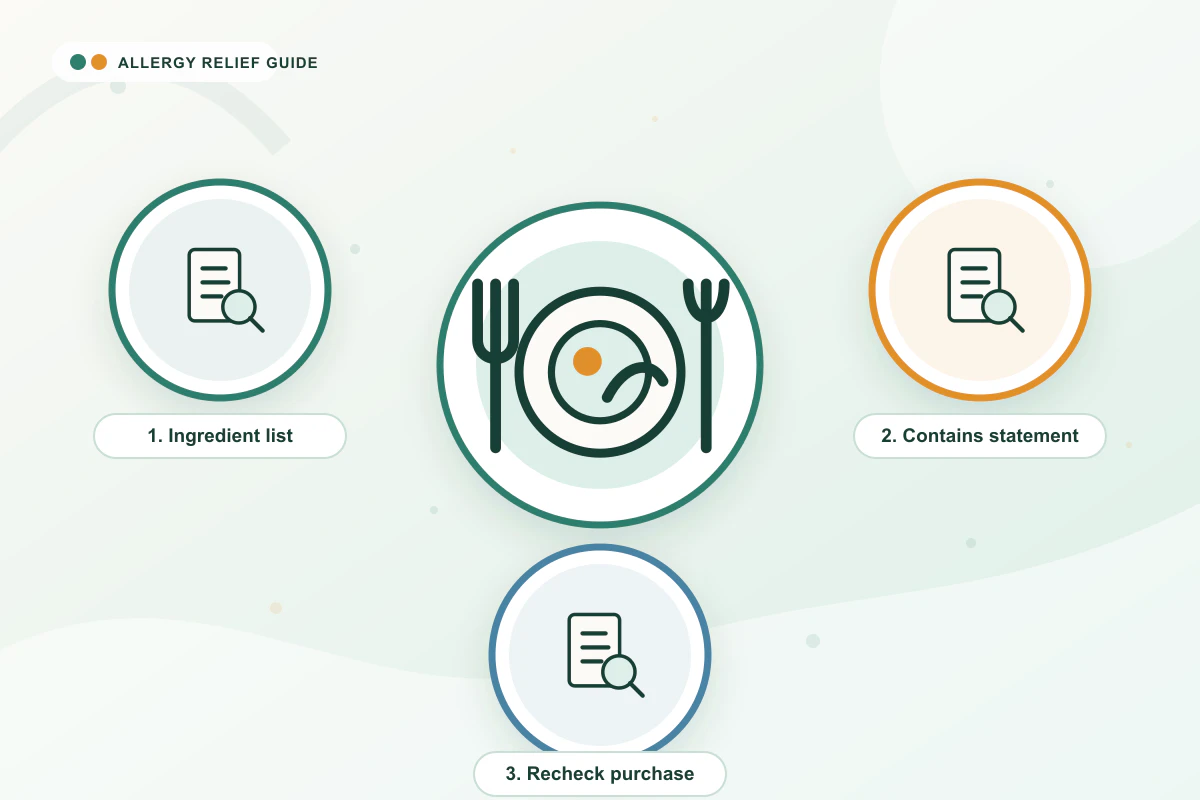
For the nine major allergens, the label must name the allergen in plain, everyday language — so a product made with a milk protein has to say "milk," not just an unfamiliar ingredient name. Manufacturers can meet the requirement in one of two ways: by naming the allergen within the ingredient list itself (for example, "whey (milk)"), or by including a separate "Contains" statement immediately after the ingredient list (for example, "Contains: milk, soy, wheat"). Either way, the goal is that you can quickly scan and identify the major allergens.
| Where to look | What it looks like | Required? |
|---|---|---|
| Ingredient list | Allergen named in plain language, e.g. 'whey (milk)' | Yes, for the 9 major allergens |
| 'Contains' statement | 'Contains: milk, soy, wheat' after the ingredients | One of the two required methods |
| Advisory statement | 'May contain peanuts' or 'made in a facility that also processes tree nuts' | No — voluntary and not regulated |
The "May Contain" Trap
Advisory labels are voluntary — their absence doesn't mean safety
Statements like “may contain,” “made on shared equipment with,” or “made in a facility that also processes” are precautionary allergen labeling. They are voluntary and not regulated, and there's no standard for when a manufacturer must (or must not) use them. That means two things: a product without such a warning could still have cross-contact risk, and the wording doesn't reliably indicate how much risk exists. If you have a serious food allergy, how to treat these advisory labels is worth discussing with your allergist.
Reading Labels in Practice
- Read the full label every time — recipes and manufacturing can change without obvious notice
- Check both the ingredient list and any 'Contains' statement
- Remember plain-language rules apply to the 9 major allergens; other allergens you react to may not be called out the same way
- Treat advisory 'may contain' statements per your allergist's advice, since they're unregulated
- When a label is unclear or a food isn't packaged/labeled, ask the manufacturer or avoid it
Label-reading is a core habit of living with food allergy, alongside carrying emergency medication if you're at risk of a severe reaction. See our anaphylaxis guide, and food allergy vs. intolerance for related background.
When to seek care
Routine
You're learning to manage a food allergy and want to read labels confidently.
Prompt (within days)
Uncertainty about whether a food is safe, or repeated reactions despite label-reading — review your approach with an allergist.
Urgent (same day)
A reaction after eating a packaged food you thought was safe — get evaluated and review the label together.
Emergency (call 911)
Signs of anaphylaxis after eating — trouble breathing, swelling of the lips, tongue, or throat, widespread hives with dizziness. Use epinephrine if prescribed and call 911.
Practical next steps
Safe general steps
- Read the full label every time, checking ingredients and any 'Contains' statement
- Learn the plain-language names of your allergens among the nine
- Follow your allergist's advice on how to treat 'may contain' advisory labels
- When in doubt about an unlabeled or unclear food, ask the manufacturer or avoid it
Actions that need medical guidance
- How strictly to interpret advisory 'may contain' labels for your allergy
- Managing an allergen not among the nine major ones
- A reaction to a food you believed was safe
Don't attempt without professional advice
- Don't assume a product without a 'may contain' warning is free of cross-contact risk
- Don't skip re-reading a label on a product you've bought before — formulations change
- Don't rely on labels alone if you're at risk of a severe reaction — carry emergency medication
Frequently asked questions
What are the 9 major food allergens in the U.S.?
How must allergens be labeled on packaged foods?
When was sesame added as a major allergen?
Does 'may contain' mean the food definitely has the allergen?
If there's no 'may contain' warning, is the food safe?
Do labeling rules cover every allergen?
Sources
- MedlinePlus (NIH/NLM) — Food Allergy
- Michigan State University Extension — The FASTER Act - Sesame as Major Food Allergen
- FoodSafety.gov (HHS) — The Food Allergy Safety, Treatment, Education, and Research (FASTER) Act of 2021
Medical disclaimer: This guide is for general education and isn't a substitute for personalized medical advice. It doesn't provide dosing. Always talk to a qualified healthcare professional about your symptoms and treatment.
 MD
MDMedically reviewed
Dr. Hannah H. Walford, MD
Allergist and Immunologist
- Website role
- Owner, Medical Director and Medical Reviewer of Allergy Relief Guide
- Professional affiliation
- Stanford Health Care / Menlo Medical Clinic, Menlo Park, California
- Areas of expertise
- Food allergy, eczema, allergic rhinitis, sinusitis and asthma
Dr. Hannah H. Walford is a board-certified allergist and immunologist experienced in caring for adults and children with allergic conditions. Her areas of expertise include food allergy, eczema, allergic rhinitis, sinusitis and asthma. She provides medical leadership and review oversight for the educational health content published by Allergy Relief Guide.
Medical content is provided for education and is not a substitute for diagnosis or individualized medical care.
Related guides
Continue building your allergy plan
Explore related guides to understand the full picture, from triggers to treatment to safety.
See the full food allergies guide