Allergy Medicine While Breastfeeding: Options and Baby Safety
Only small amounts of most medications, including allergy medicines, pass into breast milk. Second-generation antihistamines such as loratadine and cetirizine are commonly discussed by breastfeeding medicine resources as lower-sedation options when an antihistamine is needed, while first-generation antihistamines like diphenhydramine and decongestants like pseudoephedrine are more often flagged for infant sedation or reduced milk supply. This page describes what sources like LactMed and CDC report; your pharmacist or your baby's pediatrician can confirm what's right for you specifically.
Quick answer
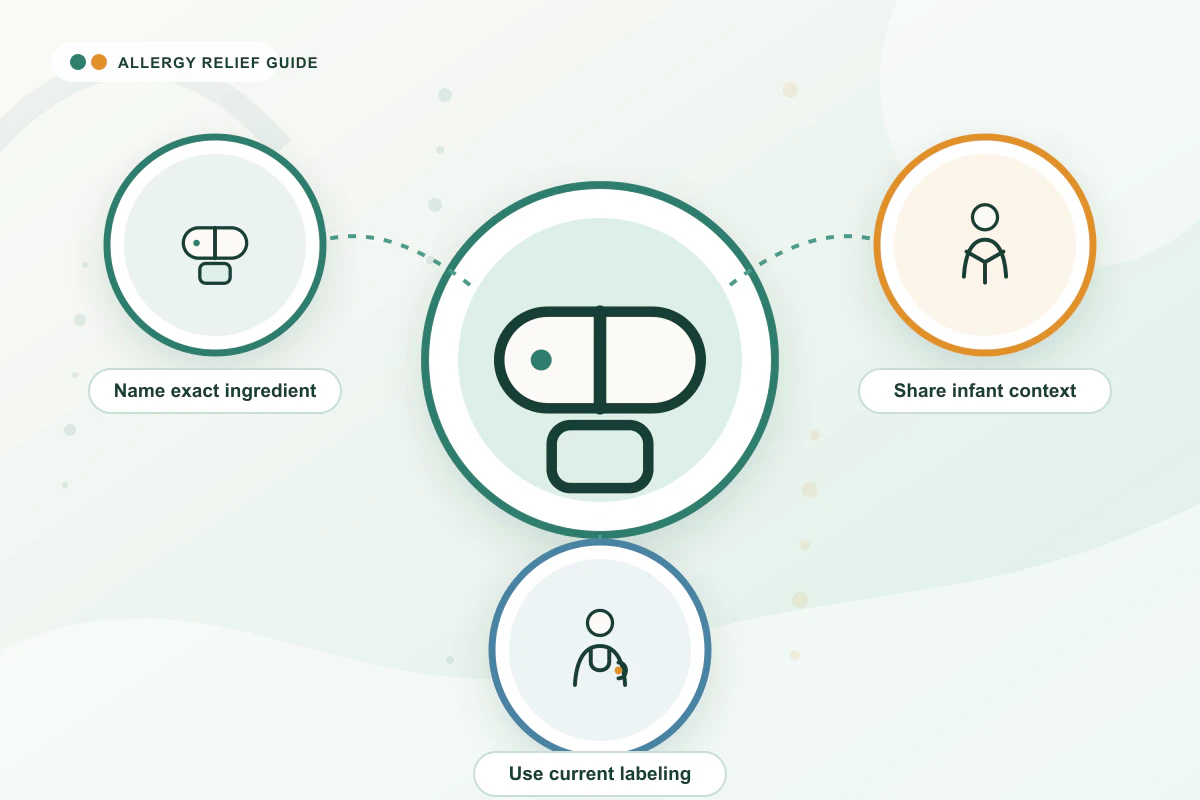
Only small amounts of most medications pass into breast milk. Second-generation antihistamines such as loratadine and cetirizine are commonly discussed as lower-sedation options when one is needed, while first-generation antihistamines and decongestants like pseudoephedrine are more often flagged for infant sedation or reduced milk supply. Confirm any choice with your pharmacist or your baby's pediatrician.
What you need to know
- Only small amounts of nearly all medications pass into breast milk, but “small” isn't automatically “no effect,” so choices still matter.
- Second-generation antihistamines (loratadine, cetirizine, fexofenadine) are the options most often discussed as preferred if an antihistamine is needed, per resources such as LactMed and the British Society for Allergy and Clinical Immunology.
- First-generation antihistamines such as diphenhydramine (Benadryl) are more often flagged for causing infant sedation and reducing milk supply.
- Oral decongestants containing pseudoephedrine can meaningfully reduce milk supply. The NIH Drugs and Lactation Database (LactMed) reports that after a single 60 mg oral dose in 8 nursing mothers there was a mean 24% decrease in milk production over the following 24 hours.
- Nasal steroid sprays and saline rinses act mostly in the nose rather than throughout the body and are commonly used as first-line options.
- Confirm any medication, including OTC products, with your pharmacist or your baby's pediatrician, especially in the early weeks of breastfeeding or if your baby was born premature.
How Medications Reach Breast Milk
The U.S. National Library of Medicine maintains LactMed, a database summarizing what's known about specific drugs and breastfeeding, and the CDC directs healthcare providers to it as a key resource. Across most medications, only a small fraction of the maternal dose ends up in breast milk, and an even smaller amount reaches the infant's bloodstream. That said, "small" varies by drug and by how sensitive a particular infant may be, which is why category matters, not just the general principle.
Antihistamine Categories Discussed for Breastfeeding
| Category | Examples of type | What sources generally note |
|---|---|---|
| Second-generation (less sedating) | loratadine, cetirizine, fexofenadine | Minimal milk transfer reported; LactMed notes loratadine studies found no significant difference in infant sedation versus controls; often the category discussed first if an antihistamine is needed |
| First-generation (more sedating) | diphenhydramine and similar | More often associated with infant drowsiness and can reduce milk supply; generally not the first choice while nursing |
| Nasal corticosteroid sprays | topical, acts in the nose | Acts locally rather than throughout the body; often used as a first-line option for nasal symptoms |
| Oral decongestants | pseudoephedrine, phenylephrine | Can meaningfully reduce milk supply; typically used cautiously and briefly, if at all, especially before supply is well established |
This table describes what breastfeeding-medicine resources generally discuss about each category — it isn't a personal recommendation. Confirm what's appropriate for you and your baby with your pharmacist or pediatrician.
Watching Your Baby After Starting a New Medicine
After starting any new medication while breastfeeding, it's reasonable to watch for unusual sleepiness, poor feeding, or unusual fussiness in your baby, and to keep an eye on your own milk supply. Contact your pediatrician if you notice any of these changes.
Non-Medication Steps
- Saline nasal rinses or sprays
- Reduce known triggers at home, such as dust mites or pet dander
- Stay well hydrated
- Use a humidifier for dry-air congestion
The option that barely leaves the nose
Most of this page, like most advice on the subject, is about choosing the least concerning tablet. That framing quietly assumes the medicine has to travel through your bloodstream to work, and for nasal symptoms it does not.
A steroid nasal spray acts on the lining of the nose directly, so very little reaches the rest of the body. The NIH Drugs and Lactation Database puts the consequence plainly: “the amounts of inhaled corticosteroids absorbed into the maternal bloodstream and excreted into breastmilk are probably too small to affect a breastfed infant”.
On acceptability, LactMed states that “expert opinion considers inhaled, nasal and oral corticosteroids acceptable to use during breastfeeding”. That reframes the question: not only which tablet, but whether a tablet is needed at all for symptoms that are mainly in the nose.
Two caveats matter. Nasal steroids work on congestion, sneezing and a runny nose rather than on itchy eyes or hives, so they do not replace an antihistamine for every symptom pattern. And they build up over days rather than working within an hour, so judging one after a single dose will underrate it. See our guide to nasal sprays for allergies.
- Acts locally in the nose, with little reaching the bloodstream
- LactMed: amounts reaching breastmilk are probably too small to affect a breastfed infant
- Expert opinion considers inhaled, nasal and oral corticosteroids acceptable during breastfeeding
- Best for congestion, sneezing and runny nose; not a substitute for treating itchy eyes or hives
- Give it several days before deciding whether it works
- Confirm any choice with a clinician or pharmacist who knows your history
Who should avoid pseudoephedrine altogether
The supply effect above is not evenly risky. LactMed draws a line that general advice usually leaves out, and it is the part worth knowing if your supply is not yet secure.
It states that “mothers with newborns whose lactation is not yet well established or in mothers who are having difficulties producing sufficient milk should not receive pseudoephedrine”. That is a clear should-not rather than a caution to weigh, and it applies precisely when a temporary dip would be hardest to recover from.
LactMed also notes that “a single dose of pseudoephedrine decreases milk production acutely and repeated use seems to interfere with lactation”. A one-off in an established supply is a different proposition from taking it daily through a season, and the daily version is the one to raise with a clinician before starting.
Congestion is usually the reason people reach for a decongestant, and it is also the symptom a steroid nasal spray addresses without the same systemic effect. That makes it a reasonable alternative to discuss rather than pushing through with an oral decongestant.
- Should not be used where lactation is not yet well established
- Should not be used where there is already difficulty producing enough milk
- Repeated use seems to interfere with lactation, not only a single dose
- Discuss a nasal option for congestion instead
- Raise any daily use with a clinician before starting
When to seek care
Routine
Mild symptoms managed with saline, nasal spray, or trigger avoidance.
Prompt (within days)
Symptoms not improving with non-medication steps, or you're unsure which medication category fits your situation.
Urgent (same day)
A noticeable, unexplained drop in milk supply after starting a new medication, or your baby seems unusually drowsy or is feeding poorly.
Emergency (call 911)
Signs of a severe allergic reaction in you (anaphylaxis) — swelling of the lips, tongue, or throat, difficulty breathing, or widespread hives with dizziness. Call 911.
Practical next steps
Safe general steps
- Try non-medication measures first for mild symptoms
- If you need medicine, ask your pharmacist which category is generally discussed for breastfeeding
- Use the lowest effective dose for the shortest time needed
- Watch your baby for drowsiness or feeding changes after starting anything new
Actions that need medical guidance
- Choosing a specific antihistamine or decongestant while breastfeeding
- Combining more than one allergy or cold ingredient in one product
- Any noticeable drop in milk supply after starting a new medicine
Don't attempt without professional advice
- Don't assume an OTC label means a product is fine while breastfeeding without checking
- Don't combine multiple allergy or cold ingredients in one product without checking each one
- Don't continue a medication if your baby seems unusually sleepy or is feeding poorly — contact your pediatrician
Frequently asked questions
Can I take allergy medicine while breastfeeding?
Which antihistamines are considered lower-risk while breastfeeding?
Does Benadryl affect breastfeeding?
Can decongestants reduce milk supply?
How much medication actually gets into breast milk?
What should I watch for in my baby after starting a new allergy medicine?
Is a steroid nasal spray an option while breastfeeding?
Who should avoid pseudoephedrine completely?
Does a nasal spray replace an antihistamine?
How quickly does a steroid nasal spray work?
Who should decide which allergy medicine I take while breastfeeding?
Sources
- NCBI Bookshelf (NIH) — Loratadine — LactMed
- NCBI Bookshelf (NIH) — Cetirizine — LactMed
- NCBI Bookshelf (NIH) — Fluticasone, Inhaled — LactMed
- NCBI Bookshelf (NIH) — Pseudoephedrine — LactMed
- CDC — Prescription Medication Use During Breastfeeding
- Cleveland Clinic — What Medications Are Safe While Breastfeeding?
Medical disclaimer: This guide is for general education and isn't a substitute for personalized medical advice. It doesn't provide dosing. Always talk to a qualified healthcare professional about your symptoms and treatment.
 MD
MDMedically reviewed
Dr. Hannah H. Walford, MD
Allergist and Immunologist
- Website role
- Owner, Medical Director and Medical Reviewer of Allergy Relief Guide
- Professional affiliation
- Stanford Health Care / Menlo Medical Clinic, Menlo Park, California
- Areas of expertise
- Food allergy, eczema, allergic rhinitis, sinusitis and asthma
Dr. Hannah H. Walford is a board-certified allergist and immunologist experienced in caring for adults and children with allergic conditions. Her areas of expertise include food allergy, eczema, allergic rhinitis, sinusitis and asthma. She provides medical leadership and review oversight for the educational health content published by Allergy Relief Guide.
Medical content is provided for education and is not a substitute for diagnosis or individualized medical care.
Continue building your allergy plan
Explore related guides to understand the full picture, from triggers to treatment to safety.
See the full allergy treatment & relief guide