
Managing Allergic Asthma Long-Term
Allergic asthma is asthma triggered or worsened by allergens like pollen, dust mites, pet dander, and mold. Long-term management combines two allergy-specific pillars: reducing your exposure to the allergens that set off symptoms, and following a written asthma action plan built around a daily controller medicine plus a quick-relief reliever inhaler for flare-ups. Tracking symptoms and, if you use one, peak flow readings helps catch worsening early, before it becomes an emergency.
Quick answer
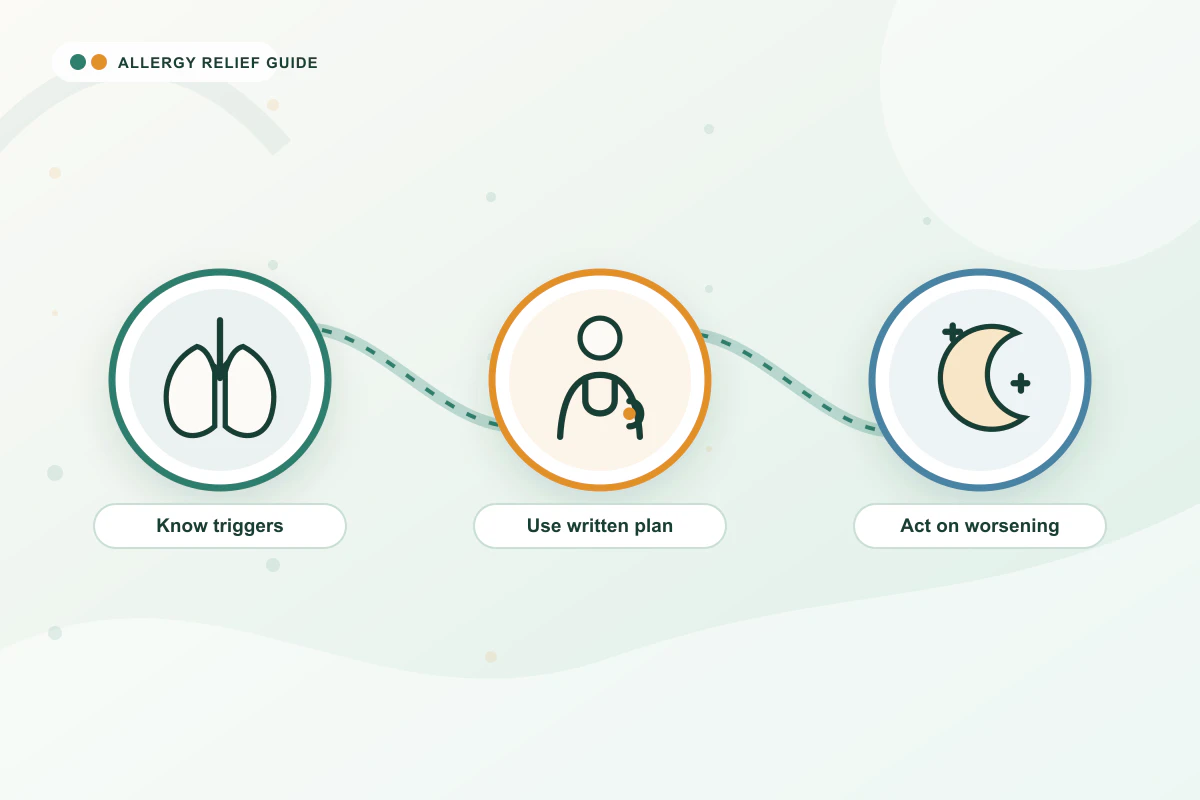
Allergic asthma is asthma triggered or worsened by allergens like pollen, dust mites, pet dander, and mold. Long-term management combines two allergy-specific pillars: reducing your exposure to the allergens that set off symptoms, and following a written asthma action plan built around a daily controller medicine plus a quick-relief reliever inhaler for flare-ups. Tracking symptoms and, if you use one, peak flow readings helps catch worsening early, before it becomes an emergency.
What you need to know
- Allergic asthma is the most common type of asthma; allergens trigger airway inflammation through an IgE immune response.
- Common triggers include dust mites, pet dander, pollen, cockroach allergen, and mold.
- Long-term control relies on two habits together — allergen avoidance and consistent use of prescribed controller medicine — not either alone.
- A written asthma action plan divides your symptoms and (if you use one) peak flow readings into green, yellow, and red zones so you know exactly what to do at each stage.
- Needing your reliever (rescue) inhaler more than about 2 days a week, outside of exercise, is generally a sign asthma isn't well controlled and needs a medical review.
- Severe breathing difficulty, blue-tinged lips, or a reliever inhaler that isn't helping are emergencies — call 911.
What Is Allergic Asthma?
Allergic asthma develops when your immune system reacts to an inhaled allergen — most often dust mites, pet dander, pollen, mold, or cockroach allergen — by producing immunoglobulin E (IgE) antibodies. When you're exposed again, that IgE response triggers inflammation and narrowing in your airways, which can cause wheezing, coughing, chest tightness, and shortness of breath. Allergic asthma is considered the most common type of asthma, and researchers have found that as many as 90% of children with allergies also have asthma, which is one reason clinicians often manage the two conditions together rather than separately.
Because the same allergens that cause sneezing and congestion can also trigger asthma symptoms, treating your allergies is not a side project — it is part of treating your asthma. Managing allergic asthma over the long term generally means addressing both the airway inflammation itself and the allergen exposure that keeps setting it off.
Controller vs. Reliever (Rescue) Medicine
Asthma medicines generally fall into two roles, and understanding the difference is central to long-term control.
| Type | Purpose | How it's typically used |
|---|---|---|
| Controller (such as an inhaled corticosteroid) | Taken daily to reduce airway inflammation and prevent attacks before they start | Used every day as prescribed, even on days you feel well |
| Combination ICS-formoterol inhaler | An approach some clinicians prescribe for moderate-to-severe persistent asthma, per a 2020 NHLBI guideline update | May be used both daily and as an as-needed reliever, only under a clinician's specific instructions |
| Reliever / rescue (short-acting beta2-agonist) | Opens the airways quickly during symptoms or an attack | Carried at all times; used for sudden symptoms, not as a daily substitute for a controller |
| Oral corticosteroid | A short course for more significant flare-ups | Used only as directed by a clinician, typically for a limited number of days |
Inhaled corticosteroids are considered the most effective long-term anti-inflammatory option for persistent asthma. Stopping or skipping a controller medicine because symptoms feel better is one of the most common ways well-controlled allergic asthma slips back out of control, since the underlying airway inflammation can still be present even without obvious symptoms.
Your Written Asthma Action Plan
An asthma action plan is a written document from your clinician that turns your symptoms — and your peak flow readings, if you track them — into three color-coded zones, so you always know what to do next.
| Zone | What it means | Peak flow (if used) | What to do |
|---|---|---|---|
| Green | Good control — no symptoms interfering with your usual activities or sleep | 80–100% of your personal best | Continue your controller medicine exactly as prescribed |
| Yellow | Caution — may mean an asthma attack is starting or your medicine needs adjusting | 50–79% of your personal best | Follow your plan's yellow-zone instructions; contact your provider if you aren't improving |
| Red | Danger zone | Below 50% of your personal best | Follow your plan's red-zone instructions and seek urgent or emergency care right away |
Your personal best peak flow is the highest reading you achieve over a 2–3 week period when your asthma is well controlled, and your clinician uses it to calculate your specific zone thresholds. If you don't yet have a written action plan, ask your clinician for one — it removes the guesswork during a flare-up, when it's hardest to think clearly.
Reducing Your Allergy Triggers
Because allergic asthma is driven by allergen exposure, reducing that exposure is treatment, not just prevention. Indoors, that typically means dust-mite-proof mattress and pillow covers, HEPA filtration, regular vacuuming, managing pet dander, and addressing any mold. Outdoors, it means paying attention to pollen counts on high-symptom days and showering or changing clothes after extended time outside during your allergy season. For a full breakdown of the most common allergens and how to reduce them, see our guides to dust mite allergy, pet allergies, and pollen allergy.
Allergists generally agree that treating asthma medication alone, without also addressing the allergy triggers behind it, is often not enough for lasting control. If your allergic asthma remains difficult to control despite a consistent controller medicine and reasonable trigger reduction, ask your clinician whether a longer-term option such as allergen immunotherapy could help; see our allergy treatment guide for an overview of the broader options.
When to seek care
Routine
Symptoms are well controlled, your reliever inhaler is used fewer than 2 days a week (outside of exercise), and your action plan is working as expected — continue routine follow-up.
Prompt (within days)
Increasing reliever use, nighttime symptoms more than twice a month, or yellow-zone symptoms that aren't improving as your plan expects.
Urgent (same day)
Peak flow staying in the yellow zone despite following your action plan's instructions, or symptoms starting to interfere with daily activities or sleep.
Emergency (call 911)
Severe shortness of breath, difficulty speaking full sentences, blue-tinged lips or fingertips, a red-zone peak flow reading, or a reliever inhaler that isn't helping — call 911.
Practical next steps
Safe general steps
- Ask your clinician for a written asthma action plan if you don't already have one
- Identify and reduce your specific allergy triggers at home
- Track your symptoms and reliever use to spot patterns early
- Keep your reliever inhaler accessible at all times
Actions that need medical guidance
- Starting, adjusting, or stopping a controller medicine
- Deciding whether a combination ICS-formoterol as-needed approach fits your specific case
- Considering longer-term options such as allergen immunotherapy alongside asthma treatment
Don't attempt without professional advice
- Don't stop or reduce your controller medicine on your own because you feel fine
- Don't treat frequent reliever use (more than 2 days a week) as normal — tell your clinician
- Don't wait out red-zone symptoms at home
Frequently asked questions
What triggers allergic asthma?
What's the difference between a controller and a rescue inhaler?
What do the green, yellow, and red zones on an asthma action plan mean?
Can allergic asthma be managed without a daily medicine?
How often is it normal to use a reliever inhaler?
When is allergic asthma an emergency?
Sources
- NHLBI, NIH — Asthma - Treatment and Action Plan
- ACAAI Patient — Allergic Asthma
- Asthma and Allergy Foundation of America — Allergens and Allergic Asthma
- Kaiser Permanente Health Encyclopedia — Asthma Zones
- MedlinePlus (NIH/NLM) — Asthma
Medical disclaimer: This guide is for general education and isn't a substitute for personalized medical advice. It doesn't provide dosing. Always talk to a qualified healthcare professional about your symptoms and treatment.
 MD
MDMedically reviewed
Dr. Hannah H. Walford, MD
Allergist and Immunologist
- Website role
- Owner, Medical Director and Medical Reviewer of Allergy Relief Guide
- Professional affiliation
- Stanford Health Care / Menlo Medical Clinic, Menlo Park, California
- Areas of expertise
- Food allergy, eczema, allergic rhinitis, sinusitis and asthma
Dr. Hannah H. Walford is a board-certified allergist and immunologist experienced in caring for adults and children with allergic conditions. Her areas of expertise include food allergy, eczema, allergic rhinitis, sinusitis and asthma. She provides medical leadership and review oversight for the educational health content published by Allergy Relief Guide.
Medical content is provided for education and is not a substitute for diagnosis or individualized medical care.
Continue building your allergy plan
Explore related guides to understand the full picture, from triggers to treatment to safety.
Go to the Allergy Safety guide