Allergy Season by Region: How Timing Varies
Allergy season doesn't start on the same date everywhere — it shifts with your region's climate. The general sequence is the same nationwide: tree pollen in early spring, grass pollen in late spring and summer, and weed pollen (especially ragweed) from late summer into fall. But warmer southern areas tend to start earlier and run longer, while cooler northern areas start later. Research also shows pollen seasons across the U.S. have been getting longer and more intense over recent decades. Knowing your region's pattern helps you start treatment before symptoms peak.
Quick answer
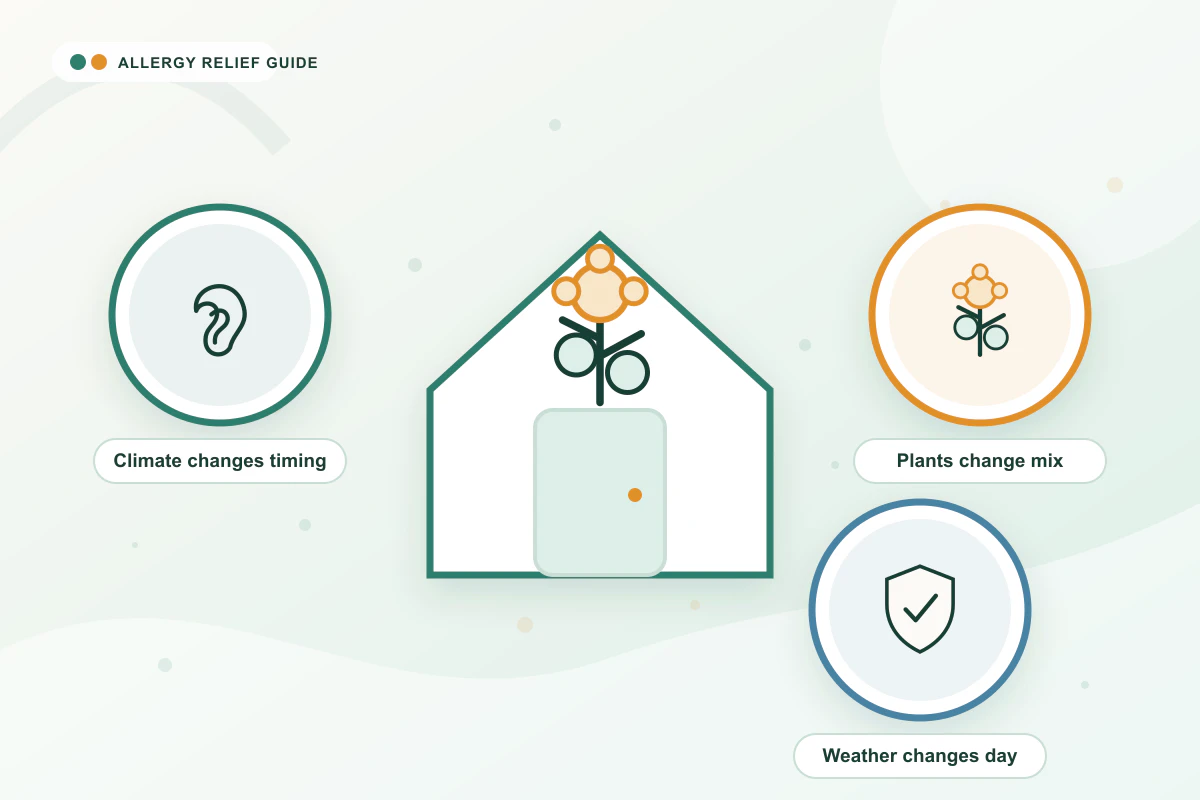
Allergy season timing shifts with regional climate. The nationwide sequence is the same: tree pollen in early spring, grass pollen in late spring and summer, weed pollen (especially ragweed) from late summer into fall. Warmer southern areas tend to start earlier and run longer; cooler northern areas start later. Research shows U.S. pollen seasons have been getting longer and more intense over recent decades. Knowing your region's pattern helps you start treatment before symptoms peak.
What you need to know
- The pollen sequence is the same across the U.S.: trees in early spring, grasses in late spring and summer, weeds (especially ragweed) from late summer into fall.
- Timing shifts by region and climate — warmer southern areas tend to start earlier and last longer; cooler northern areas start later.
- Local weather matters year to year: a mild winter or early warm spell can start tree pollen sooner.
- Research shows U.S. pollen seasons have lengthened and pollen amounts have risen over recent decades, linked to a warming climate.
- Because timing is regional, checking a local pollen forecast is more useful than assuming a fixed national calendar.
- Starting allergy treatment before your region's peak, rather than after symptoms hit, generally works better.
The Same Sequence, Different Timing
Wherever you live in the U.S., pollen tends to arrive in the same order across the year: trees release pollen first, in early spring; grasses follow in late spring and summer; and weeds — ragweed above all — dominate from late summer into fall. What changes by region is when each phase starts and how long it lasts. That's driven mostly by climate: the growing season, temperature, and first and last freeze dates. For the month-by-month national view, see our allergy season calendar.
Why Regions Differ
| Region type | General pattern |
|---|---|
| Warmer southern areas | Pollen season tends to start earlier and run longer, with milder winters allowing an earlier tree-pollen start |
| Cooler northern areas | Season tends to start later, compressed by a shorter frost-free growing period, though northern regions have seen some of the largest recent increases in season length |
| Year-to-year weather | A mild winter or early warm spell can pull tree pollen forward; a late freeze can delay it |
Research measuring pollen across U.S. monitoring stations has found that seasons generally start earlier now than in the 1990s and that northern (higher-latitude) areas have seen larger increases in season length — a reminder that your local pattern can shift over time.
Seasons Are Getting Longer
A consistent finding across studies is that U.S. pollen seasons have been lengthening and pollen concentrations rising over recent decades, a trend linked to a warming climate and higher carbon dioxide levels that can boost pollen production. Peer-reviewed analysis of two decades of U.S. pollen data found meaningful increases in peak and annual pollen totals, with larger changes at higher latitudes. Practically, this means many people are experiencing longer allergy seasons than they used to — another reason to track your local forecast rather than rely on old assumptions.
Use Your Region's Timing
- Check a local pollen forecast for your area rather than assuming a fixed national date
- Note which pollens hit you hardest (tree, grass, or weed) and when they peak locally
- Start allergy treatment before your region's peak, since prevention works better than catching up
- On high-pollen days, keep windows closed, use filtered indoor air, and shower after extended time outside
- If you move to a new region, expect your triggers and timing to shift
For specific seasons, see our spring allergies and fall allergies guides; for the trigger itself, our pollen allergy guide.
When to seek care
Routine
You want to anticipate your local allergy season and start prevention at the right time.
Prompt (within days)
Seasonal symptoms that a standard over-the-counter routine isn't controlling — consider testing or a treatment plan.
Urgent (same day)
Seasonal symptoms with wheezing, chest tightness, or shortness of breath, especially with asthma.
Emergency (call 911)
Severe breathing difficulty or an asthma attack not responding to your reliever inhaler — call 911.
Practical next steps
Safe general steps
- Identify which pollens affect you and when they peak in your region
- Check a local pollen forecast rather than a fixed national calendar
- Start allergy treatment before your region's peak
- Reduce exposure on high-pollen days (windows closed, filtered air, shower after outdoors)
Actions that need medical guidance
- Seasonal symptoms not controlled by an over-the-counter routine
- Whether allergy testing or immunotherapy fits your seasonal pattern
- Managing seasonal triggers alongside asthma
Don't attempt without professional advice
- Don't assume allergy season starts on the same date everywhere — it's regional
- Don't wait until symptoms peak to start treatment — prevention works better
- Don't ignore seasonal breathing symptoms — get asthma evaluated
Frequently asked questions
Does allergy season start at the same time everywhere?
When is pollen season in my area?
Why does my allergy season feel longer than it used to?
Which regions have the longest allergy seasons?
How should I use my region's allergy timing?
Will my allergies change if I move?
Sources
- CDC — Allergens and Pollen (Climate and Health)
- PMC (NIH) — Allergenic pollen season variations in the past two decades under changing climate in the United States
- MedlinePlus (NIH/NLM) — Allergic rhinitis
Medical disclaimer: This guide is for general education and isn't a substitute for personalized medical advice. It doesn't provide dosing. Always talk to a qualified healthcare professional about your symptoms and treatment.
 MD
MDMedically reviewed
Dr. Hannah H. Walford, MD
Allergist and Immunologist
- Website role
- Owner, Medical Director and Medical Reviewer of Allergy Relief Guide
- Professional affiliation
- Stanford Health Care / Menlo Medical Clinic, Menlo Park, California
- Areas of expertise
- Food allergy, eczema, allergic rhinitis, sinusitis and asthma
Dr. Hannah H. Walford is a board-certified allergist and immunologist experienced in caring for adults and children with allergic conditions. Her areas of expertise include food allergy, eczema, allergic rhinitis, sinusitis and asthma. She provides medical leadership and review oversight for the educational health content published by Allergy Relief Guide.
Medical content is provided for education and is not a substitute for diagnosis or individualized medical care.
Related guides
Continue building your allergy plan
Explore related guides to understand the full picture, from triggers to treatment to safety.
See the full seasonal allergies guide