Claritin vs. Zyrtec vs. Allegra: Onset, Drowsiness and Who Each Suits
Three second-generation antihistamines, one aisle, one decision. This page compares loratadine, cetirizine and fexofenadine on the things the boxes don't tell you: how fast each is absorbed, what each product label actually says about drowsiness, which one has an age limit, and which one your breakfast juice can interfere with.
Quick answer
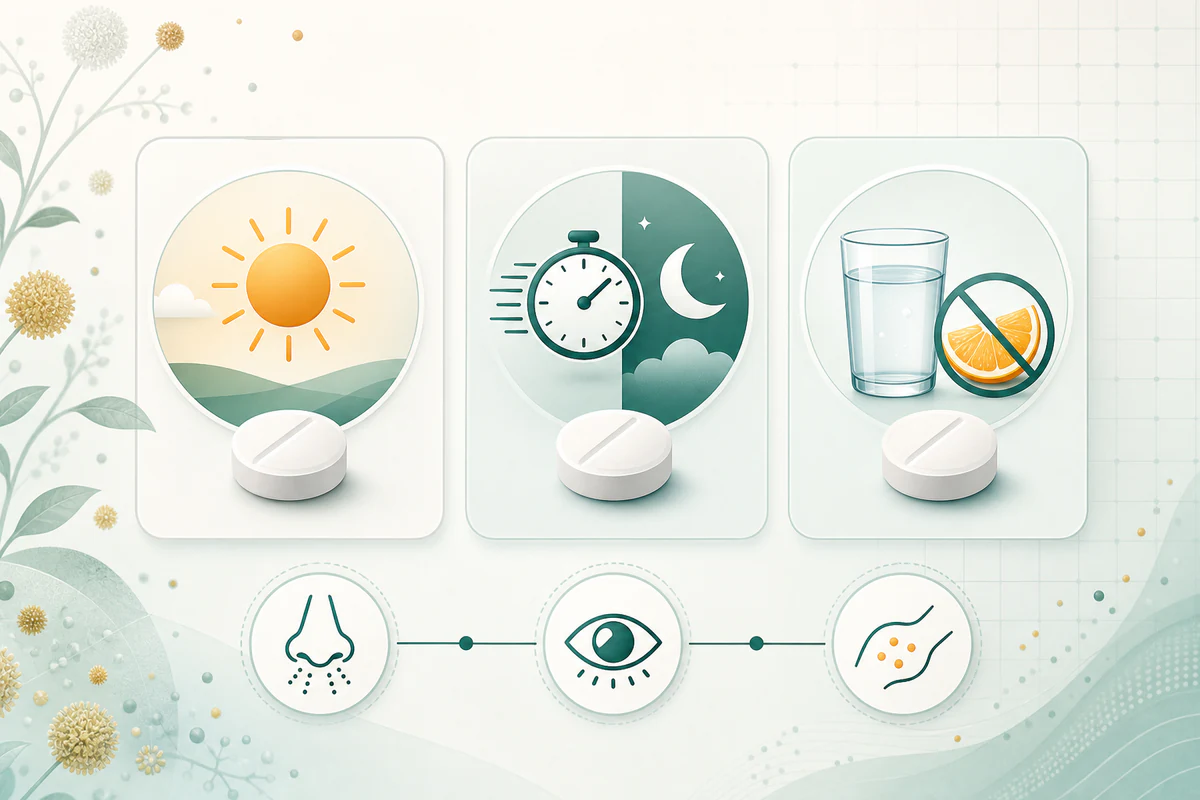
Zyrtec (cetirizine) is absorbed fastest, peaking near 1 hour, and is the only one of the three whose label warns that drowsiness may occur. Allegra (fexofenadine) peaks around 1.5 hours and carries no drowsiness warning at all — but must be taken with water, never fruit juice. Claritin (loratadine) sits between them and is the only one with no "ask a doctor" flag for adults over 65.
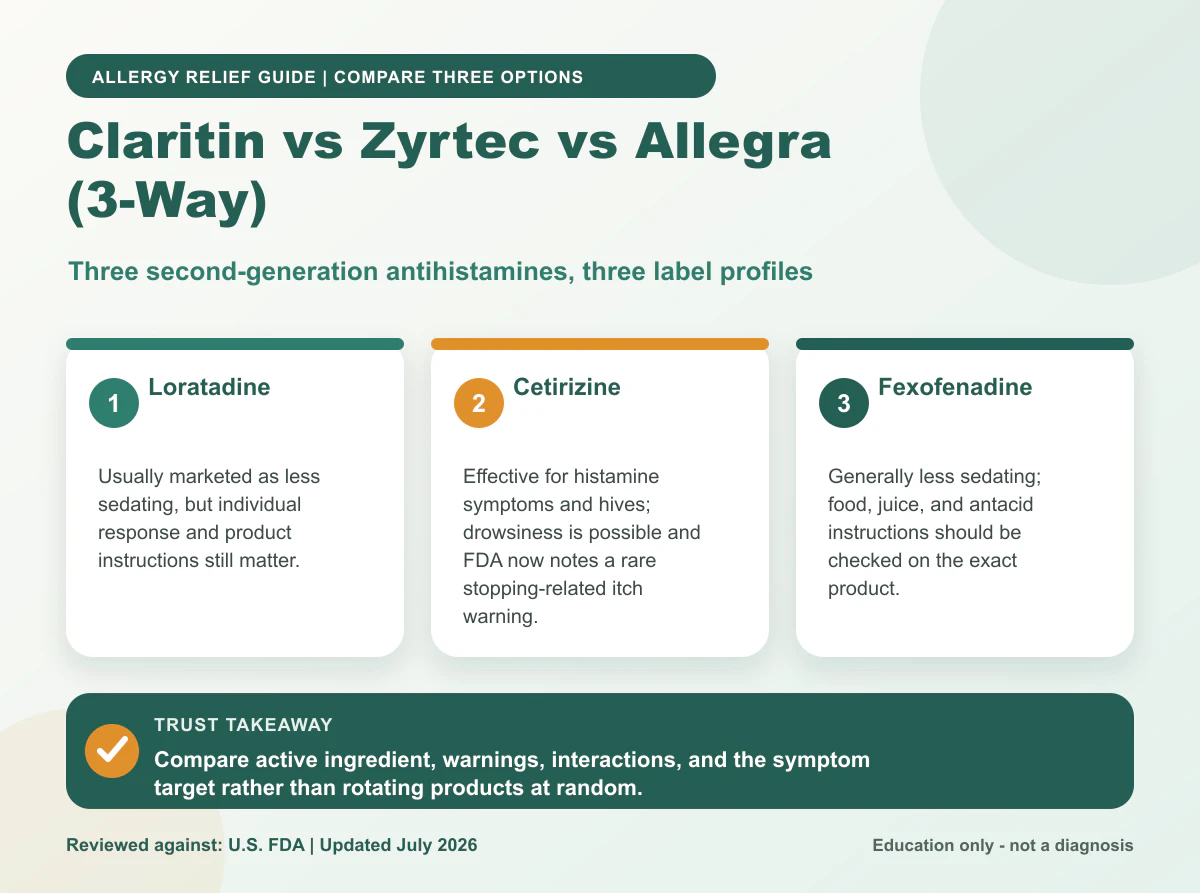
Claritin (loratadine), Zyrtec (cetirizine), and Allegra (fexofenadine) are the three most common once-daily, second-generation OTC antihistamines, all relieving allergy symptoms with much less drowsiness than older options. Zyrtec tends to work fastest but is slightly more likely to cause drowsiness; Claritin and Allegra are usually the least sedating; and Allegra should be taken with water, not fruit juice. Because response varies, the best is often whichever works well for you.
What you need to know
- All three — Claritin (loratadine), Zyrtec (cetirizine), and Allegra (fexofenadine) — are second-generation antihistamines that cause far less drowsiness than first-generation options. Claritin and Zyrtec are once daily; Allegra is once daily as the 180 mg adult tablet, but the 60 mg tablet and the children's liquid are taken every 12 hours.106
- Zyrtec tends to have the fastest onset but is slightly more likely to cause drowsiness than the other two.
- Claritin and Allegra are usually the least sedating.
- Allegra (fexofenadine) should be taken with water — fruit juice can reduce its absorption.
- All three treat typical allergy symptoms (sneezing, runny nose, itchy eyes) and are also used for hives.
- Individual response varies, so if one doesn't control your symptoms well, another may.
The Three Compared at a Glance
| Feature | Claritin (loratadine) | Zyrtec (cetirizine) | Allegra (fexofenadine) |
|---|---|---|---|
| Generation | Second | Second | Second |
| Dosing | Once daily | Once daily | Once daily (180 mg adult tablet)5; the 60 mg tablet and children's liquid are every 12 hours106 |
| Onset | Moderate | Often the fastest | Moderate |
| Drowsiness | Low | Low, but slightly more than the others for some people | Among the lowest |
| Food/drink note | None specific | None specific | Take with water, not fruit juice |
| Also used for | Hives | Hives | Hives |
| Time to peak in the blood | Symptom relief measured at about 75 minutes in a ragweed-challenge study7 | About 1 hour3 | About 1.5 hours for the tablet, 1 hour for the liquid; peak histamine blocking at 1–2 hours8 |
| How long half a dose takes to clear | Not stated on the labels cited here | About 8.3 hours3 | About 14.4 hours8 |
| What the OTC label says about drowsiness | Only warns of drowsiness if you take more than directed4 | "Drowsiness may occur"; also says avoid alcoholic drinks2 | No drowsiness warning on the label; marked non-drowsy5 |
| Drowsiness in clinical trials | The less sedating of Claritin and Zyrtec | Reported by about 14% of people aged 12 and over, and dose-related3 | Crosses into the brain minimally; described as one of the least sedating8 |
| Youngest age on the label | Under 6 — ask a doctor4 | Under 6 — ask a doctor2 | 180 mg tablet: under 12, do not use. Children's liquid: from age 256 |
| Adults 65 and over | No age-specific flag on the label4 | Ask a doctor2 | Ask a doctor5 |
| Kidney disease | Ask a doctor4 | Ask a doctor2 | Ask a doctor; clearance is markedly slower in advanced kidney disease8 |
| Other things to keep apart from it | None specific | Alcohol, sedatives and tranquillisers2 | Fruit juice, and aluminium or magnesium antacids — space those a few hours apart1 |
| Itching after stopping long-term daily use | Not described | FDA warns of rare but severe itching after months to years of daily use9 | Not described |
How They Differ in Practice
All three are effective, non-drowsy, once-daily options, so the differences are matters of degree. Cetirizine (Zyrtec) is often noted for a relatively fast onset, which some people prefer, at the cost of a slightly higher chance of mild drowsiness than the other two. Loratadine (Claritin) and fexofenadine (Allegra) are usually the least sedating. Allegra has one practical quirk worth remembering: take it with water, because fruit juices like orange, apple, and grapefruit can reduce how much of it your body absorbs.
Which one works fastest?
"Fastest" gets repeated a lot in three-way comparisons without a number attached. Here is what the labels and pharmacology reviews actually report:
- Zyrtec (cetirizine) — blood levels peak at roughly 1 hour after a dose.3
- Allegra (fexofenadine) — peaks at about 1.5 hours for the tablet and about 1 hour for the liquid, with maximum histamine blocking 1 to 2 hours in.8
- Claritin (loratadine) — in a controlled ragweed-pollen challenge, plain loratadine tablets produced a significant improvement in symptoms versus placebo at 75 minutes.7
Read that list again and the honest conclusion is that the three are separated by minutes, not hours. Cetirizine has a genuine but small head start. If you are taking one daily through a pollen season, the difference disappears entirely once the drug reaches a steady level in your blood — onset only matters for the very first dose.
Where they differ more meaningfully is at the other end. Fexofenadine hangs around longest, with an average elimination half-life of about 14.4 hours, against roughly 8.3 hours for cetirizine.38 That is part of why the 180 mg Allegra tablet holds a once-daily claim.
None of them is a rescue medicine
Antihistamines block histamine that has not been released yet. They cannot undo congestion and swelling that has already built up. A dose taken before a known exposure — mowing the lawn, visiting a house with a cat — does far more than one taken after symptoms peak. See how long an antihistamine takes to work.
Drowsiness: what each label actually says
All three are sold as non-drowsy, but the three consumer labels are not written the same way — and that difference is the most reliable guide you can get without trying them.
- Allegra (fexofenadine) — its Drug Facts label carries no drowsiness warning at all, and the product is marked non-drowsy.5 Pharmacology reviews describe fexofenadine as crossing into the brain minimally and as one of the least sedating second-generation antihistamines.8
- Claritin (loratadine) — its label mentions drowsiness only in the context of taking more than directed.4
- Zyrtec (cetirizine) — its label states plainly that "drowsiness may occur", tells you to avoid alcoholic drinks, warns that sedatives and tranquillisers can add to it, and to take care driving.2 In the trials behind the label, sleepiness was reported by about 14% of people aged 12 and over, and it was dose-related.3
In plain terms: roughly one in seven people feel something on cetirizine, and if you are one of them it usually shows up in the first few days. On fexofenadine, the regulator did not consider a warning necessary. That is a stronger signal than any "non-drowsy" claim on the front of a box. More on the mechanism in why antihistamines make you drowsy, and the wider picture in antihistamine side effects and antihistamines and alcohol.
Allegra's absorption rules: juice, antacids and why they matter
The page above mentions the fruit-juice caution, but it is worth knowing why it exists and what else shares the problem, because this is the one practical difference that can make Allegra underperform through no fault of the drug.
Fruit juice
Grapefruit, orange and apple juice all reduce how much fexofenadine your body absorbs. The mechanism is interference with a transport protein in the gut wall (P-glycoprotein) that moves the drug across into your bloodstream.8 MedlinePlus is blunt about it: do not take fexofenadine with fruit juices.1 Water is the answer. The juice itself is fine — just not in the same glass, and ideally not around the same time.
Antacids
This one is missed far more often. Antacids containing aluminium or magnesium — the Maalox and Mylanta family — also cut fexofenadine absorption. The guidance is to take the antacid a few hours before or after your dose rather than together.1 The Allegra Drug Facts label repeats the same instruction.5
Neither Claritin nor Zyrtec carries these particular restrictions. If you routinely take your morning pill with juice or with an antacid, that alone is a reasonable reason to pick loratadine or cetirizine instead — not because Allegra is worse, but because a drug you absorb poorly cannot work properly.
How to Choose
- Want the fastest relief and don't mind a small chance of drowsiness? Cetirizine (Zyrtec) is often the pick
- Prioritizing the least possible sedation? Loratadine (Claritin) or fexofenadine (Allegra)
- Usually take your pill with juice? Claritin avoids Allegra's fruit-juice absorption issue
- If one doesn't control your symptoms well, try another — individual response genuinely varies
For deeper head-to-heads, see Claritin vs. Zyrtec, Zyrtec vs. Allegra, and Claritin vs. Allegra. To choose by specific need (non-drowsy, fast-acting, itchy eyes, hives), see our best antihistamine guide.
Matching the medicine to the person
The three labels diverge most once you stop being an average adult. These are the label-level differences worth knowing before you buy.
Adults over 65
Claritin is the only one of the three with no age-specific flag. Both the cetirizine and the 180 mg fexofenadine consumer labels tell adults 65 and over to ask a doctor before use.25 That does not make either unsafe — it means the label wants a clinician involved. For a straightforward over-the-counter purchase, loratadine is the simplest starting point. More in allergies in older adults.
Children
Age limits differ more than most people expect. The 180 mg Allegra tablet says "do not use" under 12; the children's fexofenadine liquid starts at age 2 and is given every 12 hours, not once daily.56 Claritin and Zyrtec both direct you to ask a doctor under 6.24 Always buy the children's product rather than splitting an adult tablet — see children's allergy medicine and allergies in children.
Kidney disease
All three labels say to ask a doctor if you have kidney disease, because a different dose may be needed.245 Fexofenadine is the one to be most careful with: it is cleared largely unchanged, and in advanced kidney disease the amount circulating in the body rises substantially.8
Pregnancy and breastfeeding
This is a conversation, not a shelf decision. The cetirizine label says it is not recommended while breastfeeding; the Claritin and Allegra labels ask you to check with a health professional.124 See allergy medicine in pregnancy and allergy medicine while breastfeeding.
If you take one every day for months
The FDA has required a warning that stopping cetirizine or levocetirizine after long-term daily use — typically months to years — can cause rare but severe itching within days, in people who had no itching before they started.9 Loratadine and fexofenadine are not part of that warning. If you already know you will be medicating daily for a long season, that is a genuine point in favour of Claritin or Allegra.
Which one is best for hives?
All three are used for the itching and redness of hives (urticaria), and all three appear in that role on their consumer information.14 Cetirizine is described as a treatment for hives as well as hay fever, and a dedicated Zyrtec Hives product is sold for it.
In practice, clinicians often reach for cetirizine or levocetirizine first when itching is the dominant symptom — partly because they are the more sedating of the group, which can help when itch is disturbing sleep. Fexofenadine is the better fit when the itching has to be controlled without any risk of dulling the day.
Get medical care rather than self-treating if hives last more than about six weeks, keep returning, come with swelling of the lips, tongue or throat, or come with any trouble breathing. Read more in hives and urticaria and antihistamines for hives.
What They All Share
Whichever you choose, all three relieve typical allergy symptoms while you take them but don't treat an underlying cause, and none is a substitute for epinephrine in a severe allergic reaction. If a standard once-daily dose of any of them isn't controlling your symptoms, that's worth discussing with a pharmacist or clinician rather than simply doubling up on your own. For the full landscape of antihistamine types, see our antihistamines guide.
When to seek care
Routine
You're comparing the three main OTC antihistamines to pick one for everyday allergies.
Prompt (within days)
Symptoms not controlled by a standard dose of any single one — ask a pharmacist before combining or increasing.
Urgent (same day)
Allergy symptoms interfering with sleep or daily life despite a standard non-drowsy antihistamine.
Emergency (call 911)
Signs of a severe allergic reaction — trouble breathing, swelling of the lips, tongue, or throat, widespread hives with dizziness. Use epinephrine if prescribed and call 911.
Practical next steps
Safe general steps
- Pick one based on your priority (speed vs. lowest sedation) and give it a fair trial
- Take Allegra (fexofenadine) with water, not fruit juice
- If one doesn't work well, try another of the three
- Check labels for age-appropriate products and dosing
Actions that need medical guidance
- Symptoms that persist despite trying more than one
- Combining antihistamines or increasing the dose
- Choosing for a child or an older adult, or alongside other medications
Don't attempt without professional advice
- Don't double up doses on your own if one isn't working — ask a pharmacist first
- Don't take Allegra with fruit juice
- Don't rely on any of them to treat a severe allergic reaction
When none of the three is the right answer
If you have given more than one of them a fair trial and you are still struggling, the problem is usually not which antihistamine you picked.
- Congestion is the giveaway. Oral antihistamines do relatively little for a blocked nose. A steroid nasal spray is widely regarded as the most effective first-line treatment for frequent or seasonal nasal allergy symptoms, and it needs several days of daily use before it is working properly.
- Check it is actually allergy. Facial pain and pressure, thick discoloured mucus and fever point elsewhere — compare the patterns in allergies vs. a sinus infection.
- Consider the fourth option. Levocetirizine (Xyzal) is a close relative of cetirizine, often taken in the evening — see Zyrtec vs. Xyzal. For itchy, watery eyes specifically, allergy eye drops reach the tissue the tablet struggles to.
- Reduce the exposure. Medicine works harder when the trigger is still in the room — see indoor allergens and allergy-proofing a bedroom.
- Find out what you react to. Allergy testing replaces guesswork, and allergy shots or under-the-tongue immunotherapy treat the underlying sensitivity rather than the day's symptoms. An allergist can say whether you are a candidate.
Needing daily medicine for months, losing sleep, or missing work or school are all reasonable reasons to be seen — see when to see a doctor for allergies.
Frequently asked questions
Which is the best: Claritin, Zyrtec, or Allegra?
Which of the three works fastest?
Which is the least likely to cause drowsiness?
Do I need to take any of them a special way?
Can I switch between them?
Are all three safe for daily, long-term use?
Which of the three is the strongest?
Why can't you take Allegra with fruit juice?
Can you take Allegra with antacids?
Which is best for adults over 65?
Which is best for children?
Which one is best for hives?
Why do I get itchy after stopping Zyrtec?
Which lasts the longest?
Is it worth paying for the brand name?
Sources
- StatPearls (NCBI/NIH) — Antihistamines
- Cleveland Clinic — Antihistamine Types & Side Effects
- The Medical Letter — Fexofenadine (Allegra) and Fruit Juice
Sources for the specific figures on this page
- MedlinePlus, U.S. National Library of Medicine — Fexofenadine. Uses including hives, forms, the fruit-juice instruction, the aluminium/magnesium antacid spacing instruction, and the kidney-disease and pregnancy precautions.
- DailyMed, U.S. National Library of Medicine — Cetirizine hydrochloride 10 mg — Drug Facts label. Once-daily directions, "drowsiness may occur", the alcohol and sedative warnings, and the "ask a doctor" flags for adults 65 and over and for liver or kidney disease.
- DailyMed, U.S. National Library of Medicine — Cetirizine hydrochloride — full prescribing information. Time to maximum concentration of approximately 1 hour, mean elimination half-life of 8.3 hours, and dose-related somnolence reported in about 14% of patients aged 12 and over.
- DailyMed, U.S. National Library of Medicine — Claritin (loratadine) 10 mg — Drug Facts label. Indications, 24-hour once-daily directions, the "ask a doctor" flag for liver or kidney disease and for children under 6, and the drowsiness-if-exceeding-the-dose warning.
- DailyMed, U.S. National Library of Medicine — Fexofenadine hydrochloride 180 mg — Drug Facts label. Once-daily directions with water, "do not use" under 12, "ask a doctor" for adults 65 and over and for kidney disease, the fruit-juice and antacid instructions, and the absence of any drowsiness warning.
- DailyMed, U.S. National Library of Medicine — Children's fexofenadine hydrochloride 30 mg/5 mL — Drug Facts label. Dosing from age 2 every 12 hours, and the kidney-disease, fruit-juice and antacid warnings.
- DailyMed, U.S. National Library of Medicine — Fexofenadine hydrochloride 60 mg — Drug Facts label. "Take one 60 mg tablet with water once every 12 hours; do not take more than 2 tablets in 24 hours", "children under 12 years of age: do not use", and the same kidney-disease, fruit-juice and antacid warnings as the 180 mg product.
- Ellis AK, et al. — Onset of action for loratadine tablets for the symptomatic control of seasonal allergic rhinitis in adults challenged with ragweed pollen in the Environmental Exposure Unit. Allergy, Asthma & Clinical Immunology, 2018. Significant symptom improvement versus placebo at 75 minutes.
- StatPearls, NCBI Bookshelf (NIH) — Fexofenadine. Peak plasma concentration at about 1.5 hours for the tablet and 1 hour for the suspension, maximum histamine inhibition at 1–2 hours, mean elimination half-life of 14.4 hours, minimal blood-brain barrier penetration, reduced bioavailability with grapefruit, apple and orange juice via P-glycoprotein inhibition, and prolonged clearance in renal disease.
- U.S. Food and Drug Administration — Drug Safety Communication: FDA requires warning about rare but severe itching after stopping long-term use of the oral allergy medicines cetirizine or levocetirizine (Zyrtec, Xyzal and other trade names). 209 cases identified worldwide from reports received between 25 April 2017 and 6 July 2023. Also listed on the FDA's medical product safety information index.
Medical disclaimer: This guide is for general education and isn't a substitute for personalized medical advice. It doesn't provide dosing. Always talk to a qualified healthcare professional about your symptoms and treatment.
 MD
MDMedically reviewed
Dr. Hannah H. Walford, MD
Allergist and Immunologist
- Website role
- Owner, Medical Director and Medical Reviewer of Allergy Relief Guide
- Professional affiliation
- Stanford Health Care / Menlo Medical Clinic, Menlo Park, California
- Areas of expertise
- Food allergy, eczema, allergic rhinitis, sinusitis and asthma
Dr. Hannah H. Walford is a board-certified allergist and immunologist experienced in caring for adults and children with allergic conditions. Her areas of expertise include food allergy, eczema, allergic rhinitis, sinusitis and asthma. She provides medical leadership and review oversight for the educational health content published by Allergy Relief Guide.
Medical content is provided for education and is not a substitute for diagnosis or individualized medical care.
Continue building your allergy plan
Explore related guides to understand the full picture, from triggers to treatment to safety.
See the best antihistamine guide