Eczema and Allergies: The Atopic Connection
Eczema (atopic dermatitis) is closely tied to allergies. It stems partly from a weakened skin barrier — often linked to genes like filaggrin — that lets moisture out and lets allergens and irritants in. That leaky barrier is thought to help drive the “atopic march,” the tendency for eczema in early childhood to be followed by food allergy, asthma, and hay fever. In fact, eczema is one of the strongest risk factors for developing food allergy: a substantial share of children with moderate-to-severe eczema have an IgE-mediated food allergy. Management centers on repairing and protecting the skin barrier and avoiding triggers.
Quick answer
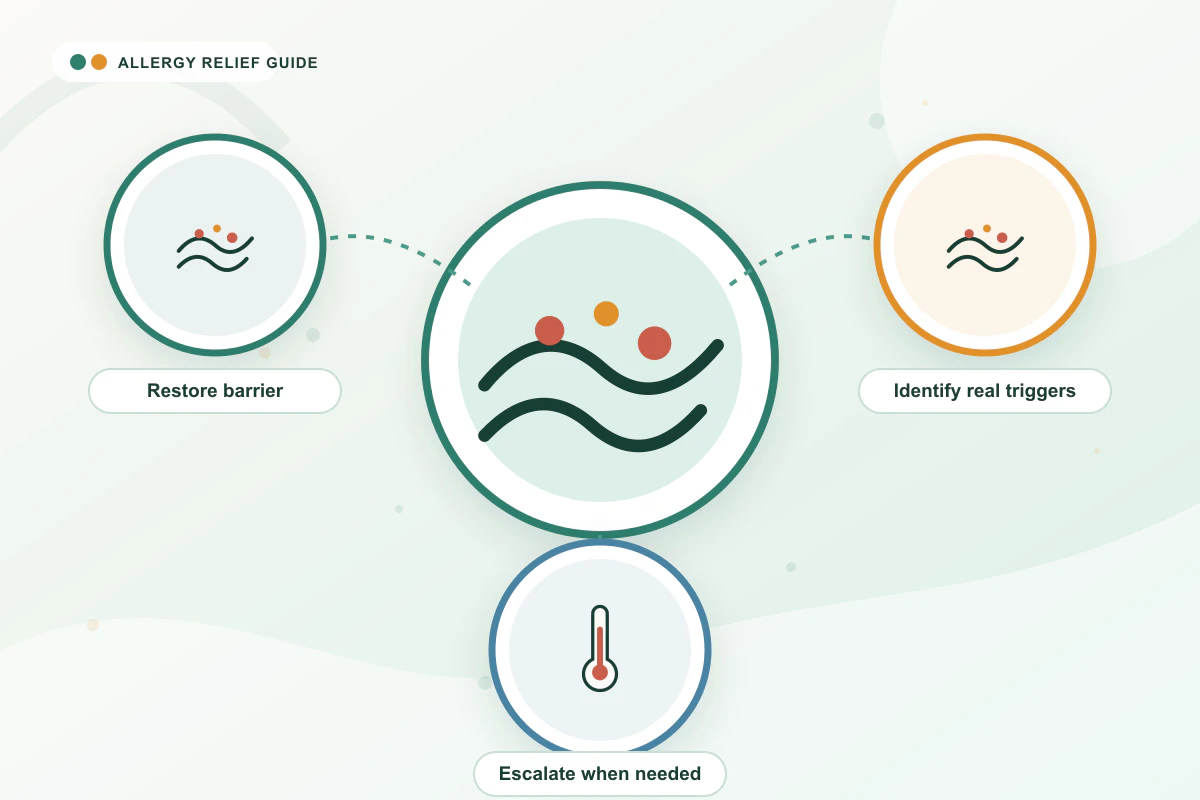
Eczema (atopic dermatitis) is closely tied to allergies. It stems partly from a weakened skin barrier (often linked to genes like filaggrin) that lets moisture out and allergens in. That leaky barrier is thought to help drive the “atopic march” — eczema in early childhood often followed by food allergy, asthma, and hay fever. Eczema is one of the strongest risk factors for developing food allergy. Management centers on repairing and protecting the skin barrier and avoiding triggers.
What you need to know
- Eczema (atopic dermatitis) is an itchy, inflammatory skin condition closely linked to allergies.
- A weakened skin barrier — often tied to genes such as filaggrin — lets moisture escape and lets allergens and irritants penetrate.
- This barrier problem is thought to help drive the 'atopic march': eczema in early childhood is often followed by food allergy, asthma, and allergic rhinitis.
- Eczema is one of the strongest risk factors for developing food allergy; a substantial share of children with moderate-to-severe eczema have an IgE-mediated food allergy.
- Triggers that flare eczema include irritants, dry skin, heat and sweat, stress, and in some people specific allergens.
- Management centers on daily moisturizing to repair the skin barrier, avoiding triggers, and using prescribed anti-inflammatory treatments for flares.
The Skin-Barrier Link
Your skin's outer layer acts as a barrier that keeps moisture in and keeps allergens, irritants, and microbes out. In eczema, that barrier is impaired — often connected to genetic factors like mutations in the filaggrin gene, along with other proteins that hold skin cells together. A weakened barrier loses water (so skin gets dry and cracked) and, importantly, lets environmental allergens penetrate the skin more easily. That combination of dryness, inflammation, and allergen entry is central to why eczema behaves the way it does and why it's tied to allergic conditions.
The "Atopic March"
The atopic march describes a common progression: eczema appearing in infancy or early childhood, followed over time by a higher chance of developing food allergy, asthma, and allergic rhinitis (hay fever). Researchers think the leaky skin barrier plays a starring role — when allergens penetrate inflamed skin, the immune system can become sensitized to them, setting the stage for allergic disease elsewhere. This is why eczema, especially when it's moderate-to-severe and starts early, is considered a marker of allergic risk, not just a skin problem.
Eczema and Food Allergy
The link between eczema and food allergy is strong enough to be clinically important. Eczema is one of the strongest risk factors for developing an IgE-mediated food allergy, and a substantial share of children with moderate-to-severe eczema also have a food allergy. That said, this connection is often misunderstood: not every food that seems associated with eczema is a true allergy, and broadly eliminating foods based on assumptions can do harm, especially in children. Suspected food allergy should be evaluated by a clinician rather than self-diagnosed — see our food allergy vs. intolerance and food allergies guides. Notably, for high-risk infants with severe eczema, early guided introduction of peanut can actually help prevent peanut allergy; see our introducing peanut to baby guide.
Managing Eczema
- Moisturize daily and generously to repair and protect the skin barrier — the foundation of eczema care
- Use gentle, fragrance-free cleansers and lukewarm (not hot) water, and pat skin dry
- Identify and avoid personal triggers: irritants, harsh soaps, heat and sweat, and stress
- Use prescribed anti-inflammatory treatments (such as topical corticosteroids) for flares as directed
- See a clinician for moderate-to-severe eczema, suspected food allergy, or eczema that isn't controlled
Eczema is a distinct condition from contact dermatitis and hives; for those, see our contact dermatitis and hives (urticaria) guides.
When to seek care
Routine
Mild eczema managed with daily moisturizing, gentle skin care, and trigger avoidance.
Prompt (within days)
Eczema that's spreading, not controlled by moisturizing, or frequently flaring — and any suspected food-allergy connection worth evaluating.
Urgent (same day)
Signs of skin infection (increasing pain, warmth, oozing, pus, or spreading redness), or a severe widespread flare.
Emergency (call 911)
A food reaction with facial or throat swelling, or trouble breathing, is anaphylaxis — use epinephrine if prescribed and call 911. (Eczema itself is not an emergency.)
Practical next steps
Safe general steps
- Moisturize daily and generously to support the skin barrier
- Use gentle, fragrance-free products and lukewarm water
- Identify and avoid your personal eczema triggers
- See a clinician for moderate-to-severe or poorly controlled eczema
Actions that need medical guidance
- A suspected food-allergy connection to eczema (get proper evaluation)
- Prescription treatments for flares
- Eczema that isn't controlled with skin care alone
Don't attempt without professional advice
- Don't broadly eliminate foods based on assumptions — especially in children — without professional evaluation
- Don't skip daily moisturizing, which is the foundation of eczema control
- Don't ignore signs of skin infection or a severe food reaction
Frequently asked questions
How are eczema and allergies connected?
What is the atopic march?
Does eczema cause food allergies?
Should I cut out foods to treat my child's eczema?
What triggers eczema flares?
How is eczema managed?
Sources
- NIAID (NIH) — Eczema (Atopic Dermatitis)
- PMC (NIH) — Skin Barrier Function and Its Importance at the Start of the Atopic March
- MedlinePlus (NIH/NLM) — Allergies
Medical disclaimer: This guide is for general education and isn't a substitute for personalized medical advice. It doesn't provide dosing. Always talk to a qualified healthcare professional about your symptoms and treatment.
 MD
MDMedically reviewed
Dr. Hannah H. Walford, MD
Allergist and Immunologist
- Website role
- Owner, Medical Director and Medical Reviewer of Allergy Relief Guide
- Professional affiliation
- Stanford Health Care / Menlo Medical Clinic, Menlo Park, California
- Areas of expertise
- Food allergy, eczema, allergic rhinitis, sinusitis and asthma
Dr. Hannah H. Walford is a board-certified allergist and immunologist experienced in caring for adults and children with allergic conditions. Her areas of expertise include food allergy, eczema, allergic rhinitis, sinusitis and asthma. She provides medical leadership and review oversight for the educational health content published by Allergy Relief Guide.
Medical content is provided for education and is not a substitute for diagnosis or individualized medical care.
Continue building your allergy plan
Explore related guides to understand the full picture, from triggers to treatment to safety.
See the types of allergies guide