
How to Safely Introduce Peanut and Other Allergens to Babies
Research led by the landmark LEAP study found that introducing peanut early and regularly can meaningfully lower a baby's chance of developing peanut allergy, and NIAID-endorsed guidelines now organize recommendations by risk level. Babies with severe eczema or an existing egg allergy are considered high risk and should be evaluated, often with allergy testing, before introduction between 4 and 6 months. Babies with mild-to-moderate eczema are moderate risk and can typically start around 6 months. Babies without eczema or egg allergy are low risk and can be introduced to peanut along with other solid foods, per family preference.
Quick answer
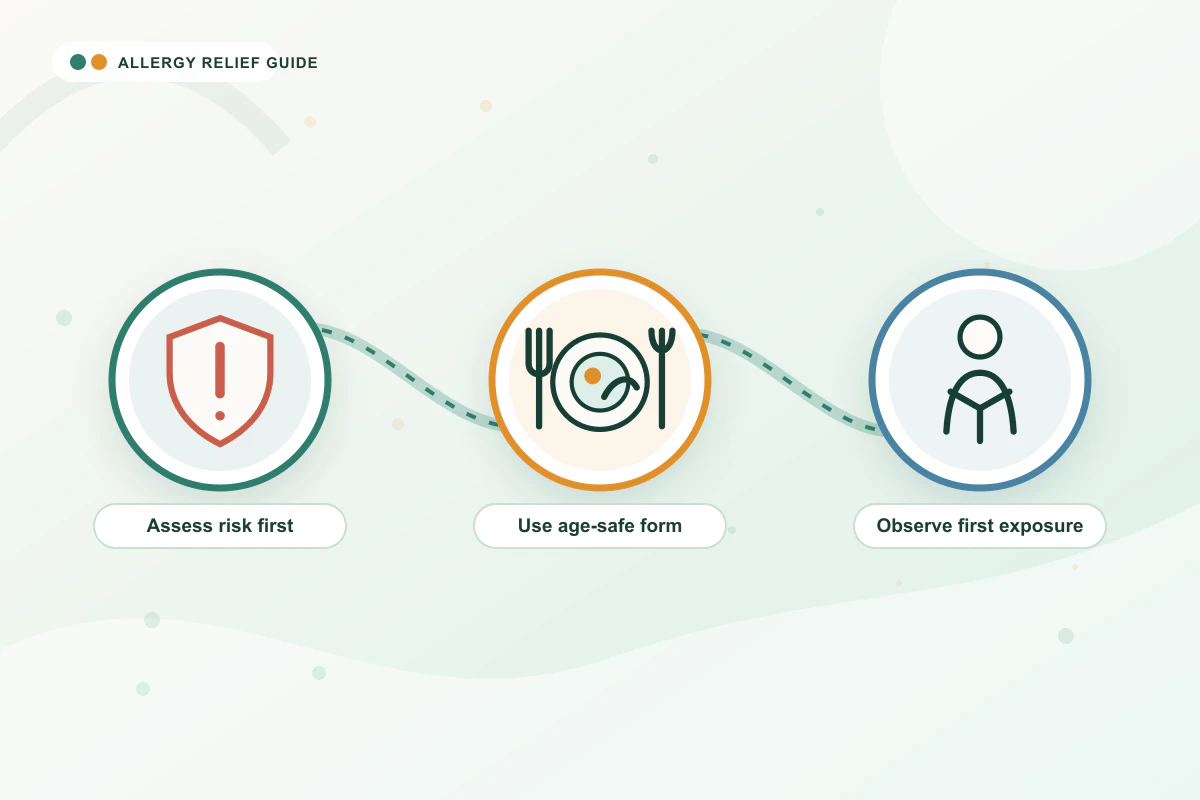
NIAID-endorsed guidelines, based on the LEAP study, organize peanut introduction by risk level. High-risk babies (severe eczema or egg allergy) should be evaluated, often with allergy testing, before introduction between 4 and 6 months. Moderate-risk babies (mild-to-moderate eczema) can typically start around 6 months. Low-risk babies (no eczema or egg allergy) can be introduced along with other solids, per family preference.
What you need to know
- The LEAP study found an 81% relative reduction in peanut allergy when an infant-safe form of peanut was introduced early (4–11 months) and eaten regularly through age 5.
- High risk: babies with severe eczema, egg allergy, or both should be evaluated by a clinician, often with a blood or skin prick test, before introducing peanut, typically between 4 and 6 months if testing supports it.
- Moderate risk: babies with mild-to-moderate eczema can typically have peanut introduced around 6 months, at home or in a clinician's office.
- Low risk: babies without eczema or egg allergy can have peanut-containing foods introduced along with other solid foods, according to family preference.
- Peanut should never be given as a whole nut or a thick spoonful of peanut butter to an infant, both because of choking risk and because a large first exposure isn't the recommended approach.
- A baby who is already allergic to peanut should not be given peanut foods; testing helps clarify this before introduction in higher-risk infants.
Why Early Introduction Matters
For years, families were often advised to delay allergenic foods, but that guidance changed after the LEAP (Learning Early About Peanut allergy) study, which found that introducing peanut early and keeping it in a baby's diet regularly was linked to a substantially lower rate of peanut allergy by age 5 compared with avoidance. Based on this and related research, the National Institute of Allergy and Infectious Diseases (NIAID) published addendum guidelines in 2017, endorsed by the American Academy of Pediatrics, organizing recommendations by a baby's individual risk level rather than a single one-size-fits-all rule.
Risk Categories and Recommended Timing
| Risk level | Who it applies to | General recommendation |
|---|---|---|
| High risk | Severe eczema, egg allergy, or both | Evaluation first, often with a blood or skin prick test; if appropriate, introduction under medical guidance around 4–6 months |
| Moderate risk | Mild-to-moderate eczema | Introduction around 6 months, at home or in a clinician's office, without needing testing first |
| Low risk | No eczema and no egg allergy | Introduce peanut-containing foods along with other solids, according to family preference |
These categories and ages are general clinical guidance; your pediatrician can help place your baby in the right category and advise on timing, especially if your baby has other health conditions.
How to Introduce Peanut Safely
- Never give a whole peanut, peanut pieces, or a thick spoonful of peanut butter directly — these are choking hazards for infants
- Thin smooth peanut butter with warm water or breast milk/formula to a runny consistency, or use a small amount mixed into a puree your baby already eats
- Age-appropriate peanut puffs designed for infants are another commonly used option
- Introduce one new allergenic food at a time, and wait a few days before introducing the next, so you can identify a reaction if one occurs
- Once introduced and tolerated, keep peanut in your baby's diet regularly — the LEAP study's protective effect was tied to regular, ongoing exposure, not a single taste
Other Common Allergens
The same general logic — introduce early, in age-appropriate forms, and keep in the diet regularly once tolerated — is commonly discussed for other major allergens too, including egg, tree nuts, milk, soy, wheat, fish, and sesame. As with peanut, a baby with an existing allergy to one of these foods, or significant risk factors, benefits from a clinician's guidance before introduction. See our food allergies guide for a broader look at the most common allergens.
When to seek care
Routine
A low-risk baby (no eczema, no egg allergy) being introduced to peanut and other solids as part of routine feeding.
Prompt (within days)
A baby with mild-to-moderate eczema, before introducing peanut, to confirm your plan with your pediatrician.
Urgent (same day)
A baby with severe eczema or an existing egg allergy — get an evaluation, often including allergy testing, before introducing peanut.
Emergency (call 911)
Hives, swelling of the face or lips, vomiting, or difficulty breathing after a new food is introduced — stop the food and call 911 for breathing difficulty or widespread symptoms.
Practical next steps
Safe general steps
- Identify whether your baby has eczema (and how severe) or an egg allergy to place them in the right risk category
- For low- or moderate-risk babies, introduce peanut in an age-appropriate, thinned or puffed form
- Introduce one new allergenic food at a time and watch for a reaction over the following hours
- Once tolerated, keep the food in your baby's regular diet
Actions that need medical guidance
- Whether your baby needs allergy testing before introducing peanut
- Introducing peanut to a baby with severe eczema or an existing food allergy
- What to do if you suspect a reaction during or after introduction
Don't attempt without professional advice
- Don't give a whole peanut, peanut pieces, or a thick spoonful of peanut butter directly — choking hazards
- Don't introduce peanut to a high-risk baby without your clinician's guidance
- Don't introduce more than one new allergenic food on the same day
Frequently asked questions
When should I introduce peanut to my baby?
Does my baby need allergy testing before trying peanut?
How do I give peanut to a baby safely?
Does early introduction really prevent peanut allergy?
What if my baby has a reaction when I introduce peanut?
Should other allergenic foods be introduced early too?
Sources
- NIAID, NIH — Addendum Guidelines for the Prevention of Peanut Allergy in the United States
- FARE (Food Allergy Research & Education) — Peanut Early Introduction Guidelines
- American Academy of Pediatrics — Updates in Food Allergy Prevention in Children
Medical disclaimer: This guide is for general education and isn't a substitute for personalized medical advice. It doesn't provide dosing. Always talk to a qualified healthcare professional about your symptoms and treatment.
 MD
MDMedically reviewed
Dr. Hannah H. Walford, MD
Allergist and Immunologist
- Website role
- Owner, Medical Director and Medical Reviewer of Allergy Relief Guide
- Professional affiliation
- Stanford Health Care / Menlo Medical Clinic, Menlo Park, California
- Areas of expertise
- Food allergy, eczema, allergic rhinitis, sinusitis and asthma
Dr. Hannah H. Walford is a board-certified allergist and immunologist experienced in caring for adults and children with allergic conditions. Her areas of expertise include food allergy, eczema, allergic rhinitis, sinusitis and asthma. She provides medical leadership and review oversight for the educational health content published by Allergy Relief Guide.
Medical content is provided for education and is not a substitute for diagnosis or individualized medical care.
Related guides
Continue building your allergy plan
Explore related guides to understand the full picture, from triggers to treatment to safety.
See the full food allergies guide